Apr 282012

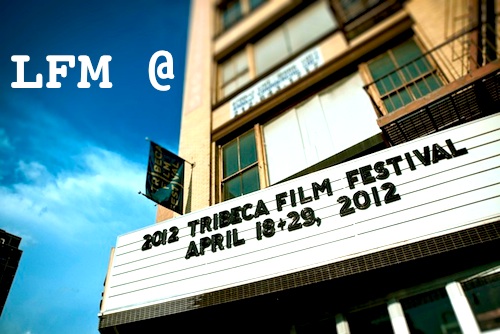
By Joe Bendel. In 1962, Rudolf Nureyev made his post-defection American debut at the Brooklyn Academy of Music (BAM). However, the 1960’s would be a difficult decade for the performing arts institution. Still, it survived and eventually thrived, as James Sládek documents in BAM150, a portrait of the venue in its sesquicentennial year, which screened again today during the 2012 Tribeca Film Festival.

Originally founded to rival the concert halls of Manhattan, BAM had a difficult time establishing its own identity, notwithstanding the appearance of high profile artists such as Nureyev, Sarah Bernhardt, and even Mark Twain. It was more in the business of leasing space than producing performances when Harvey Lichtenstein took the reins of leadership in 1967.

During his tenure, Lichtenstein dramatically raised BAM’s stock through the somewhat contradictory strategies of institutionalizing the avant-garde and pursuing big name performers. Ironically, the economic growth of the 1980’s helped stabilize the venue despite the many theater pieces it staged protesting the very policies that made it all possible. However, it was nearly all undone by Lichtenstein’s disastrous attempts to establish a repertory company.
BAM150 is a perfectly respectable survey of the hall’s history. Sládek has a nice approach to the material, smoothly blending moments of quiet, Wiseman-esque observation with more conventional talking head sequences. The combined effect gives audiences a pretty good feel for the rapidly expanding institution.

After previously profiling Mark Kostabi, a somewhat dubious artist more famous than he should be, Sládek has shifted gears, shining a spotlight on an arts organization that ought to be more widely recognized. It is also a rather shrewd filmmaking decision, since his documentary is a lead pipe cinch to be screened at BAM’s Cinématek. Still, he faced a bit of a challenge, considering dance and theater performances are fleeting by nature. As a result, viewers must often settle for descriptions rather than video documentation. Fortunately, the quality of interview participants helps to compensate, including the likes of Steve Reich, Peter Brook, Alan Rickman, and Isabella Rossellini.

Clearly produced in a celebratory spirit, Sládek never pushes or prods his subjects into any news-making revelations, but he keeps it all moving along briskly. Most likely destined for an engagement at the BAM Cinématek and an eventual PBS broadcast life, BAM150 is basically pleasant and informative. Modestly recommended for proud Brooklynites and those fascinated by the performing arts world, BAM150 screened again tonight (4/28) as this year’s Tribeca Film Festival enters its concluding weekend.

LFM GRADE: B-

Posted on April 29th, 2012 at 10:40pm.
Bookmark and Share

By Joe Bendel. Sex for money can be so liberating – at least, that is what some guys always say. A similar position is staked out in a rather mature new film produced and directed by women and featuring a largely female cast. Even if you adore Juliette Binoche, this is not a film to watch with your parents. However, a lot of people saw it with other people’s parents when it screened at the 2012 Tribeca Film Festival. And mere days later, Malgoska Szumowska’s Elles has opened its conventional theatrical run in New York.

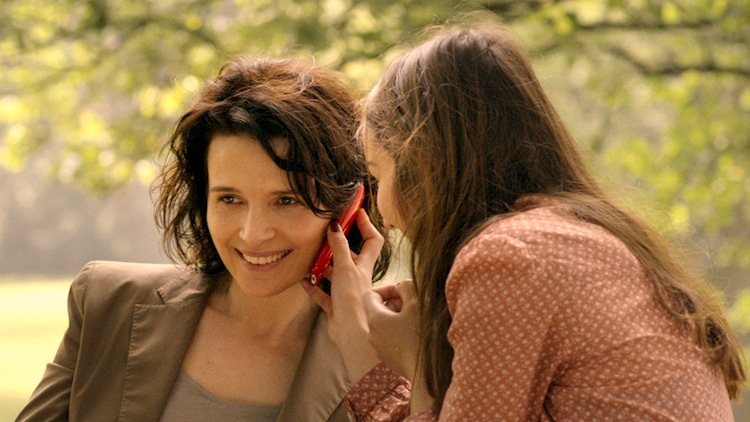
Anne is a wife, a mother, and a freelance writer. Her latest story is a confidential profile of student prostitutes. The assignment came at an awkward period in her marriage, around the same time she busted her husband for a certain kind of net surfing. As she talks to these confident young women, she becomes obsessed with their explicit stories. According to Charlotte and Alicja, their approach to sex is healthier, because there is no hypocrisy. They make a comfortable living exploiting men’s weaknesses of the flesh. Maybe so, but liberation never looked so demeaning.

Films exploring the jujitsu ‘empowerment’ of prostitutes are nearly as old as the profession itself. One obvious comparison is Steven Soderbergh’s The Girlfriend Experience, which also screened at Tribeca three years ago. Yet that film, starring an actual pornstar, is far more circumspect in what it depicts. In fact, there is no on-screen sex and only a spot of nudity is to be seen here or there. It is the emotional entanglements surrounding sex that concern GFE. In contrast, Elles jumps right into some of the more explicit scenes you will see in a public theater. And it was not tagged with an NC-17 rating for no reason.

Frankly, Soderbergh had the right idea. Even if Szumowska had a razor sharp analysis of sexual politics to offer, it is hard to get past some of the things she shows the audience. However, the film’s feminist themes are pretty threadbare and the drama is more frustrating than absorbing.

Normally a bedrock of reliability, even Binoche seems a little off here as the journalist. Her reactions to everything often seem wildly disproportionate to the circumstances at hand. Still, Anaïs Demoustier and Joanna Kulig both bring smart, attractive presences to bear on this material. For the record, I briefly met Kulig on the way to a post-screening Q&A and she seems like a lovely and engaging person. I imagine the audience had a lot of questions for her, but whether they had the guts to ask them is another matter entirely. It is also worth noting that the legendary Krystyna Janda (whose credits include Andrzej Wajda’s Man of Marble and Ryszard Bugajski’s The Interrogation) also co-stars in the largely thankless role of Alicja’s mother.

Something about Elles simply does not click. It is not necessarily because of the subject matter, but it makes the lack of depth and cohesion more conspicuous. Due to the accomplished cast, cineastes should have it on their radar, but it is not recommended as a satisfying theater-going experience. After its high profile Tribeca screenings, Elles is now open in New York at the Angelika Film Center.

LFM GRADE: D+

Posted on April 28th, 2012 at 10:38pm.

Bookmark and Share

LFM wants to thank Indiewire for featuring Joe Bendel’s Tribeca coverage in Indiewire’s Criticwire ranking of the best films from the 2012 Tribeca Film Festival. Indiewire is a great resource for the independent film community, and we’re very proud of Joe’s coverage of Tribeca and other festivals.

Posted on April 28th, 2012 at 9:47pm.

Bookmark and Share

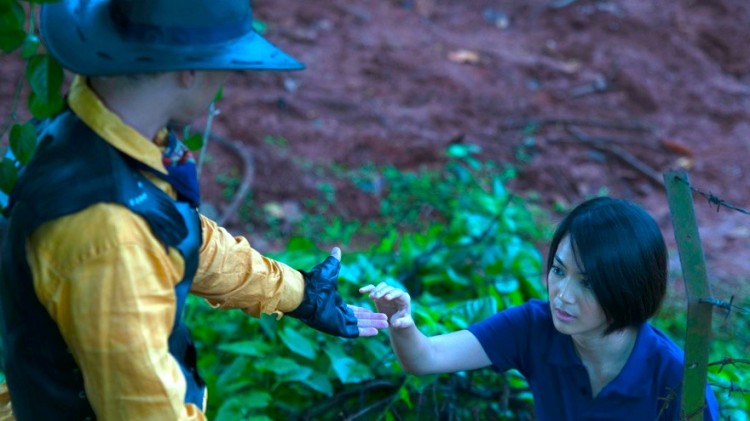
By Joe Bendel. The Ragunan Zoo is a slightly run down Eden, and the city around it is jungle. One innocent young woman will learn the nature of the world outside in the singularly named Edwin’s Postcards from the Zoo (see clips here), which screened today at the 2012 Tribeca Film Festival.

Abandoned in the zoo as a young girl, Lana simply stayed there, falling in with a group of itinerant workers who do odd jobs around the park and sleep on the premises. Growing up amongst the animals, she seems to have special bond with them, particularly the giraffe. However, her sheltered existence is turned upside down when word comes of the migrant workers’ imminent eviction from the zoo.

Fascinated by a mysterious street magician dressed as a cowboy, Lana is lured out of the park, becoming his assistant and ambiguous companion. While she acclimates to their performance routines, it is not long before she is working at a massage parlor in an even more ambiguous capacity.

Like Lana, Postcards should have never left the zoo. In those early scenes Edwin and cinematographer Sidi Saleh create a breathtakingly delicate, fable-like environment. It is fascinating to watch the quietly subtle ways Lana interacts with the animals. The Ragunan Zoo is also a truly wonderful setting, looking a bit wild and over-run by forest, in a way that further heightens the fantasy atmosphere.

However, once she leaves the idyllic zoo, Postcards becomes a largely by the numbers end-of-innocence tale. While there are arresting visuals to be found throughout the film, usually involving return trips to the zoo, we have been down this road hundreds of times before. Yes, it reflects the reality of Jakarta, which is also why it clashes with everything special in the film. It is also getting emotionally exhausting to see yet another little girl abandoned or abducted in a film from the region. The filmmakers ought to start picking on someone more their size.

Even if Postcards is undermined by its second half, it is impossible to take your eyes off Ladya Cheryl’s Lana. Her earnest engagement and exquisite vulnerability gives the film an emotional center of gravity, preventing it from becoming a mere exercise in archetypal tropes. It is haunting work.

There were obviously some crack animal trainers contributing their talents to Postcards. Cheryl is also an absolutely luminous presence. However, viewers are more likely to fall in love with her or the Ragunan Zoo than Edwin’s movie. Richly crafted but somewhat disappointing, Postcards from the Zoo screened again today (4/28) as this year’s Tribeca Film Festival enters the home stretch.

LFM GRADE: C+

Posted on April 29th, 2012 at 9:31pm.

Bookmark and Share

By Joe Bendel. Representing the fourth dimension in 2D is quite the daunting challenge. Fortunately, none of the filmmakers participating in a new hipster sci-fi anthology take it seriously. Nor will annoying glasses be necessary when watching The Fourth Dimension, three short films produced and assembled by Vice and Grolsch Film Works (cheers, mate), which screened again this afternoon as part of the 2012 Tribeca Film Festival.

In the opening The Lotus Community Workshop, Harmony Korine (yes, but don’t panic) takes us to a world much like our own, where Val Kilmer plays a low rent motivational speaker named Val Kilmer. Addressing church groups in roller rinks, he passes off ego-centric tripe as New Agey pearls of wisdom. Occasionally hinting at the metaphysical, Lotus seems more like a confessional piece from Kilmer, admitting to his fans: “I realize I was once Iceman in Top Gun and now I’m kind of a slob, but at least I still don’t have to work at a real job.” This is a case where brevity is definitely Korine’s ally. Given the relatively short running time, the self-referential joke maintains its novelty better than one might expect.

Making a bit of a concession to the film’s umbrella premise, Alexey Fedorchenko’s Chronoeye involves indirect time travel. Employing some analog-style technology, a misanthropic Russian scientist (is there any other kind?) is able to glimpse into the past. However, there is an attractive neighbor above him to remind viewers not to lose sight of the present. Fedorchenko (probably best known for the strikingly austere road movie Silent Souls) maintains a fable-like vibe, preventing Chronoeye from descending into the realm of romantic cliché.

Jan Kwiecinski’s Fawns might come closest to revealing the fourth dimension, since it induces Armageddon. Much like Abel Ferrara’s meandering 4:44 Last Day on Earth, doomsday vaguely involves global warmish-ing, but here it is more Biblical. A cataclysmic flood has led to worldwide evacuation, but a group of Polish slackers are too cool to pay attention. Instead, they careen about a provincial town, hinting at the sexual tensions within their group. Suddenly though, the end of the world takes a serious turn for the aimless youth. Frankly, none of the Kwiecinski’s characters are particularly well defined, but as a mood piece, it is quite eerie.

Defiantly disregarding the theme that ostensibly holds it together, The Fourth Dimension lurches all over the place, but it is not without merit. Indeed, there should be enough eccentricity in each constituent short film to satisfy some strange subset of cult film fandom out there someplace. Recommended for those in search of a bit of bemusement, it screened yesterday as part of the 2012 Tribeca Film Festival.

LFM GRADE: B-

Posted on April 28th, 2012 at 8:56pm.

Bookmark and Share
Apr 282012

By Joe Bendel. Jo Nesbø is best known for his gritty detective Harry Hole, but film adaptations of his work have largely focused on the criminal and the compromised. Just as Morten Tyldum’s Headhunters begins its American theatrical run here in New York, Magnus Martens’ even better and bloodier Jackpot (trailer here) screened last night as part of the 2012 Tribeca Film Festival.

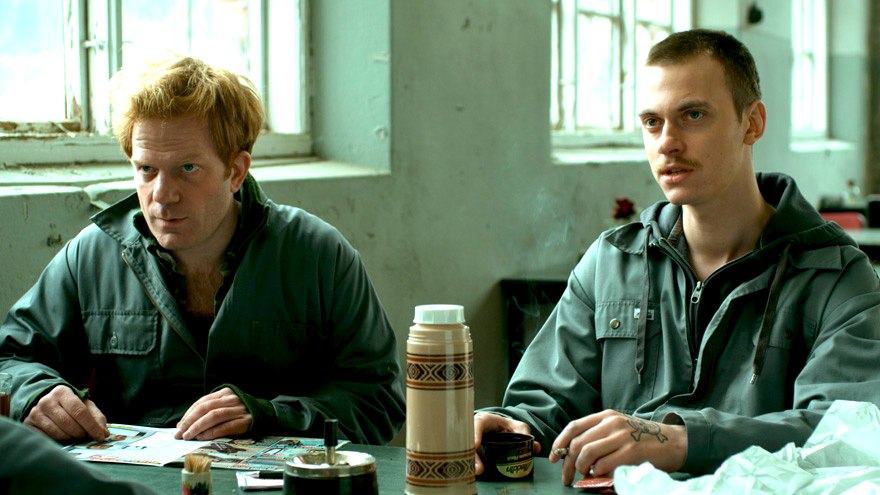
Oscar Svendsen is not a criminal, but the artificial Christmas tree factory he works at specializes in hiring released convicts. According to the detective interrogating him, this means he is used to thinking like a crook. Be that as it may, Svendsen certainly has some explaining to do, such as how he came to be found clutching a shotgun beneath a rather large dead woman amid a bloodbath at a strip club. Let the flashback carnage begin.

Reluctantly, Svendsen agreed to enter a betting pool with three of his scariest co-workers. Against all the odds, their dubious betting system produces a twelve-game winning ticket. Everyone should be happy, but when Svendsen returns to his apartment, he finds a dead body. Supposedly their late colleague got greedy and attacked the other two, who killed him in self-defense. Or so they tell Svendsen. True or not, there is a corpse to dispose of. This will get messy. Not for nothing, Svendsen wonders if he will be next.

Based on a Nesbø story, Jackpot is a lot like early Coen Brothers, but with a greater body count. Evidently the process for fabricating fake Christmas trees is a lot like sausage-making, so you know what that means. The pieces are sent flying almost as fast and furiously as the constant double-crosses. Indeed, Martens is not exactly shy in his approach to the material, but he keeps a tight rein on the narrative, never letting the proceedings descend into absolute bedlam.

As Svendsen, the game but unassuming Kyrre Hellum resembles a rag doll being tossed about. However, that works rather well in the context of the film. In contrast, Henrik Mestad displays mucho screen presence, supplying much of the film’s mordant wit as the investigating Detective Solør. Yet even more laughs come from blood-splattered slapstick gags that would make the re-launched Stooges blanch. Still, Svendsen’s three knuckle-headed co-conspirators are all rather generic. Indeed, that lack of a flamboyant villain is the only real knock on the film.

You should probably know by now if Jackpot is your cup of tea. Frankly, the execution (so to speak) is superior to many other films in what could be considered the recent Scandinavian noir invasion, but it definitely makes the typical Tarantino-impersonating film look rather sedate by comparison. For those looking for some good chaotic fun, it definitely fits the bill. Recommended for connoisseurs of outrageous crime drama, Jackpot screens again this weekend as the 2012 Tribeca Film Festival concludes.

LFM GRADE: B+

Posted on April 27th, 2012 at 8:54pm.

Bookmark and Share

Olga Kurylenko returns to the Ukraine in "Land of Oblivion."

By Joe Bendel. On April 25th, 1986, Pripyat was known as a model “Atomic City.” Two days later, it was well on its way to being a radioactive ghost town. The resulting physical and emotional damage done to the local Ukrainian populace is starkly dramatized in Michale Boganim’s Land of Oblivion (trailer here), which screens during the 2012 San Francisco International Film Festival.

It rained on that fateful April 26th, fixing the radiation in the area surrounding the nuclear power plant. That was bad news for Pripyat, the bustling Ukrainian town built accommodate Chernobyl workers – but good for the rest of the world.

Making a bad situation worse, many Ukrainians would needlessly perish because of the Soviets’ reluctance to admit the severity of the crisis. One of them will be Anya’s new husband Pyotr, a fireman pulled away from their wedding reception for lethal duty at Chernobyl. The disaster will also rob young Valery of his father Alexei, a safety engineer expressly forbidden from warning Pripyat residents of the deadly reality he understood only too well. In contradiction of Soviet policy, he sends Valery and his mother away on the first train out of town. Faced with the guilt and futility of the situation, Alexei roams the streets of Pripyat, handing out umbrellas as certain death rains from the sky.

Ten years later, Anya has not moved on with her life. She works as a guide, taking curious French tourists and grieving survivors on tours of the no man’s land that was once her home. One of her groups includes Alexei’s widow and Valery, who has become an angry teenager greatly desiring some closure.

In happier times.

Shot on-location in the forbidden zone, Oblivion looks downright spooky. It clearly suggests the upcoming Oren Peli produced Chernobyl horror movie should be scary as all get-out, even if they do an only a half-way decent job of it. Frankly, watching Anya lead her busloads of gawkers is jarring enough. Obviously this job is profoundly unhealthy for her, but she remains psychologically tethered to the ghost town.

While Oblivion abstains from graphic depictions of radiation sickness, it presents an unambiguous indictment of the Soviet authorities’ rampant CYA-ing and callous indifference to Ukrainian suffering. Like the character of Anya, it somewhat loses its way during the early scenes of the 1996 winter story arc, but when Boganim starts following the wayward Valery through Pripyat’s desolate streets and abandoned buildings, the film achieves an air of surreal high tragedy.

Admirably understated, former Bond-girl Olga Kurylenko’s work as Anya, in her native Ukrainian, is remarkably assured and shrewdly modulated. As Alexei, Polish actor Andrzej Chyra is also quite restrained, yet touching.

In her first dramatic feature, Israeli-born French documentarian Boganim balances the intimate and the ominous fairly dexterously. Oblivion also boasts a distinctive soundtrack from Polish jazz musician Leszek Możdżer. Refraining from his experimentations with “treated” pianos, his themes are surprisingly upbeat and swinging, but they help propel the audience through much of the on-screen grimness. Often visually arresting, Land of Oblivion is a well produced film, definitely recommended, particularly for those fascinated by the Chernobyl disaster and the Soviet era in general, when it screens again this Friday (4/27) and Sunday (4/29) during this year’s San Francisco International Film Festival.

LFM GRADE: B+

Posted on April 27th, 2012 at 1:12am.

Bookmark and Share

Charlie Hunnam and Olivia Wilde in "Deadfall."

By Joe Bendel. A prodigal son plows through a blizzard to make it home for Thanksgiving dinner. However, this will not be the stuff of a Norman Rockwell painting. Instead, his fate will become intertwined with that of two wanted fugitives in Stefan Ruzowitzky’s Deadfall, a chilly thriller from the Academy Award winning director of The Counterfeiters, which screens during the 2012 Tribeca Film Festival.

Having endured a traumatic childhood together, Addison and his sister Liza are now hopelessly codependent. He also has a propensity for violence.  They just knocked over a casino, but a freak accident mars their getaway. Splitting up (for reasons driven more by the narrative than by survival considerations) an exhausted Liza is rescued from the frozen roadside by Jay, an ex-con former Olympic boxer, who through a complicated set of circumstances already suspects the law is after his dumb hide. 

Liza knows the cops are looking for her and Addison, so his parents’ home near the Canadian border sounds like the perfect rendezvous. Much to her surprise though, she quickly develops intense feelings for the dumb palooka, which she can tell are mutual. Liza does not yet know Jay’s father is the former sheriff and his successor’s unappreciated deputy-daughter is a close friend of the family, but she will learn when Jay’s Planes, Trains, and Automobiles story turns into The Desperate Hours.

Eric Bana in "Deadfall."

There are an awful lot of contrivances in Deadfall. Indeed, Jay and Liza fall for each other faster than light-speed. Still, in his case, it might be rather believable, considering he just got out of prison and she is played by Olivia Wilde. In fact, for the most part, Ruzowitzky’s energetic pacing and the conviction of his cast largely overcome the credibility gaps.

Most importantly, Addison and Liza make an excellent villain-femme fatale tandem. Eric Bana compellingly brings out Addison’s avenging angel complex, while Wilde nicely balances Liza’s cunning and vulnerability. Though Charlie Hunnam is not exactly a great thespian, the audience can certainly believe his ex-boxer has taken a number of blows to the head. Not so surprisingly, Sissy Spacek adds a real touch of class to the film, playing Jay’s mother with grace and intelligence.

Despite the ragged edges, Deadfall is an easy man vs. man vs. the elements thriller to get caught up in. Sure to become a family Thanksgiving tradition, it screened yesterday as part of the 2012 Tribeca Film Festival.

LFM GRADE: B

Posted on April 27th, 2012 at 1:12am.

Bookmark and Share

Check it out above.

Posted on April 27th, 2012 at 1:10am.

Bookmark and Share

By Joe Bendel. In 1932, the British economy was also rather depressed, but appearances had to be kept up, nonetheless. A well-to-do widowed mother is determined to see her eldest daughter married in proper style, even if it kills the rest of her family in Donald Rice’s Cheerful Weather for the Wedding, which screens during the 2012 Tribeca Film Festival.

Dolly Thatcham became re-acquainted with her rich, twittish fiancé during a grand tour of Albania. She was most definitely on the rebound, following the end of her affair with Joseph Patten, a promising young academic. He was somewhat self-centered, but there was real passion between them, as the audience sees in multiple flashbacks. Her controlling mother could make the rest of the family sufficiently miserable on her own, but when the sullen Patten shows up at the house, it puts everyone further on edge. The fact that the bride has locked herself in her dressing room with a bottle of rum hardly helps matters either.

Based on the novella by Julia Strachey, a member of the Bloomsbury Group whose work has gained popularity in recent years, Cheerful Weather could be considered a lite beer version of Downton Abbey, but Rice and Mary Henley Magill’s adaptation clearly lacks Sir Julian’s delicious wit. Of course, the presence of Elizabeth Montgomery in the rather thankless role of Thatcham’s overbearing mother further invites such comparisons.

From "Cheerful Weather for the Wedding."

Still, Cheerful Weather offers a number of memorable moments, largely courtesy of its snappy supporting cast. Indeed, Mackenzie Crook and Fenella Woolgar steal scene after scene as the bickering Dakins, who largely reconcile through their shared distaste for his family. Julian Wadham also adds a humane touch to the film as the not-as-dumb-as-he-looks bumbling Uncle Bob, while Zoe Tapper brings considerable allure and even a bit of depth to Evelyn Graham, Thatcham’s fortune hunting maid of honor.

Unfortunately, Cheerful Weather’s weak romantically-doomed leads undermine the audience’s investment in the actual wedding. Looking rather dazed, even in the flashbacks, Felicity Jones’ turn as Thatcham is a pale shadow of Michelle Dockery’s Lady Mary Grantham. More baffling is the complete lack of screen presence displayed by Luke Treadaway as the morose Mr. Patten.

Frankly, it is hard to understand why Thatcham or Patten would pine for each other, but it is easy to see how this family would annoy the Dakins. Yet viewers can enjoy elements of the picture once they have shifted their sympathies accordingly. An okay but hardly exceptional period drama, Cheerful Weather seems best suited for PBS’s Masterpiece. For diehard Anglophiles, it screens again this Saturday (4/28) as this year’s Tribeca Film Festival enters its final weekend.

LFM GRADE: C+

Posted on April 27th, 2012 at 12:14am.

Bookmark and Share

By Joe Bendel. The United Nations has long acted like one of the four horsemen of the apocalypse; in the case of Haiti, it is literally pestilence. Allegedly thanks to the UN peacekeeping force, a deadly wave of cholera has swept the dysfunctional country. Viewers witness the epidemic from the vantage point of a young ball player in David Darg & Bryn Mooser’s short documentary, Baseball in the Time of Cholera, which screens as part of the Help Wanted programming block during the 2012 Tribeca Film Festival.

Joseph Alvyns and his friends should simply be spending an innocent summer on the baseball diamond. They play as often as they can, but it is impossible to ignore the post-hurricane chaos around them. Yet when Alvyns sees the devastation of the 3/11 hurricane and tsunami in Japan, he is compelled to reach out in a spirit of solidarity. His efforts attract international attention, even earning him a VIP trip to Toronto, courtesy of the Blue Jays. Unfortunately, when he returns cholera strikes at the heart of his family.

Technically, Darg and Mooser do not conclusively establish the Nepalese “peace-keepers” are the source of the cholera outbreak. Still, the sight of raw sewage spilling from their latrine into Haiti’s central river – coupled with the Heisman pose the Nepalese commander gives their camera man – constitutes a pretty convincing circumstantial case. The film also asks a legitimate question: why are there peace-keepers stationed in a country that has not been at war for centuries? However, they largely let the successive authoritarian and socialist governments off the hook for bringing the Haitian state to the brink of complete failure.

Time boasts some unusually big names behind the camera, including executive producers Olivia Wilde and Tesla Motors entrepreneur Elon Musk (one of three POV figures in Chris Paine’s Revenge of the Electric Car, which screened at last year’s Tribeca). To its credit, the film community has rallied to Haiti’s aide, yet there has not been a similar celebrity rush on behalf of Japanese recovery efforts. Therefore, it is worth taking the time to note that those wishing to follow Alvyns’ example can also donate to the Japan Society’s relief fund (details here).

For a short documentary, Baseball in the Time of Cholera nicely balances muckraking and heartrending tragedy. It should screen at Turtle Bay, but instead it will screen again in lower Manhattan this Friday (4/27) and Sunday (4/29) as the Tribeca Film Festival continues throughout the weekend.

Posted on April 26th, 2012 at 11:39pm.

Bookmark and Share
Apr 262012

By Joe Bendel. Right now, Norway’s economy is a lot like our own. There are way more job-seekers than open positions to fill. At such times, if a recruiter sends you on an interview, you go, even though you might be leaving a few stray valuable objects d’art lying about your home unguarded. That is Roger Brown’s racket, but it turns unexpectedly deadly in Morten Tyldum’s Headhunters, which opens this Friday in New York and also screened yesterday as part of the San Francisco International Film Festival.

Brown is a man slight of stature, married to his bombshell wife, Diana. Suffering from a king-sized inferiority complex, he has allowed them to live beyond their means by burglarizing the homes of his executive search clients. With his house of cards on the brink of collapse, Brown’s prayers appear to be answered in the person of Claes Greve. Not only is the former tech CEO the perfect candidate for a plum position Brown must fill, he also owns a genuine Rubens painting of rather dodgy providence. Win-win, right?

However, when Brown starts to suspect the younger man and his wife are carrying on an affair behind his back, he sabotages Greve’s campaign for the position. At this point, Greve reacts more forcefully than Brown anticipates. Mouse, meet cat.

Headhunters is quite a nifty one-darned-thing-after-another thriller. Tyldum has a good handle on the material, constantly ratcheting-up the tension, but periodically using black comedy to release some steam. In his hands, the frequent twists are entertaining rather than forced or exhausting.

Tyldum also has a nice looking cast to focus on. Especially bankable is the presence of Game of Thrones alumnus Nikolaj Coster-Wladau, now world famous for playing Lena Headey’s brother (and other things), Ser Jaime Lannister, here perfectly cast as Greve. As Diana Brown, former model Synnøve Macody Lund certainly looks the part, but she also has some nice dramatic moments as well. In the lead, Aksell Hennie’s Brown holds the film together while coming to grief quite effectively.

Based on Norwegian mystery writer Jo Nesbø’s first book outside of his bread-and-butter series, Headhunters engages in some of the same far-fetched anti-corporate humbug undermining so many recent domestic crime dramas. However, Tyldum keeps the rollercoaster loop-de-looping at such breakneck speed, it is not so distracting. Definitely a dark but thoroughly enjoyable exercise in skullduggery, Headhunters is easily recommended and opens theatrically this Friday (4/27) in New York at the Landmark Sunshine.

Posted on April 26th, 2012 at 11:38pm.

Bookmark and Share
Terms of UsePrivacy Policy Libertas Film Magazine™ is produced by The Liberty Film Festival.® Suffusion WordPress theme by Sayontan Sinha