By Joe Bendel. We often overlook the Russianness of one of our most beloved Christmas traditions. It is Tchaikovsky’s Nutcracker, after all. Almost one hundred twenty years ago to the day, The Nutcracker premiered at the Mariinsky Theatre in St. Petersburg (known as the Kirov during darker Soviet days). At the time, reviews were rather mixed, but it caught on eventually. The Mariinsky Theatre Ballet Company and the Mariinsky Theatre Symphony Orchestra, under the direction of Valery Gergiev, once again perform the holiday favorite where it all began. The Sugar Plum Fairy will indeed dance when The Nutcracker screens in 3D nationwide, for one day and one day only, this coming Monday, via Fathom Events.

As everyone should know, young Masha’s eccentric godfather, Councilor Drosselmeyer, brings some remarkable toys to her family’s Christmas Eve festivities. However, only she has eyes for his wooden Nutcracker. Waking just before midnight, Masha witnesses an epic clash between the Mouse King’s rodent army and the gingerbread soldiers led by the Nutcracker. Thanks to her intervention, the Nutcracker prevails. Shortly thereafter, they are transformed into fully grown lead dancers and whisked off to a fantasy land. Much dancing ensues.
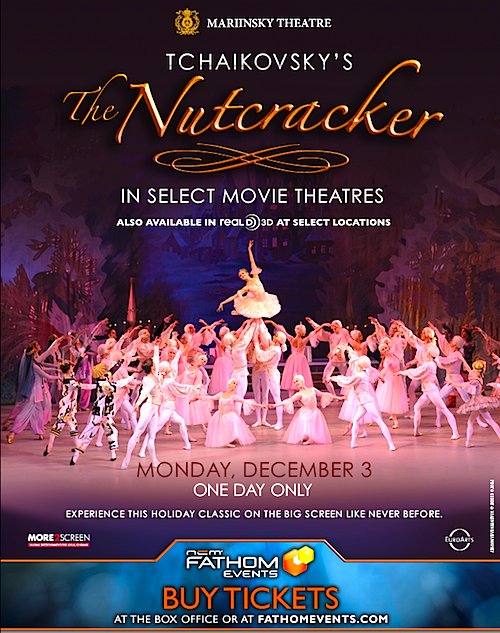
Directed for the screen by Andreas Morrell, the Mariinsky Nutcracker does not skimp on pageantry. The sets and costumes are as lavish and elegant as viewers would expect – except the mice soldiers, who are deliberately cartoony enough not to upset even the most sensitive of young viewers. Of course, the dancers are world class, particularly the striking Alina Somova as Princess Masha. Evidently, though, Mariinsky patrons are tough audience. They do not show much love until the principles reach the Land of Sweets. That must be a Russian thing.

Incorporating Vasily Vainonen’s acclaimed choreography, the Mariinsky Nutcracker should satisfy experienced ballet connoisseurs and first-time viewers. While only available in 2D for review attention, it should lend itself quite nicely to 3D, especially the whirling dances in the Land of Sweets, performed in long, flowing exotic garb. Indeed, Wim Wenders’ Pina proved the utility of 3D cinematography in conveying the spatial dynamics of dance.

There is a reason The Nutcracker has become a Christmas tradition. Tchaikovsky’s music and the fantastically bittersweet story, sort of adapted from E.T.A. Hoffman’s story, just always seem to work. With dancers of the Mariinsky’s caliber performing in such a storied venue, it can’t miss. Recommended for festive families and the cultured elite alike, the Mariinsky’s Nutcracker screens twice this coming Monday (12/3) at theaters throughout the country, including the AMC Empire and Regal Union Square here in New York.

LFM GRADE: B

Posted on November 30th, 2012 at 12:547pm.
Bookmark and Share

By Joe Bendel. Sometimes even criminals need a bailout. Of course, they can always help themselves to an involuntary one. That is what crime and government are all about. Yet, somehow Andrew Dominik turns a modest heist caper into a didactic statement on political economy in the frustrating lost opportunity titled Killing Them Softly, which opens today nationwide.

Killing reminds viewers how annoying it is to have to listen to CNN in an airport concourse. Say what you will about Tarantino, but at least his gangsters listen to vintage soul music. It is news radio all the way for Dominik’s low life thugs. At almost every point of Killing news reports of the 2007 financial crisis and Obama’s campaign speeches blare down on viewers like Big Brother in Oceania. The economy was bad. We get it, thank you. Here’s a newsflash—it’s still stalled.

Against this omnipresent backdrop, Frankie recruits his dog-napping buddy Russell to pull off a risky score. They are going to hold-up the mob-protected card game run by Markie Trattman. Ordinarily, knocking over a connected game is a losing proposition, but in this case someone else will automatically be blamed: Trattman. A while back, he conspired to take down his own game and blabbed about it afterward. Everyone likes Trattman, so they let it slide, once, but if it happens again things are sure to get ugly.

At first, everything seems to be going according to plan. Then fixer Jackie Cogan is called in to investigate. He intuitively knows Trattman has been set-up, but he does not have much sympathy for the man. Frankly, sentiment really is not his thing, not even for an old past-his-prime hitman chum he mistakenly brings in to help clean up the job.

You can see why Brad Pitt is a movie star in Killing. Even when chewing on over-the-top “America is a corporation not a community” dialogue that would make The Simpsons’ Mr. Burns snicker, he is an electric presence. For the most part, his scenes with Richard Jenkins’ Driver, the exasperated counselor to the mob’s corporate governing committee, are smartly written and bitingly witty. However, Dominik plays out his crime as a metaphor for capitalism well past the breaking point.

Yet, when you strip away Killing’s layers of ostensive “relevance,” one is left with a fairly routine crime drama. A score goes down and several people involved, one way or another, are subsequently dispatched, but it is difficult to care much about their fates. After all, Dominik scrupulously establishes the lack of innocence in this world. Still, Ray Liotta has his moments as the tragic Trattman, a self-defeating figure like so many of Killing’s characters.

There is no meaningful takeaway from Killing, because its premise is faulty. The mob is not like a corporation, it is like a government that can take what it wants and change the rules at its convenience. Dominik’s adaptation of George V. Higgins’ novel gives viewers a few clever lines and a couple of colorful scenes, but that is about the extent of it. A real disappointment, Killing Them Softly is not recommended when it opens today (11/30) in New York at the AMC Kips Bay and Regal Union Square.

LFM GRADE: D+

Posted on November 30th, 2012 at 12:46pm.

Bookmark and Share

By Joe Bendel. Over the centuries, it has been tough to be a Chinese peasant. Famines have been a fact of life, but because they have been traditionally interpreted as a sign of heavenly displeasure with the ruling authorities, those in power have been more inclined towards denials than an activist response. Such was the case during the Great Leap Forward and such was the case during the Republican era, at least according to Feng Xiaogang’s latest historical epic, Back to 1942, which opens today in New York.

The war is not going well for the Nationalist forces, but Chiang Kai-shek is trying to keep up appearances with the Allies. He is looking to Henan’s granaries to support his beleaguered troops and his local administrators do not have the guts to explain the boots-on-the-ground reality to him. Faced with high taxes, drought, locusts, and the Imperial Japanese military, the peasants of Henan do what they have traditionally done: take flight to Shanxi.

It turns out the drought is a great leveler. Amongst the refugee contingent is Landlord Fan and his family, accompanied by their (sort of) faithful servant and their formerly resentful tenants. As they trudge towards an unwelcoming Shanxi, they are victimized by deserters and strafed by the Japanese, losing what little they had left. While the Nationalist government turns a blind eye, American journalist Theodore H. White sets out to shame them into action. Yet, even when relief is authorized, it is held up by graft and incompetence. So pervasive are the horrors, they might even cause the ardent Father Sim to lose his faith.

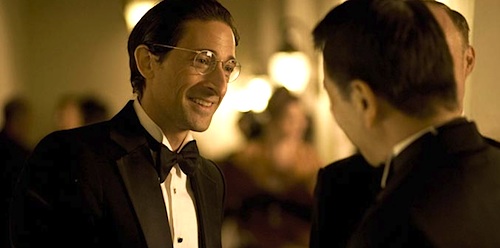
Adrien Brody as Theodore H. White in "Back to 1942."

Back is a tough film to take. Based on Liu Zhenyun’s memoir (adapted by the author), Feng’s film puts his characters through the ringer for precious little pay-off. Granted, it was a bleak period of history, but viewers are still left with the feeling of “all that for this?” As one would expect from Feng (whose jingoistic Assembly happens to be a ripping good war film), Chiang Kai-shek rather takes it in the shins. However, the film arguably has a soft spot for trouble-making Americans, like White (indeed, defying authority is what we’re best at, or at least it used to be).

Like the inverse of Iron Man 3 casting Andy Lau, Back to 1942 recruited some name actors to appeal to the American market, including a not half bad Adrien Brody as White. Unfortunately, Tim Robbins looks completely out of place as Father Thomas Morgan. Almost as if by design, the refugee characters largely blend together into a throng of downtrodden humanity, but Assembly star Zhang Hanyu stands out as the humbled Father Sim; for shell-shocked angst, he is the man to get. Likewise, Ziwen “Fiona” Wang has her moments as Xingxing, the disillusioned former daughter of privilege.

Although Feng is remarkably adept at staging big warfighting scenes, there is little of the spectacle of battle in Back. Instead, he concentrates on the overflowing transports and teeming masses of refugees. It is all quite a big, impressive production, but after a while it becomes exhausting overkill.  For hardy war movie enthusiasts, it opens today (11/30) at the AMC Empire and Village VII and in San Francisco at the AMC Mercado, courtesy of China Lion Entertainment.

LFM GRADE: C+

Posted on November 30th, 2012 at 12:46pm.

Bookmark and Share

By Joe Bendel. How did Luc Deveraux go from being the hero of the original Universal Soldier to the messianic villain of the latest installment? One can hardly tell from the five previous of films. While only two or possibly three are considered “canonical,” none bear much narrative relationship to each, besides some shared names and unreconstructed 1980’s style action. At least 1999’s The Return had Kianna Tom, and the latest outing recruits Scott Adkins. Somewhat fittingly, the action star of the future is out for revenge against an action star of the past in John Hyams’ Universal Soldier: Day of Reckoning, which opens today in New York.

One night, Luc Deveraux broke into innocent citizen John’s home, killing his wife and daughter and leaving the man in a coma. When John comes to, he is interviewed by an FBI agent, who conveniently points him in Deveraux’s direction. Of course, the audience can immediately tell it is all an implanted memory designed to turn John into a vengeful tool of the government. Nonetheless, the opening segment’s violent cruelty is a definite buzz kill.

As John proceeds on his manipulated mission, Deveraux and his band of rogue Unisols try to stop him with a series of hallucinatory messages and some straight forward muscle provided by Magnus, one of the most recently “awakened” Unisols enlisted into Deveraux’s doomsday cult. While Deveraux and his apparently immortal former nemesis Andrew Scott have developed a serum to counteract the Unisol programming, it appears that its net effect merely switches their blind obedience to Deveraux, himself. Frankly, there seems to be plenty good reason for the Feds to be hunting Deveraux, regardless of their methods.

From "Universal Soldier: Day of Reckoning."

For some reason, a number of critics have embraced Reckoning even though it merely revisits the same sort of terrain John Frankenheimer’s infinitely superior Manchurian Candidate first staked out decades ago. At this point, the film’s moral ambiguity and government paranoia are so old hat, they are just plain boring.

Still, bringing in Adkins helps. He will be making action films long after his above-the-title Expendables 2 co-stars. Playing to his strengths, there are a few nifty fight sequences, including a particularly well choreographed melee in a sporting goods store. As Adkins’ baseball bat wielding opponent, former UFC Champ Andrei “The Pitbull” Arlovski nicely steps into the Randall “Tex” Cobb-ish role of Magnus.

Watching Adkins and Van Damme have another go at each other is certainly entertaining, but Reckoning lacks both the slickness and the self-awareness of a quality B-movie beatdown like the old school Assassination Games. Hyams (son of Peter) seems to want to do Universal Soldier as adapted by Philip K. Dick, but most fans would rather see the Golan-Globus version. Not nearly as original as it believes it is, Universal Soldier: Day of Reckoning (or UniSol 3½) is only recommended for hardcore Adkins and franchise die-hards when it opens today (11/30) in New York at the Village East.

LFM GRADE: C

Posted on November 30th, 2012 at 12:45pm.

Bookmark and Share

[Editor's Note: the full version of the article below and its accompanying slideshow appear today on the front page of The Atlantic.]

A guide to the famous Hitchcock trademarks that appear in Sacha Gervasi’s film about the director

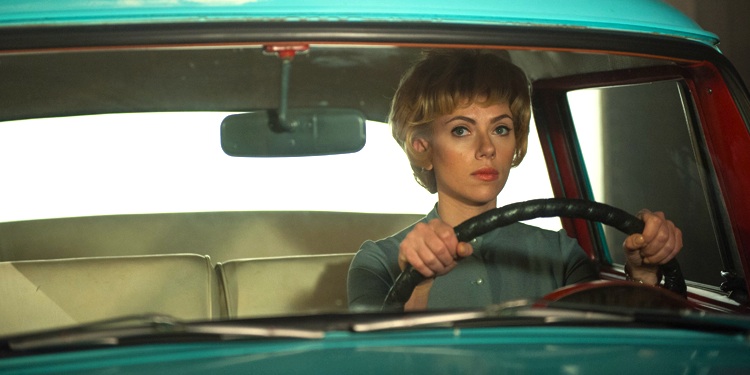
By Govindini Murty. Sacha Gervasi’s new film Hitchcock takes a smart and entertaining look at the creation of Alfred Hitchcock’s scandalous Psycho, one of the seminal films of the 20th century. Based on Stephen Rebello’s book Alfred Hitchcock and the Making of Psycho, it sheds light on Alfred Hitchcock’s (Anthony Hopkins) pivotal collaboration with his wife Alma Reville (Helen Mirren), his battles with studio executives and censors, and his ambiguous relationships with his leading ladies Janet Leigh (Scarlett Johansson) and Vera Miles (Jessica Biel).

And while Psycho was considered a risky departure for Hitchcock, the film shared much with the director’s prior work, ranging from the influence of ’20s German Expressionist cinema to Hitchcock’s obsession with beautiful blondes, voyeurism, and split identities.

Here is a cultural guide to some of the themes, personalities, and cinematic references in Hitchcock.

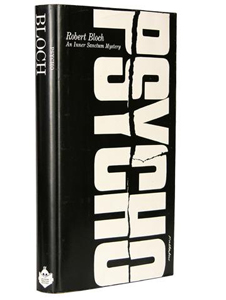
Robert Bloch’s novel Psycho

Robert Bloch’s 1959 novel Psycho created a sensation for its depiction of the violence lurking in small-town America. The story of a demented killer who cross-dresses as his tyrannical mother in order to murder young women, the novel was based in part on the true story of convicted killer Ed Gein. When Alfred Hitchcock decided to film Psycho, he was told it would be impossible because of its controversial subject matter and was turned down by Paramount. It was only when Hitchcock announced he would fund the film’s $800,000 budget himself that Paramount agreed to distribute it.

Although Hitchcock declared that he only filmed what was in the novel, screenwriter Joseph Stefano made significant changes to the story, turning Norman Bates from a pudgy, unattractive middle-aged figure into a shy, handsome young man. Stefano also changed the story’s structure, beginning the movie with the more sympathetic Marion Crane character, rather than with Norman Bates.

>>>TO READ THE REST OF THE ARTICLE AND SEE THE ACCOMPANYING SLIDESHOW, PLEASE VISIT THE ATLANTIC.

Posted on November 28th, 2012 at 9:36am.

Bookmark and Share
Nov 272012

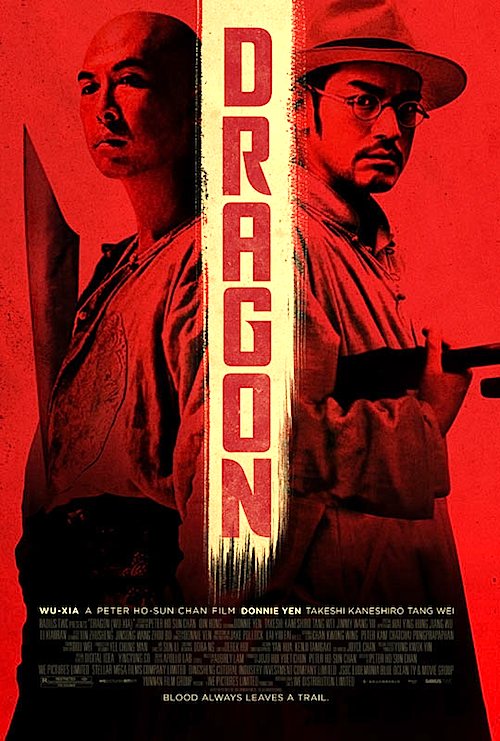
By Joe Bendel. China is a big country. In 1917, a man could get lost there if he had a reason to. A court investigator suspects an unassuming paper-mill worker is such a person in Peter Ho-sun Chan’s martial arts historical-procedural Dragon (a.k.a. Wu Xia), which opens this Friday in New York.

One day, Liu Jin-xi wandered into town, catching the eye of Ayu, a single mother deserted by her husband. Liu married her, adopting her clan name and providing the sort of stability she yearned for. Then one day two escaped convicts start terrorizing the community. Liu dispatches them with a series of “lucky shots” in an unlikely melee that could have been choreographed by one of the great silent film comedians. Or perhaps not.

Xu Bai-jiu is not buying it. Highly skilled in arcane knowledge, the investigator can practically see Liu radiating chi. Putting two and two together, Xu deduces Liu is actually Tang Long, the presumptive heir of the ruthless 72 Demons criminal clan. Unfortunately, Xu’s efforts with the corrupt judiciary attract the attention of the 72 Demons, who come reclaim their turncoat brother, one way or another.

Considering Wu Xia (as Dragon was then known) broke Michael Jackson’s record for the largest public billboard, one might expect it to be a big sprawling epic. Yet, Dragon is a moody character driven piece, dominated by the cat-and-mouse game played by Donnie Yen’s Liu and Takeshi Kaneshiro’s Xu. Of course, action director Yen does his thing when the Demons show up – including late 1970’s Shaw Brothers superstar Kara Hui, who appears as the Demon Master’s lethal wife. Fans will be happy to hear he stages some great smack-down action, including a super finale smartly incorporating the film’s holistic themes.

Yen has the right mix of affability and earnestness for Tang-trying-to-be-Liu. Yet it is Xu who emerges as the film’s truly tragic figure. Cerebral and intense to the point of snapping, Kaneshiro makes a great movie anti-hero. A man who uses acupuncture to deaden his emotions and holds regular dialogues with his subconscious, Xu’s unyielding fealty to the letter of the law bears bitter fruit for everyone, most definitely including himself. Tang Wei is also right on the money as the sensitive Ayu, still struggling with abandonment issues.

Chan knows his way around the set of a large scale action film, having helmed The Warlords and produced Teddy Chen’s high octane Bodyguards and Assassins. He certainly delivers the martial arts goods, but it is his early scenes establishing Liu as a family man, filmed with a pastoral beauty by Jake Pollock or Lai Yiu-fai, that set-up the film’s dramatic essence so effectively. It is a life viewers will agree is worth fighting for. Smarter and more emotionally engaging than most wuxia period action films, Dragon (or Wu Xia) is highly recommended for genre fans when it opens this Friday (11/30) in New York at the Village East.

LFM GRADE: A-

Posted on November 27th, 2012 at 11:22am.

Bookmark and Share

By Joe Bendel. Notorious British Rock and Jazz drummer Ginger Baker is the sort of difficult individual people often call a “character” to be polite. There is plenty of “character” talk going on throughout a new warts-and-all documentary profile of the former Cream musician. However, some of his very former colleagues choose not to mince their words in Jay Bulger’s Beware of Mr. Baker, which opens this Wednesday at Film Forum.

Baker is the king of widely acclaimed but short-lived bands, like Cream, Blind Faith, Ginger Baker’s Airforce, Masters of Reality, and a dynamite legit jazz band Baker formed during his Colorado residency. He is a major reason why each outfit struck a chord with listeners and critics alike, and also the primary cause of their premature demise. Just ask Eric Clapton, Baker’s colleague from Cream and Blind Faith. Bulger does exactly that. While the timeless guitarist tries to be diplomatic, it is clear Baker the Wildman scared the holy heck out of him—and probably still does.

It is mind-blowing to watch Baker’s repeating pattern of career comebacks cut short by self-sabotage. A case in point would be his African sojourn, partly documented in Tony Palmer’s rather engaging Ginger Baker in Africa. Arguably at the height of his fame, Baker went off the grid, traveling to a decidedly unstable Nigeria to explore traditional forms of music. Yet somehow he managed to fall in with Fela Kuti, who was not particularly inclined towards Europeans appropriators, only to alienate the musician-activist by joining the Nigerian ruling class’s Polo Club (that part Palmer misses out on).

In fact, polo has often been the downfall of Mr. Baker. Those ponies are expensive and they draw the attention of tax inspectors like a magnet. Still, the polo club Baker founded in Colorado and the jazz concerts his group gave after matches emerges in Bulger’s account as a brief high point in the drummer’s chaotic life.

While not Bulger’s uppermost concern, Beware makes a compelling case on behalf of Colorado’s local jazz talent. If you can satisfy Ginger Baker, than you can play with anyone. In fact, he had a great ear, recruiting excellent musicians like Fred Hess and trumpeter Ron Miles, who also appears as an interview subject. Of course, most of the film’s potential audience will be more interested in the likes of Clapton, Steve Winwood, Stones drummer Charlie Watts, Cream bassist Jack Bruce, Johnny Rotten, Lars Ulrich, Stewart Copeland, Femi Kuti, and various ex-wives. If there is anyone Bulger couldn’t get, they aren’t missed.

There is something perversely inspiring about Baker’s resiliency. He keeps doing it his way, regardless of the consequences. Beware captures all the madness of the Ginger Baker experience, but Bulger tries his best not to let it overshadow the music. Naturally, Baker is often his own worst enemy in this respect. Yet, somehow viewers will want to listen to Baker’s classic tracks after witnessing his spectacularly anti-social behavior. That is a neat trick Bulger deserves mucho credit for pulling off. A thoroughly entertaining documentary chocked full of unforgettable headshaking, face-palming moments, Beware of Mr. Baker is recommended for fans of rock, jazz, world music, and all around excess when it opens this Wednesday (11/28) at New York’s Film Forum.

LFM GRADE: A

Posted on November 27th, 2012 at 11:21am.

Bookmark and Share

By Joe Bendel. They lack the official recognition of the Falasha Ethiopians, but a small group of Igbo Nigerians remain convinced they are part of one of the ten lost tribes of Israel. ‘Small’ would be the word to emphasize here; in a country almost entirely divided between Christian and Muslim believers, Jewish Nigerians are a distinct minority. Nonetheless, growing numbers of Igbos are embracing Judaism as part of their heritage. Jeff L. Lieberman documents their lives and faith in Re-Emerging: The Jews of Nigeria, which screens as part of the 2012 African Diaspora International Film Festival in New York.

It is complicated, but many Igbo believe they are the modern day descendants of the Tribe of Gad. It could certainly be possible, but it would have been one arduous trek. One has to have a little faith. Still, the Jewish Igbo point to striking ways their language and culture corresponds to Hebrew and Jewish religious practices. Tragically, the Igbo experience during the 1967-1970 Nigerian Civil War also somewhat paralleled that of European Jewry during World War II, with an estimated three million Igbo killed due to the massacres and economic blockades perpetrated by the Muslim north.

From "Re-Emerging: The Jews of Nigeria."

Whether Eri, fifth son of Gad, really made it to Nigeria hardly matters to Rabbi Howard Gorin, who emerges in Re-Emerging as one of the most impassioned international advocates for the Jewish Igbos. Like Rabbi Gorin, the Jewish scholars who have visited the Igbo community describe the experience for Lieberman as inspiring and even humbling.

Indeed, there are some surprisingly affecting moments in Re-Emerging. Lieberman also supplies a good deal of helpful cultural-historical context without bogging down the film in anthropological minutia. Nor does Lieberman turn a blind eye on the institutional corruption afflicting Nigeria at large. Yet he raises the intriguing question of what Igbo Judaism might mean for African-Americans, many of whom are descended from captured Igbo slaves, without fully exploring the implications.

Re-Emerging is an informative film that broadens one’s perspective on both the Jewish and African Diasporas. Indeed, it is a laudably inclusive selection of this year’s ADIFF that ought to expand the festival’s audience. Recommended for multicultural and multi-faith audiences, Re-Emerging: The Jews of Nigeria screens next Monday (12/3) at the Columbia Teachers College Chapel as the 2012 ADIFF continues in venues throughout New York.

LFM GRADE: B-

Posted on November 27th, 2012 at 11:21am.

Bookmark and Share

By Joe Bendel. Toussaint Louverture was a freed slave, an abolitionist, and a onetime slave-owning plantation master. He led an epic life dramatized in all its messy glory throughout Philippe Niang’s two part French miniseries, Toussaint Louverture (trailer here), which screens in its entirety as the centerpiece selection of the 2012 African Diaspora International Film Festival in New York.

Told in flashbacks, viewers know right from the start that Napoleon will eventually have his fill of Louverture, consigning him to prison, where his lackeys interrogate the Haitian general for the whereabouts of an apocryphal buried treasure. In a way, Louverture was lucky to be there. Having watched a cruel slaver murder his father, the young Louverture would have been next had Bayon, a more humane plantation holder, not interceded (evidently, this scene involves some dramatic license, but so be it). Recognizing the boy’s talents, Bayon somewhat reluctantly teaches Louverture to read and even grants him his freedom as a young man. The evolving, cliché-defying relationship between the two men is one of the strongest elements of this bio-drama.

Eventually, Louverture takes arms, but again this is complicated. Serving as an officer first for the Spanish and then the French, Louverture fought against every European power in Haiti at one time or another. Although he is an abolitionist, Louverture strives to maintain strategic ties to the colonial landlords. The Louverture Niang shows the audience is not a class warrior. He wants to keep their capital in Haiti—he just doesn’t want to be considered part of it. However, this inevitably brings conflict with hotter heads intent on score-settling.

Indeed, the tragedy of Niang’s Louverture is the way cynical white, black, and mulatto Haitians exploit racial resentment to further their power games. It is also fascinating to see how the chaos of the French Revolution shaped events a hemisphere away. However, given Louverture’s reputation as one of history’s great revolutionaries, many viewers will be surprised that there are no battle scenes in Niang’s production, just the anticipation and consequences of armed conflict.

Jimmy Jean-Louis as Toussant Louverture.

Something of a throwback to the epic historical minis of the 1980’s, Louverture is sweeping, melodramatic, and ennobling in a very satisfying way. As one might expect, Jimmy Jean-Louis’s dynamic lead performance is the key. He is suitably intense, without allowing Louverture to degenerate into a fire-breathing revolutionary stereotype. Likewise, Philippe Caroit genuinely humanizes the French old guard as the decidedly un-Legree-ish Bayon.

A French television veteran, Niang’s tele-movie Prohibited Love (which screened at the 2010 ADIFF) also dealt with racial themes pointedly, but without wallowing in didacticism. Louverture is even better. In fact, it should appeal to audiences across the ideological spectrum, aside from any odd remaining Bonapartists out there. Appealingly old fashioned, Toussaint Louverture is a well produced period drama, recommended for history buffs and Francophone audiences when it screens next Saturday and Sunday (12/1 and 12/2) as the centerpiece of this year’s ADIFF.

LFM GRADE: A-

Posted on November 23rd, 2012 at 12:12pm.

Bookmark and Share

By Joe Bendel. It is like the Bewitched version of the “Scottish Play.” Two identifiably different actors will play the murderous general, due to complicated circumstances. It is all part of the backstage drama brought to the fore in Nadine M. Patterson’s meta-postmodern-experimental-musical-docudrama Tango Macbeth (trailer here), which screens during the 2012 African Diaspora International Film Festival in New York.

Unconventional in many ways, this Macbeth will be choreographed. Yes, there will be tango, as well as some vaguely Fosse-esque steps, but that is the least of Patterson’s gamesmanship. While the play itself is shot in stylized music video-style black-and-white, the ostensive behind-the-scenes rehearsal will be filmed in Wiseman-like color. There will be nearly as much fireworks going on amidst the cast and crew as in the presumptive play within the film.

Hopefully, it is all a bit of meta-meta fun, or else Macbeth #1 will be in for some indigestion when he finally screens Tango. Yet, the Shakespeare is still in there and the cast is often quite good bringing out the flavor and dynamics of Shakespeare’s most perilous tragedy. In fact, Brian Anthony Wilson is absolutely fantastic as Macduff (and himself as Macduff), blowing the doors off the Thane of Fife’s big scenes. Based on his work in Tango, most viewers will probably be up for watching him tackle the title role in a more traditional production.

From "Tango Macbeth."

Alexandra Bailey also has some powerful scenes as Lady Macbeth, apparently developing some nice chemistry with both Macbeths. If Carlo Campbell, Macbeth #1, always appears in character[s], than it is a really fearless performance. Ironically though, Eric Suter’s best scene comes not as Macbeth #2, but when he was still a swing player, appearing as Lady Macbeth’s assassin.

It might seem hypocritical to criticize Anna Karenina for Joe Wright’s stylistic excesses, but praise Patterson’s explicitly avant-garde approach. Yet, they are coming from two very different places. While Wright is just tossing in a distracting bit of hipster pretension, Patterson is fundamentally deconstructing both Shakespeare and traditional notions of stage drama.

The talented ensemble makes quite a mark in Tango, yet it is likely to disappoint anyone hoping to see actors in classical costume, dancing about with roses in their teeth (perhaps bitterly so). However, for the aesthetically adventurous it is a fascinating production. Recommended for frequent patrons of the Anthology Film Archives, it screens Saturday (11/24) and Sunday (11/25) as part of this year’s ADIFF.

LFM GRADE: B

Posted on November 23rd, 2012 at 12:11pm.

Bookmark and Share

By Joe Bendel. Hopeville is the sort of town that will drive you to drink. It is probably not the place for a recovering alcoholic granted provisional custody of his estranged son, but Amos Manyoni does not have a lot of options in John Trengove’s Hopeville (trailer here), an original feature film adaptation of the popular South African miniseries, which screens as part of the 2012 African Diaspora International Film Festival in New York.

Pools play in important role in the life of Manyoni’s son Themba. He was a champion swimmer, but his mother tragically died in an accident en route to one of his meets. Clean and sober for over a year, Manyoni regains his parental rights, as long as he adheres to three conditions: stay away from alcohol, hold down a steady job, and provide Themba access to a pool. Hopeville sounds perfect. He has a gig lined up there with the municipal government and there is a pool, except not really.

Drained and in a state of disrepair, the pool now serves as a garbage dump. The corrupt mayor and his council cronies are planning to develop it into a booze drive through, but they are reluctant to tell Manyoni their plans forthrightly. Instead, they do their best to secretly undermine his efforts to single-handedly fix up the pool. Much to their frustration, though, Manyoni’s work begins to inspire the depressed town.

Hopeville is the sort of film tailor-made for feel-good festival play. There is redemption, family values, spirited old folks, and triumph over adversity. Manyoni even develops a romance with Fikile, the mayor’s ice cream vendor mistress, but it is decidedly chaste—just an odd kiss and a bit of handholding.

From "Hopeville."

Of course, you cannot spell “Hopeville” without “evil.” That might be too strong a term, but Desmond Dube’s venal mayor is definitely a pointed portrayal of post-apartheid political opportunists. Yet, by and large, Hopeville is about inclusion and multi-racial community.

Themba Ndada is painfully earnest but still reasonably down to earth and credible as Manyoni. While there is a lot of manipulation going on, viewers will still find themselves caring about his trials and tribulations. While Dube plays the mayor like a caricature of graft, Hopeville boasts several appealingly colorful supporting turns, including Jonathan Pienaar as the Fred, the not-as-bad-as-he-looks barkeep.

On one hand, Hopeville is competently produced, likable, and well-intentioned. It is also predictable and sentimental. Sometimes, that is all rather comforting. Recommended for patrons in the mood for reassuringly inspirational cinema or interested in contemporary South African film, Hopeville screens this Saturday (11/24) and the following Thursday (12/6) as part of the ADIFF in New York.

LFM GRADE: C+

Posted on November 23rd, 2012 at 12:10pm.

Bookmark and Share

By Joe Bendel. An expansionist Eastern regime is dead set on war with Japan, at a time when America’s defense capacity and influence in the UN are both at all time lows. They say it’s the near future, but it feels only too near. Still, there may yet be hope in Isamu Imamake’s apocalyptic anime feature The Mystical Laws, created by executive producer Ryuho Okawa (founder of the controversial Japanese religious fusion movement, Happy Science) which opens this Friday in New York.

In an authoritarian country not identified as China, a shadowy military science officer named Tathagata Killer assumed power in a coup. Now known as the Godom Empire, his kingdom becomes the dominant super-power, thanks to the remarkable technology provided by the beautiful but mysterious industrialist Chan Leika.

The world slept while the demonic dictator consolidated power, except Hermes Wings. Partly a Doctors Without Borders-style NGO and partly a secret society dedicated to preserving free democratic values, Hermes Wings is considered the greatest threat to the Godom overlord, so he targets them accordingly. Through tragic circumstances, Sho Shishimaru rises to the top of Hermes Wings. There is a reason people have confidence in him: according to prophecies, he might be both the savior and the second coming of Buddha, which is an awful lot for any dude to live up to.

From "The Mystical Laws."

Mystical Laws could be described as a Buddhist Left Behind, with generous helpings of Christian symbolism thrown in for good measure. It is also anime. In truth, just about every conception of divinity is covered in Mystical, including the embodiment of the “Spirit of Japan,” who looks rather attractive. Some of the symbolism is impossible to miss, such as the swastikas the Godom army marches under, or the crosses on which they crucify enemies of the state. Still, if the slightly odd film represents an attempt to proselytize, it is dashed hard to tell what for.

Okay, so subtlety really isn’t Mystical’s thing. Nonetheless, the first two acts constitute a rather intriguing end-of-the-world/sci-fi conspiracy thriller. The relationship between Shishimaru and Leika is also nicely developed, and the Buddhist elements give it all a distinctive flavor. Unfortunately, the third act is largely given over to a Harry Potter-esque clash of fireballs and god-rays.

You have to take satisfaction from a Japanese film that bemoans the lack of American military bases. Indeed, it takes notions of faith, freedom, and sacrifice profoundly seriously. With art and characterization well within the anime industry standard, perhaps even slightly higher, it might be the most effective end-of-days religious thriller, well maybe ever (for what that’s worth). It certainly puts to shame impassioned but clunky evangelical films, like Jerusalem Countdown.

Mystical probably is not your Cheetos-eating fanboy’s anime. However, anyone interested in a film arguing that religion plays an essential role in a healthy society (and also implying a need for a strong military) might just get sucked in, in spite of themselves. Recommended for fans of challenging anime, aesthetically adventurous evangelicals, and nontraditional Buddhists (collectively a woefully underserved market), The Mystical Laws opens this Friday (11/23) in New York at the Cinema Village.

LFM GRADE: B

Posted on November 23rd, 12:07pm.

Bookmark and Share
Terms of UsePrivacy Policy Libertas Film Magazine™ is produced by The Liberty Film Festival.® Suffusion WordPress theme by Sayontan Sinha