PLEASE NOTE: Living with the Infidels Episode 3, “The Honey Trap,” features adult situations. If that might offend you, please don’t watch the webisode. Otherwise, enjoy.
Here is Episode 3 of Living with the Infidels. We hope you enjoy the series.
By Jason Apuzzo. A few weeks ago we posted about NBC’s new series The Event, which seems to feature a variety of narrative elements with political overtones. Specifically, we analyzed the extended trailer for the series (above), and picked out these prominent elements from it:
• Heroic, charismatic young black President.
• CIA conspiracy involving illegal detainees.
• A secret detention facility in Alaska
• Some sort of 9/11-type event (i.e., world-changing, clash-of-civilizations-type encounter)
• A 9/11-type suicide attack with a plane targeting the President
Since that time, there’s been a considerable amount of on-line speculation on the series. Much of this has to do with the fact that NBC showed the pilot episode of The Event at Comic-Con. See reviews of the pilot episode here, and a review of the pilot screenplay here.
***SPOILERS AHEAD***
'Sophia Macguire' from NBC's "The Event."
The most interesting thing that’s been ‘spoiled’ about the series is that The Event may be another of the many sci fi invasion projects we’ve been posting about here all summer. New York Magazine recently let the cat out of the bag on this one (see here and here). The key element tipping everybody off to the sci-fi component of the series seems to be that the airplane seen hurtling, kamikaze-style toward the President at the end of the trailer above (and at the end of the pilot episode) apparently vanishes into thin air, ostensibly as a result of some advanced/alien sci-fi-type technology. This mid-air vanishing of the plane, however, is not the series’ ‘event’ itself according to the show’s producer, but merely indicative of things to come. For more details, you can find out a lot about the show at a new site called The Event Log.
We’ve been talking all summer here at Libertas about how science fiction projects are currently becoming the ‘accepted’ medium by which filmmakers in both Hollywood and the indie world are dealing with our current wars, and domestic political anxieties. Indeed, I had what I considered to be a very interesting exchange recently on this subject with my friend Patrick Goldstein over at the LA Times. It appears that The Event may be continuing this overall trend of ‘politicized’ sci-fi.
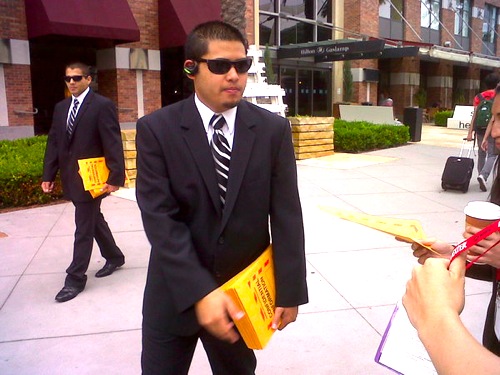
NBC flacks handing out 'secret dossiers' about "The Event" at Comic-Con.
One of the really interesting bits of speculation on the new series concerns the nature of the ‘detainees’ in the series’ Alaska detention center – the same center that our heroic young President fights the CIA in order to open. [I’m trying to image where NBC got that plotline … but I just can’t think of any real world examples. :)] Much of the speculation centers around whether the detainees are either: human visitors from the future, aliens, or human visitors from the future who’ve had contact with aliens.
The leader of this group of detainees is a sober-looking, middle-aged woman named ‘Sophia Macguire’ (played by actress Laura Innes; she’s in the trailer above). Here’s a little insight, from someone who’s written a few screenplays: whenever you have a sober-looking, middle-aged female character named ‘Sophia’ (a name meaning ‘wisdom’) you can rest assured that this character will be used within the storyline to impart some choice nugget of wisdom to the main hero – in this case the President. It’s usually a sure thing in these types of stories.
So expect The Event to present a scenario for its viewers in which the ‘wisest’ character in the show, who knows the most, is a detainee at a secret CIA facility. Well! Isn’t that an interesting plotline in our post-Guantanamo world?
The facility at Mount Inostranka remains a top priority to our national security. Recent events surrounding the facility must be remedied immediately.
Handle the first with extreme urgency. A breach of protocol has resulted in the escape of …….. The Agency must seek and extract the escapee to trade for information. The Mission allows for acceptable collateral damage.
Ever since 1944, ……. them, The Agency has maintained complete secrecy surrounding the detainees and the facility;….survivors that were apprehended, one demonstrated to be their leader and is……….. Sophia Macguire can not be allowed to communicate with anyone from outside the facility and must be monitored at all times. She must be questioned about the disappearance of……
Even though we have suspected substantial differences…..the source……have we been able to pinpoint to believe the detainees are…..leads the Agency……but we need further information. For this cause,…….
Valid information is still required to confirm……must not allow any further information to be leaked.
Execute orders immediately. A team led by General Whitman will be joining you in Alaska tomorrow.
No action is to be taken in updating the President. This information is on a need-to-know basis and the President should not be briefed on the existence of the facility. This must remain a matter for the intelligence services, which have been managing this without interference for decades. And as you know, we have our reasons.
These recent developments are all unquestionably related to increased activity among the detainees. The Agency needs you to address this, immediately.
By authority of: Blake Sterling
Signature: B. Sterling
Note that this Sophia character “can not be allowed to communicate with anyone from outside the facility” and “must be questioned about the disappearance of” something/someone. In other words: she knows a lot.
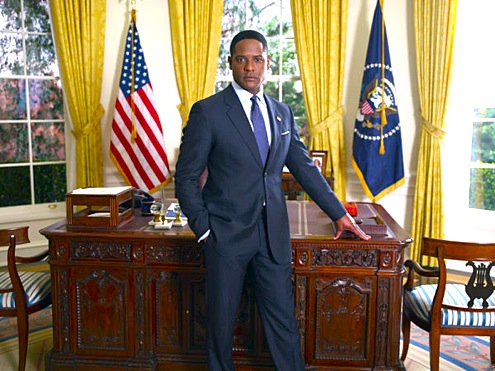
Blair Underwood as The President.
My guess here? Looking beyond the series pilot, my sense is that Sophia Macguire and her fellow detainees, who have apparently been in captivity in Alaska since 1944, are some sort of human time travelers who’ve had alien contact. [I assume they’re human because if they were aliens they presumably wouldn’t let themselves be captive for 60+ years!] As a result of this contact, they have insight into advanced technologies that allow them to do things or comprehend things like … planes vanishing, and perhaps the extending of lifespans.
So what we have here, ultimately, is the following: the mythologizing of people in a CIA detention facility, who might actually be ‘wiser’ than we are, and who are possessed of esoteric insights we cannot fathom – i.e., how planes vaporize in thin air, so to speak. And the heroic Obama stand-in is there on the spot to free them.
What a charming gift NBC’s giving us, just on the heels of the 9/11 anniversary. Thanks, NBC, but I think I’ll be watching V instead.
By Jason Apuzzo. I’m curious as to what people think of this preview (above) for NBC’s forthcoming series, The Event. Here are the main elements I’m getting from this trailer:
• Heroic, charismatic young black President.
• CIA conspiracy involving illegal detainees.
• A secret detention facility in Alaska?
• Some sort of 9/11-type event.
I believe this is what is referred to as ‘on the nose’-style filmmaking. And we apparently now have the Obama Administration’s own version of The West Wing.
Somehow you knew this was coming, didn’t you?
[Special thanks to LFM’s Patricia Ducey for tipping me off about this.]
[Special thanks to Hot Air for linking to this post.]
By Jason Apuzzo. We reported recently here at Libertas about how the CW’s reboot of the Nikita franchise will be making the CIA the villains of the piece. So far as we’re aware, we’re the only site currently making a fuss over this.
Variety (registration required) is now reporting today that the show is currently turning heads for a different reason – namely, the raciness of it’s advertising.
At Libertas, of course, we dive right in to such controversies.
As I mentioned in my earlier post about this show, what alerted me to this show to begin with was a gigantic, eye-popping billboard of star Maggie Q slapped up against a building here in LA. The poster was the already quite racy one of her in a red dress (see here). Now, apparently, the people at CW are trying to get huge billboards of Maggie Q in leather and tattoos (see left) into major markets like New York, Chicago and Los Angeles – and even here in LA not everybody’s going along with it.
Let me begin by stating the obvious: it would be spectacularly hypocritical of me to complain about the sexiness of this show’s advertising, given our regular featuring of pin-ups here at Libertas. On the contrary: we love this sort of thing, as it speaks to the sort of freedoms we enjoy here in the West that are routinely frowned upon in totalitarian societies (both of the Islamo-fascist and communist variety) elsewhere in the world.
Plus, the girls look cute – which should be reason enough.
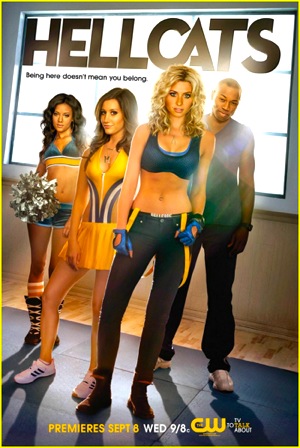
Cheerleaders.
With that said, even I think that putting up 50ft. billboards of Ms. Q in leather and tattoos in public places like malls, where families and children may gather, is probably a bit much. And for safety reasons, I don’t think it’s too good of an idea to put these billboards near freeways. The one of her in the red dress (see here) is more than enough to get the point across.
What bothers me more is that this new show apparently goes The Full Stallone in taking a nasty swipe at the CIA. Why aren’t people more bothered by this? Let me put it this way: why are we so prudish about the sex component to this series, yet so completely untroubled by what the show is depicting in terms of our own government?
Attacking our intelligence services is such a terrible idea at this point in time, as those services struggle under the combined weight of low morale, rampant anti-Americanism overseas and budget cutbacks. And here’s another problem: shows like this do, eventually, get syndicated in foreign markets … and what kind of effect do you think they have, particularly among those already inclined toward hating America? [Foreign distribution rights to Nikita have already been sold to the UK and Australia.]
Much as with The Expendables, I really wanted to like this show. It had the potential of being a kind of sexed-up version of 24 – or a weekly Salt, if you will – and in fact that’s what the show should have been. Instead, they had to make America’s intelligence services into the enemy, into ruthless murderers bent on assassination. What a shame.
The only silver lining here, I suppose, is that the CW is giving us a better-looking show this fall called Hellcats. The show is apparently based on the book, Cheer: Inside the Secret World of College Cheerleaders. I’ve put the trailer for the show below. This cheeky comedy-drama’s premise is described this way:
Hellcats revolves around Marti, a pre-law college student from the wrong side of the tracks. When budget cutbacks and her mother’s constant carelessness cause her to lose her scholarship, she joins the Hellcats, the college’s competitive cheerleading team.
Perfect! A series about a young gal forced into a life of cheerleading due to tragic circumstances. [Is Roger Corman running this network?] Between the new terrorist-fighting Hawaii Five-O and this, I think we’re set now.
By Jason Apuzzo. Yesterday we posted about a forthcoming web series called Red Storm that looks exciting. Today we wanted to introduce LFM readers to another forthcoming web series that’s gotten a fair bit of pre-release hype, called The Mercury Men.
The Mercury Men is a 1940s-style adventure serial about a lowly government office drone who finds himself trapped, when deadly alien visitors from the planet Mercury seize his office building and use it as a staging ground for a nefarious plot. Aided by a daring aerospace engineer from a mysterious organization known as “The League,” the office drone must stop the invaders and their doomsday device, the Gravity Engine.
By Jason Apuzzo. There are a lot of independent film projects we’re hearing about all the time here at LFM. Something we wanted to show you today, during this extended Fourth of July weekend, is a trailer for the forthcoming web series Red Storm. We’ve embedded the trailer for this series above.
The filmmakers keep things mysterious, but the series appears to have as its premise a scenario that seems straight out of the new Red Dawn film, coming this fall from MGM. Some sort of massive occupying force – Chinese communist? Russian fascist? – invades and occupies America, and a hearty band of freedom fighter-rebels fight back.
It’s interesting, of course, that this sort of invasion anxiety is reappearing in American filmmaking, as we’ve discussed previously.
The imagery used in the trailer is effective, ominous and compelling. Marching armies (Chinese? North Korean?) … nuclear testing … the protestor stopping the tank in Tiananmen Square … the 9/11-style imagery of a crumbing building, shattered by explosions, raining debris on cars below … with those cars being passed by what look to be Chinese tanks. Continue reading Red Storm: The Return of The Red Menace?