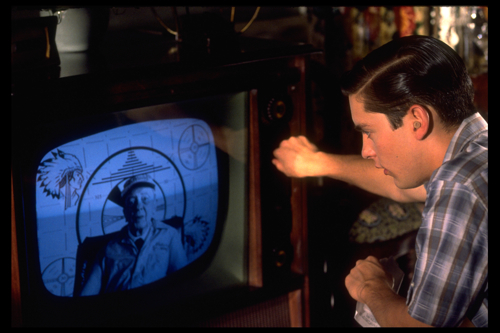
By David Ross. Avatar would seem to have no rivals in terms of asinine but aggressive cultural politics. It turns out to have a strong rival, Pleasantville (1998), the premise of which is that two modern kids (Tobey McGuire and Reese Witherspoon) get sucked into a 1950s TV show. They must save this world of family dinners and manicured lawns from its soullessness, mindlessness, and totalitarian conformity by literally teaching the locals how to have sex (in one icky scene, Reese gives her TV mother a lesson in the basics of masturbation). People awaken from their celibate comas and the world begins to shift from black and white to color, introducing a gratuitous racial allegory as the “coloreds” are harassed by the black and white remnant. Meanwhile, the pages of books, which were previously blank in token of the general emptiness of things, suddenly begin to fill with the words of D.H. Lawrence, J.D. Salinger, and other proto-liberationists. By the end of this magical process of transformation, the kids are humping like rabbits in the backseats of cars, the parents are headed for divorce, the citizenry is fighting in the streets, and the town is reduced to rubble – in short, thank god, the sixties have arrived, and not a moment too soon. Tobey returns to the present day to find that his dubious divorcee mother has broken up with her boyfriend. Tobey dries her eyes having learned the crucial lesson that life is “all about change,” never mind that it has led to the cultural wasteland depicted in the film’s opening scene, in which Tobey and Reese, nerd and slut, enact the clichés of the modern high school.
Baby Boomer propaganda has succeeded wonderfully, Pleasantville and Mad Men being cases in point. My students constantly parrot the assertion that the fifties were an era of conformity, conservatism, and materialism. I retort that the fifties were a golden age of American arts and culture, whose leading lights – Ray Charles, John Coltrane, Miles Davis, Hitchcock, Nabokov, Charles Mingus, Thelonious Monk, Flannery O’Connor, Eugene O’Neil, Jackson Pollock, Ayn Rand, Dr. Seuss, Muddy Waters, Billy Wilder, Tennessee Williams, Edmund Wilson – have no equivalent in later decades. I remind them, also, that the sixties did not even have the brains to invent themselves, but were invented in the pages of Allen Ginsberg and Jack Kerouac, whose masterpieces, “Howl” and On the Road, respectively appeared in 1956 and 1957. When you consider those who remained active – E.E. Cummings, Eliot, Faulkner, Frost, Hemingway, Henry Miller, Marianne Moore, Pound, William Carlos Williams – and those from elsewhere whose work was filtering into American culture – Bergman, Bresson, Camus, Fellini, Kurosawa, Picasso – the fifties become a crushing commentary on our own inadequacy.
Nabokov and Lionel Trilling here discuss Lolita on Canadian public television. Consider what this clip implies about the despised fifties: that a largish number of people not only gave a damn about a novel like Lolita (the third bestselling novel of 1958), but gave a damn what an academic Mandarin like Trilling had to say about it.
Wow. You missed a lot in Pleasantville. Just as one small hint, the town’s logo was cribbed from the U.S. Socialist Party. I understand that your actual point is to defend the fifties, but this really has nothing to do with Pleasantville. The film used fifties television as a metaphor for anti-individualist oppression. The plot concerns David/Bud’s discovery of his own moral sovereignty. I don’t know if this qualifies it as a worthy conservative movie, but Pleasantville is an excellent libertarian film.
Good luck with this site. I like the ideas motivating this place.
I agree with David Ross about Pleasantville’s noxious underpinnings, and though I enjoy Mad Men to some extent, it certainly is revisionist in a similar way. People with 1950s agendas always seem to feel that suddenly in 1964 a switch was flipped and progress happened overnight.
I’m a bit surprised you didn’t mention Blast From the Past, which is the anti-Pleasantville, David.
Mad Men could go either way. They’ve actually been fairly brutal towards liberal/bohemian culture so far, but I’m apprehensive about how they will handle escalation in Vietnam, the rise of the anti-war movement and the ‘counterculture’, etc.
Welcome back Libertas!!
The socialists have to attack the 50s. Taxes were extremely low, employment was low, the standard of living was higher than today and the government was far less intrusive and local. A refutation of everything the left stands for – so naturally it has to be “revised” in today’s media into a hell hole of capitalist exploitation and uptight cultural values.
Bruce Bawer’s wonderful essay The Other Sixties is required reading on this topic.
While I completely agree with the fact that most of my students, along with most of the people I run into, have a distorted view of the “stifling” 50s and the “liberating” 60s, I have some serious objects to piece.
To begin with, you never prove, or even attempt to prove your assertion that Pleasantville is, “a strong rival” to “Avatar… in terms of asinine but aggressive cultural politics.” Avatar presents not only an anti-American but an anti-human view of reality, in which we are doomed to be mindless brutes who will destroy our environment and any other environments we come into contact with. Our only hope is to abandon being human and allow a higher form of life, a noble savage, to replace us. Pleasantville, on the other hand, is primarily a struggle between conformity and personal freedom. Putting aside what is does or does not say about 1950s America, it is at heart a story that affirms the right and the ability of people to handle their own lives. It does not end, as you claim, with, “the citizenry… fighting in the streets, and the town… reduced to rubble.” It ends with everyone and everything in living color and looking beautiful. The female lead no longer wants to be a slut and heads off for college, while the male lead realizes that the phony world of a classic TV sitcom, which he longed to live in, is not what he really wants at all. He must embrace life as it has been handed to him and make the most of it. As Greg Swann before me commented, this is, “an excellent libertarian film,” and I believe one that many conservative could also embrace.
As for the film’s view of the 50s, I think it is vitally important that we look at the world the main characters actually travel to – the world of a make believe class TV sitcom – and not confuse this with a film where characters time travel to the actual 1950s. The film does pass judgment on the present day belief that some self-described conservatives have, that we should be living in a Leave it to Beaver, Father Knows Best, fairytale, which never actually existed. The reason why the books in Pleasantville have no text in them and the jukebox plays no “colored” music, is not because the actual 50s lacked for good art or interesting ideas, but because the mass media representations of the era, in particular the sitcoms, tended to represent a very sedate and simplified view of the time. It is not just the post-60s impression that has lead people to false assumptions and conclusions on this matter. You can show us all the Canadian public television you like, this really does nothing to counter the fact that most U.S. TV views during the Eisenhower years saw a sheltered, paired down, glimpse of the wider world. At least they had the benefit of seeing more of that world outside the idiot box, but a viewer today who watches a classic TV show is going to start from the assumption that those times were something very different from what they actually were, if taken in their totality.
I think that you have a pro-50s bias, which I completely understand. Nevertheless, I think you need to step back from your frustration with the general public’s general lack of historical knowledge and assess Pleasantville for what it is; a pretty good film.