By Joe Bendel. Most armchair political analysts were stunned when Joseph Cao, a Vietnamese-American Republican, defeated scandal-plagued Democrat William “Big Freeze” Jefferson to represent nearly the entire city of New Orleans in Congress. Alas, party registration will likely represent a challenge for Rep. Cao’s re-election. However, he will have an important base of support in the Crescent City’s Vietnamese community, whose strength and resiliency has emerged as a major post-Katrina political development.
Documenting the unexpected rise of the New Orleans East neighborhood that challenged an out-of-touch municipal government and ultimately elected the nation’s first Vietnamese-American congressional representative, S. Leo Chiang’s A Village Called Versailles (see the trailer here) airs this coming Tueday (check your local listings) as part of the current season of Independent Lens on most PBS outlets.
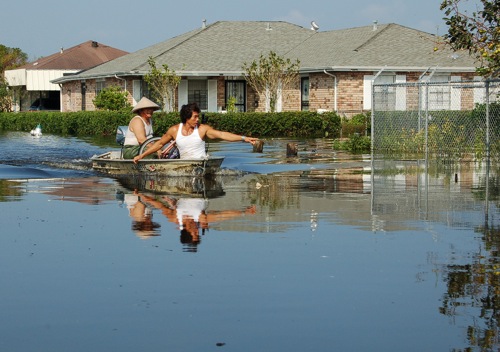
Many of the older Vietnamese residents of the Versailles neighborhood (named after a large housing complex in Eastern New Orleans) had already endured two painful dislocations. Mostly from two predominantly Catholic towns in the North, they had first fled the North Vietnamese Communists to the South, only to come to America as refugees following the fall of Saigon. Indeed, the Katrina evacuation brought back many painful memories.
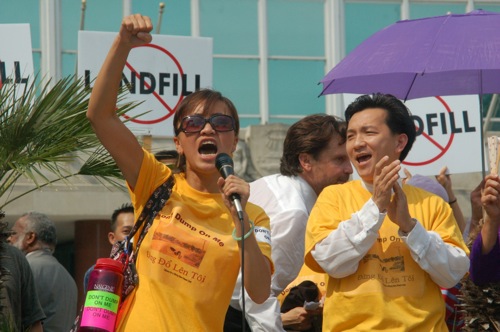
However, this time they returned – reclaiming their homes and neighborhood – in large measure thanks to the unifying role played by Father Vien Nguyen and the Catholic Church. Unfortunately, their rebuilding efforts were nearly sabotaged when then “Mayor” Ray Nagin used dubious emergency powers to dump an environmentally questionable landfill in their midst.
Refreshingly, Chiang’s broadcast cut refrains from the sort of cheap political shots that are often commonplace in Katrina related documentaries (yes, that means you, Trouble the Water, among others). However, there’s just no papering-over Nagin’s arrogant disregard for the Versailles community. Of course, Nagin’s now gone, but the community is still there.
While documentaries about so-called “political empowerment” are often rather dull and stilted, Village is legitimately inspiring. It unambiguously illustrates the positive role faith can play in public life at a time when organized religion and the Catholic Church in particular do not get a lot of love from the documentary film community. Village also celebrates the voluntarist spirit and genuine grassroots activism. The film’s only real shortcoming is the largely synthesized soundtrack. Though some pleasant incidental music was obviously composed to evoke the neighborhood’s Vietnamese heritage, in general, it is disappointing to hear only incidental snatches of distinctly NOLA (or Versailles) music.
Appearing only ever-so-briefly in the film, Cao’s election became the obvious capstone for Village. Indeed, it clearly explains the circumstances apart from the Jefferson scandal that made his election possible. The winner of the New Orleans Film Festival’s Audience Award, Village is easily one of the more uplifting documentaries about the Katrina aftermath. The film offers a number of important lessons, not the least being the positive role faith can play in a community. Definitely recommended, it airs Tuesday (5/25) on most PBS stations. The DVD is available for purchase here.
UPDATE: The LA Times reviews the film here.