By Joe Bendel. Juan Pujol was the all-time greatest writer of spy fiction, but he wrote for a very select audience: German intelligence. Supposedly based in England, the Spanish double agent wrote incredibly verbose reports to his unsuspecting German handlers, riddled with disinformation and imaginary sub-agents, but it all boiled down to one word: Calais. Misdirecting the National Socialist war machine was the intrigue of a lifetime in Pujol’s life of intrigue, idiosyncratically documented in Edmon Roch’s Garbo the Spy (trailer above), which opens this Friday in New York.
The Germans knew him as Alaric, but the British code-named him Garbo. A deserter during the Spanish Civil War, Pujol’s story is so unlikely it would be difficult to believe without documentation. In fact, MI-5 did not believe him when the unprepossessing man came cold-calling. Rebuffed but undeterred, Pujol next approached the Germans, who immediately recruited him as an agent.
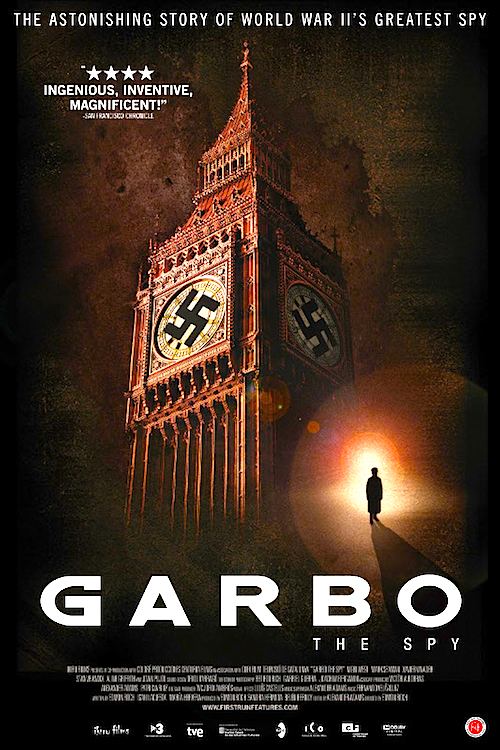 Pujol fed the Germans a steady diet of information largely culled from old newspapers that nonetheless built up his controllers’ trust. Eventually, after several further overtures, the British realized Pujol was legit and began directing his work. While he passed along a great deal of misleading intel, his most important assignment was Operation Fortitude, a concerted campaign to convince the Germans the D-Day invasion would land at Calais rather than Normandy.
Eventually, the war ends satisfactorily for Pujol. A bit of time passes, he disappears, and at some point is reported dead. Obviously though, there will be more to the master of the deception’s story. Military historian Nigel West (and former conservative MP under his given name, Rupert Allason) would tell the full tale when he literally wrote the book on Pujol, finally giving the remarkable spy his proper due.
Roch’s film is incredibly cinematic, employing extensive archival footage and clips from vintage war and espionage films as illustrative devices. In fact, the video sampling strategy often threatens to overwhelm the deadly serious subject matter, giving Garbo a vibe somewhat akin to a Jay Rosenblatt short film collage. Frankly, it occasionally borders on the inappropriately ironic. Still, the substance of Pujol’s story consistently rises above any stylistic excesses.
Garbo the film also boasts a relatively small but highly specialized cast of interview subjects, including West (as he is billed) and Aline Griffith, Countess of Romanones, a contemporary of Pujol’s working clandestinely for the OSS. Everything they have to say is quite noteworthy. It also interviews members from both of Pujol’s families, neither of whom knew of the other until West discovered his fate.
There is no question Pujol saved many Allied lives. Perhaps hundreds of thousands of servicemen survived the European theater because the Germans were dug in at Calais. The strange details and anecdotes surrounding Operation Fortitude by themselves are well worth the price of admission. Totally fascinating history, briskly if somewhat distractingly rendered on-screen by Roch, Garbo is definitely worth seeing, particularly for history buffs and espionage junkies, when it opens today (11/18) in New York at the Quad Cinema.
Posted on November 18th, 2011 at 3:52pm.

 On the other hand, I never tire of the Who. I love to feel the whiplash of their sonic overdrive: the skittering cannonade of the drums, the waves of guitar thunder, the endless frisky invention of Entwistle’s bass. In terms of instrumental prowess and cohesion, the Who far exceed the Beatles, the Rolling Stones, and even Led Zeppelin. The band’s defining idiosyncrasy – in many ways the secret of its success – was the unique reversal of the guitar and bass parts. So often Townsend establishes the rhythm or adds tonal effects while Entwistle carries the melodic burden. Watching the Who play live, one realizes that what sound like guitar parts – power chords, dashing melodic runs – are actually bass parts. The primacy of the bass gives the Who’s music such underlying movement and momentum. The most dynamic aspect of the music is buried deep in the tonal structure and speaks to some primal lobe of the brain, the part that remembers the pulse of the womb. Jimi Hendrix was the greatest rock instrumentalist of all time, but Entwistle may be in his quiet way the second greatest.