LFM Reviews The Taking of Tiger Mountain

By Joe Bendel. Qu Bo’s war novel Tracks in the Snowy Forest was adapted as the revolutionary opera Taking of Tiger Mountain by Strategy, one of the so-called “Eight Model Plays” allowed to be staged during the Cultural Revolution. After years of frustration, Tsui Hark has finally realized his big shiny capitalistic adaptation of Qu Bo’s source novel, but the good guys are still PLA soldiers and the bad guys are not. The powerful outlaw Lord Hawk is about to learn he is on the wrong side of history in Tsui’s The Taking of Tiger Mountain, which opens this Friday in New York.

It is the bitter cold winter of 1946 and warlordism plagues northern China. PLA Captain 203 and his troops have been dispatched to restore order, but they are outmanned and outgunned. For reinforcements, the Party sends him Little Dove, a cute medical officer, and Yang Zirong, a political and intelligence officer, whose exact brief is rather vague. After helping the Captain shore up the most vulnerable village lying in the foothills of Hawk’s mountain stronghold, Yang announces his plan to infiltrate the band of brigands posing as a notorious but seldom seen member of a rival gang. Capt. 203 is not exactly crazy about the plan, but he signs on anyway, since there is no stopping Yang. Of course, he will need Yang’s intelligence when Hawk finally decides to attack the village.

Wisely, Tsui never lets any of his characters jabber on about historical dialectics. Aside from a few snarky comments about the Nationalists, there are not a lot of ideological identifiers in Tiger Mountain beyond the obvious uniforms. However, a contemporary descendant of one of the survivors often watches Xie Tieli’s 1970 film treatment of the Revolutionary opera, giving us several quick tastes of its didacticism.

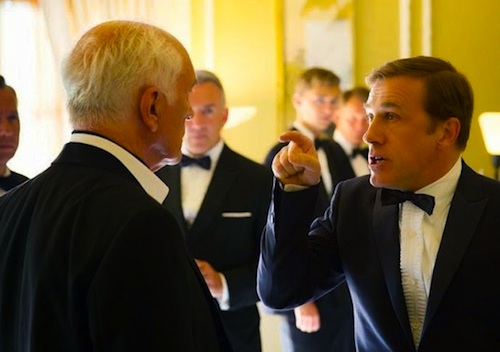
Frankly, if you are going to tackle any of the Eight Model Plays, it might as well be Tiger Mountain, because nobody is in favor of banditry. Tsui stages some suitably big action spectacles, including the big mountain plane crash that factors so prominently in the trailer and one-sheet, but he puts it in the darnedest place, thereby sacrificing much of its suspense. It really feels like it was tacked on at the last minute to justify the expense of 3D.

From "The Taking of Tiger Mountain."

Given its propaganda roots, it is not so very surprising that most of the Tiger Mountain characters or more like symbolic types than fully developed individuals. Still, Zhang Hanyu (terrific in both the under-appreciated Equation of Love and Death and the otherwise problematic Back to 1942) plays Yang with grit and roguish panache. Tong Liya’s turn as Little Dove is also both sensitive and energetic. “Big’ Tony Leung Ka Fai chews on plenty of scenery as Lord Hawk, but unfortunately, Yu Nan never seems to quite unlock Qinglian, his involuntary mistress. However, her presumably orphaned son Knotti is like a human emergency brake, bringing the narrative to a screeching halt whenever he is on screen.

It is not often you can see a film with apostolic links to Madam Mao and the Gang of Four that features an animatronic tiger developed by the Jim Henson Creature Shop, but here it is. One could perhaps debate who has done the coopting in Tiger Mountain, but the real point is the action, which is decent but never approaches the level of Tsui’s spectacular Flying Swords of Dragon Gate. If action fans can tune out the political implications, it is an okay as a quick snack, but it will not be a crossover breakout, like The Raid franchise, by any means. For loyal Tsui fans, The Taking of Tiger Mountain opens this Friday (1/2) in New York, at the AMC Empire.

LFM GRADE: C+

Posted on December 30th, 2014 at 5:18pm.

LFM Reviews Love on the Cloud

By Joe Bendel. Screenwriter Sha Guo will write treatments for just about every sort of contemporary Chinese film a doofus character such as himself might appear in. There will be romantic comedy, tragedy, compulsive social networking, and a surprisingly credible haunting. Still, the big question will be whether he gets the girl or the dog, or both, or neither in director-screenwriter Gu Chang-wei’s Love on the Cloud, which is now playing in New York.

Sha Guo and his buddies, aspiring cinematographer Ma Dai and would be matinee idol-producer Huang Xaigang, the so-called “Three Dreamers,” have just reeled in an investor for their first film, Living with the Werewolf. Ms. Ma the beef magnate just wants a couple script revisions: product placement for her Little Bull company. No problem, they can do that. In this case, “they” means Sha Guo. After a hard session of rewriting, he hits the social media apps looking for a hook-up. Instead, up-and-coming auto-show model Chen Xi exploits his “Sad Shar Pei” handle, suckering him into dog-sitting her furrowed browed Mo Chou. Of course, he agrees, hoping it will lead to bigger and hotter things. However, both Chen Xi’s dog-sitting and Ms. Ma’s rewrites will become a constant in his increasingly frustrated life.

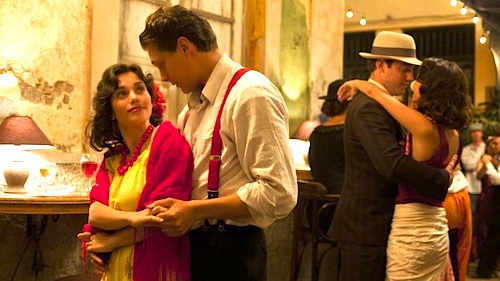
Given its title and genre, HK film fans might assume Love on the Cloud is the next installment in Pang Ho-cheung’s Love in a Puff-Love in the Buff series, but Cherie Yu and Jimmy Cheung will not be breaking up and getting back together again, at least not right now. Cloud is actually Beijing-set and Mainland produced, featuring a star turn from Angelababy. About a billion people already knew the model-turned-actress was a star, but with Cloud she successfully transitions from perky teen roles (Love in Space, All’s Well Ends Well 2010 and 2011) to a legit romantic lead. She smokes up the screen and leaves poor Michael Chen and his hapless Sha Guo looking small and deflated on-screen.

From "Love on the Cloud."

Still, when he is satirizing the Chinese film business with the other two Dreamers, Chen is a good sport, keeping the material remarkably grounded, all things considered, by minimizing the shtick and the mugging. In fact, the entire cast earns props because Gu throws the kitchen sink at them, but never wastes much time on dry, boring transitions. Frankly, it is hard to believe how much of the film works. Even the horror movie segments, necessitated by another batch of rewrites for Ms. Ma, are actually sort of creepy and very true to genre conventions.

Angelababy is radiant throughout Cloud and Chen keeps plugging away, but good old Mo Chou just sort of steals the picture rather effortlessly. The camera loves the Shar Pei, but he never resorts to cheap tricks to look cute. So yes, give the dog credit for subtlety of his performance (would it be going too far to compare him favorably with Meryl Streep’s excessive theatrics in Ossage County? It’d be true.) Regardless, there are enough laughs mixed with Angelababy’s glamour and Mo Chou’s furry charm to keep Cloud chugging along at a good clip. Recommended for those who like a good doggie rom-com with a little bit of an edge, Love on the Cloud is now playing in New York at the AMC Empire.

LFM GRADE: B

Posted on December 30th, 2014 at 5:17pm.

LFM Reviews The Gambler

By Joe Bendel. They say gambling is a victimless crime, but not in Jim Bennett’s case. Anyone too closely linked to the degenerate literature professor could find themselves in a world of collateral hurt. The same goes without saying for Bennett, but that seems to be part of his wildly self-destructive plans. Several very large debts will inevitably come due in Rupert Wyatt’s Christmas Day release, The Gambler, a loose remake of the moody 1970s James Caan vehicle considered to be partially inspired by the Dostoyevsky novel of the same name.

Bennett’s beloved grandfather has just passed away, leaving him nothing, because he is a total mess. He shouldn’t need an inheritance, as a gainfully employed academic with one reasonably well received novel under his belt. Unfortunately, Bennett can rack up debt quicker than a president with no private sector experience. We will see him do it during the first of many trips to an underground casino.

Bennett has amassed $240,000 in gambling debts to the Korean mob, led by the severe Mr. Lee. You really do not want to owe him money. To keep playing and keep losing, Bennett borrows fifty K from loanshark Neville Baraka. You really, really do not want to owe him money. He is up briefly, but eventually he blows through that as well. After being rebuffed by his wealthy mother, Bennett explores the possibility of yet another loan from Russian mobster “Frank,” who is a real character. You really, really, really do not want to owe him money. In fact, Frank is so hardcore, he even gives Bennett pause. Nevertheless, it is only a matter of time before they do business together.

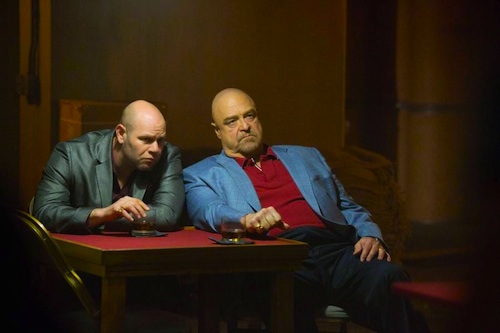
Wyatt’s Gambler is way better than you would expect, but it is almost entirely due to the villains. John Goodman’s Frank gets a good number of laughs throughout the film, but he is still scary as all get-out. Given his record of memorable supporting turns in award-contending films (Argo, The Artist, Inside Llewyn Davis), Goodman arguably deserves an honorary Oscar by now. As usual, he makes the film. Likewise, Michael Kenneth Williams regularly upstages his more famous co-star as the flamboyantly ruthless Baraka, while Alvin Ing also makes quite an impression as the icily intense Mr. Lee. Even Anthony Kelley earns some notice as Lamar Allen, Bennett’s star basketball player student, who may or may not shave some points for his prof.

From "The Gambler."

To an extent, Mark Wahlberg convincingly falls apart as Bennett. However, he conspicuously overplays screenwriter William Monahan’s vastly overwritten, bombastic, self-loathing classroom lectures. You’d think he was trying to be Meryl Streep in Osage County, but at least he is not half as embarrassing. On the other hand, the role of Amy Phillips, Bennett’s student-slash-potential love interest-slash-witness to his implosion is not exactly what you would might similarly describe as overwritten. Frankly, Brie Larsen, last year’s indie sensation in Short Term 12, looks like she regrets every minute playing her.

Regardless, Wyatt keeps the pace brisk and cinematographer Greig Fraser gives it all a hazy City of Angels noir sheen. It is often quite visually dynamic and whenever he needs help, Wyatt can count on Goodman for an injection of adrenaline through the film’s breastplate. Recommended for those who enjoy distinctive heavies, The Gambler opened nationwide on Christmas day, including at the Regal Union Square in New York.

LFM GRADE: B

Posted on December 29th, 2014 at 2:38pm.

LFM Reviews Tim Burton’s Big Eyes

By Joe Bendel. Depending on who you ask, Margaret Keane’s big-eyed children paintings are either a precursor to George Rodrigue’s gallery-accepted Blue Dog paintings or a spiritual forerunner of Thomas Kinkade’s kitsch. Either way, the key point for her new bio-film treatment is that they really were her paintings and not the work of her credit-stealing husband. It is a strange story, but it is told in a disappointingly conventional manner in Tim Burton’s Big Eyes, which opened this Christmas in New York.

Margaret Ulbrich packed up her daughter and walked out on her first husband at a time when such drama was scandalous. She relocated to San Francisco to pursue her dream of making it as an artist, but the only eye her work catches is that of Walter Keane. He too fancies himself an artist, but the real estate broker only has a talent for salesmanship. Convinced she needs taking care of, Ulbrich soon marries the brash Keane, believing their mutual interest in art will be a good thing.

One fateful night at Enrico Banducci’s hungry i club, Keane manages to sell one of his wife’s big eye paintings, but he kind of, sort of allows the purchaser to believe he is the artist. One thing leads to another and soon Walter Keane is a media sensation. Although she is troubled by the arrangement, Ms. Keane keeps churning out big eyes to feed her husband’s growing pop culture empire. However, despite his secret fraud, Walter Keane is bizarrely vexed by the proper art world’s snobbish appraisal of his (meaning her) work, leading to some odd confrontations with the profoundly unimpressed art critic John Canaday, who really ought to be considered the hero of this picture.

Of course, MDH Keane (as she starts to sign paintings) will eventually have enough of her husband’s manipulations and deceit. Running off to Hawaii, Keane re-starts her life after joining the Jehovah’s Witnesses. When she is finally ready, she will assert her claim to the Big Eyes body of work, precipitating a court battle for rights to the Keane brand.

There are many aspects of Big Eyes that will make people want to like it. After all, how often do films feature Cal Tjader jamming in Banducci’s club or portray Jehovah’s Witnesses in a favorable, empowering light? Unfortunately, Burton’s uninspired made-for-cable vibe and Christoph Waltz’s overly manic performance always feel at odds with each other. The climatic courtroom scenes are particularly problematic, coming across as excessively jokey, without ever delivering a good punch line.

From "Big Eyes."

At least Waltz is trying. As Margaret Keane, Amy Adams and her woe-is-me victim routine simply fade into the background. Their teenaged daughter also periodically wanders in and out of the film, but good luck remembering anything she says or does. Still, Burton and a fine supporting cast make the pre-hippy San Francisco scene come alive on-screen. Jon Polito flat out steals the film as the charismatic Banducci, while Terence Stamp’s Canaday is a tart-tongued joy. Danny Huston also adds some desperately needed acerbic flair as journalist Dick Nolan, who narrates the film as if it were a newspaper column.

Given Burton’s name in the credits, viewers will be waiting for Big Eyes to get good and crazy. Unfortunately, Scott Alexander & Larry Karaszewski’s screenplay is the cinematic equivalent of a Reader’s Digest condensed book. You can pick up the general outline, but the distinctive idiosyncrasies are largely glossed over. The results are disappointing, especially for Burton fans. Mostly just okay, Big Eyes probably only satisfied Keane collectors when it opened nationwide on Christmas, including at the Angelika Film Center in New York.

LFM GRADE: C

Posted on December 29th, 2014 at 2:38pm.

LFM Reviews Leviathan

By Joe Bendel. It is worth noting that Andrey Zvyagintsev originally hails from Siberia, the traditional banishing ground of Russian dissidents. Perhaps then it is not surprising that dissent is in his DNA. Up to now, his films have shown an affinity for the marginalized and the compromised in Russian society. However, his latest, Cannes award winning film boldly critiques the two greatest power centers in modern Russia, Putin’s government and the Orthodox Church. Rather shockingly, Russia selected Zvyagintsev’s Leviathan as their official foreign language Oscar submission (one can imagine several film authority bureaucrats were transferred to Siberian radio for that one), but it stands a fair chance of being nominated, having just made the shortlist cut. Already a recognizable contemporary classic, Leviathan opens Christmas Day at Film Forum.

Kolya is not a sophisticated man, but he knows injustice for what it is. He lives next to his hardscrabble automotive garage with his somewhat younger second wife Lilya and Roma, his son from his first marriage. His house and surrounding land are all he owns, but the town’s corpulently corrupt Mayor Vadim Shelevyat covets it for his dodgy development scheme. Naturally, he is not inclined to pay Kolya a fair price, preferring instead to use the Russian equivalent of imminent domain.

Shelevyat expects that will be that, as it usually is when the machinery of the state is unleashed, but Kolya is made of unusually stern stuff. His old army buddy Dmitri also happens to be a hotshot attorney from Moscow, who owes Kolya a favor. Dmitri fully understands the law in such cases, but Shelevyat and his underlings refuse to acknowledge it. The advocate also has a dossier of embarrassing dirt on the Mayor, but getting into a hardball contest with Shelevyat is a dangerous proposition. As the provincial dictator turns up the heat, with the implied support of the local Orthodox bishop, tensions within Kolya’s family and Dmitri’s mixed motives threaten to fatally undermine the embattled mechanic.

There is no mistaking Leviathan’s political implications, especially when Putin’s ominous portrait stares down from Shelevyat’s wall as plans each successive abuse of power. However, the extent to which he calls out the Orthodox Church for abetting the current regime is jaw-droppingly gutsy (should you doubt it, simply review the fate of the Pussy Riot band-members after protesting the Church’s support for Putin). Yet, it would be wrong to mislabel Zvyagintsev as anti-Church, because there is at least one pious Orthodox clergyman in Leviathan, who appears uncomfortable with his leadership.

Zvyagintsev briefly unleashes Russia’s anarchic sensibilities when Kolya’s off-duty highway patrol officer buddies take him target-shooting using the portraits of the old Soviet masters. Not so coincidentally, they might be the healthiest characters in the film, but despite their unruliness, they are largely disenfranchised cogs in a state apparatus dominated by the likes of Shelevyat.

From "Leviathan."

Clearly, Leviathan offers a withering assessment of the current state of Russian affairs, but Zvyagintsev’s critiques are fully integrated into the wider narrative whole. In fact, the former serve the latter, rather than vice versa. As a result, Leviathan has the form of a parable, the soul of a Russian tragedy, and the moral outrage of a J’accuse. Critically, it is also remarkably forceful when judged on purely cinematic terms. As Kolya, Aleksey Serebryakov is no mere symbolic everyman. His pain and rage hit the audience on a level that is honest and true. Likewise, Vladimir Vdovichenkov plays Dmitri and all his human failings with mature subtlety. Yet perhaps appropriately, Roman Madianov largely defines and personifies Leviathan as the buffoonish but ruthless Shelevyat.

Without question, Leviathan is an important cinematic statement that will reverberate beyond the short term awards season. It is like hydrogen peroxide in film form. It stings and it disinfects. Stylistically, it is somewhat uncompromising, but it still demands a wide audience. Highly recommended, it opens Thursday the 25th (ho, ho, ho, Merry Christmas) at Film Forum in New York. Patrons in other cities should waste no time seeing it when it opens, in case the national exhibitors start pulling it for fear it will offend an oppressive foreign regime, since that’s what they apparently do these days, especially when they are released by a division of Sony.

LFM GRADE: A

Posted on December 23rd, 2014 at 11:46am.

LFM Reviews See You in Montevideo

By Joe Bendel. Uruguay hosted the first FIFA World Cup in 1930. It was a full sixty-five years before Sepp Blatter joined the international sports organization, but the fix was still in, nonetheless. The Yugoslavian National Team will bear the brunt of the tournament’s dubious officiating, but they will make history just the same in Dragan Bjelogrlić’s See You in Montevideo, which Serbia selected as their official foreign language submission for the upcoming Academy Awards.

It was not easy getting to Uruguay. It took an entire film (Bjelogrlić’s Montevideo: Taste of a Dream, submitted in 2011) for poor earnest Aleksandar “Tirke” Tirnanić and roguish Blagoje “Moša” Marjanović to unite their team and win the honor of representing Yugoslavia at the World Cup. The transatlantic passage was no picnic either, entailing much seasickness. Even when they arrive, the Yugoslavian team still can’t get any respect. Expected to go one-and-out, they are booked in a divey hotel, while the rest of the field will stay at palatial resort. Nobody gives them a puncher’s chance when they draw Brazil in the first round, but since they face-off halfway through the film, it might be safe to assume they have an upset in them. However, impartial officiating goes out the window when Yugoslavia is matched up with the host nation in the semis.

The National Team’s 1930 run is still the best international showing for both Yugoslavian and Serbian football-soccer to date and it is a pretty good sports story. However, two films both clocking in with a running length of about two and a half hours hardly seems economical. Frankly, each could have easily come in under ninety minutes, but they love the all Serbian 1930 Yugoslavian team in Serbia, so Bjelogrlić takes his time.

This time around, Bjelogrlić and his co-writers Ranko Božić and Dimitrije Vojnov prospect for more laughs and pile on the subplots. Sometimes they do not make much sense, like that featuring the game Armand Assante as Hotchkins, an American looking to sign players for some sort of American soccer tour, which would have gone over like a lead balloon in depression-era America. However, Tirnanić’s romance with Dolores, a Uruguayan beauty, is rather sweet and appealing, even if her lunatic brother’s subplot to the subplot is way too over-the-top.

Regardless, Petar Strugar convincingly transitions Marjanović from dashing cad to world-weary sportsman. Assante chews scenery like he hasn’t eaten since American Gangster. It is a head-shakingly odd performance, but strangely enjoyable. Elena Martínez generates plenty of heat as Dolores and forges some respectable screen chemistry with Miloš Biković’s otherwise plodding Tirnanić. However, Branko Đurić is defiantly shticky and manipulative as Paco, a Croatian expat who befriends Mali Stanjoe, the team’s young Dickensian mascot.

Perhaps the most striking aspect of the second Montevideo installment is the nostalgia for Yugoslavian identity. While the previous film often expressed pride in the team’s Serbianess, the players explicitly demand respect for Yugoslavia this time around. Despite the weirdness of Assante’s Hotchkins, the film also portrays the American team in a consistently favorable light, suggesting they were good sports, much like Jackson Scholtz in Chariots of Fire. In fact, the conclusion serves as a cool example of sportsmanship and old fashioned love of the game.

From "See You in Montevideo."

Evidently, there is even more to the team’s story that was chronicled in a companion television series. One of the smaller sports networks ought to pick-up the entire Montevideo franchise, because the sport is growing in popularity here, but 1930 still represents America’s peak World Cup performance, so far (just as it does for Yugoslavia and Serbia). It certainly deserves a wider international audience than the FIFA-bankrolled United Passions. Easily one of the most accessible films of this year’s foreign language submissions, See You in Montevideo did not make the Academy shortlist, but at least it had a buzzy special screening in Los Angeles last Monday, hosted by Deadline’s AwardsLine. Recommended for sports fans who do not mind a little sentimentality, it will screen again soon at the 2015 Palm Springs International Film Festival.

LFM GRADE: B-

Posted on December 23rd, 2014 at 11:46am.