LFM Reviews Sagrada: the Mystery of Creation

By Joe Bendel. It could very well have been St. Joseph himself who miraculously constructed the Loretto Chapel’s circular staircase in Santa Fe, but strictly speaking, he was a carpenter. That leaves Antoni Gaudí in pretty exclusive company as a beautified architect. One hundred thirty years after it first broke ground, his life defining project continues to be erected in Barcelona. Stefan Haupt follows the progress and meditates on the significance of the already imposing cathedral in Sagrada: the Mystery of Creation, which opens this Friday in New York.

Originally commissioned in 1882, the Order of St. Joseph hired Gaudí to take control of the unwieldy project a year later. Known for his devout Catholicism and wholly distinctive style, Gaudí was an inspired but slightly risky choice. Throughout his final years, he lived and breathed the Sagrada Familia, even though he knew he would never live to see its completion. He hoped to see the Nativity façade finished, but tragically succumbed to injuries sustained from a tram accident. For a while, his assistant Domènech Sugranyes carried on in his stead, until the macro events of the Twentieth Century temporarily halted the project.

Haupt does a nice job chronicling the various phases of construction, but his cast of talking head experts are suspiciously concise when discussing the effects of the Spanish Civil War. Evidently, when the Loyalists were burning churches, they also destroyed all of Gaudí’s plans and scale models that they could find, leaving the Sugranyes and his fellow architects in absolute disarray, but they were good leftists, so let’s not discuss it.

Still, Haupt and the current architectural team clearly understand the Ken Follett-like sweep of the project. For many, it represents not just faith in God and his church, but a faith that succeeding generations would finish the work they started. Obviously, the final Sagrada Familia will be necessarily different from what Gaudí originally conceived, which is a burden and an opportunity for several contemporary artists working on its decorative elements. Easily the most eloquent is Japanese sculptor Etsuro Sotoo, who converted to Catholicism while working on the Sagrada Familia. In fact, there are a number of Japanese connections to the cathedral, such as Hiroshi Teshigahara, who previously documented an earlier period of construction in his film Antonio Gaudí (also opening this Friday).

From "Sagrada: the Mystery of Creation."

At times, Haupt asks (or implies) some spot on questions, like what do contemporary Christians build if we no longer erect cathedrals? Of course, his trump card is the Sagrada Familia itself. It is a stunning sight, perhaps even more so when juxtaposed against the modern secular cranes supporting its raise into the heavens. It would be hard to make it look prosaic, but Haupt and cinematographer Patrick Lindenmaier find particularly cinematic angles for some truly dramatic visual compositions.

On the other hand, Haupt forces an artificially surreal note into the film when he stages brief scenes of dancer Anna Huber posing amid the half-constructed interiors. Regardless, it still serves as a thoughtful overview, primer, and guided tour of what has already become Barcelona’s most popular tourist attraction. Sometimes religion and architecture can actually draw a crowd. Recommended for Gaudí admirers, Sagrada: the Mystery of Creation opens this Friday (12/19) in New York, at the Elinor Bunin Munroe Film Center.

LFM GRADE: B

December 14th, 2014 at 10:31pm.
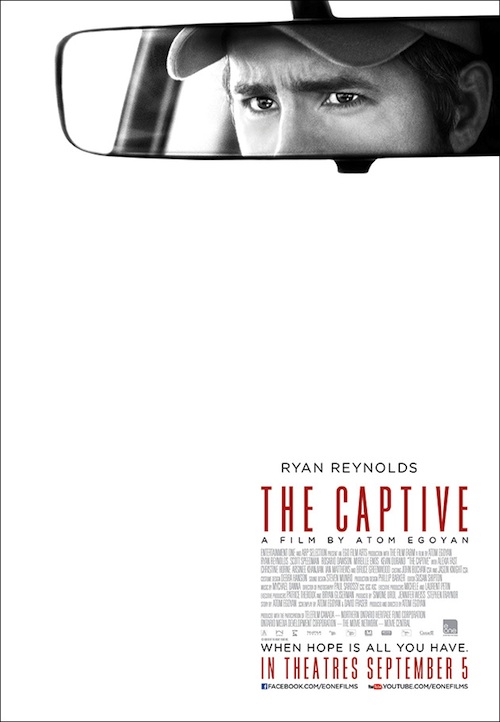
LFM Reviews The Captive

By Joe Bendel. Its population is less than ninety thousand, but evidently organized pedophilia is a growing danger in Niagara Falls, Ontario. They now have a sizable police task force working full time on such crimes. The leader even becomes an Oprah style celebrity. However, they have not produced sterling results. After eight years, Matthew Lane’s daughter Cass is still missing. Past his breaking point, the desperate father is more than willing to take the law into his own hands, if he can finally find a target in Atom Egoyan’s The Captive, which opens tomorrow in New York.

It has been a hard eight years for Lane and his wife, Tina. She still blames him for their daughter’s abduction and so does he. He only briefly popped out to pick up a pie while she rested in the back seat of his truck after ice skating practice. Tragically, it was long enough for the pederast ringleader stalking them. As the years advanced and their marriage imploded, Tina started seeing Det. Nicole Dunlop for counseling, but her partner (and lover) Det. Jeff Cornwall still suspects Lane sold his daughter to a pedophile ring, because he reminds him of a guy he used to know. Seriously, that’s the best he can do after eight years?

Of course, Lane’s investigative techniques basically amount to him driving around looking for something suspicious, but he is still more effective than the cops, who will make a series of spectacular blunders. Eventually, Det. Dunlop will wind up in peril herself, following a head-scratchingly unlikely chain of events.

Frankly, it is a real shame Captive morphs into such a klutzy thriller, because Ryan Reynolds’ lead performance could have been a career game-changer in a tighter, more grounded film. He really digs in and digs deep as Lane. You feel his pain and his rage, without any cheap theatrics. He also makes the thriller mechanics work better than they deserve to, particularly an oblique confrontation with his daughter’s abductor late in the game.

Conversely, Kevin Durand is an excellent actor, but his performance as Mika, the pervert ringleader is beyond caricature. Everything about him, from his affected voice to his sinister sliver of a moustache screams “Chester Molester.” Yet, he still hob nobs with Niagara Falls’ elite without anyone getting suspicious. Rosario Dawson is reasonably competent as Det. Dunlop. She may not look like she is from Niagara Falls, Ont., but diversity in Canadian cinema is a good thing. As if on cue, Scott Speedman also turns up, underwhelming us as Cornwall, arguably the worst cop ever who wasn’t on the take, just to remind everyone this is a Canadian film.

There was a time during the mid-1990s and early 2000s people who did not normally patronize festivals and art cinemas still went to Egoyan’s films because they were so widely acclaimed and zeitgeisty. What a difference three or four films make. Many of his regular themes are still present and accounted for, but the narrative twists are rather clunky and therefore dashed difficult to buy into. Reynolds’ work is legitimately award caliber, but it really needs Ice-T and Richard Belzer. If you have DirecTV, it is almost worth watching just to see how Paul Sarossy’s uncompromisingly icy cinematography conflicts with the otherwise lurid vibe, but it is hard to recommended The Captive when it opens today (12/12) in New York, at the Village East.

LFM GRADE: C-

Posted on December 12, 2014 at 8:34pm.

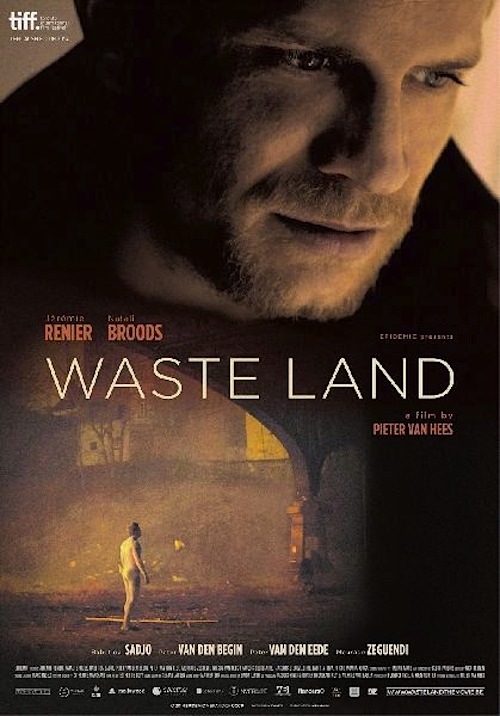
LFM Reviews Waste Land @ The AFI’s 2014 EU Film Showcase

By Joe Bendel. Géant is the Col. Kurtz of Belgian art dealers. He has definitely embraced the heart of darkness in the Congo. He even has his personal “witch doctor.” It is not clear that he really believes, if the cop pursuing him believes he believes, or even whether the cop starts to believe himself. Regardless, Det. Leo Woeste is in for a rough final investigation in Pieter Van Hees’s Waste Land, which screens during the AFI’s 2014 EU Film Showcase.

Woeste is your basic cop on the edge. He tries to be a good husband and a responsible father to the step-son he has helped raise since infancy, but he has seen some terrible things. The fact that his new partner, Johnny Rimbaud, is a coke-fueled hedonist hardly stabilizes his erratic mood swings. When his wife Kathleen announces her pregnancy, but doubts the wisdom of keeping the baby, Woeste promises to retire from the force and start acting normal. Unfortunately, he has one last case to solve.

When an African immigrant is murdered and dumped in a garbage bag, the initial clues point towards Géant. Woeste tries to be extra-supportive to the slain man’s grieving sister, Aysha Tshimanga, perhaps because his fatherly instincts have been stimulated. However, their relationship soon takes on weird sexual overtones. She will accompany him to various underground boxing matches and hipster night clubs, where the throbbing hot house atmosphere will keep his head spinning.

Waste Land flirts with a lot of genres, but it never fully commits to any. It also injects some clumsy commentary on imperialism, particularly a running non-joke supposedly claiming Woeste is descended from Leopold II. Nevertheless, much of the second act investigation is rather compelling procedural stuff. Unfortunately, the climax is so self-consciously feverish, it undermines the gritty mystery and ambiguous genre elements that proceeded it.

Still, there is no denying Dardenne Brothers regular Jérémie Renier puts on a clinic as Woeste. This is fierce, no-holds-barred, rub-your-nose-in-the-self-destruction work, but it is never self-indulgent. In fact, he balances the inward burn with the outward rage quite adroitly. Babetida Sadjo also finds a spark in Tshimanga that elevates her beyond a mere victim, while Peter Van den Begin gorges on scenery as the roguish Rimbaud.

Despite its narrative frustrations, Waste Land is a massively stylish film. Cinematographer Menno Mans makes Brussels look like a real life Sin City, where most of the buildings are either abandoned warehouses or underground dance clubs. The opening sequence is especially evocative, in a disconcerting way. Nicely played and skillfully put together, Waste Land just lurches out of control down the stretch. Recommended for those who will admire its ambition, Waste Land screens this coming Tuesday (12/16) and Wednesday (12/17), as part of the AFI’s EU Film Showcase, outside of Washington, DC.

LFM GRADE: B-

Posted on December 12th, 2014 at 8:59pm.

LFM Reviews The American Revolution

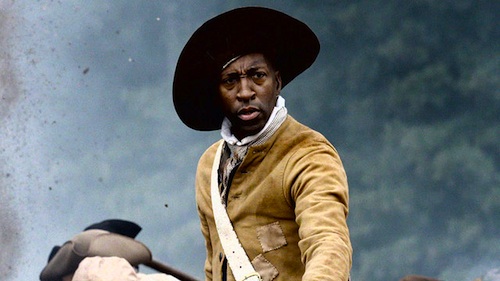
From "The American Revolution."

By Joe Bendel. Losing one’s place in history is another unfortunate drawback to falling on the battlefield. Had he survived Bunker Hill, Dr. Joseph Warren probably would be remembered as a Founding Father on par with Washington, Jefferson, and Franklin. Instead, he sacrificed everything for liberty. Warren and scores of other overlooked patriots get their due in American Heroes Channel’s three-part The American Revolution, which premieres this Monday night, beginning with Rise of the Patriots.

It was Warren who dispatched Paul Revere on his famous midnight ride. He was a founding commander of the Minutemen, the organizer of an early patriot spy ring within Redcoat occupied Boston, and a leading orator for the cause. Yet, despite Warren’s prominence, Revere would become the iconic Minuteman. Through PBS-style dramatizations and several historians’ expert commentary, AHC’s American Revolution gives viewers a sense of how indispensable the good doctor was to the Patriot campaign in its earliest days.

Each installment will have a defining figure like Warren, but other notably overlooked Revolutionary War heroes will be peppered-in throughout the series. Rise also duly salutes freed slave Salem Poor, whose courage at Bunker Hill seems tailored made for a dramatic treatment, as well as the irascible French and Indian War veteran Samuel Whittemore, who holds the distinction of being the oldest Revolutionary War veteran and apparently the hardest to kill.

From "The American Revolution."

The whole approach of the series is quite appealing. Clearly, there is a working assumption that freedom and love of country are worth fighting for. By focusing on the worthy but marginalized supporting players, it finds an angle to make familiar history feel fresh. No cherry trees or kite flying this time around. As an additional bonus, the talking heads are more engaging and in many cases more interesting to look at than is often the case in historical programming.

Frankly, the holiday season is a rather apt time to broadcast Revolutionary War programming, with the 238th anniversary of Washington’s Christmas Crossing of the Delaware fast approaching. Appropriately, heroes of Valley Forge and the Battle of Trenton will dominate the second episode, The Empire Fights Back, premiering immediately following Rise. AHC’s Revolution then concludes this Tuesday with Return of the Rebels. Based on the entertaining and indeed educational Rise, the entire American Revolution should definitely be well worth watching when it premieres this Monday (12/15) on Discovery Communication’s American Heroes Channel.

Posted on December 12th, 2014 at 8:31pm.

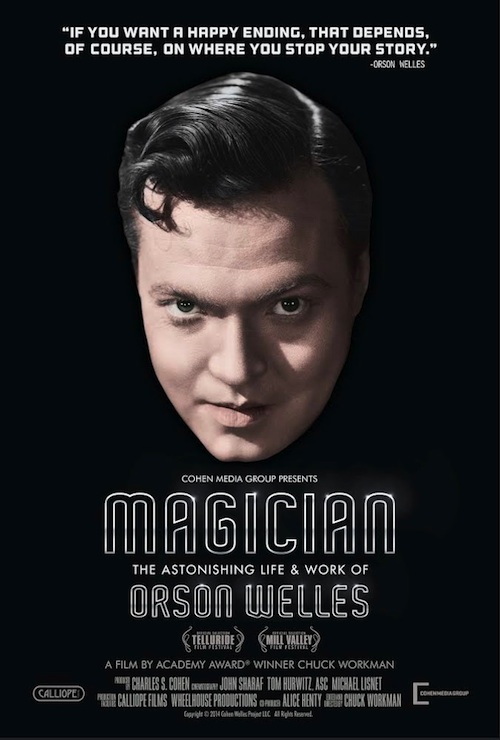
LFM Reviews Magician: the Astonishing Life & Work of Orson Welles

By Joe Bendel. Just imagine what might have been if Orson Welles had worked in the digital era. Probably no other filmmakers left behind so many unfinished yet potentially great films. As his latest video-biographer Chuck Workman documents, Welles had no shortage of work ethic. It was simply a lack of everything else, particularly money. You may have heard this story before, but Workman illustrates the great auteur’s rise and fall with a wealth of striking visuals and many rarely seen archival interviews. Welles gets the full Workman treatment in Magician: the Astonishing Life & Work of Orson Welles, which opens this Wednesday in New York.

Welles was a precocious but never small child. Evidently, in the Welles family, children had to be interesting performers, or they were banished to the nursery to be boring in private. Obviously, Master Orson was not about to be shunted away. In a departure from many DVD-behind-the-scenes-extras, Workman patiently invests a bit of time up-front on Welles’ formative years in Woodstock, Illinois, where he honed his craft at the Todd School and the local Woodstock Theatre, whose main stage has since been renamed in Welles’ honor. Workman takes the audience there and it does indeed look like fitting launching pad for Comet Welles—an intimate yet classy space that could fire a young genius’s imagination.

By the time Welles hit the New York theater world, he was practically a fully formed master. Workman breezes through his early Broadway triumphs and radio superstardom, essentially using the feature films to island-hop his way through Welles career. At this point, the film starts to feel very familiar to anyone with a casual knowledge of Welles’ life and career. Yes, Citizen Kane is a masterpiece and The Magnificent Ambersons sort of is too, but according to Welles RKO cut out the most important parts. However, Workman includes some fascinating interview excerpts with the late Oscar winning Robert Wise, justifying the cuts he made at the studio’s behest.

Magician also incorporates tantalizing glimpses of films Welles started but never completed, such as The Deep, Don Quixote, and the technically finished but now mostly lost Merchant of Venice. Frankly, this is some of the best material Workman collects, hinting at what might have been. It nicely compliments Workman’s full visual portrait of the artist, which also directly addresses his larger than life celebrity status, as seen through clips of Welles guest appearances on I Love Lucy, The Muppet Show, and various chat shows and commercials.

There are not a lot of surprises in Magician. Frankly, you really have to stretch to find any new material at all in the film. Still, Workman and company make a convincing defense of Welles’ unfinished oeuvre, arguing he was committed enough to start production, whereas most would-be filmmakers accept defeat in the development or pre-production stages.

Magician certainly makes you want to watch all of Welles’ films again, including the ones that we can’t, which means it probably accomplishes its goals, but it never feels as fresh as Visionaries, Workman’s relatively recent (stylistically traditional) survey of avant-garde filmmaking. Recommended for Welles diehards looking for something to tide them over until the long rumored release of The Other Side of the Wind (promised for the auteur’s centennial this coming May), Magician opens Wednesday (12/10) in New York, at the Lincoln Plaza Cinema.

LFM GRADE: B-

Posted on December 9th, 2014 at 8:24pm.

LFM Reviews Marco Polo on Netflix

By Joe Bendel. He wrote the equivalent of a bestselling memoir, before the invention of Gutenberg’s printing press. Dozens of hand-written manuscripts of The Travels of Marco Polo have widely circulated, making it rather difficult to determine the canonical truth of the celebrated merchant’s life. That might be frustrating for scholarly biographers and historians, but it rather takes the pressure off filmmakers dramatizing his life. Before securing his fame and fortune, the young Venetian (or “The Latin” as he will often be called) finds an unusual place in the Court of Kublai Khan, becoming enmeshed within a geo-political struggle between two ancient dynastic powers in Marco Polo, an original ten episode historical series premiering on Netflix this Friday.

Polo never knew his father Niccolò Polo, until the Venetian trader made a brief homecoming, before setting off for Asia once again. Desiring a paternal relationship, the younger Polo invited himself along, but it is soon apparent he is quite well-attuned to the rhythms and mysteries of the Eastern world, perhaps even more than his father and uncle. In fact, the great Kublai Khan accepts Marco Polo into his service, when Niccolò Polo offers to barter him in exchange for trading rights along the Silk Road. Of course, the son is quite put out by this, but his father promises to return, which he will, but maybe not in the manner he imagined.

Valuing Polo’s shrewd observations unclouded by courtly biases, Kublai Khan often dispatches the Latin to report on flashpoints within his empire. Not surprisingly, Polo’s favor rather displeases the Khan’s Chinese-educated son, Prince Jingim. Frankly, Polo is not exactly close to anyone in court, least of all the Khan’s trusted ministers. However, he will develop something approaching friendship with Byamba, the Khan’s illegitimate son with one of his many concubines. Polo also becomes ambiguously involved with Kokachin, the Blue Princess, the last surviving noble of a conquered people, and Khutulun, the Khan’s independent-minded warrior niece.

Regardless of historical accuracy, writer-creator John Fusco spends enough time in the Khan’s harem to make the broadcast networks curse the FCC. As Mel Brooks would say, it’s good to be the Khan. Yet, despite the nudity and hedonism, some of MP’s strongest action figures are women. As Khutulun, Korean actress Claudia Soo-hyun Kim credibly wrestles men twice her size and projects a smart, slightly subversive sensibility. Olivia Cheng also displays first class martial arts chops (sometimes naked) as Mei Lin, a Song concubine who infiltrates the Khan harem on the orders of her war-mongering brother, the villainous Imperial Regent Jia Sidao. Zhu Zhu’s Kokachin might be more demur, but she is still quite compelling, balancing her vulnerability with resoluteness. Of course, international superstar Joan Chen frequently upstages everyone as the iron-willed Empress Chabi.

From "Marco Polo."

Italian actor Lorenzo Richelmy holds his own as best he can amid the exotic locales and pitched battles, maintaining the necessary fish-out-of-water earnestness. However, he is no match for the British Benedict Wong (son of naturalized Hong Kong parents), who absolutely dominates the series as Kublai Khan. Although he put on considerable weight for the role, it is his commanding presence that really seems huge. Likewise, Tom Wu is terrific delivering the goods for genre fans as Hundred Eyes, Polo’s blind tutor in the martial arts.

In the initial episodes, MP offers more intrigue and Game of Thrones style decadence than actual fist-and-sword action, but the martial arts melees increase as the series progresses, with the threat (or promise) of an epic war hanging over everyone’s heads. There is a lot of setting-the-scene in episode one, but it quickly sets the addictive hook in the second installment and reels in viewers from there. Kon-Tiki directors Espen Sandberg & Joachim Rønning give the pilot an appropriate sense of mystery and sweep, which carries forth throughout the show. Based on the six episodes provided to the media, MP definitely seems to maintain its passion-fueled energy and richly detailed period production values. Highly recommended (so far), Marco Polo launches for binge-streaming this Friday (12/12) on Netflix.

LFM GRADE: A-

Posted on December 9th, 2014 at 8:23pm.