LFM Reviews Isis Rising: Curse of the Lady Mummy

By Joe Bendel. Remember the good old days, when Isis was merely a vengeful Egyptian demigod determined to wreak havoc upon the earth? Well, she’s back and more scantily clad than ever. A group of randy college students will feel her wrath in Lisa Palenica’s Isis Rising: Curse of the Lady Mummy, now available on DVD from TomCat Films.

Centuries ago, Osiris and his wife-sister Isis were murdered by their power-mad brother Set. The thing is, you can never kill a black arts practitioner like Isis dead enough. All she needs is a half dozen college kids who frankly look too old to be undergraduates trying to get stoned off some resurrection incense and she’s back in business. As luck would have it, Professor Shields’ star pupil Amy and five of her dumbest classmates have volunteered for an all-night research session in the local natural history museum.

Evidently, some strange collector has donated a trove of hitherto unseen antiquities to the museum, including said incense, as well as Isis’s Book of the Undead and her mummified corpse. It is so spectacular, internationally renowned Egyptologist Dr. Nasir has joined the party, hoping to uncover evidence to support his theories (which basically boil down to if Isis were still here, she’d be really hacked off). So yes, you could probably say he’s in for a case of good news-bad news.

If you are wondering why Isis looks more appropriately dressed for the Luxor Hotel in Vegas than Luxor, Egypt, it might help to know she is played by adult entertainment star Priya Rai in her mainstream breakout debut. However, her established fanbase is likely to be disappointed with Rising, since it really only delivers the obvious cleavage and one carefully cropped sex scene featuring other cast members.

It is hard to fairly judge Rai’s performance because her screen time is relatively limited and what little dialogue she has is electronically distorted. Still, it is easy to see how she found success in her chosen field (feel free to insert your own joke about orbs here). Evidently, co-producer James Bartholet also works in “the business,” but you can’t really see why from his supporting turn as Henry the goofball security guard, which is probably a blessing.

As you would expect from a B-movie, the supporting ensemble varies widely in terms of professionalism. Without question, Jing Song and Seth Gandrud score the highest marks as Amy the A-student and Dr. Nasir respectively. You really have to give the latter credit for all the cheesy exposition he duly establishes with a straight face. As for the other classmates, including writer-director Palenica’s Felicia, they just can’t get killed soon enough.

From "Isis Rising: Curse of the Lady Mummy."

The special effects throughout Rising are uniformly bad—even by the production standards of mid 1980’s straight-to-video sci-fi-horror knock-offs. However, they found a small but legit natural history museum to shoot in, so the mummy-less contemporary scenes looks surprisingly good. In fact, it is sort of bizarrely entertaining to watch them madly dash about the dinosaur exhibits, like having a museum sleepover as a kid with half a dozen of your nuttiest friends.

There was probably room in the world for a low budget film about a curvaceous mummy overstocked with awkward conversations, so Palenica and company have filled it. If you keep your expectations low enough, like basement level low, it is sort of fun, or at least hard to actively dislike. Frankly, every cult film expert probably needs to see it, just so they can address the Rai connection. For her fans and diehard mummy enthusiasts, Isis Rising is now available on DVD from TomCat Films.

Posted on November 19th, 2014 at 3:34pm.
LFM Reviews The Mule

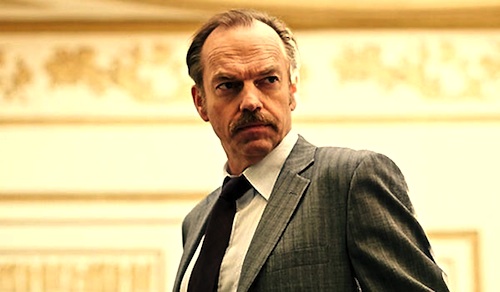
From "The Mule."

By Joe Bendel. Working in customs can be a dirty business. Rubber gloves just don’t come thick enough to make it alright. Of course, it is even worse to be a suspected smuggler on the receiving end. For obvious reasons, time is presumably on the law’s side, but one poor dupe will do his best to put his bodily functions on hold in Tony Mahony & Angus Sampson’s “based on a true story” crime drama The Mule, which releases in select markets and on VOD this Friday.

Unbeknownst to sad sack footballer Ray Jenkins, the vice-captain of his team and their dodgy patron have a regular heroin smuggling operation going. This year, Jenkins really ought to attend the annual season-ending trip to Thailand, since he has been awarded their player of the year honor. It would also be a fine opportunity for Jenkins to stuff his stomach with condoms filled with heroin. He would prefer to decline, but his parents’ gambling debts have him in a tight spot. He nearly gets away clean, but some last minute suspicious behavior gives him away to Australian customs.

Not quite as dumb as he looks, Jenkins will not agree to any x-rays or cop to anything. Under Aussie law, he will be held without charge for seven days or two number twos, at which point the evidence should speak for itself. However, Jenkins refuses to go, fortified by his strange willpower and a heavy dose of constipating codeine. It will get ugly, as Detectives Croft and Paris become increasingly impatient holed up in their airport hotel room with its jury-rigged porcelain throne, especially the hot-headed Croft.

If any film could scare a prospective drug mule straight, this would be it. Let’s just say it goes there and skip the graphic descriptions. Frankly, Sampson and co-writers Leigh Whannell (from the Saw franchise) and Jaime Browne largely turn poor Jenkins into a moaning ball of constipation wrangled over by the various cops, gangsters, and his legal aide attorney. However, he will somehow rouse himself for some clever third act twists.

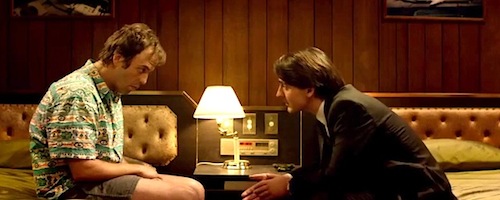
From "The Mule."

Hugo Weaving is a constant source of entertainment, snarling his way through the film as Croft. Co-writer-co-director Sampson is also appropriately nebbish, in a doughy way, as the unspeakably miserable Jenkins. While Georgina Haig’s public defender is not much of a presence, the film rather slyly implies she is far more interested in Jenkins as a potential cause than concerned with his physical well-being. Regardless, Whannell and John Noble hold up their ends as totally slimy villains.

Contrasting pitiful Jenkins’ cautionary tale with the wall-to-wall coverage of Australia’s America’s Cup Victory makes The Mule a rather idiosyncratic early 1980s period piece. Still, this is not Miami Vice. No doubt about it, the premise is a bit off-putting, to put it tactfully. However, the execution is quite strong, buoyed by its considerable attitude and gumption. Recommended for fans of dark, somewhat scatological thrillers, The Mule launches on iTunes and opens in limited release this Friday (11/21).

LFM GRADE: B+

Posted on November 19th, 2014 at 3:34pm.
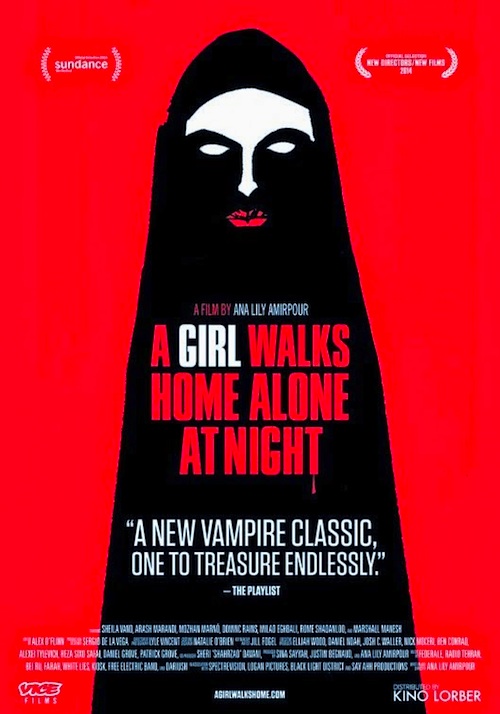
LFM Reviews A Girl Walks Home Alone at Night

By Joe Bendel. This vampire wears a chador rather than a cape. She is clearly not an Anne Rice kind of vampire, but you will still find plenty of vice in Bad City, where she stalks her victims. Ana Lily Amirpour finally delivers the Iranian existential rock & roll vampire western the world has been waiting for with A Girl Walks Home Alone at Night, which opens this Friday in New York.

The dialogue is Persian, but it was shot in a California boom-and-bust oil town that easily passes for a lawless provincial corner of Iran. Although not explicitly political, there is no way the regime would ever cotton to a depiction of Iranian society rife with prostitutes, pimps, pushers, and junkies (frankly, they are just no fun whatsoever). Of course, this seedy environment makes a perfect hunting ground for “the Girl,” who prowls through Bad City’s dark streets late at night on her skate board.

Like an old school E.C. Comics blood-sucker, the Girl generally bites those who have it coming, such as “the Pimp,” who has been hassling “the Persian James Dean” over his junkie father’s debts. Or at least he had been. Yet, the Girl somehow develops a friendship with “the Prostitute” despite their very different temperaments. However, it is her halting mutual attraction to the Persian James Dean that really challenges her choice of undead lifestyle.

AGWHAAN sounds absolutely crazy on paper and indeed in many ways it is, but it is an art film through-and-through rather than a cult midnight movie. Amirpour’s pacing is slow and deliberate, in a seductive kind of way. If audiences are not careful, Bad City will anesthetize them. Fortunately, the driving alt rock-rockabilly soundtrack supplies plenty of aural caffeine (this is a case where a soundtrack album could easily out-perform the source film).

Regardless, viewers should stick with AGWHAAN, because it is a truly unique cinematic experience, starting with Lyle Vincent’s gobsmackingly arresting black-and-white cinematography. Arguably, the film is stylistically most closely akin to the work of Bruce Weber (best known for directing Calvin Klein commercials and the Chet Baker doc Let’s Get Lost).

AGWHAAN is the sort of film that washes over you, yet it still heralds the arrival of a major star in Sheila Vand. As the Girl, she gives a quiet but deeply expressive performance. Somehow she is able to look exquisitely vulnerable and eerily sinister at the same time, which is quite a trick. Likewise, Mozhan Marnò defies all clichés with her sensitive work as the prostitute.

There is something wonderfully subversive about a delicate looking lady vampire wreaking havoc on Iran’s low life men. Who wouldn’t love to see her take the bite to the oppressive theocrats in a sequel? A rich feast for eyes and ears, it is completely unlike any other vampire movie you have previously seen. Highly recommended for fans of ambitious genre film and Persian cinema, A Girl Walks Home Alone at Night opens this Friday (11/21) in New York at the IFC Center.

LFM GRADE: A

Posted on November 17th, 2014 at 7:49pm.

LFM Reviews Flamenco, Flamenco

FLAMENCO trailer from Dada Films on Vimeo.

By Joe Bendel. Carlos Saura is sort of like the Busby Berkeley of flamenco and other traditional Iberian musical forms, except he stages musical numbers with Spartan elegance. There will be no talking whatsoever, just singing, dancing, and playing in his latest intimate musical performance film. Saura follows up his 1995 art house hit Flamenco with the aptly titled Flamenco, Flamenco, which opens this Friday in New York.

Saura will not even cheapen his visually gorgeous film with a lot of inter-titles identifying the many accomplished musicians making up his all-star flamenco ensembles. In a way, that is unfortunate for them, because their performances would make converts out of any non-fan who just happened to wander into Flamenco-squared. Indeed, the Flamenco choreography framed by Saura and revered cinematographer Vittorio Storaro is particularly cinematic, emphasizing the dancers’ long vertical lines and their whirling garments.

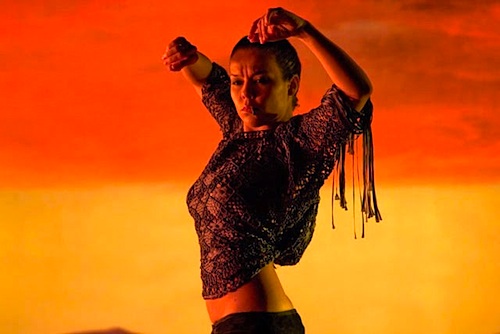
There is no question Saura is one of the best filmmakers in the world when it comes to capturing dance on film. He also has an intuitive sense of how to best use the inherent tension of flamenco percussion. Although flamenco costuming is traditionally rather modest, several of the younger singers and dancer convey quite a bit of passion through their performances. However, when María Bala steps forward for her solo, the audience is transported to the Andalusian caves.

From "Flamenco, Flamenco."

In terms of quality, Flamenco, Flamenco is remarkably consistent, but there are still notable standouts. Surprisingly, one of the best is a two piano duet for Dorantes and Diego Amador. They both have spectacular technique, but what really distinguishes “Cartagenera y Bulerías” is just the sheer contagious fun they are having playing together.

This time around, Saura’s approach will be somewhat controversial for purists, because he includes several younger, fusionistic performers, such as Rocío Molina. However, when she dances “Garrotín” with a cigarillo clenched in her lips, she looks like she could have been Bizet’s inspiration for Carmen. Yet perhaps the most striking choreography comes on the sacred-themed “Holy Week,” which also stretches our conceptions of flamenco in a different way.

Shot entirely within the Seville Pavilion for 1992 Expo, F-F has a real sense of flowing space, accentuated by Storaro’s swooping camera that often matches the dancers’ dramatic moves. At times, Saura uses gallery motifs for his backdrops, but he often just employs warm primary colors to set-off the performers. Aside from his previous films (such as Tango and Fados), the most logical comparative would be Trueba’s Calle 54, which is high praise indeed. A rich feast for eyes and ears alike, Flamenco, Flamenco is highly recommended for general audiences, whether they think they like flamenco or not, when it opens this Friday (11/21) in New York at the Lincoln Plaza Cinemas.

LFM GRADE: A-

Posted on November 17th, 2014 at 7:48pm.

LFM Reviews Monk with a Camera

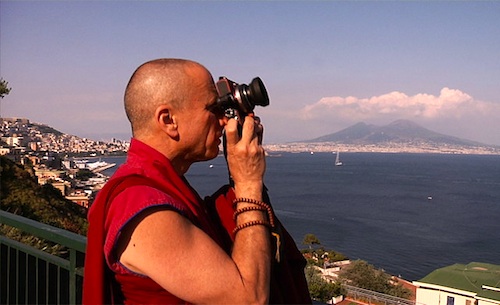
By Joe Bendel. Being the subject of documentaries runs in the Vreeland family. Celebrated Vogue editor Diana Vreeland’s career was chronicled in her own doc, Diana Vreeland: the Eye has to Travel and she logically played a part in films by Bruce Weber and about Bert Stern. Through her influence, her photographer grandson Nicholas apprenticed with Richard Avedon and Irving Penn, but instead of following in her footsteps, he charted his own course as a Tibetan Buddhist monk. Vreeland’s life and complicated relationship to the worldly discipline of photography are explored in Guido Santi & Tina Mascara’s Monk with a Camera, which opens this Friday in New York.

Typically, young men of Vreeland’s background either become playboys or elite public servants, like his ambassador father. He was well along his way to the former, considerably aided by his precocious talent for photography. Meeting models was never a problem for him, but a chance introduction to Khyongla Rato Rinpoche changed his life.  Through the spiritual instruction of his lifelong teacher, Vreeland found the meaning he had been seeking.

Although the Tibetan exile initially discouraged him from taking robes, Vreeland’s calling would not be denied. It helped when his cameras were stolen, thereby eliminating such distracting influences. However, his brother gave him a replacement as a going away gift, should inspiration later strike him. Years later, necessity would serve that function while spearheading a relatively ambitious fundraising drive to expand the growing Rato Monastery, his teacher’s former home. As a Vreeland, he still had plenty of well-healed contacts, but the financial crisis threw a spanner in the works. However, sales of his striking photographs successfully covered the sudden shortfalls. Such resourcefulness even impressed His Holiness the 14th Dalai Lama.

From "Monk with a Camera."

There are plenty of lessons to learn from Vreeland’s story, starting with the obvious inclusiveness of Tibetan Buddhism. While he might have engendered understandable skepticism when formally beginning his journey, clearly no racial resentment or class warfare prejudices hampered his acceptance in the cloistered community. It also suggests art can serve sacred causes as well as worldly desires. Indeed, his work shows a keenly humane eye for the bustling hardscrabble life around the monastery and throughout India.

For a film so focused on the spiritual life, Camera is surprisingly lively. Santi and Mascara captured some highly significant milestones, but also incorporate plenty of quietly telling moments. Despite their vows, Vreeland and his colleagues are still very definitely engaged in the business of life. It is just a terrible shame that they cannot practice their religion in its traditional spiritual seat. Indeed, Camera is rather timely in a way, following the recent APEC summit, where our current lame duck apparently had nothing to say about the state of the Tibetan occupation, once again. Recommended for spiritual seekers and photography bugs alike, Monk with a Camera opens this Friday (11/21) at the Lincoln Center.

LFM GRADE: B+

Posted on November 17th, 2014 at 7:59pm.

LFM Reviews Kasamayaki @ DOC NYC

KASAMAYAKI Trailer from YUKI KOKUBO on Vimeo.

By Joe Bendel. Katsuji and Shigeko Kokubo are a lot like the Shinoharas in Cutie and the Boxer, except they gave up their ambitions of conquering the American art world and returned to Japan. When they did, somehow they left their twelve year old daughter Yuki behind. If you are wondering how that worked, their grown filmmaker daughter will ask them directly when she documents her post 3/11 return to Japan in Kasamayaki, which screened during this year’s DOC NYC.

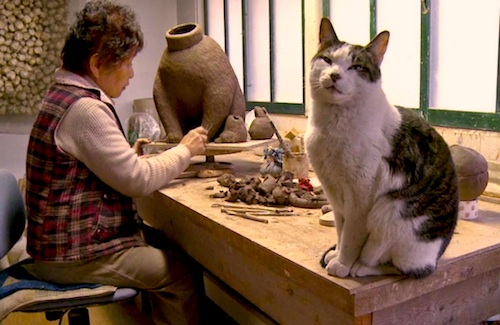
A stone’s throw from Fukushima, Kasama is a traditional rural artist colony, particularly known for its kasama-yaki style of pottery. At its finest, it approaches the sort of elegant and deceptively simple work the Ippodo Gallery often showcases. In recent years, the Kokubos largely support themselves through their pottery, but Katsuji had dreamed of making it as a painter.

Just what arrangements they made for their daughter when they slunk out of New York are never really explained. There is some vague talk about not wanting to take her out of school, but her mother clearly does not want to discuss it—and her father is just as obviously the junior partner when it comes to family decisions.

From "Kasamayaki."

Frankly, Kasamayaki is a somewhat odd film, because it is outwardly quite placid and meditative, but there is a lot of emotional turmoil brewing below the surface. At times, the very act of filmmaking appears to be a deliberate strategy to keep Kokubo’s parents at arm’s length. However, those eager for some heartwarming Hallmark moments will at least get a bit of paternal rapprochement. There are also cats and dogs lazing all around the Kokubos’ converted farmhouse, which is always a plus for that audience.

Kasamayaki is much more about intimate family drama than documenting the realities of post-earthquake Fukushima, but there are a few telling time capsule moments, as when Kokubo’s father checks out one of the Geiger counters provided by the local government. Yet, despite it all, Kasama still looks like a lovely place to visit when seen through her lens.

Although small in scope, it is strangely absorbing, following in the tradition of intensely personal Japanese documentaries, represented by films like Mami Sunada’s Death of a Japanese Salesman and Yang Yonghi’s Dear Pyongyang. Recommended for those who appreciate Japanese pottery and the vérité aesthetic, Kasamyaki screened as part of DOC NYC 2014.

LFM GRADE: B

Posted on November 17th, 2014 at 7:46pm.