LFM Reviews Frequencies

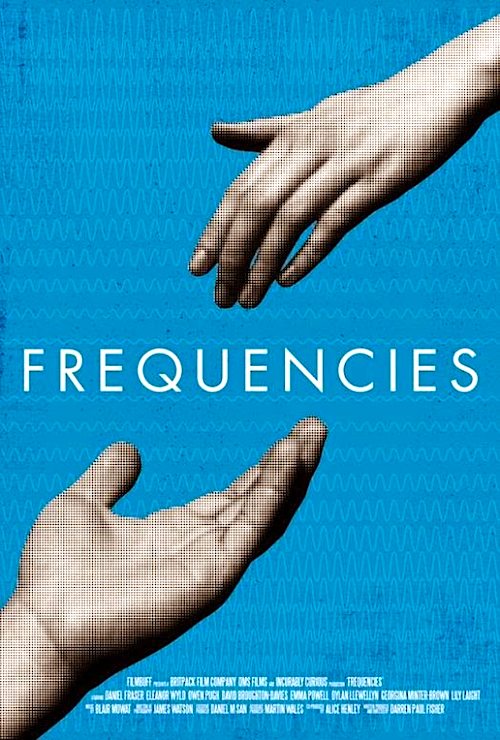
By Joe Bendel. If a name conveys a child’s future potential then Marie-Curie Fortune’s is indeed apt. Conversely, Isaac Newton Midgely is more of a Midgely than a Newton. The slogan of their near futuristic world is “knowledge is destiny,” but in practice your bio-metric “frequency” really determines your lot in life. Midgely will try to alter his hard-coded destiny in Darren Paul Fisher’s Frequencies (a.k.a. OXV: The Manual), which opens in New York this Friday, hitting iTunes the day before.

Sort of like The Force or just plain luck, one’s frequency measures how well you fit into the world around you. Someone with a high frequency is never late or klutzy. Everyone responds to them positively. However, Fortune’s abnormally high frequency almost entirely crowds out her capacity for emotions. In contrast, Midgely is a genius, but he has a negative frequency. Whenever they meet at school, sparks fly, much in the manner of matter encountering anti-matter. Things become so chaotic a sixty second limit is imposed on their presumably random meetings. Of course, Midgely happens to be smitten with Fortune, who sort of leads him on, out of scientific curiosity and a lack of empathy.

Flashing forward to adulthood, we find Midgely still has not gotten over Fortune, but he may have developed a means of moderating frequencies, with the help of his old school chum, Theodor Adorno Straus. By lowering her frequency, Fortune is finally able to take pleasure from life. She even thinks she has fallen in love with Midgely, but when the nature of Straus’s breakthrough device becomes apparent, all bets are off.
Many decent genre films are built around a good gimmick, but become increasingly conventional as they progress. Frequencies is the rare film that begins with an intriguing Macguffin, the social predetermination of frequencies and Midgely’s attempt to change them, but morphs it into something even bigger and archetypal, uniting science fiction and fantasy, while raising the stakes for everyone.

Granted, post-Tarantino, temporal shifts are annoyingly over-used and often distractingly unnecessary, but Fisher’s triptych structure heightens the significance of each big revelation. This is a film with genuine logical integrity that fits together remarkably well. Those familiar with the Marxist sociologist Adorno’s boneheaded criticism of jazz might have a leg up discerning his namesake character’s ultimate significance. Regardless, Frequency’s combination of social science fiction and philosophical inquiry set it worlds apart from most star-crossed love stories.

As the teen-aged Fortune and Midgely, Georgina Minter-Brown and Dylan Llewellyn give remarkably assured performances. Although we cannot properly call it chemistry (given the circumstances), the way they play off each other totally pulls the audience in. Fortunately, they have nearly as much screen time as their adult counterparts, who are the film’s real weak link. Their drab lack of charisma might make sense in the case of Daniel Fraser’s Midgely, but it leads to credibility problems in the case of Eleanor Wylde’s Fortune. Fortunately, some key supporting players help carry them, especially David Broughton-Davies as the mysteriously wise Mr. Straus. Keep your eye on him.

It would be spoilery to explain why, but Frequencies is also a wonderful valentine to classical music. Smart and engaging, it is one of those inventive science fiction films that have no need of splashy effects or fancy set pieces. Instead, it relies on the power of its ideas (how novel). Highly recommended for science fiction fans and musicians, Frequencies opens this Friday (5/23) at the Cinema Village and will be available from iTunes on Thursday.

LFM GRADE: A-

Posted on May 19th, 2014 at 12:07pm.

LFM Reviews The Fatal Encounter

By Joe Bendel. It is like a Joseon era Downton Abbey, except bloodier. The Dowager Queen openly schemes against her “grandson,” the king, as the palace servants furtively choose up sides. The drama all builds towards the infamous 1777 assassination attempt in Lee Jae-kyoo’s The Fatal Encounter, which opens this Friday in New York.

Things get complicated in the palace. Reluctantly, King Jeong-jo’s mother and grandfather sacrificed his father, the crown prince and heir to the throne, to placate the Noson faction, led by his “Grandmamma,” his grandfather’s Queen-consort. They did it solely for his sake. However, now that he has ascended to the throne, the Dowager Queen has grown tired of his independent inclinations.

When deciding to assassinate the king, the Noson conspirators assume they are holding all the cards, including key allies in the military and sleeper assassins planted deep within the palace. As a trump card, they also retain the services of Eul-soo, a hired killer who was once the sworn brother of the King’s private clerk, Gap-soo. However, many of the hidden assassins have concluded King Jeong-jo’s personal discipline and concern for the common people make him better suited to reign than their masters. Betrayals come fast and furious as the twenty-four hour countdown to the palace assault ticks down.

Fatal might just be the ultimate film for laundry intrigue, largely due to the important role played by Wol-hye, a senior maid and royal laundress with divided loyalties. Remember, they didn’t let just anyone scrub the King’s undies. While the focus is squarely on political maneuvering, there are also a few nicely staged action sequences. Viewers will not feel let down when the assassins finally arrive.

From "The Fatal Encounter."

Domestically, the big story regarding Fatal was television megastar Hyun Bin’s return to acting after his compulsory military service. He provides a perfectly fine model of strong, silent rectitude, but international audiences will be more taken with the supporting cast. Living up to his chameleon-like reputation, Jung Jae-young (known for Broken, Confession of Murder, and Moss) again transforms himself, fully bringing to life the conflicted and guilt-ridden Gap-soo. Likewise, emerging star Jung Eun-chae anchors the film as Wol-hye, neatly playing off and with nearly the entire ensemble as her numerous secret relationships come to light.

Han Ji-min (who majored in social work according to Asianwiki) is also appropriately hiss-able as the cold-blooded Dowager Queen. Sensitive viewers should be warned Fatal features several young characters in various stages of distress, but Yoo Eun-mi is particularly impressive as Bok-bing, a seven year-old apprentice maid caught between the competing factions.

Fatal provides sufficient skullduggeries to keep a steady string of shoes dropping, without getting bogged down in its own complications. It is a nicely crafted period production, with enough tragedy to keep the Korea box office satisfied, but should still appeal to most American filmgoers’ tastes. Recommended for fans of grand historicals, The Fatal Encounter opens this Friday (5/23) in New York at the AMC Empire and is now playing at the CGV Cinemas in Los Angeles.

LFM GRADE: B+

Posted on May 19th, 2014 at 12:02pm.

LFM Reviews Hard to be a God @ The 2014 Seattle International Film Festival

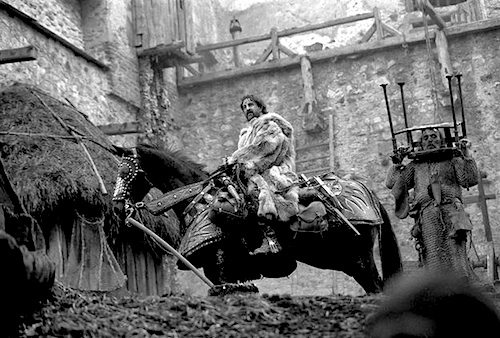
By Joe Bendel. There is a Prime Directive applied to earthlings on this foreign world, but it is much less rigid than the version in Star Trek. Killing the locals is strictly prohibited, but a little gentle development guidance is encouraged. Unfortunately, the home-worlders have collectively turned their backs on intellectual enlightenment in the late Aleksey Yuryevich German’s science fiction-in-name-only magnum opus, Hard to be a God, which screens during the 2014 Seattle International Film Festival.

You should really fortify yourself for this one. Over a decade in the making, including some six years of principle shooting, German’s adaptation of the Strugatsky Brothers’ novel is not for the faint of heart or the short of attention span. Since Stalker was also based on a Strugatsky novel, Tarkovsky is often suggested as a comparison, but the dream-like vibe and highly composed black-and-white visuals are also somewhat akin to Guy Maddin at his most self-indulgent.

Let’s be clear: if you require a strong narrative through-line then stop right here. Throughout Hard German is far more interested in setting the scene and rubbing our noses in it than telling us what happens next. In the future, supposedly intelligent humanoid life is discovered on the planet Arkanar. Yet, just when its Renaissance period should have started, the state initiated a campaign against so-called “wise-guys.” Secretly integrating themselves into society as powerful noblemen, thirty scientists try to do what they can to protect the beleaguered intellectual class against the forces of the “Greys,” but Arkanar just does not want to be helped.

German focuses on Don Rumata, a rather rakish Earthling in disguise, as he ostensibly seeks out the hunted Dr. Budakh. However, he spends an awful lot of time farting around with his servants. From time to time, he will also do a solid for the Falstaffian Baron Pampa, while sparring with the Greys. Frankly, this probably makes Hard sound more plotty than it really is. Think large, festering set pieces rather than fights and chases.

Hard clocks in just under the three hour mark and German makes the audience feel the passing of each and every minute. He also supplies several years’ worth of the hardiest moviegoer’s cinematic quota for pee, poop, and snot. His vision (completed by his filmmaker son Aleksey Jr. and co-screenwriter wife Svetlana Karmalita) allows us no illusions regarding just what the Dark Ages entailed.

From "Hard to be a God."

Nevertheless, cinematographers Vladimir Ilyin and Yuri Klimenko make it all look absolutely breathtaking, often in the manner of a Brueghel painting. (Ironically though, Lech Majewski’s The Mill and the Cross, an attempt to render a Brueghel canvas on film is somehow less static and more accessible than German’s world-building.) Yet, somehow lead actor Leonid Yarmolnik never wilts under the exhausting force of German’s mise-en-scéne. As Rumata, he is unflaggingly intense and roguishly charismatic, even when literally wallowing in the muck and mire.

This is an unusually redolent film. At times, you can practically smell the mud—at least we’ll call it mud for now. On the other hand, if you are waiting for a rocket ship or a ray gun then good luck to you. Although German passed away in early 2013, it is rather eerie watching Hard at a time when Putin also seems to be choosing militarism and barbarism. Indeed, the linkage between ignorance and state power is intentional and directly informed by the Soviet experience, but viewers still have to dig for it. Ultimately, Hard to be a God is a fascinating and often punishing film to experience. Recommended for those who want to be able to say they have seen it for themselves, it screens today (5/16), tomorrow (5/17) and the following Saturday (5/24) during this year’s SIFF.

Posted on May 16th, 2014 at 10:22pm.

A Portrait of the Artist Under House Arrest: LFM Reviews Ai Weiwei: The Fake Case

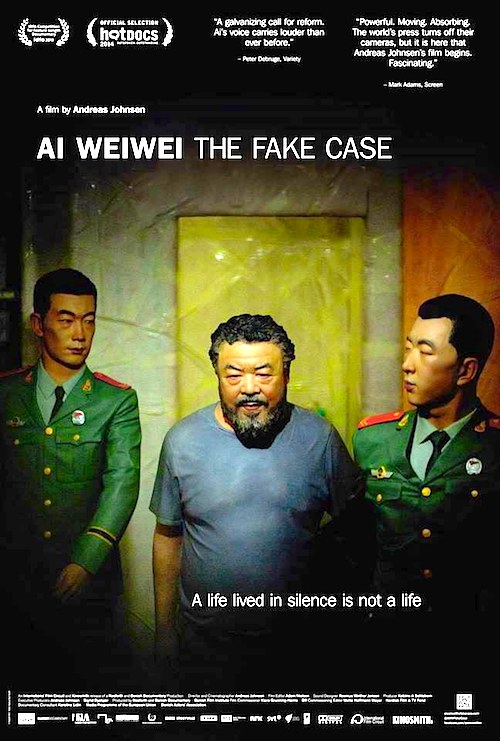
By Joe Bendel. It is the product of eighty-one days of solitary confinement and rough interrogation. Recreating scenes from his ordeal, S.A.C.R.E.D. is already recognized as one of Ai Weiwei’s masterworks, as well as a devastating critique of the Communist Party’s police state tactics. At least the government did its best to prevent any distractions from delaying its completion—by confiscating his passport and placing him under house arrest. The artist’s difficult year spent as a prisoner in his own home-studio (known as 258 FAKE) is documented in Andreas Johnsen’s Ai Weiwei: The Fake Case, which opens this Friday in New York at the IFC Center.

Ai Weiwei is one of the most important artists in the world today, as his famous sunflower seed installation at the Tate Modern and the current retrospective at the Brooklyn Museum well attest. However, Teacher Ai claims he never initially set out to be a political artist, but was forced down that path by the government’s reaction to his work and activism. Those who have seen Alison Klayman’s Ai Weiwei: Never Sorry or Teacher Ai’s own films, particularly Disturbing the Peace and So Sorry, know the artist as a compulsively outspoken, larger than life figure. It is rather shocking to see the nearly (but not completely) broken Ai Weiwei who emerges from almost three months of illegal detention early in Fake.

As a condition of his so-called parole, Ai Weiwei is forbidden to speak with the media, particularly international reporters. He duly complies, at least for a while. Suffering from memory gaps and nightmares, Teacher Ai is literally a pale shadow of his former self. Yet, as his health returns that familiar spirit also perks up.

Once again, the Communist government provides an inadvertent assist, by requiring Teacher Ai to post a considerable bond during his appeal. Much to the artist’s stunned amazement, there is a massive outpouring of support on his behalf, as 100 Yuan note paper airplanes start sailing over his wall, at no small risk to the donors. Their heartfelt messages move him deeply. Frankly, if viewers do not get a little choked up at this point, they perhaps missed their true callings as Communist torturers (as sleep deprivation is widely acknowledged as a form of torture, it is indeed fair to say Teacher Ai was tortured while in custody).

Essentially, Fake picks up where Klayman’s documentary left off, making them excellent companion films. Of course, it is hard to go wrong with any film that captures Ai Weiwei being himself. Although we might expect Teacher Ai to be far more guarded on camera following his incarceration, the opposite appears to be true. Not only do we hear him talking candidly about the lasting effects of his imprisonment, we also witness (quite touching) scenes of him interacting with his young son, Ai Lao.

Arguably, we see more of Ai the private citizen than Ai Weiwei the public figure. Of course, that rather makes sense, considering he could not leave his home without government permission during this time. Nevertheless, the injustice of his persecution is clearly and thoroughly established. Largely observational in his approach, Johnsen’s trust in his subject’s cinematic presence and compelling work (be it artistic, political, or both) pays off handsomely. A source of inspiration and outrage, Ai Weiwei: The Fake Case is highly recommended for all viewers who value free expression when it opens this Friday (5/16) at the IFC Center.

LFM GRADE: A

Posted on May 15th, 2014 at 1:18pm.

It Happens in London, Too: LFM Reviews Honour

By Joe Bendel. In her bestseller Londonistan, British journalist Melanie Phillips argues that Britain’s pluralistic liberal values are steadily eroding due to the rise of Islamist ideology from within. At one point, Mona’s brother makes a similar point, but he brazenly considers himself part of the process. Kasim happens to be a police officer, who is determined to murder his sister out of a perverse sense of family duty in Shan Khan’s simply but evocatively titled Honour, which launches today on VOD.

Mona scandalized her Muslim Pakistani family by pursuing romance with a Punjabi Hindu colleague. For that, she must die. However, she proves to be unexpectedly elusive for the severe Kasim and his somewhat reluctant younger brother, Adel, so they enlist a specialist. Ever since his release from prison, the unnamed bounty hunter has carved out a niche for himself, based on referrals from the imam he served time with. Just how the heavily tattooed white supremacist formed an alliance with the devout Muslim remains unspoken, but one can easily assume they bonded over targets of mutual hate.

Nevertheless, the nameless thug-for-hire is starting to develop a conscience, especially after witnessing the savage treatment of his last highly pregnant target. It will be ironic if the former Aryan gang member teaches Mona’s family a lesson in real honor, but in all honesty, Kasim and his cold-blooded mother set the bar awfully low.

From "Honour."

As usual, Paddy Considine is totally money-in-the-bank as the bounty hunter. It is a gritty punch-to-the-gut portrayal of soul-sickness and redemption, yet it is not really his movie. Instead, Atlantis co-star Aiysha Hart shoulders a disproportionate share of the film’s load, acquitting herself rather well. In fact, she seems to get stronger as the film progresses, vividly expressing understandable feelings of fear, pain, and betrayal. While the ad-hoc alliance between her and Considine’s grim brooder might strike some viewers as a bit too pat, their rapport helps considerably to sell it on-screen.

Hard to pigeon-hole, Honour rather effectively straddles the border between thrillers and social issue dramas. Arguably, Khan’s out-of-sequence temporal narrative gets a little too cute for its own good, but it does accentuate the suspense at several key junctures. More importantly, he masterfully maintains the tension, conveying a visceral sense of Mona’s bereft alienation.

Honour is not pitch-perfect, but it certainly pulls the audience in and keeps us hooked. It is also quite a bold film. Keep in mind, this all takes place in London (or rather a Glasgow doubling for London)—the financial capitol of Europe and beacon of freedom during two world wars—not some mountain hamlet in Afghanistan. Recommended as a film and as well a social critique, Honour is now available through VOD platforms, with a theatrical release to be announced sometime in the summer.

LFM GRADE: B+

Posted on May 15th, 2014 at 1:12pm.

LFM Reviews Chinese Puzzle

By Joe Bendel. The interconnected group of friends and lovers from Cédric Klapisch’s L’Auberge Espagnole and Russian Dolls represent a European microcosm, but to pursue their second chances at life and love they appropriately congregate in Lower Manhattan. Chinatown will see an influx of Francophone expats in Klapisch’s Chinese Puzzle, which opens this Friday in New York.

Novelist Xavier Rousseau is way behind on his latest deadline. He has been a bit distracted by the dissolution of his marriage to the British Wendy. Following his soon to be ex-wife to New York for the sake of his kids, Rousseau kind of-sort of experiences fatherhood again as the sperm-donator for his best pal Isabelle and her Chinese-American partner Ju. With little money and fewer prospects, Rousseau crashes in Ju’s hipster-friendly Chinatown apartment. It will become quite homey when he hosts his former lover Martine and her two children during their New York vacation.

Will sudden proximity rekindle their relationship? Fortunately she is rather understanding of his green card marriage to a second generation Chinatown New Yorker, but keeping up appearances for immigration will lead to a lot of door slamming and mad dashing about. Yet, somehow it all still represents the mature phase of his life.

Although Puzzle is the concluding film of what Klapisch calls “The Trilogy of Xavier’s Travels” (picture that on the DVD boxed set), it easily stands alone. However, those who are emotionally invested in the prior two installments will take great satisfaction from the nontraditional familial bonds that develop between the characters. In fact, it might be the most unabashedly optimistic and upbeat film for all concerned, propelled along by Loïk Dury and Christophe “Disco” Minck’s infectiously peppy Cesar Award nominated score.

From "Chinese Puzzle."

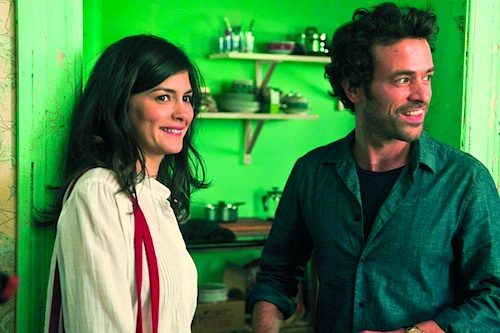
Like a comfortable old shoe, Romain Duris exudes loser likability as Rousseau. He also shares some pleasant (if not exactly scorching) screen chemistry with Audrey Tautou’s Martine. In a nice change of pace following films like The Kid with the Bike and Hereafter, Cécile de France shows a keen facility for slightly naughty physical comedy as the Belgian Isabelle. Strangely, the American marketing campaign is not playing up House of Cards’ Sandrine Holt as Ju, but she adds some class and dignity to the proceedings.

Puzzle is a breezy and buoyant film, but it is not utterly vacuous. It clearly celebrates family and friendship, suggesting that playing the cards one has been dealt might just turn out to be a blessing. That it is an unusually attractive cast of characters grappling with impending middle age just makes it all the more cinematic. A can’t miss for fans of Xavier’s previous travels, Chinese Puzzle is recommended for Francophiles and international rom-com audiences when it opens this Friday (5/16) in New York at the Angelika Film Center downtown and the Lincoln Plaza Cinema uptown.

LFM GRADE: B

Posted on May 15th, 2014 at 1:07pm.