That was a Tough Gig: LFM Reviews Titanic: Band of Courage

By Joe Bendel. Conservatory-trained Roger Marie Bricoux’s first ocean-liner gig was on the RMS Carpathia, which is best remembered for saving survivors of the RMS Titanic, which happened to be his last seafaring job, for obvious reasons. Considered paragons of the “show must go on” ethos, the dignity and tragic irony of the Titanic musicians’ lives are chronicled in Titanic—Band of Courage, a PBS special airing in select markets around the country over the next two weeks or so.

Sadly, none of the Titanic band-members lived to gig again. As most everyone knows, there was that whole business with an iceberg and an awkward lifeboat shortage. Matters could have gotten really ugly, but the musicians started playing to calm the passengers’ nerves. According to survivors, it really worked.

The night to remember offers no shortage of drama, but for viewers who are not Titanic junkies, Band of Courage also offers an intriguing glimpse into the lives of working musicians during the late Edwardian era. Essentially straddling the lower middle class and upper working class, the ocean liner musicians were required to be proficient in a variety of styles, including operetta, light classical, ragtime, and Tin Pan Alley. They had to be polished enough to withstand the shallow criticism of bored patrons and charismatic enough to earn their tip money. Scottish violinist John Law Hume was a natural in that respect.
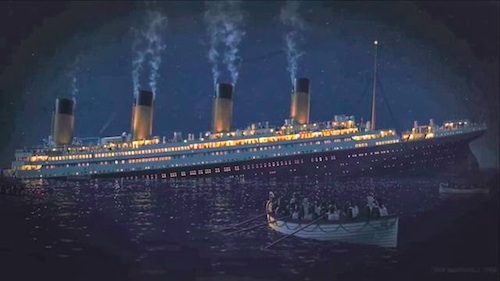
From "Titanic: BandofCourage."

Technically, there were two Titanic ensembles: a quintet and a string trio. Reportedly, they only played together on that fateful night, but they shared a common repertoire, collected and conveniently numbered in the Titanic songbook. To give viewers a sense of their sound, a contemporary septet (a piano and six strings) performs each song under discussion as various talking heads weigh in, most notably including Hume’s grandson (whom he never met) and Steve Turner, the author of The Band that Played On.

Musicians and their friends will be particularly fascinating by the details of the ocean liner musicians’ working lives during the Gilded Age. Evidently, the agents handling the White Star Line’s exclusive bookings were not especially ethical or compassionate, suggesting some things in show business never change. Frankly, viewers are likely to conclude the eight musicians in question were not well served by their somewhat cartoonish portrayal in the bloated Cameron Oscar-winner. Interesting from both a musical and historical perspective, Band of Courage comes with convenient places to put pledge breaks, so do not be surprised if someone interrupts the broadcast to ask you for money.  Recommended for fans of string music and the infamously unsinkable ocean liner, Titanic—Band of Courage airs on participating PBS stations throughout the March 1-16 window.

LFM GRADE: B

Posted on March 4th, 2014 at 9:20pm.
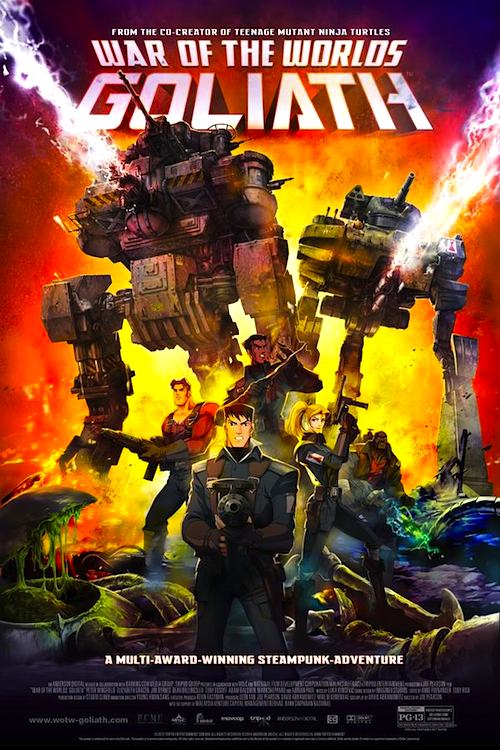
Teddy Roosevelt Gets His Independence Day On: LFM Reviews War of the Worlds: Goliath

By Joe Bendel. You would think if H.G. Wells’ Martians could master space travel and death rays, they could also develop antibiotics. It turns out they have shored up their immunological vulnerabilities and have come back for more in Joe Pearson’s animated feature War of the Worlds: Goliath, which opens in select cities this Friday.

Germs saved our butts in 1899, but the vigilant understand it is only a matter of time before the Martians return for round two. Under the leadership of U.S. Secretary of War Teddy Roosevelt, the multinational A.R.E.S. defense force is formed, employing abandoned Martian technology reverse-engineered by their science advisor, Nikolai Tesla. However, by 1914, tensions in Europe threaten to pull A.R.E.S. apart.

Captain Wells struggles to hold his team together, but he has issues stemming from the first Martian invasion, when he witnessed his parents getting zapped. The IRA also hopes to capitalize on the potential European war, striking the British with advanced weaponry they expect Corporal Patrick O’Brien to steal from A.R.E.S. Obviously, this would be a good time for Mars to attack.

Ordinarily, you do not expect steampunk science fiction with a touch of art deco from a Malaysian animation studio, but here Goliath is, with Teenage Mutant Ninja Turtles co-creator Kevin Eastman on-board as executive producer. While the jaws of its characters could not possibly be any squarer, it creates a surprisingly cool world, where A.R.E.S. battles Martians with era-appropriate biplanes and EVAJaeger-style tripods, the latest model being the titular Goliath, piloted by Captain Wells and his crew.

Frankly, the warfighting scenes are more graphic than you might expect, particularly for those unfortunate enough to get caught in the Martians’ flesh-melting lasers. However, the historical details are sort of clever, including the hotshot Captain Von Richthofen, engaging the Martians’ air support as the ace of A.R.E.S. Wells’ backstory and his relationships with his squad members are a bit clichéd, but Goliath has a real ace in the hole. Any film that features Teddy Roosevelt shooting Martians earns a pass.

Since it exists in an alternate universe, Goliath manages to be both hawkish and internationalist in its galactic world view. The animation might be just a cut above passable (if that), but the world-building details are well thought out. Fans of the Highlander television series will be particularly interested in its voice cast, which includes Adrian Paul, Elizabeth Gracen, and Jim Byrnes (probably best known for Wiseguy), with the latter being a standout as Roosevelt. It is not a classic, but it is fun in an ambitious meathead sort of way. Recommended for fans of H.G. Wells and T.R. looking for an animated distraction, War of the Worlds: Goliath opens this Friday (3/7) in select theaters.

LFM GRADE: B

Posted on March 4th, 2014 at 9:07pm.

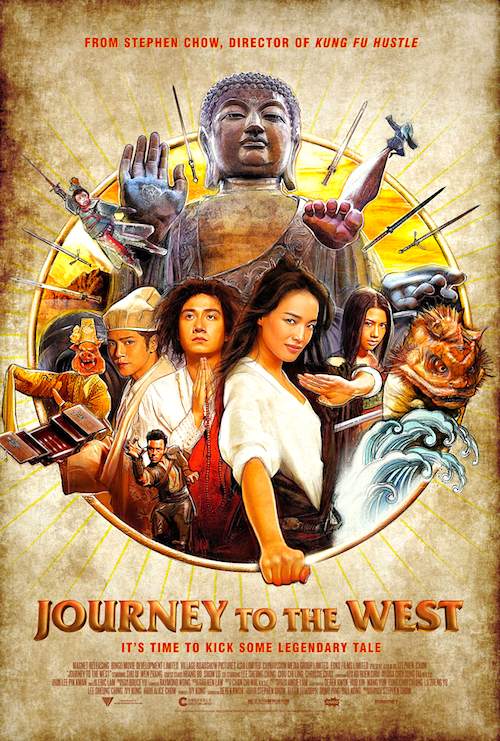
Stephen Chow Unleashes the Monkey King: LFM Reviews Journey to the West

By Joe Bendel. Wu Cheng’en’s classic Ming era novel is a big thick multi-volume work that has inspired many film adaptations drawn from various points throughout its epic time frame. Still, you might not find the exact story of Stephen Chow’s latest comedic spectacle in there, but several of the characters will certainly be familiar. The Monkey King and his fellow demons will tangle with a young and awkward Xuan Zang in Chow & co-director Derek Kwok’s Journey to the West, which opens this Friday in New York.

As a novice demon hunter, Xuan Zang hardly seems likely to reach enlightenment. However, he will do his best to fight the water demon plaguing a provincial fishing village in the go-for-broke opening sequence. While he is more effective than the charlatan that took the first crack at the creature, he is no match for the prowess of Miss Duan, a demon hunter extraordinaire. She does not think much of his use of a collection of nursery rhymes to appeal to the demons’ inner youthful goodness. Nevertheless, she falls for Xuan Zang hard, which confuses the devout Buddhist no end.

While Miss Duan handles the Water Demon with relative ease, KL Hogg (the Pig Demon) turns out to be elusively slippery.  Their pursuit of the latter will bring them into uncomfortably close contact with Sun Wukong, the Monkey King. At this point, all bets are off.

Wen Zhang (recognizable from Ocean Heaven) is appropriately wide-eyed and innocent as Xuan Zang, but the film is completely dominated by Shu Qi. As Miss Duan she shows all kinds of moves and a flair for physical humor we never knew she had in her. Watching her kick demon butt is a sight to behold, but it demonstrates the superior action opportunities for actresses in Chinese language cinema, especially when contrasted with their Hollywood counterpoints.

The prospective Expendabelles film is a case in point, with the embarrassing casting rumors centering around Meryl Streep (all dingos beware). On the other hand, every major Chinese language star takes on action roles throughout their careers, as a matter of course. Recent examples include Gwei Lun Mei in Flying Swords of Dragon Gate, Zhou Xun in the same film, as well as The Great Magician, Michelle Yeoh in nearly all her films, with Reign of Assassins being a recent example, Angelababy in Tai Chi Zero, Ziyi Zhang in The Grandmaster, and Mi Yang in Wu Dang. Now its Shu Qi’s turn and she makes the most of it.

When Shu Qi does her thing, Journey is wildly fun. Nevertheless, Chow did not return to the Monkey King character that made his name and reputation in A Chinese Odyssey just for a quick paycheck. As a reboot/prequel/film-within-the-margins, Journey starts as a massive beatdown and explodes on a cosmic scale, ending with more divine retribution than you will find in the entire Left Behind franchise. The message is simple—do not tick off Buddha.

So you have Shu Qi, a trio of demons, and an apocalyptic showdown. What more could you possibly need?  On the micro level, Ku Huen Chiu’s action choreography is impressively cinematic yet true to Chow’s eccentric aesthetic. On the macro level, Ken Law’s special effects really do not look like anything we have seen before. Plus “pseudo-model”-turned actress Chrissie Chau appears as Miss Duan’s lieutenant, Killer Four, giving her lessons in seduction that go fantastically awry. This is indeed the full assault to the senses Chow’s fans have been waiting for. Recommended with the enthusiasm of a fanboy, Journey to the West opens this Friday (3/7) in New York at the Cinema Village.

LFM GRADE: A-

Posted on March 4th, 2014 at 9:00pm.

Rediscovered and Restored: LFM Reviews A Celebration of Blues & Soul: The 1989 Inaugural Concert

By Joe Bendel. It was a Texas kind of night in D.C. A concert bill that featured the likes of Billy Preston, Albert Collins, Stevie Ray Vaughan, and Delbert McClinton certainly reminds us of Texas’s contributions to blues, soul, and R&B. Ostensibly, the show was part of the inaugural festivities of President George H.W. Bush, another Texan, by choice. Of course, inaugurations are really just an excuse to party, which is definitely the vibe of A Celebration of Blue & Soul: the 1989 Inaugural Concert, which airs nationally on participating PBS stations during the March 1-16 pledge drive.

Long feared lost to the ages, the multi-camera recordings of the inauguration night bash have been rediscovered and restored, with a longer DVD release planned for the future. Naturally, Bush campaign manager and former Percy Sledge sideman Lee Atwater served as the honorary chairman of the concert and the invisible hand behind the scenes bringing it all together. After his greeting, the shorter PBS version launches into Dr. John’s “Right Place, Wrong Time,” perhaps the most perfunctory performance of the evening.  Next, Atwater’s old boss Sledge gives the crowd what it wants: “When a Man Loves a Woman,” for probably the 500,000th time in his career, but he still does his thing with genuine feeling.

Obviously, the 1989 concert has been edited with an eye towards greatest hits to make it pledge drive friendly, but just about everyone brought their A-game for their signature tunes. Eddie Floyd shows the showmanship of an old pro on “Knock on Wood,” while Sam Moore lays down the authority on “Soul Man,” backed by musical director Billy Preston and Stax veterans Steve Cropper and Donald “Duck” Dunn.

Clearly, there is a lot of real deal blues on the program, including legendary Chess Records mainstay Willie Dixon performing “Hoochie Coochie Man,” which represents the height of blues authenticity. Albert Collins also gets his solo spotlight on “Frosty” (along with his protégé, Vaughan) as does McClinton on “Just a Little Bit.” Most of the artists are backed by the funky ensemble led by Preston and featuring Dunn and Cropper (but alas multi-reed jazzman Patience Higgins is not prominently spotlighted in the PBS cut). Of course, Bo Diddley brought in his own band, because that was how he rolled. He also had Ronnie Wood sit-in on the classic “Bo Diddley Beat” strutter, “Hey, Bo Diddley.”

From "A Celebration of Blues & Soul: The 1989 Inaugural Concert."

For understandable reasons, Stevie Ray Vaughan is the only artist allotted more than one number (this is pledge season after all), but he sure could play. He also closes the show with some fittingly nonpartisan, patriotic life-affirming sentiments. It is depressing to think only a year and a half later his own life would be cut short in helicopter crash, while he was still at the absolute peak of his powers. Indeed, the 1989 Inaugural concert captures for posterity many late greats in an appreciative setting, performing the songs that made them famous.

This is a great week for music on PBS. While the 1989 Inaugural Concert does not offer as many surprises as last night’s Jazz and the Philharmonic, it cooks along nicely. The concert itself is a lot of good, clean, soulful fun, but do not be surprised if someone asks you for money at least once during the broadcast. Recommended for fans of blues and Stax-style Memphis soul, A Celebration of Blue & Soul: the 1989 Inaugural Concert aired twice yesterday (3/1) on New York’s Thirteen and can be seen on PBS outlets throughout the country over the next two weeks.

LFM GRADE: B+

Posted on February 2nd, 2014 at 2:51pm.

Russians Still Winning, This Time in 3D: LFM Reviews Stalingrad

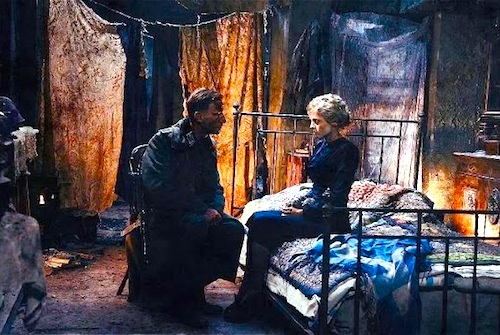
By Joe Bendel. Those who question Russia’s commitment to sustainability should at least give them credit for recycling their titles. In 1989, Fedor Bondarchuk received one of his earliest acting credits in Yuri Ozerov’s Stalingrad. Twenty-some years later, the thesp-turned-director has helmed Russia’s first film produced entirely in 3D IMAX—and it happens to have the same title. It essentially ends the same way too, but some weird editorial choices distinguish Bondarchuk’s Stalingrad, Russia’s reining box office record holder, which opens today in New York.

In large measure, Bondarchuk’s Stalingrad is inspired by the heroic exploits of Pavlov’s House, the strategically located apartment complex doggedly defended by Sergeant Pavlov and his men. In this case, it is Captain Gromov and his comrades who have dug into a reinforced tenement right across from pretty much the entire German army. While most civilians have evacuated, the elfin Katia has defiantly remained, to stoke jealousy amongst Pavlov’s men and to give them something personal to fight for.

A few steps away, Captain Peter Kahn is tasked with crushing all pockets of Russian resistance. However, National Socialist war atrocities have dampened the Prussian elitist’s morale. He is more concerned with Masha, another Russian women stuck in the wrong place at the wrong time. In the tradition of bodice rippers, he initially “ravishes” her, but then starts to fall in love with the Russian beauty. She also seems to warm to him as a protector, but fears for the consequences if and when the Soviets expel the Germans.

Perhaps the weirdest element of Bondarchuk’s film is the framing device, in which a Russian emergency responder tells a group of Germans trapped in the rubble of the Tōhoku earthquake how his mother met his five fathers during the siege of Stalingrad, because nothing is more reassuring than episodes from the bloodiest battle in human history. Dude, next time, don’t help. Frankly, the way the film exploits Japan’s 3-11 tragedy would be deeply offensive, if it were not so ludicrous. Seriously, Russian rescue workers digging out Germans in Sendai?

On the plus side, Bondarchuk makes stuff blow-up really well. Obviously, he did not intend to waste his blank check in the IMAX store.  He devises all sorts of dramatic perspectives on the action, while vividly capturing a sense of the claustrophobic nature of close quarters fighting. He is also either surprisingly fair to the Germans or simply lets Thomas Kretschmann run circles around the rest of the cast as the ethically nuanced Kahn.

From "Stalingrad."

Frankly, he represents the film’s most believably complicated character and develops some powerfully ambiguous chemistry with Yanina Studilina’s Masha. In contrast, Gromov and the other four fathers are all either colorless Reds or borderline war criminals. Either way, they make little lasting impression. It almost makes a viewer wonder if Bondarchuk set out to be deliberately subversive.

It seems unfathomable that a Russian WWII epic can make audiences sympathize with the Germans. Yet, if you close your eyes and think of Stalingrad a few days after taking it all in, it will be Krestchmann and Studlina whom the mind’s eye will recall. Nevertheless, Russia duly submitted Stalingrad as its official foreign language Oscar contender. Perhaps it is still preferably in Russia to declare a dubious victory than admit an obvious defeat. Sort of recommended in a confused way for those who appreciate battlefield spectacle, Stalingrad opens nationally today (2/28) including in New York at the AMC Empire and Lincoln Square theaters.

LFM GRADE: B-

Posted on February 28th, 2014 at 11:26am.

Naughty Coffee Klatching: LFM Reviews Venus Talk

By Joe Bendel. Some critics will reflexively compare this Korean relationship drama to that old HBO show that ended its run a decade ago. However, the three stars of this import were secure enough to allow a cameo appearance from BoA, the young and glamorous “Queen of Korean Pop.” In fact, the forty-something cast looks considerably younger than their long-faced American forerunners. They will still inevitably mismanage their private lives in Kwon Chil-in’s Venus Talk, which opens in select theaters today.

Frankly, this trio of friends is not so interested in talking, but they have to do something when they meet for brunch at Hae-young’s coffee shop. She is a single mother with a grown daughter she can’t get out of the house and the best boyfriend of the bunch. Sung-jae is mature, sensitive, and handy around the house, but harbors been-there-done-that feelings about marriage. Mi-yeon appears to be happily married, but her demands will put a strain on her relationship with her Viagra-bootlegging husband, Jae-ho. Shin-hye is more interested in her work as a television producer than any sort of romance, but a drunken fling with Hyun-seung, a much younger colleague, complicates her carefully calibrated career.

Into these lives great turmoil will fall, but they always stick together—after a bit of judgmental cattiness. Sure, you probably suspect where Kwon and screenwriter Lee Soo-a are headed and have a pretty good idea how they will get there, but it must be said Venus is surprisingly fair to the guys. Frankly, the women are at least as responsible for their relationship angst and their partners, if not more so. This is particularly true in the case of Mi-yeon and the woefully cringey Jae-ho.

While never explicit, Venus is rather saucy, especially by the standards of Korean cinema. Not for no reason, most of the more suggestive scenes feature the photogenic Uhm Jung-hwa and Lee Jae-yoon as the impressively fit Shin-hye and Hyun-seung, respectively. They have okay chemistry together and Uhm nicely mixes attitude and professionalism in her straight forward dramatic scenes.

Yet, Cho Min-su once again steels the picture in a complete change of pace from her soul-shattering turn in Kim Ki-duk’s bracing Pieta. As Hae-young, she brings more dignity, forgiveness, and general humanity to Venus than you would ever expect to find in a cougar-ish chick flick. In contrast, Moon So-ri is stuck with the least sympathetic and most over-the-top of the lot, but she fully commits to the voracious Mi-yeon nonetheless.

There have been films like Venus before and there will be plenty more like it to come. Even so, it is a credit to Kwon, Uhm, and Cho how smooth it goes down, especially for those who do not have a strong affinity for the genre. It is well executed, but never pushes the envelope of women-centric relationship dramas. Mostly recommended as a women’s-night-out movie, it opens today (2/28) in Honolulu at the Consolidated Pearlridge and in Vancouver at the Cineplex Silvercity.

LFM GRADE: C+

Posted on February 28th, 2014 at 11:18am.