What Happens in Maine: LFM Reviews Almost Human

By Joe Bendel. As an independent station way up in northern Maine, Channel 83 is not exactly the fast track to a network career, but they know how to cover mysterious disappearances. Thanks to an unearthly entity, they can look forward to some salad days in Joe Begos’ throwback 1980’s style sci-fi slasher flick, Almost Human, which releases this Friday in Los Angeles and on VOD.

Something in the Maine woods chased Seth Hampton to his buddy Mark Fisher’s cabin. Initially, the outdoorsman dismisses Hampton’s panic, but it turns out that the alien force prefers the burly Fisher. After a flash of blue light and piercing tone, Fisher is sucked out of the house, leaving Fisher’s girlfriend Jen Craven and the guilt-ridden Hampton behind. For a while, the police key in on Hampton as their prime suspect, a development the confused Craven does little to discourage. However, no evidence can be found to implicate Hampton.

Two years later, Hampton tries to live a quiet life as the town weirdo, but he is plagued by disturbing visions of similar horrors. We soon learn Fisher has returned, or at least the shell of his body under alien control. As he preys on Maine’s backwoodsmen, Hampton and Craven reconcile, hoping to find some answers and a bit of closure. Not so fortunately, the malevolently mutated Fisher soon comes looking for Craven.

Throughout Almost Human, Begos deliberately goes for a low budget retro-eighties look, much like Ti West did with House of the Devil, except even grubbier. Frankly, it seems strange to emulate the look of 1980’s straight-to-video horror, when it is so easy for genre fans to find the genuine article. Still, he shows a flair for inventive gore, but the narrative is defiantly workaday stuff.
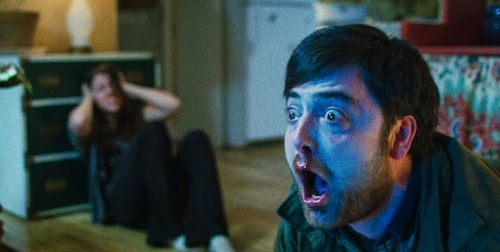
From "Almost Human."Arguably, the work of Graham Skipper and Josh Ethier are also a cut above those typically found in 80’s grind ‘em outs. Skipper (whom some might recognize from the Off-Broadway production of Re-Animator: the Musical) is actually quite engaging as the everyman Hampton trying to hold onto the last shred of his sanity. Conversely, Ethier (who also doubled as editor and co-producer) is an interesting looking heavy, whom we can sort of buy into as a hardscrabble one-man version of Jack Sholder’s under-appreciated The Hidden.

In a way, the consistency of Begos’ no-frills vision is quite impressive (right down to the old school UHF news reports we see from the fictional Channel 83), but a little goes a long way. Ultimately, Begos just defrosts some red meat leftover from the 1980’s (admittedly a great decade) rather than pulling together a nourishing feast. Serviceable as a midnight movie, but nothing viewers will carry with them after the show, Almost Human opens today (2/21) in Los Angeles at the Arena Cinema and next Wednesday (2/26) in New York at the IFC Center.

LFM GRADE: C+

Posted on February 21st, 2014 at 10:04pm.
LFM Reviews ‘Til Madness Do Us Part @ MoMA’s 2014 Documentary Fortnight

From "‘Til Madness Do Us Part."

By Joe Bendel. Perhaps you always suspected Chinese mental hospitals were not very hospitable. If so, your suspicions have been definitively vindicated by documentarian Wang Bing’s nearly four hour descent into the everyday lunacy of a decrepit facility located somewhere in the southwest provinces. Tellingly, the inmates often joke this place will “drive you crazy.” The same might be said for viewers, but there is no denying the weightiness and immediacy of Wang’s ‘Til Madness Do Us Part, which screens tomorrow as part of MoMA’s 2014 Documentary Fortnight.

Yes, some of the patients/inmates/prisoners have been committed for being politically difficult. However, they have been mixed in with killers, hardcore schizophrenics, and slightly loony relatives someone wanted to get out of the house. Unlike bad old Soviet psychotherapy, the doctors are not constantly poking and prodding the patients. In fact, staff members are rarely seen throughout the course of a day. Think Lord of the Flies instead of 1984. Frankly, it is like Bedlam in there.

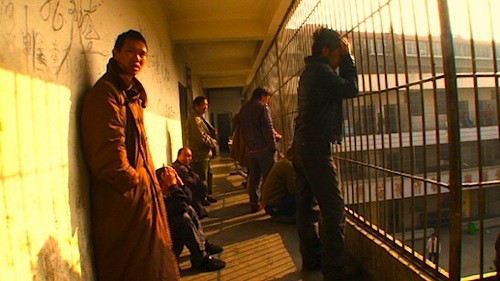
Throughout most of the film, Wang and his fellow cameraman Liu Xianhui are confined to the top men’s floor of the facility. The layout not so coincidently resembles a prison, with a central corridor overlooking the interior courtyard. Viewers will become quite familiar with this fenced in passageway, because Wang and Liu will pursue many a disturbed patient as they go tearing around and around it.

Obviously, there are many issues with this sanatorium, starting first and foremost with the conspicuous lack of resources. The level of care is also problematic, mainly consisting of the daily dispensing of happy pills, at least as far as viewers can tell. There is even a mute inmate whose identity remains a mystery to staff and patients alike. Right, what are the chances he will be cured of what troubles him?

From "‘Til Madness Do Us Part."

Given the 228 minute running time, Wang can hardly be accused of selective editing. Madness is an immersive experience more than a muckraking expose. Yet, the micro and macro implications are inescapable. Nobody would want to be there. Yet, Wang still finds pockets of humanity in the bleakness, such as the man who has somehow commenced a romantic relationship with a woman confined to a lower floor, mostly through stolen conversations through barred doors and the like.

Everything about Madness will intimidate casual audiences, with good reason. Frankly, the best way to see it is probably as a reviewer, because we are able to break it down into manageable pieces. Nevertheless, Wang is arguably the leading Chinese documentary filmmaker of our day. Anyone who seriously follows independent Chinese cinema will want to keep up with his latest. While not nearly as emotionally involving as his heartbreaking Three Sisters or the draining Fengming: A Chinese Memoir, it still has plenty of sobering moments. Recommended for stout-hearted cineastes, ‘Til Madness Do Us Part screens tomorrow (2/19), in all its 228 minute glory, as part of this year’s Doc Fortnight at MoMA.

LFM GRADE: B

February 18th, 2014 at 9:14pm.

LFM Reviews Karaoke Girl @ The 2014 San Francisco Indie Fest

By Joe Bendel. Before New York’s disgraced former congressmen and governors embark on their next vice tour of Thailand, they ought to give some thought to the women working in Bangkok’s redlight district. Sa is one of them, but the extent of her nightclub work is kept somewhat ambiguous in Visra Vichit-Vadakan’s docu-fiction hybid Karaoke Girl, which screens during the 2014 San Francisco Indie Fest.

Sa Sittijun essentially plays herself, a pure-hearted country girl, who came to the city to provide for her family. Initially, she really did work in a factory, but when it closed she was forced to take a hostess job in a karaoke bar. Of course, her family still thinks she is cracking eggs on the assembly line. It is probably more tiring work at the club, requiring constant maintenance. Due to the late hours, Sa also often has close contact with dodgy sorts. In fact, crime is a very real occupational hazard.

Despite all the hardships she endures, Sa gives alms with great frequency. She also sends money home quite regularly and returns periodically to drag her ailing father to the doctor. In short, she deserves better than the lot she drew in life, most definitely including her unreliable lover, Ton. One can only hope the Thai release for Karaoke and its success on the international film festival circuit will lead to better things for Sittijun.

Clearly, Vichit-Vadakan had up close and personal access to Sittijun’s life (or at least a revealing approximation of it). Yet, since she mostly avoids the lurid aspects of the redlight business, it does not feel as intrusive as it might. Instead, we come to understand “bar girls” must spend time on their laundry and pursue problematic relationships, just like everyone else.

From "Karaoke Girl."

Frankly, Karaoke is the sort of visually arresting docu-straddler These Birds Walk was supposed to be, but fell short of. For one thing, Sa is a far more engaging (and even sympathetic) focal character. Also, the rural backdrops and nocturnal city scenes are considerably more striking than Birds’ visuals. Great credit is due to co-cinematographers Chananum Chotrungroj and the American executive producer, Sandi Sissel (whose credits also include Salam Bombay) for maintaining an intimate focus on Sa, but still capturing a powerful sense of place.

No matter how much of her actual life is reflected on screen, Sittijun expresses a whole lot of emotional truth. Quiet but powerful, with a surprisingly spiritual dimension, Karaoke Girl is recommended for all those concerned with the condition of working women (broadly defined) in the developing world. It screens at the New Parkway Theater (in Oakland) this Thursday (2/20) as part of this year’s SF Indie Fest.

LFM GRADE: B+

Posted on February 18th, 2014 at 9:08pm.

Getting Blood from a Druid Stone: LFM Reviews Dolmen

From "Dolmen."

By Joe Bendel. It must be one of those island prejudices. They do not think much of cops on Ty Kern, even when one of them is Marie Kermeur, the belle of the isle. She has returned home from Brest to marry her childhood sweetheart, but when dead family members start piling up, she insists on getting all detectivey in the six-part French miniseries Dolmen, which is now available on DVD from MHz Network.

The Kersaint and Le Bihan families are like the Montagues and Capulets of Ty Kern. The Kermeurs are civil with both, but you would not say they are close. Something happened way back when that tied the island families together. Everyone seems to know about it, except Marie, le flic. Her family is delighted to have her back on Ty Kern for her wedding to racing skipper Christian Bréhat, but they are just as eager to see her on her way. However, when her brother Gildas has a fatal misadventure near the island’s druid stone circle, Kermeur smells a rat.

Indeed, the circumstances surrounding his death are quite suspicious. For instance, one of the menhir stones starts bleeding his blood shortly after the murder (as foul play is soon established). Kermeur is also slightly agitated by her nightmare that sort of presaged his death. Initially, Kermeur is pulled from the case, for obvious reasons. Of course, she quickly insinuates her way back into the investigation, because none of the locals will talk to Maj. Lucas Fersen, the hotshot officer dispatched from Brest.

In terms of tone, Dolmen is something of a throwback to the if-I-had-only-known novels of Mary Roberts Rinehart. Frankly, the series’ willingness to kill off Kermeurs is quite impressive, a bit like Game of Thrones in that limited respect. There is no getting around the melodrama of a bride-to-be mourning a brother and learning no end of deep dark family secrets. Still, series writers Nicole Jamet and Marie-Anne Le Pezennec make the most of the eerie Breton locales, incorporating supernatural legends and purported cult activity into the mix. In fact, for most of the series, it is an open question whether the happenings really are of an occult nature or whether there will be a tidy Scooby-Doo explanation for it all.

Teenage boys should keep in mind that Dolmen is the product of French television, because Marie Kermeur is the sort of cop who can give men interrogation fantasies. Popular TV star Ingrid Chauvin truly has supermodel looks and soap opera thesp chops, but Dolmen arguably plays to her strengths in both respects. She also works out some decent chemistry with Bruno Madiner’s Festen, who steadily grows on viewers as he sheds his by-the-book stiffness.

From "Dolmen."

Like a Twin Peaks off the Brittany coast, Dolmen is chocked full of colorfully cranky supporting characters, but by far the most intriguing is Patrick Ryan, an Irish mystery novelist and expert in Celtic lore, played with flair and gravity by Yves Rénier. French cinema connoisseurs will also be surprised to see that Hippolyte Girardot appears as the churlish Kersaint heir apparent, but does not get his name in the opening credits. In fact, he is totally on the money as the resentful Pierre-Marie, but his character is not given much to do besides glower and sulk until episodes five and six. Likewise, Nicole Croiselle makes a great villain as Yvonne Le Bihan, somewhat looking and sounding like Cloris Leachman in Young Frankenstein, but always playing it scrupulously straight. On the downside, Chick Ortega’s portrayal of the developmentally disabled Pierric Le Bihan is pretty darn cringey.

Dolmen has enough mystery, intrigue, and windswept longing to seduce even the snobbiest viewers. Technically, there is even a ripped bodice, which is appropriate considering the series’ romantic mass market appeal. It is definitely really fun stuff (tailor made for binge viewing), like a slightly more gothic and popcorn-ish Broadchurch, with way more attractive leads. Recommended for those who enjoy French scandal, Dolmen is now available on DVD from MHz Networks.

LFM GRADE: B

Posted on February 18th, 2014 at 9:04pm.

LFM Reviews Beijing Love Story

By Joe Bendel. Beijing is a lot like New York. It is a tough city, but you can still find some wildly romantic backdrops there. Five couples of varying ages and degrees of matchedness will go through love’s ups and downs all over the Chinese capital, as well as during a romantic side-trip to Greece in Chen Sicheng’s Beijing Love Story, which opens tomorrow in New York.

Unlike his married boss Wu Zheng, Chen Feng is a decent enough guy. Unfortunately, he does not have much money or legal Beijing residency. Nonetheless, the outrageously cute Shen Yan still falls for him at a hipster singles’ party. Can their romance survive the pressures of money woes and a surprise pregnancy? Her wealthy ex and the painful in medias res opening say no, but viewers should not put too much stock in either.

Meanwhile, Wu’s tomcatting is about to catch up on him. Somewhat disappointed by his lack of faithfulness, his wife Zhang Lei tries to take a page from his playbook, possibly complicating the life of her boss and platonic friend, Liu Hui in the process. He has an assignation of his own to worry about. He is meeting his mysterious mistress, Jia Ling, for a weekend in Greece. Since the two lovers are played by “Big Tony” Leung Ka Fai and Carina Lau, you would expect things to heat up here and they do.

Liu will play Jia’s games in Greece, but he is always serious about being Liu Xingyang’s father. However, she is rather upset with him, because he will not allow her to appear on a national talent show with her string ensemble. Smitten Song Ge is happy to lend a sympathetic ear and maybe even her transportation money if he can earn enough from after school jobs and maybe borrow some from his grandfather, “Old Wang.” Of course, Wang has his romantic difficulties as well. His cousin keeps fixing him on with blind dates, but his heart is never in it, even with a recently returned expat, who should be well out of his league.

Without question, Beijing works best when it follows the Liu family. Leung and Lau have scorching chemistry and the Greek locale inspires the film’s most visually stylish sequences. In contrast, the innocence and exuberance of Song’s courtship of Liu Xingyang is like a breath of fresh cinematic air. As teenaged Liu and Song, Nana Ou Yang and Liu Haoran come across like good kids at heart, but with massive screen presence.

From "Beijing Love Story."

The other interrelated couples are not necessarily dead weight, but they do not deliver the same satisfaction. Frankly, Yu Nan is absolutely terrific as the wronged Zhang, but her storyline functions more as a transition from Chen & Shen to Liu & Jia than as a fully developed arc in its own right. Wang Qinxiang is also surprisingly moving as Old Wang, but Chen really pulls out the manipulative stops for the closer. He also shows big city Beijingers at their most annoying during the initial tale of his namesake (played by the writer-director). Tong Liya’s Shen has all kinds of charisma, but there is only so much she can do for this underwhelming slacker love story.

It is not often we have a Valentine’s appropriate film to recommend for February 14th, but this year we have one. Based on Chen’s hit television series of the same name, Beijing Love Story hits more ambiguous notes than viewers might expect, but that is a good thing. Ultimately, it is the veteran superstars (Leung and Lau) and the ridiculously young looking stars of the future (Nana Ou Yang and Liu Haoran) who really sell it. Recommended for Valentine viewing, Beijing Love Story opens tomorrow in New York at the AMC Empire, from China Lion Entertainment.

LFM GRADE: B

Posted on February 13th, 2014 at 12:21pm.

LFM Reviews Frontline’s Syria’s Second Front, Children of Aleppo

By Joe Bendel. You can draw a lot of conclusions about people simply from judging the groups trying to kill them. Most western observers are utterly baffled by the bedlam of the Syrian Civil War. However, it is pretty easy to side with the initial rebel groups who rose up against the Assad regime and now find themselves battling a virulently Islamist faction in the north, once the particulars of the conflict are established. This Tuesday, PBS’s Frontline broadcasts Syria’s Second Front and Children of Aleppo, two boots-on-the-ground reports from Syria documenting the precarious state of the original, largely secular rebels and the dire conditions faced by sympathetic civilians.

ISIS, the Islamic State of Iraq and Syria, is supposedly so extreme and violent, al-Qaeda wants to keep them at arm’s length. Presumably, they will patch things up if ISIS takes operational control of Syria, which is not outside the realm of possibility. They have little use for secular society and a special enmity for reporters, whom they are perfectly willing to execute on sight. Nevertheless, Muhammad Ali, a daring independent journalist with a memorable name, has infiltrated ISIS controlled territory with a team of Free Syrian Army aligned rebels.

When ISIS eventually leaves town, everyone is relieved to see them go. Frankly, many of the local citizenry are quite courageous expressing their hopes for a free secular democratic state. However, the prospects are rather iffy, even if the fractious rebel forces can unite against both ISIS and Assad. Second Front offers some cautious optimism on this score, but it is tempered by the shocking footage of the better organized ISIS brutally administering Sharia Law.

From "Syria's Second Front."

According to Children of Aleppo, an estimated 11,000 children have been killed in the course of the Syrian conflict. Most parents opted to shelter their sons and daughters outside the country. One FSA captain is a notable exception. He and his wife still live in their once fashionable Aleppo flat with their son and three daughters. The captain’s comrades are now like extended family to his girls, which would be almost heartwarming, if their familiarity with the sounds of war were not so tragically well developed.

Those who have seen Matthew VanDyke’s Not Anymore will also recognize his footage of a twelve year old protest singer, who just started performing for his camera as a shell landed nearly on top of them. Both survived, but she evidently now lives in Qatar. Frankly, VanDyke’s film is even more effective than the Frontline films at putting a human face on the Syrian civil war. Although it is now available online, interested New Yorkers can see VanDyke’s short doc on the big screen on February 28th as part of the 2014 Winter Film Awards. In contrast, Syria’s Second Front better establishes the ideological and geopolitical context for the various factions.

The one-two punch of last month’s Secret State of North Korea and the upcoming Syria’s Second Front make this Frontline’s strongest season perhaps ever. Both broadcasts represent solid investigative journalism conducted in countries that do not recognize press freedoms. Highly recommended, Frontline’s twofer of Syria’s Second Front and Children of Aleppo air tomorrow night (2/11) on most PBS stations nationwide.

LFM GRADES: A-/ A-

Posted on February 11th, 2014 at 12:37am.