LFM Reviews The Hourglass Sanatorium, Presented by Martin Scorsese

By Joe Bendel. Smuggling a censored film was a trickier proposition in 1973. Instead of a flash drive, you had to schlep cans of film. Nevertheless, Wojciech Has managed to convey his banned, mind-bending prestige production to Cannes, where the jury led by Ingrid Bergman awarded it the Jury Prize. While never explicitly political, it is easy to see why Has’s The Hourglass Sanatorium would be too much for a risk averse Communist apparatchik to countenance when it screens as a handpicked selection of Martin Scorsese Presents: Masterpieces of Polish Cinema, hosted by the Film Society of Lincoln Center.

Based on the novel and short stories of Bruno Schulz, Hourglass is never intimidated by the constraints of narrative. Józef is traveling to a remote sanatorium, where his lower middle class merchant father Jakub is a patient. Actually, his father is already dead everywhere else except the decaying sanatorium. Within the crumbling walls, the randy inattentive staff apparently has the power to roll back time to a point where his father is still living. Through the strange power of the sanatorium, Józef is able to revisit his past through his subconscious (or vice versa) for a series of chaotic encounters with his sort of late father. Or something like that.

You could debate just what Hourglass is until the cows come home, but no way, no how is it Socialist Realism. Meaning that densely ambiguous spells nothing but trouble for a professional censor. To make matters worse, Has chose not to soft pedal the main characters’ Jewish heritage while the Polish Communist Party was still engaged in its campaign of anti-Semitic purges. At times, Has even evokes images of the Holocaust, even though the work of Shulz (himself a fatal victim of National Socialism) predated WWII.
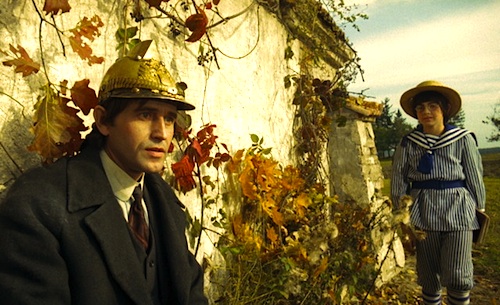
From "The Hourglass Sanatorium."

Good for Berman for digging Hourglass. It will not be to everyone’s tastes. However, it is visually stunning. The depth of vision Has employs with his swooping camera is truly dizzying. It might be heresy to suggest, but Hourglass could be that rare classic worth giving the 3D fixer-upper treatment. Ironically, the film authorities clearly opened the coffers during the production stage. The work of art director Andrzej Halinski is absolutely baroque, even decadent in an evocatively decayed way. Viewers may well wonder if Hourglass was an early influence on a young Tim Burton or Terry Gilliam.

Hourglass is an auteur’s film in just about every way, rather than an actor’s showcase. It is dashed difficult to forge an emotional connection with the audience amid all the trippiness, but at least Jan Nowicki looks convincingly lost as Józef.

Undergarments are rather loose in Hourglass, so parents should be strongly cautioned. More to the point, it is sure to raise questions with no objective answers. This is definitely high-end cult cinema, but those who appreciate extravagant set pieces and dark fantasyscapes will dive into the experience. Recommended for the adventurous and literarily inclined, The Hourglass Sanatorium screens this Friday (2/14) and Sunday (2/16) at the Walter Reade Theater, as part of Martin Scorsese Presents: Masterpieces of Polish Cinema.

LFM GRADE: B+

Posted on February 10th, 2014 at 12:28am.
LFM Reviews Easy Money: Hard to Kill

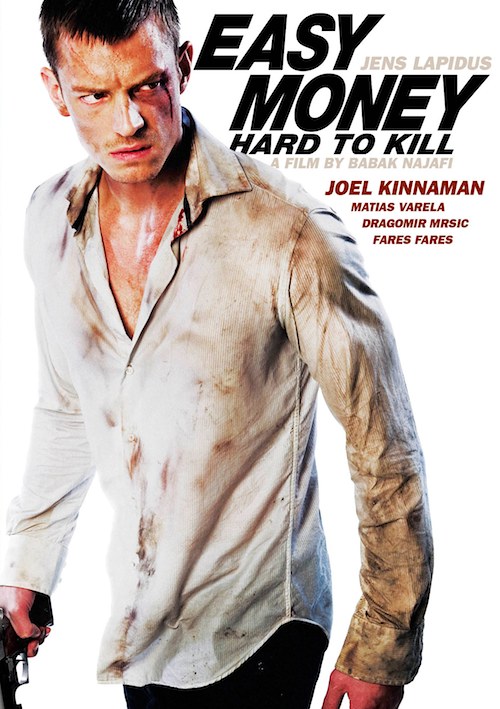
By Joe Bendel. When on work release, convicted cocaine smuggler Johan “JW” Westlund seizes the opportunity to get back to “work.” This was not always his world, but he will find there is no going back to the upright, respectable existence he once led in Babak Najafi’s Easy Money: Hard to Kill, which opens this Friday in New York.

There were a lot of casualties at the end of the first Easy Money film, but somehow Mrado Slovovic survived, despite being run-over by a car and shot at close range by Westlund. One might expect the wheelchair-bound hitman to hold a grudge, but he and Westlund bond when they become cellmates. It must be all that shared history. Once a promising business student, Westlund lent his analytical skills to an up-and-coming coke syndicate to subsidize his extravagant lifestyle. In retrospect, it was not such a great plan for the future. Trying to go straight, Westlund develops a game-changing stock-trading program, only to find during his first furlough his so-called partner has double-crossed him.

Slightly put out, Westlund chucks in the work-release song-and-dance, arranging to break Slovovic out instead. He might be paraplegic, but Slovovic is still one bad cat. He also knows the daily routine of the Serbian mob’s unassuming money launderer. While they work on their hasty caper, small time South American trafficker Jorge and lowly Lebanese enforcer Mahmoud are also making their desperate plays for survival. Naturally all three alumni from the first film will come together in some fashion during the third act.

Viewers should be able to readily follow Hard to Kill even if they did not see the franchise opener, but the constant parade of faces that are supposed to be familiar will be more rewarding to those who have. Regardless, HTK is slick, stylish, and strangely multicultural, but hardly in a way that embraces global fellowship. This is not a film that will have you humming “It’s a Small World,” but it might scare you straight, unless you live in Colorado, where these sorts of things are practically legal.

Joel Kinnaman, the star of AMC’s The Killing and the RoboCop reboot so coincidentally opening just before HTK, is suitably flinty as Westlund, but Dragomir Mrsic out hardnoses everyone as Slovovic, while still expressing his acute disappointment in himself as a father. Likewise, Fares Fares makes a compelling sad sack as the luckless Mahmoud.

Since Easy Money: Life Deluxe has already released in Sweden, it is a safe bet anyone who survives the second cut will be back to try their luck a third time. HTK does not break a lot of new ground, but the intriguing relationship that develops between Westlund and Slovovic elevates it above more routine Scandinavian crime dramas. Recommended for those who enjoy gangster films with healthy doses of violence and irony, Easy Money: Hard to Kill opens this Friday (2/14) in New York at the Cinema Village.

LFM GRADE: B

Posted on February 11th, 2014 at 12:19am.

Our Post-Zombie Future: LFM Reviews The Returned

From "The Returned."

By Joe Bendel. This is why we really shouldn’t demonize pharmaceutical companies. We might really need them sometime, especially in the post-zombie future. Medical science has developed a cure for newly infected zombies. Naturally, there is a catch. It depends on a protein extracted from the spinal columns of full blown, incurable walking dead and must be administered shortly after contamination. However, as treatment improves, there are fewer sources of the serum and more cases requiring it. This leads to an inevitable problem of scarcity in Manuel Carballo’s The Returned, which opens in Los Angeles this Friday.

You would think they would hardly notice an influx of zombies in Canada, but there is indeed a rabble rousing crowd of fear mongers making life difficult for Dr. Kate. She is the lead physician for her hospital’s “Returned” ward and a prominent fundraiser for synthesizing the serum. She also happens to be romantically linked with Alex Green, a Returned musician, whom she met while overseeing his treatment.

With stockpiles of the protein growing scarce, the mob is turning on the Returned and those who treat them. Things get really bad when a band of radicals attack her ward, making off with confidential Returned files. Already exhausting their black market options, the doctor and her hipster patient will soon be forced to take desperate measures.

From "The Returned."

Clearly, the market for zombie-related entertainment remains undiminished if even the post-zombie scenario of BBC America’s In the Flesh is subject to the old “homage” treatment. At least series writer-creator Dominic Mitchell gives viewers a fair number of old school zombie flashbacks. In contrast, The Returned is distinctly light in the shuffling horde department, but it takes its message of tolerance painfully seriously.

As a zombie film almost entirely without zombies, The Returned is bound to disappoint the majority of zombie junkies. Still, Emily Hampshire and Kris Holden-Reid make a ridiculously attractive couple who show flashes of chemistry in their scenes together. They are actually reasonably compelling when navigating the ethically ambiguous terrain of post-zombie (or maybe not so post) life.

To its credit, The Returned offers up a clever bit of business involving the Bela Lugosi near classic White Zombie (still underappreciated as the granddaddy of all zombie movies). Frankly, it is a better vehicle for Hampshire than Good Neighbors, so it might lead to more work for her down Hollywood way. Regardless, Carballo really should have dialed down the teaching moments and ratcheted up the action around the midway point, instead of going all in for angst. The Returned is a competent production, but it is already late for the party. For die-hard Canadian zombie fans, it releases this Friday (2/14) in L.A. at the Laemmle Music Hall, just in time for Valentine’s Day.

LFM GRADE: C

Posted on February 11th, 2014 at 12:09am.

LFM Reviews Monuments Men

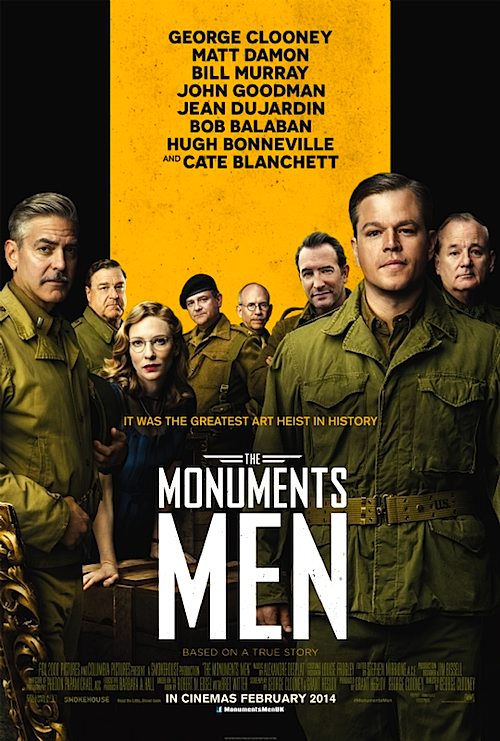
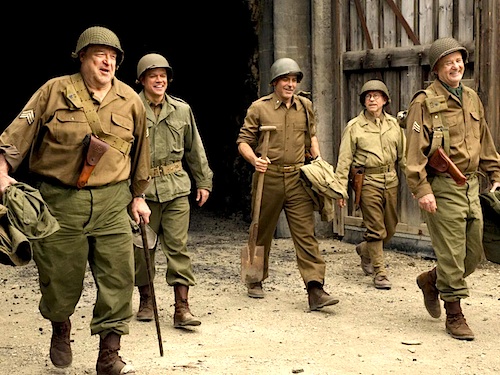
By Joe Bendel. They were the elite of America’s elite, but they readily answered the call to serve. Recruited for their knowledge of art and architecture, this special corps was tasked with preserving important cultural landmarks and restituting plundered artwork, despite having no real operational authority. The nearly 345 men and a handful of women who served in the Allied armies’ Monuments, Fine Arts, and Archives (MFAA) program are boiled down to eight cultured but courageous souls in George Clooney’s The Monuments Men, which opens today nationwide.

Even today, the scale of the National Socialist war machine’s systematic looting boggles the mind. Old masters were eagerly sought to fill Hitler’s Fuhrermuseum, a grandiose monstrosity planned for his hometown of Linz, while art deemed “degenerate” was destroyed. Alarmed by the threat to Europe’s artistic legacy, Frank Stokes (modeled after George Stout) is given the go-ahead to form the Monuments Men. Like a Harvard-educated Billy Ocean, he proceeds to recruit a clean half-dozen, including James Granger, the Met’s curator of medieval art (based on James Rorimer), sculptor Walter Garfield (strongly suggestive of Walker Hancock), and ballet impresario Preston Savitz (transparently inspired by one of the best known Monuments Man, Lincoln Kirstein).

Initially, Stokes mostly encounters hostility from his fellow officers, who understandably place the safety of their men far above that of a few statues or a pretty fountain. However, with the help Sam Epstein (based on Harry Ettlinger, one of the last surviving Monuments Men), a German-speaking Jewish immigrant enlisted man, Stokes’ men start developing leads on the National Socialists’ vast caches of stolen art. Nevertheless, even though the military tide has turned in the Allies’ favor, the clock is ticking furiously for the Monuments Men. Retreating Nazi forces have been instructed to destroy the secret art stashes, as part of the infamous Nero Decree. Making matters more complicated, the Soviets also deployed so-called Trophy Brigades on a mission to re-plunder art looted by the National Socialists as supposed “war reparations.”

To their credit, Clooney and co-screenwriter-co-producer Grant Heslov (adapting Robert Edsel’s nonfiction book) make the distinction between the Monuments Men and the Trophy Brigades as clear as day and night. They consistently honor the sacrifices made by the Monuments Men, getting genuinely patriotic down the stretch. In a big picture sense, the film does right by its heroic subjects. However, it gets rather bogged down in a draggy midsection, wherein the Magnificent Seven plus Epstein split up for a series largely unnecessary misadventures. Still, the third act picks up the tempo quite nicely.

From "Monuments Men."

Stokes/Stout is a perfect vehicle for the smooth-on-the-outside, deep-on-the-inside screen persona Clooney has developed over the years. We can easily believe he is both a learned scholar and officer material. John Goodman, Bill Murray, and Bob Balaban just sort of do their shtick as Garfield/Hancock, architect Richard Campbell, and Savitz/Kirstein, but Downton’s Hugh Bonneville gives the film unexpected heft and tragic dignity as Donald Jeffries, an art world cad seeking redemption.

Anyone interested in the Monuments Men and the National Socialist campaign of pillage should watch Berge, Newnham & Cohen’s The Rape of Europa, which is easily one of the best documentaries of the last ten years. Clooney dramatizes their story well enough, but just barely legs out a double rather than knocking it out of the park. Still, for those looking for a stirring war story with a dash of American exceptionalism, it is the only game in town this week. Recommended as a serious but reasonably entertaining WWII film, Monuments Man opens in wide release today (2/7), including the AMC Empire in New York.

LFM GRADE: B

Posted on February 7th, 2014 at 3:36pm.

He Also Does Taxes: LFM Reviews The Attorney

By Joe Bendel. Depending on who you ask, the late ROK President Roh Moo-hyun was either a principled idealist or a corrupt demagogue. A new film unequivocally holds to the former view. A thinly fictionalized Roh will argue a life-altering, inspired-by-true-events case in Yang Woo-seok’s The Attorney, which opens today in New York.

Even though he never graduated from high school, Song Woo-seok became a self-taught bar-certified attorney (sort of like Lincoln). He even briefly served as a judge, but resigned to pursue a more lucrative practice, for the sake of his family. Recognizing an early opportunity, Song becomes one of the first to take advantage of a legal change allowing attorneys to register property deeds in place of a notary. At first, the legal establishment is openly contemptuous of the bounder. Then the business starts pouring in.

Eventually, other attorneys started competing for Song’s real estate business, so Song once again makes a shrewd move into a tax practice. Ironically, when the paper-pushing Song finally litigates a case, the fix is in right from the start. In acknowledgement of a debt from his early scuffling years, Song reluctantly agrees to represent Jin-woo, the son of a forgiving noodle shop proprietor. Unfortunately, this is no ordinary criminal case, but a dubious national security prosecution, with confessions already lined up courtesy of the ruthless Captain Cha Dong-young.

When it gets down to political business, The Attorney is certainly not shy about waving the bloody martial law shirt. However, the first half of the film is actually a rather touching story of hard work and sacrifice rewarded, in the tradition of The Pursuit of Happyness. Song Woo-seok (a fusion of the director and star’s names) is an earnest everyman, who earns his piece of the pie the old fashioned (but unfashionable) way.

Of course, once the sainted Soon-ae’s son is arrested, The Attorney shifts into high moral outrage gear. Korean box office superstar Song Kang-ho leaves it all on the field as his half namesake, wringing all the righteous indignation and heroic sincerity he can out of the courtroom cross examinations. At least Yang and co-writer Yoon Hyun-ho step back from the Few Good Men, acknowledging an experienced government employee like Cha will never cop to ordering a “Code Red” on the stand.

From "The Attorney."

Fans of Song Kang-ho, Korea’s top domestic movie star, should probably seek out The Attorney, despite its excesses, because there is no telling how much of him will be left once Harvey Weinstein finishes editing Bong Joon-ho’s Snowpiercer with a hacksaw. Yet, it is veteran actress Kim Young-ae who really instills the film with dignified sensitivity as honorable gravitas as Soon-ae. It is also amusing to see Oh Dal-su (Oldboy’s sleazy private prison warden) do his shtick as Song-Woo-seok’s sitcomish office manager. Unfortunately, Kwak Do-won (a great villain in A Company Man) largely phones in Cha, the cold fish.

In a way, The Attorney sort of confirms the theory that political liberty inevitably follows economic liberty. After all, Song Woo-seok sure is busy with real estate transactions in the early 1980’s. While the performances are mostly quite impressive, it never really captures the telling period details. Without the narrative reference points, viewers might mistake it for a contemporary legal drama. While it is sure to stoke political debate in Korea, The Attorney is only recommended for American viewers with a crack cocaine level addiction to legal table-pounding melodramas when it opens today (2/7) in New York at the AMC Empire.

LFM GRADE: C+

Posted on February 7th, 2014 at 3:28pm.

LFM Reviews Viktoria @ The 2014 Sundance Film Festival

From "Viktoria."

By Joe Bendel. She drinks Coca-Cola and uses a Statue of Liberty cigarette lighter. Obviously, Boryana’s heart is not in Bulgaria’s glorious effort to build Socialism. It is in Venice. Unfortunately, her unplanned pregnancy will stymie her secret immigration plans. It is one reason why a Cold War rages between mother and daughter in Maya Vitkova’s Viktoria, which screened at the 2014 Sundance Film Festival.

Life in late 1970’s Bulgaria is pretty depressed and dehumanized. Even a trip to the OBGYN is a humiliating experience, conducted in an examination room with windows open for any passerby to observe. Boryana previously used traditional methods to induce miscarriage (a lot of jumping and the like), but to no avail this time.

In addition to putting the nix on Venice, the infant Viktoria perversely becomes a propaganda tool for the state. Not only was she born on Victory Day, she has no navel. Therefore, she is a portent of the new Socialist man of the future. No longer must women take time away from their labor for the sake of childbirth, because babies like Viktoria will surely be incubated outside their mothers.

When it comes to entitled little monsters, none can match a Communist princess. A personal favorite of Bulgarian Party secretary Todor Zhivkov, Viktoria is chauffeured to school each day, where she is given carte blanche to bully her teachers and peers alike. She even has a red phone connection direct to Zhivkov. Then one day in 1989, she becomes an ordinary kid, who nobody likes.

Despite the surreal interludes and mild magical realism, Viktoria conveys a vivid you-are-there sense of life under Communism. There is a ring of truth to it, precisely because of the absurdity. Young Viktoria’s special midriff make-up also looks quite realistic. However, the post-1989 narrative largely loses both its bite and its focus. It seems like it takes Vitkova forty minutes to never really figure out how to end it all. Still, considering the running time is over two and a half hours, there is a good feature’s length of material that works.

From "Viktoria."

While the third act might have problems, it is hardly the fault of Kalina Vitkova, who is hauntingly expressive as the twentysomething Viktoria. Likewise, her younger sister Daria is a remarkable force as the imperious and then chastened grade school Viktoria. Yet, it is Irmena Chichikova’s Borynana who will really get under viewers’ skin, depicting a persona forced into itself by circumstances and a totalitarian state.

For the most part, the sexually frank Viktoria has the vibe of a more Spartan Unbearable Lightness of Being, with trippy flights of fantasy thrown in to convey the characters inner angst. Highly recommended, it is a challenging film in terms of subject and style, but it is worth grappling with, especially its more consistent initial two hours. The first Bulgarian film selected by the Sundance Film Festival, Viktoria turned out to be a sleeper at Park City, so it is certain to have a long life ahead on the international festival circuit.

LFM GRADE: A-

Posted on February 4th, 2014 at 12:43am.