A Curtain Call for the New York Art Quartet: LFM Reviews The Breath Courses Through Us

Trailer – The Breath Courses Through Us (2013) from Asymmetric Pictures –FILMS on Vimeo.

By Joe Bendel. They were arguably the original super group of free jazz. They formed in 1964 and disbanded in 1965, yet they still had turnover on the bass. Eventually, Reggie Workman settled into the role and would return for their special anniversary tour. Despite the brevity of their tenure together, the New York Art Quartet remains enormously influential. Alan Roth documents their history and triumphant reunion in The Breath Courses Through Us, which has its American premiere today at the Library of Congress in Washington, DC.

It all started when Congolese-Danish alto-saxophonist John Tchicai met trombonist Roswell Rudd. Both musicians were exploring the creatively disruptive innovations of Cecil Taylor, recognizing each other as kindred spirits. The next piece of the puzzle was Milford Graves, a former Latin percussion specialist, who had reoriented his perspective on the drums after hearing Elvin Jones. As the New York Art Quartet, they recorded their instantly recognizable eponymous ESP release with Bernie Worrell on bass, bringing Workman on board for Mohawk the following year.

As is usually the case in jazz, the Quartet was short lived, precisely because it was just five minutes ahead of its time. At the time, they were consciously challenging traditional notions of melody, harmony, and rhythm, yet to contemporary ears they do not sound nearly as radical as much of the subsequent free music they blazed a trail for.

Sparingly using WKCR’s Ben Young as the expert commentator, Roth lucidly establishes the Quartet’s musical significance, placing them in the context of their era. We hear from all four musicians at length, all of whom are earnest and reflective about the music they made. However, there is no question Graves is a uniquely spirited and charismatic interview subject. His reminiscences are the sort of gift documentarians only dream of.

Of course, there is also plenty of straight-up music. Indeed, Roth has a nice editorial ear, selecting performances that illustrate the Quartet’s considerable technique. Watching Breath should dispel any uncharitable notions that they embraced freer forms because they could not adequately swing. After all, Rudd started off playing Dixieland and Workman recorded with just about everybody, including Art Blakey, Grant Green, and John Coltrane. At one point, Tchicai even played with a band inspired by Miles Davis’ electric period. The late controversial poet Amiri Baraka also joins the Quartet for some spoken word contributions. Roth wisely opts for his more benign pronouncements, but his interludes are still the only part of their reunion concert that sound dated.

To borrow terminology from Downbeat magazine, it is always great musicians get their overdue ovation. Breath should lead to greater appreciation of the New York Art Quartet, even among viewers not deeply steeped in the free jazz aesthetic. Recommended for open ears, The Breath Courses Through Us screens today (1/31) at the Library of Congress, with a New York premiere in the works.

LFM GRADE: B+

Posted on January 31st, 2014 at 1:54pm.
The Psychic Said What? LFM Reviews The Wait

By Joe Bendel. At least the psychic never asks for money. Maybe that is why Emma believes her. It must be admitted her timing is also spot-on, given she calls, unsolicited, immediately after the death of Emma’s mother. Much to her sister’s frustration, Emma insists it will only be a matter of time before their mother returns to the land of the living, because a stranger told her so in M. Blash’s supernatural-ish drama The Wait, which opens today in New York.

Presumably, Angela is the more responsible sister since she does all the things you are supposed to do when a family member dies. Her older sister is clearly a flake, yet everyone seems to defer to her. Instead of grieving, the family just ambles about in a daze, with the air conditioning cranked up to arctic levels. Angela recognizes cracked behavior when she sees it, but her flirtation with a scruffy hipster neighbor distracts her from pushing the issue.

Blash plays up the verdant eeriness of the Pacific Northwest woods for all its worth, simulating the vibe of Twin Peaks, but lacking the distinctive characters and stuff happening with regularity. Kasper Tuxen’s lush cinematography evokes a sense something uncanny must be going on somewhere, but there are simply too many shots of characters staring off into the distance for Wait to sustain any appreciable momentum.

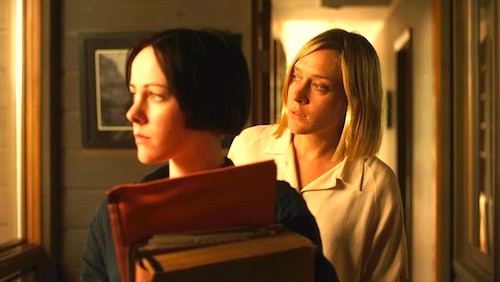
From "The Wait."

After Tuxen, Jena Malone is probably the film’s MVP. As Angela, she actually supplies a real performance, marked by vulnerability and sensuality. In contrast, Chloë Sevigny’s Emma largely fades into the background, which is surprising given the lively impression she made in Jonathan Caouette’s even more surreal short, All Flowers in Time.

With respects to the natural versus the supernatural question, Wait seems to want to have its cake and eat it, too. Blash offers up sequences to support either alternative down the stretch, but they are all so frustratingly underwhelming. There are interesting bits here and there, like the forest fire raging on the horizon, which everyone assiduously ignores, like revelers in Pompeii. Yes, it is a carefully crafted film, but there will be times viewers will want to hook it up to a car battery and give it a jump. For dedicated Malone fans only, The Wait opens today (1/31) in New York at the Cinema Village.

LFM GRADE: C-

Posted on January 31st, 2014 at 1:51pm.

LFM Reviews Cooties @ The 2014 Sundance Film Festival

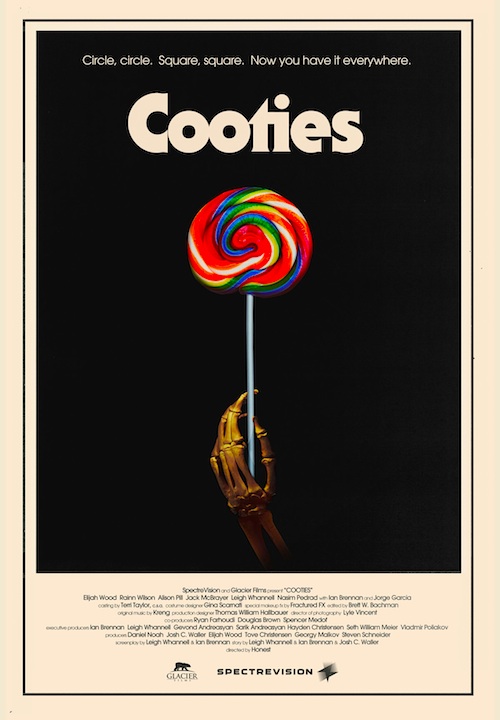
By Joe Bendel. Those who can’t do, teach. And those who can’t teach, teach at public schools. So then, what are the chances of a misfit Ft. Chicken Elementary summer school faculty member surviving a juvenile mutant attack? Not great, but at least there will be plenty of gory humor in Jonathan Milott & Cary Murnion’s Cooties, which screened at the 2014 Sundance Film Festival.

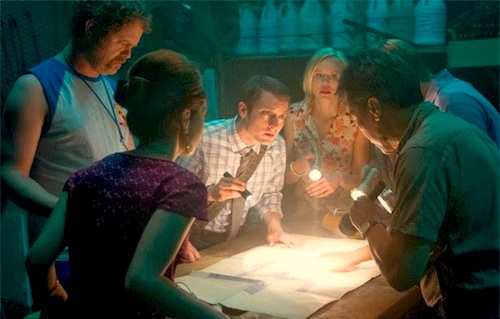
Failed novelist Clint Hadson has moved back to his mother’s house in Fort Chicken and accepted a position teaching English at his old elementary school. To make matters more depressing, his old high school crush and her jealous gym teacher boyfriend are also on the Ft. Chicken faculty. Hadson wants to be the cool teacher, who lets his students call him by his first name, but these kids are real hellions—and that is before contaminated chicken nuggets turn them into rampaging zombie death machines.

These little monsters like to bite and they are definitely contagious, but their viral brain rot only affects those who have not yet gone through puberty. In no time at all, the rabid kids have overrun the school. Hadson, his maladjusted colleagues, and a handful uninfected students hole-up, hoping help will come at 3:00, when parents start arriving to pick up their brood.

If you enjoy humor derived from splattered brains and guts then Cooties is in your power zone. Co-writers Ian Brennan and Leigh Whannel keep the shameless gags coming at a regular pace. However, the conspicuous narrative similarities between Cooties and Return to Nuke ‘Em High are distractingly awkward. Cribbing Troma—get your head around that one.

From "Cooties."

Elijah Wood’s nebbish everyman shtick works well enough for Hadson and he delivers some amusing lines here and there (partly redeeming his role in the dour travesty of Maniac). Whannel probably gets the biggest laughs as the socially inept sex ed. teacher, but nobody tries harder than Rainn Wilson, unleashing his inner Will Farrell as the past-his-prime P.E. teacher.

Horror movie fans will chuckle at Cooties, but there is nothing here they have not seen before, even if they have not yet revisited Nuke ‘Em High. For epic gross-out humor, it cannot compete with its fellow midnight selection, Dead Snow: Red vs. Dead, but both were picked up for distribution, so they were both winners at this year’s Sundance Film Festival.

LFM GRADE: B-

Posted on January 31st, 2014 at 1:47pm.

LFM Reviews Life Itself @ The 2014 Sundance Film Festival

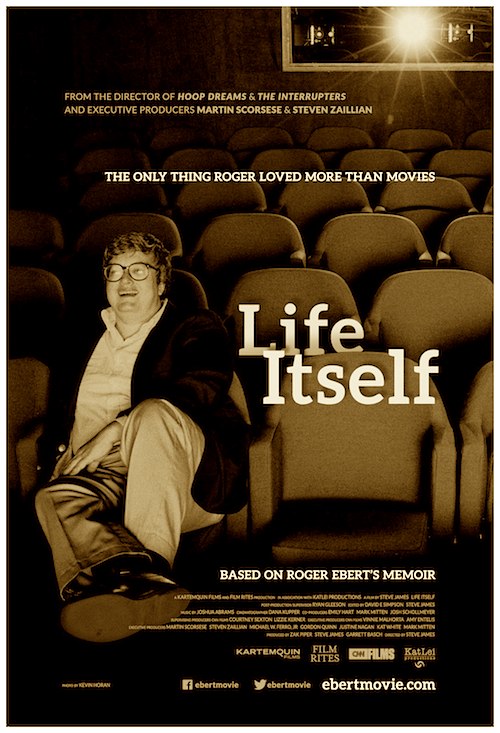
By Joe Bendel. In 1994, Siskel & Ebert helped launch Hoop Dreams towards its Sundance success with an unprecedented early review that aired during the first weekend of the festival. Twenty years later, Sundance regular Steve James returns again with a documentary tribute to his frequent champion, Roger Ebert. An affectionate profile produced with the cooperation of the Chicago Sun-Times critic during his final days, James’ Life Itself, which screens today as part of the 2014 Sundance Film Festival.

Taking its oddly uncinematic title from Ebert’s memoir, Life focuses on Ebert, but his longtime co-host Gene Siskel naturally figures significantly throughout the film. Frankly, many viewers may well feel like the two critics should have had equal billing, but perhaps Ebert finally got one over on Siskel in that respect.

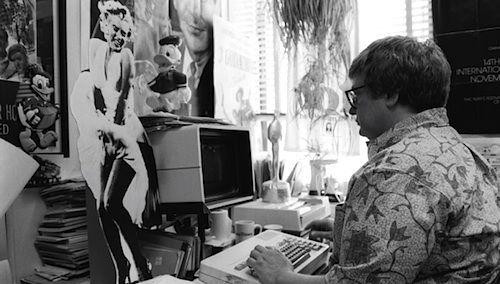
As the editor of the University of Illinois at Urbana-Champaign student newspaper, Ebert was not shy about expressing his left-of-center opinions. It would also help him fit in at the Sun-Times upon graduation. Like many entry level journalists, Ebert started out doing utility infield work at the paper, such as death notices and crime reports. When the movie critic resigned, he was assigned the beat rather off-handedly, because it was not considered a high profile gig. Pre-Kael newspaper film criticism often used generic bylines to accommodate multiple anonymous contributors. Of course, Ebert and his Pulitzer Prize for criticism would help change matters.

James devotes a fair amount of time to Ebert’s cub journalist years (which are reasonably interesting) and resolutely faces up to his naughty collaborations with sexploitation pioneer Russ Meyer (that are downright fascinating). He also intersperses the biographic business with footage of Ebert’s slow decline during the early months of 2013.

However, most viewers will be interested first and foremost in his years co-hosting movie review programs with Siskel. While James does not skimp on clips from the various incarnations of their show and prominently features the reminiscences of Siskel’s widow, their contentious partnership arguably could have been even higher in the mix. After all, it is through their television appearances that most viewers would have come to know Ebert.

From "Life Itself."

In fact, it is a wistfully nostalgic experience watching them argue and dispense thumbs. Life indeed reminds us what a comfortable presence S&E were on our idiot boxes. The influence they exercised over movie-going tastes and preferences will probably never be replicated.

Granted, James handles the scenes of the failing Ebert with tremendous sympathy, but they threaten to overwhelm the celebration of his life with uncomfortable hospital scenes. We come to understand why Ebert wanted to be so forthcoming about his health, but all the details do not have to be on-screen.

If you are wondering, Ebert’s in/famous North review did not make the cut. Maybe it will be on the DVD. Regardless, it is rather nice to see a movie that considers film criticism a worthy endeavor. Recommended for those who can never get enough movie nostalgia, Life Itself screened at this year’s Sundance Film Festival.

LFM GRADE: B

Posted on January 27th, 2014 at 4:15pm.

LFM Reviews Calvary @ The 2014 Sundance Film Festival

From "Calvary."

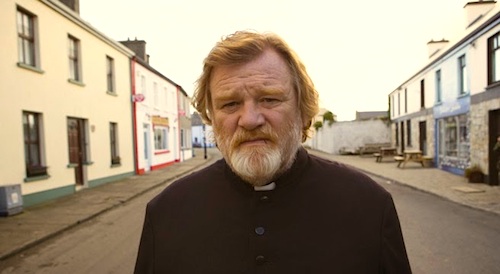
By Joe Bendel. Whenever we see a picturesque Irish village with a curmudgeonly priest we are conditioned to automatically think quaint little comedy—the kind in which old people might get naked. This will be a much darker affair. Reuniting with Brendan Gleeson, The Guard helmer John Michael McDonagh offers a sober meditation on faith, sacrifice, and forgiveness in Calvary, which screened as part of this year’s Sundance Film Festival.

Father James was called to the priesthood late in life, after his divorce. Considered a good man by those who know him, he is completely innocent of the church’s abuse scandals. Yet, that is precisely why a grown victim announces in confessional his intention to kill the upstanding father. Murdering a compromised priest simply would not have the same jarring effect as killing Lavelle. With the one week deadline looming, Lavelle sets out to find the disturbed parishioner amongst his shockingly jaded flock.

Perhaps fortuitously, Father James will also have to deal with his twentysomething daughter, who has come to recuperate from another suicide attempt. They will have some unusually serious and heartfelt discussions throughout the course of the film, even though Father James never reveals the death threat hanging over his head. However, McDonagh does not use the confessional seal as a thriller device. Since the mystery man never asks for absolution, Father James is free to seek the counsel of his bishop and the local dodgy police inspector. Yet, for various reasons, Father James is determined to handle the matter personally.

Given the title and the clock ticking down to Sunday, the symbolism of Calvary is almost crushing at times. Nonetheless, its exploration of religious conviction is exceptionally mature and thoughtful. Father James is a good man, but hardly a saint. In contrast, the village is almost shockingly contemptuous of his relative virtue. If the Church’s problematic response to the notorious rash of abuse scandals is the lighter fluid that ignites Calvary, the moral bankruptcy of the increasingly agnostic village is the kindling that keeps it ablaze.

From "Calvary."

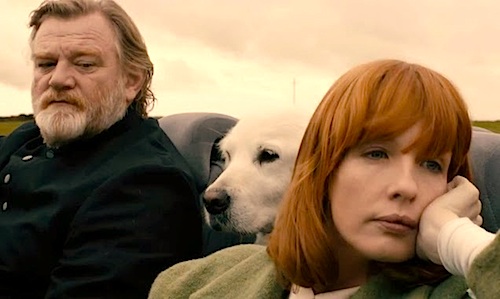
Throughout the film, Brendan Gleeson is pretty much perfect as Father James, delivering gruff one-liners, while facing a series almost Biblical trials with palpable dignity and resolution. It is a salty yet mostly understated turn that might represent a career pinnacle. Likewise, Kelly Reilly is absolutely devastating in her big scenes as his daughter. They are backed up by a diverse supporting cast, including the likes of M. Emmet Walsh and Orla O’Rourke, who always convincingly look and act like members of the dysfunctional provincial community.

At the halfway point, Calvary seems rather overstuffed with subplots and side characters, yet nearly each and every one pays off for McDonagh. It might sound like an opportunist broadside launched at the church, but its depiction of the good priest is remarkable sympathetic and nuanced. In fact, McDonagh maintains a tone much more in keeping with Bresson’s Diary of a Country Priest or Jean-Pierre Melville’s Léon Morin, Priest than the churlish score-settling of Philomena. Highly recommended (especially to those most inclined to be suspicious of it), Calvary screened as part of this year’s Sundance Film Festival.

LFM GRADE: A-

Posted on January 27th, 2014 at 4:12pm.

LFM Reviews Blue Ruin @ The 2014 Sundance Film Festival

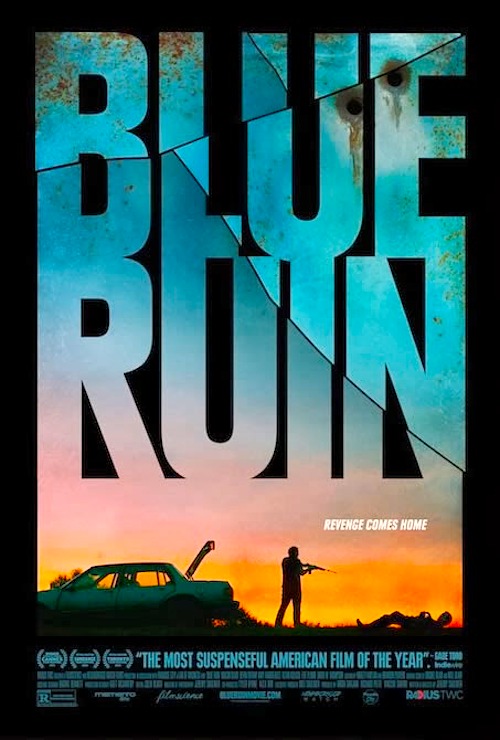
By Joe Bendel. It only takes one family to launch a feud. By the same token, an emotionally damaged drifter hopes it will only take one family member to end it. Revenge is indeed the gift that keeps on giving but never fully satisfies in Jeremy Saulnier’s Blue Ruin, which screened at the 2014 Sundance Film Festival.

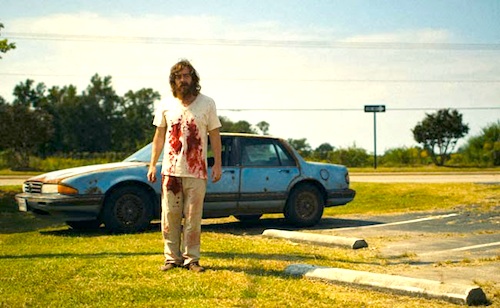
After the murder of his parents, Dwight Evans’ psyche just disintegrated. In recent years, he has survived hand-to-mouth, often living uninvited in the homes of vacationing families, until they return. Then he resumes crashing in his beat up blue four door sedan. His anaesthetized existence is interrupted by a sympathetic police officer, who informs Evans the man who killed his parents is about to be released from parole.

Will Cleland is a member of the thuggish Cleland clan. Even though they own a successful limousine rental company, they are more comfortable with back hills living. Vengeance is definitely the sort of thing they are better at, but Evans shadows Cleland from prison to his roadhouse celebration nonetheless. He is clearly an inexperienced killer, as we see firsthand when he confronts Cleland alone in the men’s room. From there, one darned thing leads inexorably to another, generating a whole lot of angst and bodies, but also threatening to engulf Evans’ estranged sister and her family.

At its essence, Ruin is equally akin to classical tragedy and hillbilly exploitation films. Saulnier’s execution is wickedly effective, showing all the awkwardness of killing and the messiness of the resulting aftermath. Frankly, some of the most inspired scenes in Ruin are the bits most films gloss over. Yet, the tension never flags, notwithstanding the occasional punctuations of gruesome humor.

From "Blue Ruin."

As Evans, co-executive producer Macon Blair is one of the most intense sad sacks you will ever see on screen. He is a palpably haunted presence, but shows flashes of inspiration, making it impossible not to root for him, despite his alarming tendency to make mistakes. He commands the film, but Devin Ratray adds some welcome attitude and general humanity as Evans’ well armed high school friend, Ben Gaffney. Eve Plumb (a.k.a. Jan Brady) is also all kinds of fierce as the ruthless Kris Cleland, thereby guaranteeing Ruin a sizable cult following.

They won’t be disappointed either Blue Ruin is a taut and evocative thriller that utilizes its southern gothic violence for comedic and elegiac purposes. It is a cooker, recommended for anyone who enjoys payback cinema. With a theatrical and VOD release coming from Radius-TWC, Blue Ruin will also screen at the SF Indie Fest on February 16th & 20th, following its Spotlight selection at this year’s Sundance Film Festival.

LFM GRADE: A-

Posted on January 27th, 2014 at 4:09pm.