LFM Reviews Elliot @ The 2014 Slamdance Film Festival

By Joe Bendel. Did the recent death of Tom Laughlin leave a vacancy for Elliot “White Lightning” Scott to become the next white, working class martial arts star? No, absolutely not. Although he aspires to be the Nova Scotian Chuck Norris, Scott’s barely-there career is only headed in one direction—due south. Viewers will understand why after watching Jaret Belliveau & Matthew Bauckman’s documentary Elliot, which premiered yesterday at the 2014 Slamdance Film Festival.

With two scruffy DIY martial arts flicks under his belt, Scott is trying to complete his most ambitious project to date, a beatdown entitled Blood Fight. Unfortunately, the production has been plagued by problems that initially do seem to be entirely his fault. Nevertheless, Linda Lum, his increasingly impatient girlfriend-slash-producer is clearly starting to have doubts about his action movie dreams and pretty much every other aspect of their relationship.

Frankly, Barney Fife had better moves than Scott, but for a while viewers will try to see him as noble dreamer, like an Ed Wood or Mark Borchardt, whose ambitions exceed their talents. However, this is not American Movie. While in China with his acupuncture class, Scott lets his yellow fever run rampant. Aspects of his not so carefully constructed backstory then start to unravel. In fact, by the time the documentary enters the third act, Belliveau and Bauckman have pretty clearly turned against their subject, which becomes quite a sight to behold.

From "Elliot."

Things get so in-your-face uncomfortable, you have to wonder if it is all an extended meta-joke in the tradition of I’m Still Here. Either way, it is dramatic stuff and a not inconsiderable feat of filmmaking, shot on location in both Nova Scotia and China. There is also a lot of humor in the film, mostly derived from Scott’s sheer brazenness and lack of self awareness.

Scott’s martial arts might be laughably amateurish (an underwhelmed Shaolin monk is obviously tempted to beat him like a drum and we sort of wish he would), but Belliveau & Bauckman practice a decidedly nimble form of cinematic jujitsu. Not exactly a film for martial art purists, Elliot is sort of like Kung Fu reality programming. Right now, the late legendary Sir Run Run Shaw is probably looking down on Scott and thinking “kid, you stink.” Yet, it is all undeniably compelling. Although it screens as part of Slamdance’s Doc Features section, it could be comfortably programmed elsewhere as a midnight movie. Recommended for anyone open to a bit of Canadian bizarreness, Elliot screens again this Monday (1/20) as part of this year’s Slamdance in Park City.

LFM GRADE: B+

Posted on January 18th, 2014 at 5:41pm.
LFM Reviews Ernest and Celestine @ The 2014 Sundance Film Festival

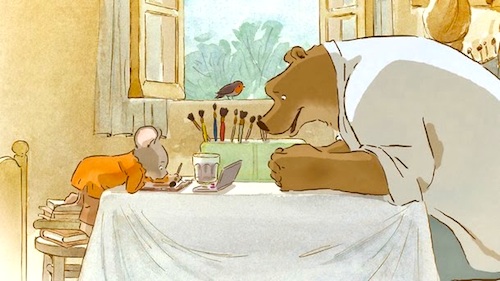
By Joe Bendel. Yesterday was a happy morning for a Belgian bear and mouse. Based on Gabrielle Vincent’s children’s books, it was always considered another serious animated Oscar contender from GKIDS – and on top of its Academy nomination, Benjamin Renner, Stéphane Aubier & Vincent Patar’s Ernest and Celestine now also holds the distinction of being one of the first two films selected for the inaugural Sundance Kids section at the 2014 Sundance Film Festival, which kicked off  Thursday night in Park City.

Bears live above ground, in a human-like state of middle class respectability. The mice live below, toiling away in a Dickensian subterranean city. Neither Ernest the busking bear nor Celestine the artistic mouse fit comfortably within their respective communities. Like most mice, Celestine is expected to scavenge coveted bear’s teeth from the surface world for the mice dentists, who sit atop the social order down below. Naturally, she is terrible at it. However, a chance encounter with Ernest leads to some rare cross-species collaboration—teeth for Celestine and food for Ernest.

Alas, word of their scandalous association leads to pariah status for them both. Yet, for a while they live happily together as outlaws in Ernest’s remote forest bungalow. Of course, neither the world of mice nor bears will be content until they are apprehended. Still, that will be the best opportunity for E&C to teach them a lesson in tolerance.

From "Ernest and Celestine."

E&C’s hand-drawn animation has an elegant, old European feel that is refreshingly nostalgic. While sometimes the message is laid on with a heavy hand, the vibe is usually quite gentle and sweet. Frankly, one would never expect such a graceful and well intentioned film from Aubier and Patar, the team behind the anarchic bedlam of the Town Called Panic franchise, but here it is—and it is indeed a fine work of animation. Their figures are expressive and endearing, but not cloyingly cute. Jazz cellist Vincent Courtois’s lightly buoyant score also reinforces the sophisticated atmosphere.

While only the celebrity English version of C&E will play at Sundance (featuring Forest Whitaker as Ernest), its announced March release will also include select subtitled screenings of the original French (with Lambert Wilson gruffly giving voice to Ernest). Visually it is an absolute charmer and the characterization is strong enough to overcome the not so subtle teaching moments. Recommended for all children and fans of animation, Ernest and Celestine screens this Saturday (1/18) and next Saturday (1/25) in Park City, as well as this Sunday (1/19) in Salt Lake, as part of this year’s Sundance Film Festival.

LFM GRADE: B

Posted on January 18th, 2014 4:17pm.

LFM Reviews Whiplash @ The 2014 Sundance Film Festival

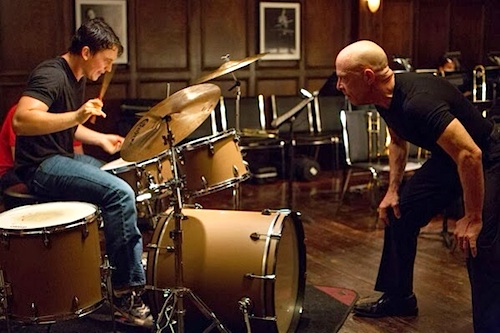
From "Whiplash."

By Joe Bendel. The late lamented IAJE’s annual conference-jazz gathering used to be such a breath of fresh air, because you could see the enthusiasm young high school kids have for America’s great original musical art form. In the case of Andrew Neiman, there is a dark side to that passion—personified by a ruthlessly manipulative band director.  There will literally be blood on the drum kit in Damien Chazelle’s Whiplash, an opening night selection of the 2014 Sundance Film Festival.

If the nebbish Neiman and the Mephistophelean Terence Fletcher sound familiar, it is because they first appeared in Chazelle’s proof-of-concept short, which won the short film jury award at last year’s Sundance and went on to screen at NYFF. Concept proved. That harrowing trial-by-fire is replayed in the feature length Whiplash with a new Neiman, but the irreplaceable J.K. Simmons returns as Fletcher.

Forget Simmons’ character in Oz—Fletcher is far scarier. He out Buddy Riches Buddy Rich. Unfortunately, as the director of a Juliard-like music college’s concert jazz big band, he holds tremendous power to help or hinder aspiring musicians. Needless to say, when Neiman gets his first supposed shot playing with Fletcher’s Studio Band, it is a disaster. Of course, the kid is set-up to fail when he is thrown head first into Hank Levy’s “Whiplash,” a chart that looks like differential equations translated into Sanskrit. However, Neiman craves Fletcher’s approval so badly, he will work his fingers to the bone practicing the twisty flag-waver.

Whiplash the short was a nifty piece of jazz-informed filmmaking, but it exceeds all expectations as a feature. Once again, Simmons is the engine making it all run. His Fletcher is a natural cinematic successor to R. Lee Ermy’s drill sergeant in Full Metal Jacket and Jack Nicholson’s Col. Jessup in A Few Good Men—for real. Yet, there is a reason for his abusive-borderline sociopathic behavior. Even more than in the predecessor short, Chazelle’s full length script and Simmons’ performance make it clear Fletcher is always true to the music in his fashion.

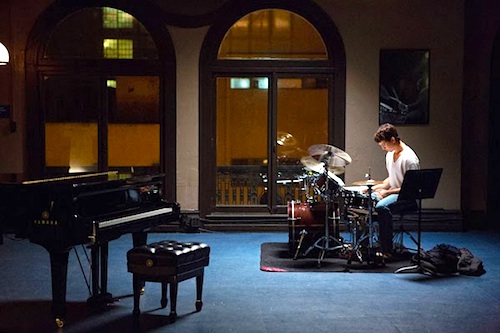
From "Whiplash."

While some might be troubled by Fletcher’s homophobic taunts (actually, you’re sort of supposed to be), this is the one area jazz has not historically been a trailblazer for tolerance. Indeed, many have compared big band outfits to military units and viewers can understand how so from many scenes in Whiplash.

To his credit, Miles Teller also really digs in as Neiman. There is nothing cute or quirky about his work. In fact, it is downright painful watching him cower and cringe. He also looks convincing with the sticks. Chazelle, the former jazz drummer, probably gave him a few pointers. After all, Whiplash is based on his own experiences with a martinet bandleader (loosely so, we can only hope).

Frankly, Chazelle has done the near impossible, getting Sony to care about jazz. It is sort of a coming of age story, but it does not exactly wrap things up in a neat little bow. Regardless, it is a major statement from Chazelle. He really opens it up as a director, staging an unusually dynamic and dramatic climatic concert. By the same token, his script rings with truth and attitude, particularly for those who are in anyway familiar with jazz education. The result is a smart, stylish film that swings like mad. Highly recommended, Whiplash screens again today (1/17), Wednesday (1/22), and Thursday (1/23) in Park City and Saturday (1/18) in Salt Lake as part of the 2014 Sundance Film Festival.

LFM GRADE: A

Posted on January 18th, 2014 at 4:13pm.

LFM Reviews R100 @ The 2014 Sundance Film Festival

By Joe Bendel. Even though filming is not even wrapped on the questionable movie adaptation of Shades of Grey, Hitoshi Matsumoto has already mashed-up the S&M melodrama genre beyond human recognition. From Japan, we have a cautionary, surreal meta-meta postmodern bondage conspiracy tale, while Hollywood is banking on a dude who wears grey ties. How quaint. In the mean time, Matsumoto subverts perversion throughout R100, which screens during the 2014 Sundance Film Festival.

Takafumi Katayama is a drab and depressed working drone who needs to unwind a little. He thinks he has found just the ticket when he joins a mysterious club for submissive men. At first, he gets the release he is seeking when the black-clad women meet him at their scheduled rendezvouses to beat him about and smash his sushi rolls (that’s not a euphemism). However, when they start showing up at his home and work, matters turn a distinctly charcoal shade of grey.

As each dominatrix escalates their encounters, Katayama starts to fear for his life and the safety of his young son and father-in-law. Then things get really weird, but not do bother complaining about logical inconsistencies. The film will provide that commentary itself.

Strictly speaking, there is no nudity or sex in R100, but it is absolutely, positively not for kids. The title is a play on the Japanese motion picture rating system that could be roughly translated as NC-100 for American audiences—and not for nothing. Yet, the film definitely seems to suggest you are begging for trouble if you go out looking for something on the deviant side of life.

From "R100."

Regardless, R100 careens so defiantly over the top, parsing its symbolic layers and potential take-away teachings becomes a head-spinning endeavor. If any of this film sounds problematic, then you should probably avoid R100 because there is way more of whatever it is that troubles you than we’ve covered so far. On the other hand, cult cinema connoisseurs looking for a new and distinctive head trip will find it here. Imagine Eyes Wide Shut transported to the world of Quentin Dupieux’s Rubber and you will start to get the idea.

Nao Omori perfectly anchors the film as the existentially put-upon Katayama. Just looking at him sort of makes you want to smack him alongside the head. However, he handles the character’s strange evolution with understated power. As his son Arashi, Haruki Nishimoto distinguishes himself as an unusually engaging young actor. Fortunately, his classmates will not be able to see R100 for a while and hopefully he will not have to take much taunting over it in later years.

R100 pushes the envelope, but it never skitters into irredeemably disturbing territory. Indeed, at some point the macro insanity trumps all of the dominant/submissive game-playing. Although decidedly one-sided, there is also some decent fight choreography in the first act for action fans. Recommended for exclusively adventurous viewers (but rather forcefully for them), R100 screens Sunday (1/19) and Tuesday (1/21) in Park City as well as this Monday (1/20) in Sundance Resort as part of this year’s Sundance Film Festival.

LFM GRADE: B+

Posted on January 18th, 2014 at 4:05pm.

LFM Reviews Oshima’s Boy

By Joe Bendel. 2013 sadly marked the passing of two pivotal luminaries of Japanese cinema. Nagisa Oshima was a true maverick auteur, whose films’ frank sexual and political content influenced generations of subsequent filmmakers. Donald Richie was a film historian and critic, as well as an experimental filmmaker in his own right, whose scholarship largely introduced the western world to Japanese cinema. They are exactly the sort of accomplished figures likely to be overlooked by the Oscar broadcast’s perennially controversial in memoriam tribute, in favor of actors from teeny-bopper TV shows with a handful of low budget horror flicks in their filmography. At least Film Forum shows better judgment and memory with their week-long engagement of Boy, which was championed by Richie as “Oshima’s finest film,” beginning yesterday (Friday 1/17).

Ten year old Toshio Omura has a school uniform, but he never attends classes. Instead, he travels throughout Japan with his grifter father Takeo and his short-sighted (in both senses) step-mother, Takeko Taniguchi, scamming motorists with fake accidents. It is always him or Taniguchi taking the flops and never the elder Omura. He just shows up later to shakedown a financial settlement. Of course, throwing one’s body in the vicinity of moving vehicles is bound to cause some bruising over time. However, the damage done to Omura’s innocence is irreparable. At times, he rebels, but he ultimately stays for the sake of his little brother, Peewee.

Oshima vividly captures just how sad and profoundly unfair it is when kids are not allowed to be kids. Without question, Master Omura is far more mature than his step-mother, with whom he has an enormously complex relationship. Shot on the streets, run-and-gun style, Oshima shows the audience Japanese society from his young protagonist’s perspective and it is hardly pretty. Nobody wants to get involved, which is why a parasite like his father stays in business so long.

From "Boy."

In the annals of child performances, Tetsuo Abe’s work as Omura should rank in the uppermost echelon. It is an exceptionally disciplined turn, packing a visceral emotional punch. As an added bonus, he displays uncommon screen chemistry with pitch perfect one year old Tsuyoshi Kinoshita as Peewee. They have scenes together that will rip your guts out. Likewise, as Taniguchi, Akiko Koyama (Oshima’s off-screen wife and his frequent co-star in films like the classic Empire of Passion and the under-revived Ceremony) is agonizingly vulnerable and absolutely maddening in equal measure.

In contrast, Fumio Watanabe is largely lost in the shuffle as the pedestrian lout of a father, but this is unquestionably the boy’s film, not his father’s. Frankly, it is rather remarkable Koyama and little Kinoshita register so strongly.

Despite Oshima’s auteurish flourishes, periodically shifting from vivid color to black-and-white or gold tinted stock, the inspired-by-a-true-story Boy always feels uncomfortably real. It is a bracing film, yet it is also deeply humanistic. Cinematographers Seizô Sengen and Yasuhiro Yoshioka frame some striking images and their use of color is often dramatic, but they never overwhelm the film’s vibe of lonely melancholy. Justifiably hailed by the late Richie, Boy is a powerful masterwork, recommended for all serious film lovers as it opens in New York at Film Forum.

LFM GRADE: A

Posted on January 18th, 2014 at 2:52pm.

LFM Reviews Pur @ The 2014 New York Jewish Film Festival

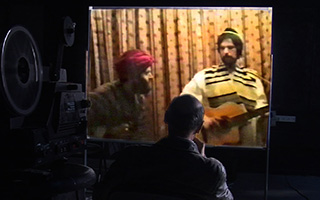
From "Pur."

By Joe Bendel. Soviet Jewry faced systematic discrimination and religious persecution. Yet policies of segregation inadvertently facilitated an organized form of Jewish celebration and resistance. Naturally, none of the large state universities would admit Jewish students, but Meit College would. It was there that a core group of students met and began staging underground productions of the traditional Purim Spiel pageant. Anat Vovnoboy captures the oral history of the Purim Spiel veterans as they watch surviving footage of their Purim Spiel performances in her short documentary Pur, which screens during the 2014 New York Jewish Film Festival.

Frankly, recording the Purim Spiel shows on amateur home video was a potentially dangerous practice, but history is much richer as a result. As one of the participants notes, many of the early Communist leaders were Jewish, yet the revolution was followed by a pogrom that never really abated. Few of Vovnoboy’s interview subjects were raised with any sense of what their Judaic heritage meant. They more or less learned together as a loose group of constructively rebellious college students.

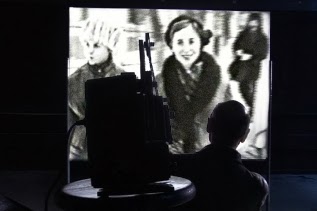
From"Pur."

While they were not all necessarily Refuseniks per se, the Purim Spiel celebrants’ rediscovery of Judaic tradition largely coincided with the Refusenik movement addressed in NYJFF’s excellent opening night film, Friends from France. Indeed, there were real risks involved for the Purim celebrants, several of whom would see the insides of Soviet prisons and interrogation rooms. As a result, many of the lyrics of the program, such as “How did they let such a blood thirsty tyrant put a crown on his head” take on perilous political dimensions. In fact, the Purim Spiel rather forthrightly addressed topical issues, even lampooning Saddam Hussein in its final installment.

More than just talking heads, Vovnoboy is blessed with a cast of insightful and often witty interviewees. Listening to their reminiscences is a pleasure. She also displays a keen eye for telling archival footage. There is no question this material could be expanded into a feature treatment, but for now it is a very good short doc. Highly recommended, Pur screens with the intriguing Before the Revolution this coming Monday (1/20) and Tuesday (1/21) at the Walter Reade, as part of this year’s NYJFF.

LFM GRADE: A

Posted on January 18th, 2014 at 2:44pm.