LFM Reviews Amy Winehouse – The Day She Came to Dingle @ The 2014 New York Jewish Film Festival

By Joe Bendel. Tragically, Amy Winehouse passed away only two and a half short years ago. Could she already be due for a critical reassessment? A case could be made based on the stripped down and surprisingly soulful set recorded live for the Irish music television series, Other Voices. Indeed, the intimate setting suited her sensibilities, judging from Maurice Linnane’s Amy Winehouse—the Day She Came to Dingle, which screens during the 2014 New York Jewish Film Festival.

Produced in a small Anglican church in the remote Irish coastal city of Dingle, Other Voices has become an unlikely launching pad for many top UK performers. Saint James is a small space, with a maximum capacity of eighty. There is no avoiding the audience, but the right performer can feed off their energy. Winehouse seemed to get that. In 2006, when still in the process of breaking through internationally, she performed a set of what are now her greatest hits, with only guitarist Robin Banerjee and bassist Dale Davis backing her.

In between the six full numbers, Day cuts to excerpts from the no gossip-all music interview John Kelly conducted with Winehouse that might surprise many people. When asked about her influences, Winehouse primarily discusses jazz artists, such as Thelonius Monk and Sarah Vaughan (who is also seen in a vintage performance of “I Got It Bad,” as a pleasant bonus). She is also clearly knowledgeable about the UK jazz scene, singling out Soweto Kinch as a current favorite, so give her credit for that too. Evidently she started in jazz and even still played private duo gigs with a piano accompanist as late as 2006.

From "Amy Winehouse - The Day She Came to Dingle."

When watching Day, one gets the sense Winehouse might have been happier playing smaller, upscale jazz clubs than arenas and massive festivals like Glastonbury. While her Dingle repertoire is arguably more closely akin to 1960’s soul and girl groups, “Love is a Losing Game” has a bit of jazz rhythm to it, making it one of the highlights of the set. However, the stark arrangement of “Back to Black” is a defining standout and rather spooky sounding in retrospect.

At one point, Winehouse helpfully reminds viewers of her Russian Jewish heritage, thereby explaining why Day is a selection of this year’s NYJFF. It is a bit of a curve ball, but receptive viewers might find the manageable one hour program boosts their appreciation of Winehouse. After all, nobody from Dingle has a critical word to say about her, including Saint James’ Rev. Mairt Hanley and the old fellow who picked her up at the airport.

An entirely positive addition to her recorded legacy, Amy Winehouse—the Day She Came to Dingle is recommended for Winehouse fans and those who follow British pop music in general. While it is surely destined to be released on some format here in America, it has its New York premiere this coming Tuesday (1/14) and Wednesday (1/15), screening with the short film First Lesson in Love at the Walter Reade Theater.

LFM GRADE: B

Posted on January 9th, 2014 at 9:02pm.
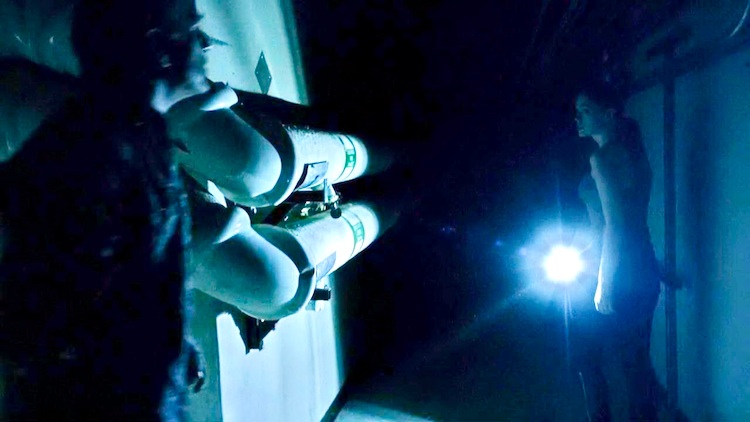
Lovecraftian Fear and Loathing: LFM Reviews Banshee Chapter

By Joe Bendel. This film probably could not have been made while Hunter S. Thompson was alive. As a gun nut with a taste for experimental drugs and paranoid politics, anti-hero Thomas Blackburn is conspicuously modeled on the gonzo journalist. Thompson might have issued a shotgun rebuttal – or he might have been amused by it all. In fact, Blackburn is by far the best thing going for Blair Erickson’s murky conspiracy horror movie, Banshee Chapter, which opens this Friday in select cities.

For the sake of his gonzo-ish book, James Hirsch plans to sample an industrial form of MDMA used in the CIA’s ill-conceived MK-ULTRA mind control experiments. It is all for the sake of journalism, mind you. Long story short: bad trip. After Hirsch mysteriously disappears, leaving behind only some expository video tapes, his former ambiguous college friend Anne Roland sets out to track him down.

The synthesized drug was supplied to Hirsch by “Friends in Colorado,” which is a transparent alias for Blackburn. When Roland tracks down the anti-social novelist, he tricks her into partaking some of his associate’s freshest batch. That also leads to a bad trip—of supernatural dimensions. In fact, Banshee is actually based on H.P. Lovecraft’s short story “From Beyond,” which we can glean because Blackburn helpfully takes time out to tell the tale to Roland.

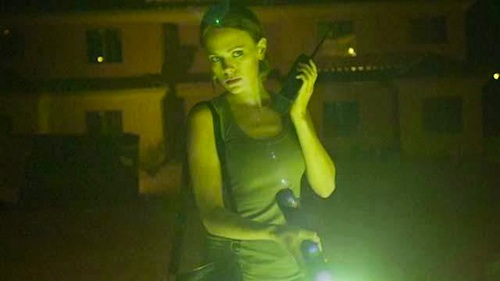
From "Banshee Chapter."

Veteran character actor Ted Levine (recognizable from Silence of the Lambs and about a jillion others films and shows) is frankly kind of awesome as Blackburn. Listening to him snarl and snark is a blast. As an added bonus, Katia Winter’s Roland is a reasonably intelligent and forceful genre protagonist. Unfortunately, it takes forever to get the two together.

Overly determined to establish Banshee’s inspired-by-real-events bonafides, Erickson shows us clip after clip of archival press conferences and congressional hearings, as well as his found footage dramatizations of MK-ULTRA experiments gone wrong. As a result, the first third of the film has the feel of a cheesy old Syfy Channel special.

Of course, once the narrative finally starts it makes no sense whatsoever. Somehow the CIA “Numbers Stations” are bafflingly involved in the cosmic skullduggery, but the logic is sketchy. About all that’s missing are Area 51 and the Grassy Knoll. Clearly, Erickson has more talent for dialogue than plot development. Levine chews on some great lines, but when Banshee ends, viewers will be wondering what that was all about. Genre fans will probably get a kick out of Blackburn on Netflix, but there’s not enough there there to justify theatrical ticket prices. For diehard Lovecraftian conspiracy junkies, it opens tomorrow (1/10) in Los Angeles at the Arena Cinema (and has already released on VOD).

LFM GRADE: C+

Posted on January 9th, 2014 at 8:58pm.

The Anime Rebuild Continues: LFM Reviews Evangelion 3.0

By Joe Bendel. There is nothing like partially destroying the world to cause an existential crisis. Shinji Ikari was always a moody kid, but he is in for the mother of all guilt trips. The franchise that rejuvenated mecha anime returns with the third installment of Hideaki Anno’s feature anime “rebuild” series, Evangelion 3.0 You Can (Not) Redo, which screens this Friday in New York.

If you saw 2.0, you might be somewhat surprised to learn that the climactic battle did not turn out so well, but not as surprised as Ikari. He will have quite a rude awakening from fourteen years of suspended animation. His former protector, Misato Katsuragi, is now the leader of WILLE, an outfit explicitly opposed to his father’s NERV—and she apparently hates his guts. A lot of people do, including his former hotshot comrade-in-arms, Asuka Shikinami. Nobody will spell it out for him, but they are all adamant he should never step inside an EVA battle bot again.

As a result, he is more than willing to desert WILLE for NERV when offered the chance, particularly since the getaway EVA is piloted by Rei, whom Ikari thought he had saved at the end of 2.0. She has changed though, whereas his father is the same old cold Machiavellian. At least Ikari makes a new friend in Kaworu Nagisa, with whom he plays four-handed piano and learns the full devastating extent of the Third Impact he inadvertently hastened.

From "Evangelion 3.0."

Given the fourteen year time jump, 3.0 ought to be a convenient entry point to the series, but it actually feels denser than the previous two outings. It is definitely a middle film, ending more with a lull in the action than any sense of closure. While he was never a barrel of laughs, Ikari’s mopiness becomes almost insufferable. On the plus side, Shikinami really comes into her own as an anime action role model for girls. Listening to her tear into Ikari is good, sort of clean, cathartic anime fun.

As usual, the art of 3.0 remains several cuts above the industry standard. This time out, writer-chief director Anno cranks up the apocalyptic elements something fierce, but somehow the religious overtones do not feel as pronounced. The complete lack resolution will frustrate casual viewers, but fans will dig the metal-on-cosmic metal action (they should also stay for the teaser-stinger). Recommended for anime connoisseurs who appreciate the intricate series mythology and Shikinami’s attitude, Evangelion 3.0 screens this Friday (1/10) at the Big Cinema Manhattan, Saturday (1/11) at the Yonkers Drafthouse, and Saturday (1/11) and next Tuesday (1/14) at the Village East, as well as other select theaters throughout the country.

LFM GRADE: B-

Posted on January 8th, 2014 at 11:41am.

Amnesiac Hitmen in Love: LFM Reviews Key of Life, Now on DVD

By Joe Bendel. All movie lovers know amnesia and romance go together like fish and chips. Yakuza not so much, but they are all part of the mix in screenwriter-director Kenji Uchida’s understated rom-com, Key of Life, which releases today on DVD from Film Movement.

The mysterious Shinichiro Yamazaki (professional handle: Kondo) has just taken out an unfortunate businessman. Despite his protective garb, the hitman has a discrete dab of blood on him. He is also somewhat sweaty, so he heads for a public bath, where he promptly slips on a bar of soap and cracks his head. Seizing the opportunity, suicidal loser-actor Takeshi Sakurai grabs his keys and clothes, while an ambulance whisks him off to the hospital. When Sakurai finally resolves to face up to the well heeled Yamazaki, he finds the man has no memory of his past life. Although he still feels a tiny bit guilty, Sakurai continues impersonating Yamazaki, blissfully unaware of the man’s dangerous line of work.

Meanwhile, book publishing executive Kanae Mizushima gives herself a short deadline to find and marry a reasonably respectable man. She has her reasons. Sakurai, as Yamazaki erroneously presumes himself to be, seems like a poor prospect. Yet a chance encounter leads to possible romance for the two meticulous souls. Of course, all sorts of complications are lurking around the corner, many of them involving the Yakuza who has a rather distasteful follow-up gig for Kondo.

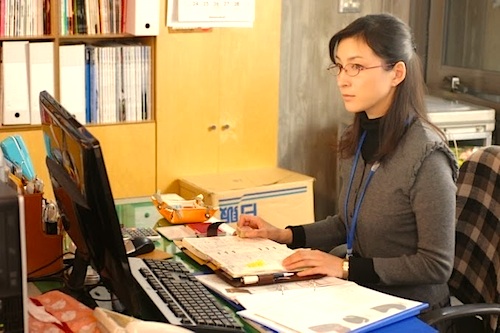
From "Key of Life."

On paper, Key sounds like a whizbang screwball comedy, but Uchida’s execution is surprisingly quiet, laidback, and mature. Recognizing a good thing going on, he allows plenty of time for the ambiguously romantic relationship between Mizushima and the real Yamazaki to unfold. He juggles a gracious plenty plot points, yet Key is first and foremost a rom-com that excels at the rom.

Prolific character actor Teruyuki Kagawa is absolutely pitch-perfect as Yamazaki (assuming Sakurai’s identity), conveying all his world weary soulfulness, while still springing all his character’s revelations like the crafty pro he is. Likewise, Ryoko Hirosue (sort of the Japanese Sandra Bullock, probably still best known internationally for her supporting turn in the Oscar winning Departures) is exquisitely demur and sensitive as the reserved Mizushima. Together, they develop some unusually fresh and deep screen chemistry. Unfortunately, Masato Sakai’s real Sakurai looks like quite the weak link in comparison, but at least he delivers one memorable extra-base hit late in the third act.

Even though Uchida maintains an appealingly light and easy-going vibe, Key has far more heft than the average comedy of any sub-genre. It is a film that appreciates the awkward ways people relate to each other. Witty, romantic, and greatly satisfying, Key of Life is highly recommended for general audiences. It is now available on standard DVD from Film Movement.

LFM GRADE: A

Posted on January 7th, 2014 at 8:20pm.

Jet Li Supervises: LFM Reviews Badges of Fury, Now on DVD/Blu-ray

By Joe Bendel. Jet Li’s Huang Fei Hong is sort of the Sergeant Murtaugh of the Hong Kong police. He is definitely getting too old for this sort of thing, but unlike his Lethal Weapon counterpart, he always punches out promptly at 5:00 and disappears for long stretches. That leaves most of the slapstick to his younger colleagues. Seniority has its privileges. Still, whenever Huang returns for a throw down, things perk up dramatically in Wong Tsz-ming’s Badges of Fury, which releases today on DVD and Blu-ray from Well Go USA.

Huang is a crafty old salt who is more interested in his retirement portfolio than office politics. Wang Bu-er thinks he’s all that, but has an uncanny talent for self-sabotage. Their young, insecure team leader has paired them together in the hope some of Huang’s mature risk-aversion will rub off on Wang. So far, it is not taking. Wang just keeps blundering ahead, inadvertently aiding the escape of the wanted criminal Huang nearly captures in the spectacular opening action sequence.

However, Badges is not really about the fugitive Chen Hu. Frankly, it keeps changing its mind, but the preponderance of the narrative involves the investigation of the so-called “Smile Murders.” Each of the victims died with a strange smile plastered across their faces. It turns out they were also all once engaged to low budget starlet Liu Jinshui. Quickly, Liu falls under suspicion, but her half-sister Dai Yiyi appears far more dangerous, given her obvious va-va-voom.

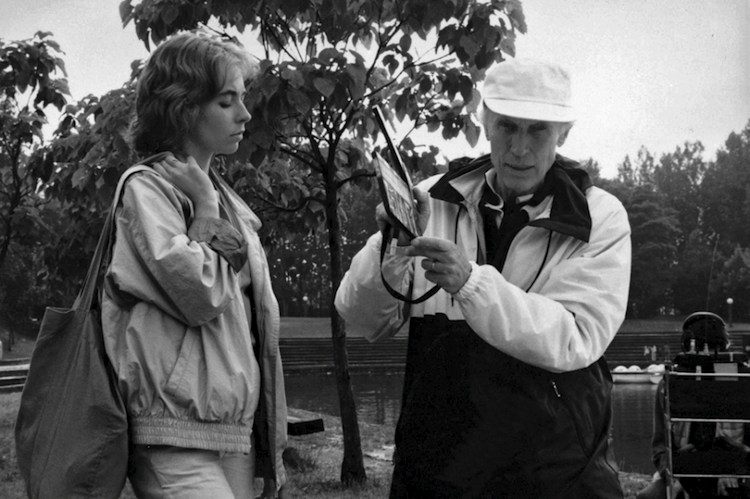
From "Badges of Fury."

When Badges goes for laughs, it can be painful. However, action director Corey Yuen embraces the film’s cartooniness, unleashing his inner Itchy and Scratchy for some absolutely off-the-wall fight scenes. In the big opener and closer, Jet Li shows he still has his mojo. It is too bad there isn’t more of him as the steely Huang. Unfortunately, his Ocean Heaven co-star Wen Zhang kind of stinks up the joint with his shtick. Rising star Michelle Chen (so memorable in Ripples of Desire) is also clearly out of her element as their exasperated superior. At least, Ada Liu vamps it up with gusto as the femme fatale sister.

As if Badges were not inconsistent enough, it also shoehorns in more cameos than the director’s cut of It’s a Mad, Mad, Mad, Mad World. Sometimes it works great, as when action star Wu Jing shows up to rumble as an insurance investigator. Other times, it can be a rather head-scratching distraction for viewers not up on their Hong Kong reality television. Still, it is always pleasant to see Lam Suet, Stephy Tang, Josie Ho, and Grace Huang on-screen.

When it clicks, Badges is a martial arts machine. When it doesn’t, it is usually dabbling in romantic comedy. Still, Jet Li and Wu Jing’s chops, Yuen’s gravity-defying fight choreography, and Liu’s sex appeal should be enough to hold HK action junkies’ interest on DVD. Recommended for fans, but not as a Jet Li entry point, Badges of Fury is now available for home viewing from Well Go USA.

LFM GRADE: C+

Posted on January 7th, 2014 at 8:18pm.

LFM Reviews Rohmer in Paris @ First Look 2014

By Joe Bendel. His professional pseudonym was derived from Sax Rohmer, but Éric Rohmer is not known for genre pictures. Aside from the occasional well regarded period piece, he remains most celebrated for work within the comedy of manners rubric and his intimately observed relationship dramas. This hardly seems the stuff to inspire obsessive analysis in the tradition of Room 237, but Richard Misek proves the Rohmer canon rewards such close critical scrutiny in his docu-essay Rohmer in Paris, which has its American premiere this Saturday as part of the Museum of the Moving Image’s annual First Look.

The epicenter of Misek’s film is the Tim Hotel in Paris. It was there the potentially adulterous lovers in Rohmer’s Rendezvous in Paris were to have their assignation, only to spy their respective spouses arriving together on a similar mission. As fate would dictate, Misek was also at the Tim Hotel that day and inadvertently found his way into a few frames of Rohmer’s film. Realizing his presence in Rendezvous years after the fact, Misek began binge viewing Rohmer’s filmography.

Obvious commonalities are immediately apparent. Rohmer’s characters are largely Parisians, either in Paris proper or on holiday in the countryside. Chance meetings are commonplace and everybody walks incessantly. As a result, Rohmer’s films document the development of modern Paris, particularly his beloved Left Bank. Considered collectively, his work becomes something of a Möbius strip of characters in motion, crossing over but not interacting with their counterparts from other films.

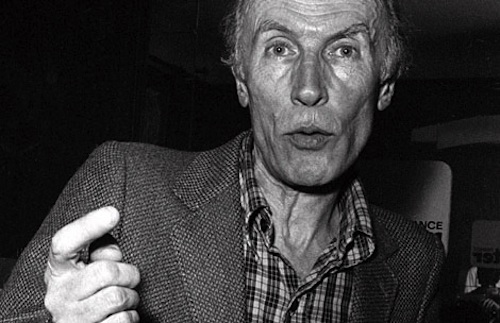
Eric Rohmer.

Cleverly edited by Misek, RIP largely (but not quite entirely) consists of clips from Rohmer films that vividly illustrate his points. While Misek’s commentary is clearly informed by Post-Structuralist critical theory, he never loses sight of the exquisite human dimension to Rohmer’s film. Indeed, he is absolutely brimming over with compassion for the enigmatic subject of Rohmer’s short documentary Nadja in Paris.

RIP probably sounds like indulgent film geekery and perhaps it is, but it is also unfailingly pleasant, conscientiously respectful of Rohmer (and the legacy of classic film in general), and weirdly touching. Misek even wraps things up in a Rohmer-esque ending, which is quite a trick for a documentary.

There is no getting around RIP’s scholarly roots, but it is still easily accessible to anyone interested in Eric Rohmer. It might not hold mass market appeal, but it is a very good film. Most importantly, Misek leaves viewers wanting to re/watch Rohmer’s remarkably accomplished oeuvre, which is always the acid test for a film like this. It also happens to be relatively concise (under seventy minutes), so MoMI will screen it with The Bakery Girl of Monceau, one of Rohmer’s shorts discussed in detail during RIP. Recommended rather enthusiastically to Rohmer fans and postmodernist film students, Rohmer in Paris screens this Saturday (1/11) as part of MoMI’s First Look in Astoria, Queens.

LFM GRADE: A-

Posted on January 7th, 2014 at 8:15pm.