Back to Clean Up New York Again: LFM Reviews Abel Ferrara’s Ms .45

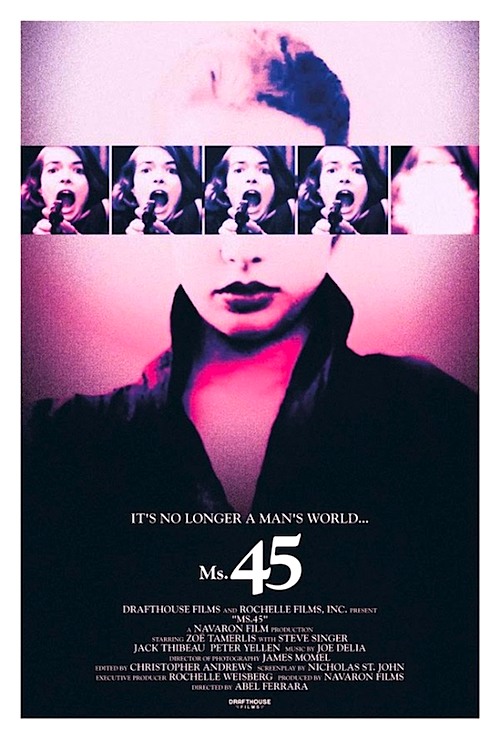
By Joe Bendel. You know any film that gives a shout out to the Guardian Angels in its closing credits is the product of a very specific time and place. Obviously, this is New York, but not just pre-Giuliani. It is also pre-Dinkins during the first Koch administration. Things are pretty rotten, but they will improve a bit, only to get considerably worse before America’s Mayor turned the city around. However, one violent crime victim does not have twelve years to wait for the City to become livable again. She is determined to clean the town up, one male predator at a time, in Abel Ferrara’s exploitation favorite, Ms .45 (trailer here), which Drafthouse Films rereleases tonight in New York at the IFC Center.

Thana is an apparently mute seamstress who simply wants to be left alone to live her modest dormouse existence. Then one night after work, she is sexually assaulted on two separate occasions. The second was a home invader, whom she successfully fights off. He will now be leaving her apartment in pieces. She also takes possession of his gun and its seemingly endless supply of bullets. The first time she uses it out of panic, but killing lowlife scum soon gets to be a compulsion for her.

Right, so let the body count begin. Frankly, it is easy to see both why critics initially loathed Ms .45 and how it subsequently developed a rabid cult appreciation. The film shows Ferrara’s gritty street level aesthetic at its absolute rawest, but he also displays a surprisingly keen eye for visual composition. The concluding conflagration’s Texas-sized Freudian imagery is especially bold.

Ostensibly, Ms .45 functions as a feminist-empowerment vigilante exercise, yet the film’s gender politics are rather slippery on closer examination. Always a little off, the increasingly agitated Thana begins to conflate any innocent expression of male sexuality with violent sexual aggression, which holds potentially horrific implications. It is tempting to interpret her choice of Halloween costume—a nun’s habit—as a commentary on feminist Puritanism. Or perhaps Ferrara was just trying to offend Catholics. Regardless, you have to respect a film with something to appall everybody.
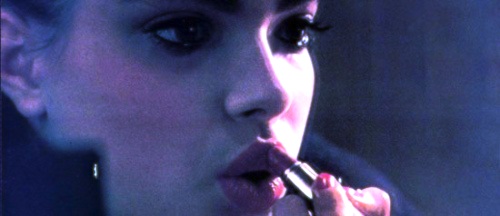
From "Ms .45."

Ferrara’s future Bad Lieutenant co-writer Zoë Tamerlis Lund fits the part of Thana disturbingly well (especially given her sadly premature end). She projects all kinds of vulnerability but is simultaneously spooky as all get out. Despite the film’s deliberate sleaziness, there are fine dramatic moments in 45, particularly Lund’s tragically ironic scene with a bar patron played by Jack Thibeau.

When watching Ms .45, it is hard to shake the uneasy feeling we are looking two years into the future of the de Blasio administration. At least the music is funky, featuring some first class studio cats, like Artie Kaplan. Amusingly, the instrumentation heard on the soundtrack does not always match the musicians seen on-screen, but so be it. This is not the sort of film where one should obsess over small details. Instead, it is an opportunity to see Ferrara truly in his element, serving up the vicarious guilty pleasures of street justice. Recommended for cult film connoisseurs, the lovingly restored Ms .45 screens this weekend (12/13 & 12/14) midnight-ish at the IFC Center in New York and a tad earlier at the Alamo Drafthouse in Yonkers.

LFM GRADE: B+

Posted on December 13th, 2013 at 7:36pm.
It Happened in Park City: LFM Reviews The Crash Reel

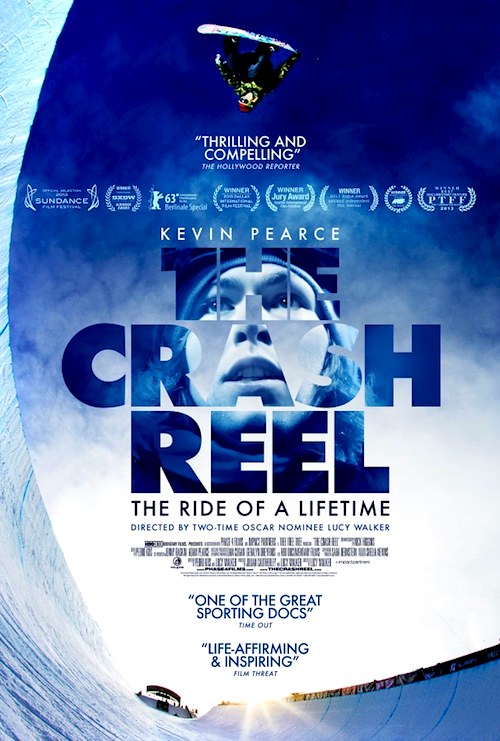
By Joe Bendel. If they are smart, organized snowboarding and other extreme sports will get proactive about preventing serious brain trauma, like that suffered by Olympic prospect Kevin Pearce. Or they can just bury their heads in the sand like the NFL. Anyone care to lay odds on which course they take? Perhaps Oscar nominated filmmaker Lucy Walker will shift the needle a bit with her HBO produced documentary profile of Pearce, The Crash Reel, which opens today in New York at the IFC Center.

Pearce was sort of the Zenned-Out Natural, who generated jaw-dropping amplitude on his runs. His friend-turned-rival Shaun White is depicted as the Ice-Man of snowboarding, who never made a mistake, but lacked Pearce’s indefinable X-factor. While White was a driven lone wolf (or so he appears), Pearce led a free-spirited group of competitive snowboarders known as the “Frends,” because there is no “i” in there. Then during a fateful training run in Park City (a town which holds continuing significance throughout the film), Pearce took a fall that is truly sickening to watch.

Obviously, this changes everything. It is a slow process, but Pearce begins to the recover physically and mentally. However, several individuals tangentially related to Pearce are not so fortunate. In fact, their sad intersecting stories provide some of Reel’s most poignant moments. Yet, despite these tragic examples and the objections of his family, Pearce remains determined to make his competitive return.

Walker is a talented filmmaker, who really should have taken home the Oscar for The Tsunami and the Cherry Blossom. She skillfully broadens Reel’s focus, without turning it into an outright advocacy PSA. Walker and her team also culled through a remarkable wealth of archival and privately recorded video clips. Say what you will about extreme sports athletes, but they certainly document themselves thoroughly. Unfortunately, they are not always wildly interesting as interview subjects. Ironically, White is probably the most engaging on-camera presence, aside perhaps from another extreme skiing colleague, whose appearances take on tragic implications in the third act.

As fate would have it, Walker first met Pearce at an unrelated Sundance event and eventually premiered Reel at this year’s festival. Yet, one wonders how the Park City snow sports industry will appreciate their unflattering role in the film. Granted, the road-back section drags a bit from time to time, but there is clearly a reason why every scene was included. Indeed, it would make an effective (if somewhat depressing) double feature with Steve James’ Head Games. Recommended for fans and critics of snowboarding and related sports, The Crash Reel opens theatrically today (12/13) at the IFC Center.

LFM GRADE: B

Posted on December 13th, 2013 at 7:33pm.

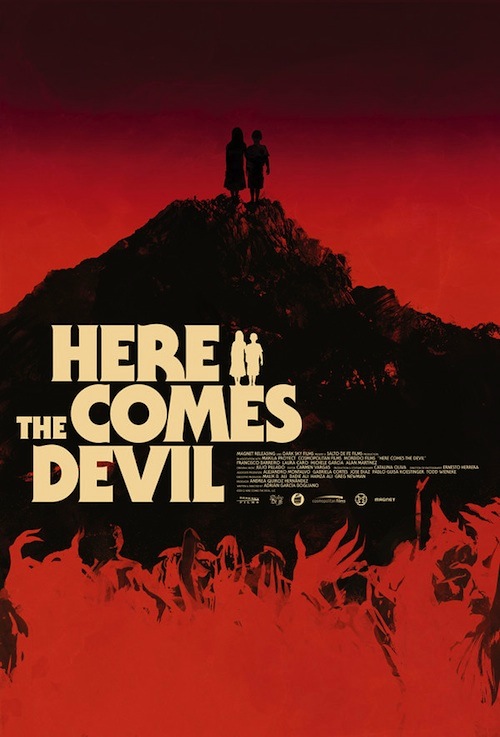
There’s Something Wrong with Kids This Quiet: LFM Reviews Here Comes the Devil

By Joe Bendel. It starts with a gratuitous sex scene, closely followed by a generous helping of gratuitous violence. Obviously, there is no call for subtlety here. Whether or not it really is Old Scratch stirring up mischief or the demonic spirit of a notorious serial killer hardly matters. Either way there will be big trouble in Adrián García Bogliano’s Here Comes the Devil, which opens today in New York.

In time, the prologue will make more sense, as is often the case with good prologues. For the time being, our story revolves around Sol and Félix, two reasonably humdrum parents on holiday with their adolescent son and daughter. To squeeze in some adult quality time, they let Sara and Adolfo go explore a nearby craggy hill. When they are not back by the appointed time, panic and recriminations replace passion. Making matters worse, this particular corner of northern Mexico seems to have some sort of sinister history.

When the kids suddenly turn up the next morning, everything seems to be okay. Yet, they now seem strangely distant. Initially, Sol and Félix fear something might have happened with the slow-witted man they caught suspiciously eying Sara at the gas station at the foot of the hill. However, it becomes increasingly difficult to rationalize away all the uncanny incidents occurring around the house.

Devil is sort of like a throwback to 1980’s horror films, but with a taste for post-2000 excess. Ironically, it probably has more sex than blood, but it still definitely is not for the squeamish. Regardless, Bogliano creates a profoundly creepy atmosphere, nicely building off the somewhat confused but still intriguing backstory.

Mexican pop idol Laura Caro makes a surprisingly strong horror movie mom and Francisco Barreiro (also seen in the original We Are What We Are) is at least sufficient to the task as the more passive Felix. Befitting its genre status, Devil also features several small but memorably colorful supporting turns, such as Enrique Saint Martin as the severe-looking gas station manager, who might know only too well just what is going on here.

Devil’s midsection actually boasts some rather inspired developments that definitely set it apart from the field. Bogliano makes the most of his ominous yet seemingly everyday locales (filmed in Tijuana and neighboring Tecate), maintaining the effectively portentous vibe. Well crafted by horror industry standards, Here Comes the Devil is recommended for mature genre fans when it opens today (12/13) in New York at the Cinema Village, just in time to help us get in the holiday spirit.

LFM GRADE: B

Posted on December 13th, 2013 at 7:29pm.

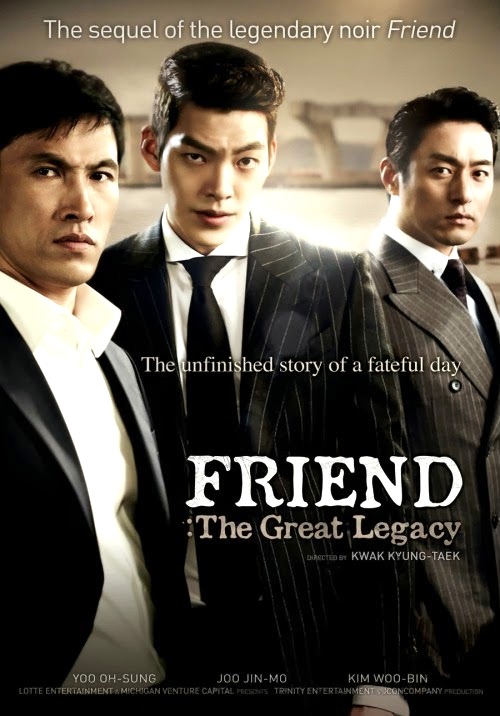
Back in the Family Business: LFM Reviews Friend 2: The Legacy

By Joe Bendel. Gangsters have a strong sense of history, probably because the past is constantly coming to bite them. Lee Joon-seok is a case in point. He will have all sorts of unfinished business on his hands after serving his seventeen year prison sentence in Kwak Kyung-taek’s Friend 2: the Legacy, which opens today in New York.

Lee is doing time for ordering the hit on a rival gang leader, who was once his childhood best friend. The turncoat was sort of asking for it, but it still bothers Lee from time to time. Shortly before his release, Lee is visited by a casual social acquaintance from his youth. Her son Choi Seong-hoon is a fellow prisoner, who has been marked for death after crossing Lee’s outfit. Much to his surprise, Lee extends his protection to the young thug, eventually taking him on as a protégé when they are both released.

They will be busy. Lee finds the syndicate his father first organized has been largely hijacked by Eun-gi, a cold-blooded boardroom gangster who exploited the vacuum left by Lee’s incarceration and the failing health of their Chairman. Obviously, Lee is not about to let this stand, even when a fairly obvious revelation threatens to undermine his relationship with the volatile Choi.

Friend 2 probably has four or five flashbacks too many, periodically revisiting not just Lee and Choi’s tumultuous backstories, but also giving viewers the highlights of the gang’s formative days under Lee’s enterprising father. The latter are almost superfluously tangential, but they are executed with a good deal of style and provide a lot of gangster genre goodies, so its worth going along with them, even if they confuse the narrative thread.

Regardless, Yoo Oh-seong is unquestionably Friend 2’s steely MVP. He is all hardnosed business as Lee, yet he still suggests hints of that troubled conscience buried somewhere deep within him. Kim Woo-bin is certainly convincingly erratic as Choi. Frankly, Friend 2 is not a great showcase for women’s roles, but the always reliable Jang Yeong-nam works wonders as Choi’s still attractive and resilient mother.

The gangster themes of family, loyalty, and betrayal are pretty standard stuff by now, but Friend 2 executes them with energy and conviction. The hits and brawls are always quite cinematic and the period scenes are nicely crafted. Propelled by Yoo’s serious-as-a-heart attack performance, Friend 2 is a solidly entertaining (if not exactly game-changing) crime epic, recommended for those who appreciate that specific genre and Korean cinema in general. It opens today (12/13) in New York at the AMC Empire.

LFM GRADE: B

Posted on December 13th, 2013 at 7:25pm.

Seven Brothers vs. The Khitan Army: LFM Reviews Saving General Yang; Now on Blu-ray/DVD

By Joe Bendel. The story of the Yang Family Generals and their noble sacrifices has been told on film before, including twice by the Shaw Brothers. Still, Ronny Yu and his co-screenwriters, Edmund Wong and Scarlett Liu, give it a fresh twist – and an English title obviously intended to evoke Spielberg’s post-D-Day blockbuster. They certainly have plenty of tragedy and bloody warfighting to work with. Death comes swiftly but the stain of dishonor is eternal in Yu’s Saving General Yang, which releases this week on DVD and Blu-ray from Well Go USA.

Nobody is more celebrated throughout the Song Dynasty for keeping the Khitan at bay than General Yang Ye. That also means he has made plenty of enemies, the fiercest being Yelü Yuan, the Khitan commander, who blames Yang for his father’s death in battle. However, Yang’s more politically astute rival Lord Pan poses a greater snake-in-the-grass danger. Despite Yang’s proven military leadership, the emperor appoints Pan as supreme commander of the Imperial Army, essentially demoting Yang to frontline general. He will regret that decision.

Of course, the first chance Pan gets, he retreats, leaving General Yang in the lurch. Rather than moving in for the kill, Yelü allows the wounded Yang to regroup on Wolf Mountain, fully expecting the Yang Brothers will try to rescue their besieged father. It is not just war for him, it is personal.

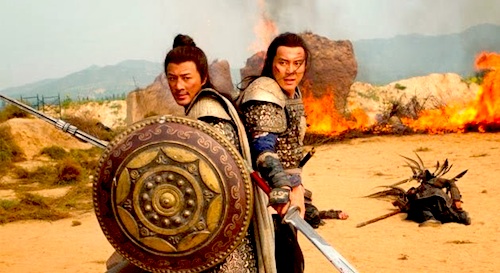
From "Saving General Yang."

Obviously, the Yang clan is in for a lot of mourning, but at least the brothers die spectacular deaths. Yu and action Stephen Tung Wai know how to stage a battle scene, emphasizing brutal realism instead of super human heroics. These might be some of the roughest, least exaggerated action sequences you will see in a year of wuxia films. On the other hand, when it comes to romance, Saving largely punts. At the least we briefly meet Ady Ang as Princess Chai, who definitely seems like the sort of Imperial royalty you would consider taking home to meet your parents. (Unfortunately, both Yang and Pan have a son who had that same idea, which is how most of this trouble starts in the first place.)

As the titular general, veteran HK actor Adam Cheng is aces at projecting a commanding presence. Likewise, Young & Dangerous franchise alumnus Ekin Cheng is appropriately steely as the first Yang son, Yang Yanping. However, numbers two through seven are largely indistinguishable from each other. All we really know about Vic Chou’s Yang Sanlang (#3) is his prowess with bow-and-arrow, but frankly that’s good enough, considering his role in a massive third act archery duel with Yelü’s chief lieutenant.

Saving’s big battle set pieces are quite impressive, with set designer Kenneth Mak and cinematographer Chan Chi-ying crafting a first class period production with epic sweep and down-and-dirty grit. If you like hot-blooded war films circa 986 AD, this one delivers. Just don’t ask for any extraneous characterization or whatnot. Recommended as red meat for genre fans, especially those who appreciate the enduring story of the honorable Yangs, Saving General Yang is now available for home viewing from Well Go USA.

LFM GRADE: B

Posted on December 11th, 2013 at 1:05pm.

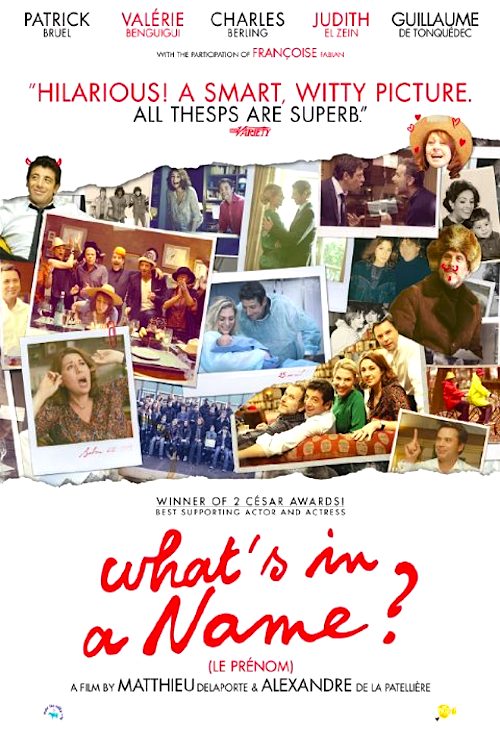
LFM Reviews What’s in a Name

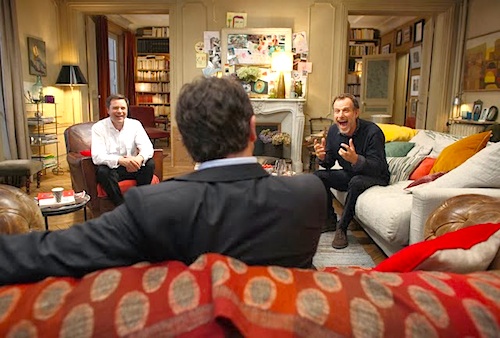
By Joe Bendel. It is a question Shakespeare and Asimov asked, in very different contexts. A group of family and friends will wrestle with it anew during the sort of dinner party you might find in the work of Yasmina Reza. In fact, the name game hysterics unleashed by an expectant father also have their roots on the French stage. After dominating the French box office, co-writer-co-directors Alexandre de La Patellière & Matthieu Delaporte’s screen adaptation of their play What’s in a Name now opens this Friday in New York.

Even though it comes fairly early in the first act, you really have to hear for yourselves what Vincent Larchet plans to name his son. Everybody is rather stunned by the news, particularly his brother-in-law Pierre Garraud, a popular literature professor who wears a lot of corduroy. He might be the most vocal in his disapproval, but Larchet’s sister Elizabeth (a.k.a. “Babu”) and childhood chum Claude Gatignol are rather taken a back as well. Just as emotions start to settle, Larchet’s very pregnant yet still compulsively late wife Anna Caravatti arrives to kick things up again.

Arguably, Name really is a lot like Carnage, except it has considerably more warmth (which is admittedly an easy bar to clear). The initial round of bickering is wickedly funny, even though you have to wonder how any parent could propose doing that to their child. Of course, the heated argument duly dislodges other closely held secrets and resentments, making it quite a dramatic night.

If you like talky movies (in the best sense) than Name is where you want to be. Even in translated subtitles, de La Patellière & Delaporte’s dialogue is deliciously sharp and punchy. Featuring most of the original stage cast, the ensemble’s crisp delivery would pass muster with Howard Hawks and his stop-watch. There are also some rather politically incorrect moments, particularly with everyone’s assumptions regarding Gatignol, a suspiciously sensitive trombone player in the Radio France Orchestra.

From "What’s in a Name."

The Fab Five are all quite strong, but Patrick Bruel really puts his stamp on the film, displaying comedic chops American audiences probably will not expect from his excellent work in A Secret and O Jerusalem. Even though they all get their quirks, Charles Berring’s Garraud becomes what passes for an anchor of stability in this bedlam, yet the newcomer still has some fine moments losing his cool with Bruel. Frankly, Valérie Benguigui’s frumpy martyr act as Garraud-Larchet gets a bit tiresome, but Judith El Zein brings notable grit and verve to bear as the late-coming Caravatti.

Even though Name is essentially still a five character one set affair, de La Patellière & Delaporte open it up enough so it does not feel distractingly claustrophobic. It never drags either. Infused with attitude yet ultimately forgiving of all its characters’ shortcomings, What’s in a Name is smart entertainment, recommended for Francophiles and those who appreciate literate comedy when it opens this Friday (12/13) in New York at the Cinema Village.

LFM GRADE: B+

Posted on December 9th, 2013 at 12:48pm.