Getting Macro on the Micro Level: LFM Reviews Economic Freedom in Action

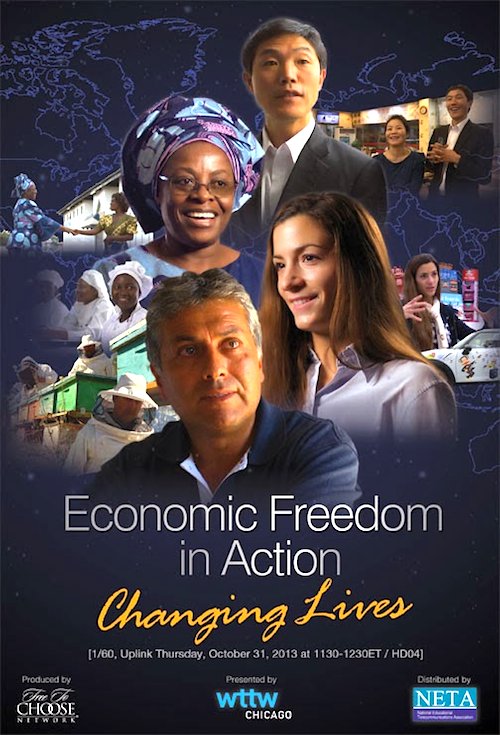
By Joe Bendel. Thanks to economic freedom, you can buy Paul Frank merchandise in Slovakia. The availability of monkey-face t-shirts might not sound like an epochal triumph, but it has made a world of difference for the Rybárikovás and their standard of living. Even more dramatic are the case studies of the North Korean defector providing start-up capital to his fellow refugees in the ROK and the Chilean beekeeper exporting queens to struggling European bee farms. Drawing upon these highly personal case-studies and the Fraser Institute’s annual report on world economic freedom, host-economist Johan Norberg argues that policies of economic liberty make the world a better place whenever they are adopted in Economic Freedom in Action: Changing Lives, which airs on Chicago’s WTTW this Thursday.

Written and directed by James & Maureen Castle Tusty, the filmmakers responsible for inspiring Singing Revolution, and produced in conjunction with the Free to Choose Network, Action follows the template established by Milton & Rose Friedman’s groundbreaking series, sprinkling manageable nuggets of analysis amid plentiful real world examples. Spanning the globe, Action starts in Africa, examining the country’s extraordinary turn-around from the perspective of Sylvia Banda.

Under Socialist president-for-life Kenneth Kaunda, Zambia was an economic basket case – but following his ouster, it has become one of the continent’s fastest growing economies, thanks to an ambitious privatization program. Banda was able to ride that wave. Starting with an unfurnished one-room restaurant, she now operates one of the nation’s largest food supply companies. Through capitalism, she has enacted a series of agricultural and hygiene reforms that the government and NGOs struggled to implement.

The contrast between economic liberty and authoritarianism is starkly demarcated on the Korean peninsula. While famine is an everyday fact of life in the tightly regimented DPRK, the ROK is a land of plenty, often leading to culture shock for defectors like Daesung Kim. To help his fellow refugees adapt, Kim started a venture capital firm that invests in their small enterprises. Once struggling to survive, those he works with now have a stake in South Korea’s economy and can provide entrepreneurial expertise if and when the North finally liberalizes its markets and political system.
Arguably, Kim is the bravest capitalist featured in Action. In contrast, the stakes were never so high for Katerina Rybáriková, but her story nicely illustrates the necessity of economic liberty in addition to political liberty. After the fall of communism, Slovakia still lagged behind most of Eastern Europe and ranked relatively low on the Fraser Institute’s index. However, a concerted program of privatization and property rights guarantees created the climate that allowed Rybáriková to successful pitch a Slovakian franchise to the Paul Frank corporate office.

One might expect Action to steer clear of Chile, yet it completely proves the thesis of Friedman’s Capitalism and Freedom, with political liberty duly following the establishment of economic liberty. While acknowledging the abuses of the Pinochet regime, Action charts the explosive growth following his economic reforms that remain largely unadulterated to this day. Thanks to the market-based economy, brothers John and Miguel Hernandez have been able to build their bee farm into a going pollination service and bee queen exporting concern, a business with particularly positive global ramifications, given environmental concerns regarding dwindling bee populations.

Chile and South Korean have consistently ranked high on the Fraser report, while Zambia and Slovakia have been recent up-and-comers. That begs the obvious question: how does America rank? For years, we usually held the second or third spot, but we have fallen in recent years, to number nineteen. Norberg and the Tustys do not engage in a lot of finger-wagging, but the significance of this tumble is hard to miss.

Indeed, Action is a remarkably sure-footed exploration of the real world impact of economic policies. By focusing on human stories it never comes across like an econ lecture or a ration of polemics. It is thoroughly convincing, but it is also really good television, taking viewers to places they rarely see in the mainstream media. Highly recommended, Economic Freedom in Action: Changing Lives airs this Thursday (11/14) on Chicago’s WTTW and can be seen in syndication on PBS stations throughout the month. It will also be available for online viewing courtesy of the Free to Choose Network.

LFM GRADE: B+

Posted on November 11th, 2013 at 2:20pm.
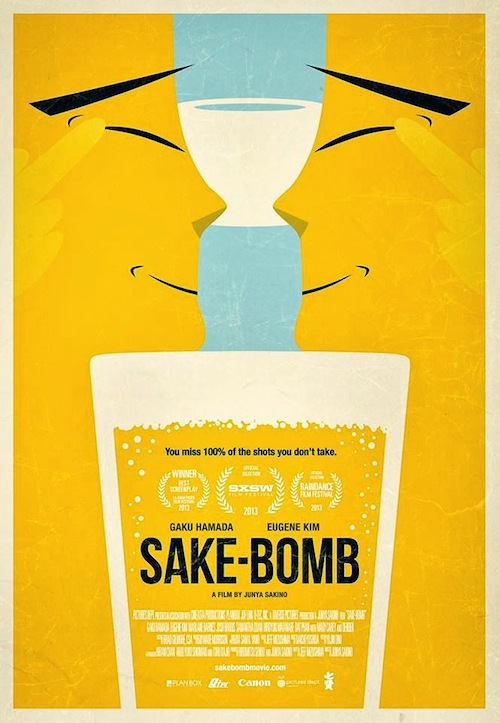
Have a Drink, Cousin: LFM Reviews Sake-Bomb

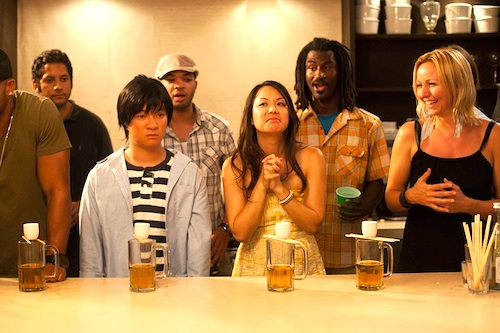
By Joe Bendel. As a sake-brewing apprentice about to succeed his master, Naoto relates to the potent potable on a deep level. It is almost sacrilegious to ask him to drink a sake-bomb (the old sake shot submerged in a beer). Nonetheless, he acquits himself fairly well when he hits the California party scene with his snarky cousin (better than the churlish vlogger, in fact). Eventually, everyone will learn a thing or two in Junya Sakino’s extended family road comedy, Sake-Bomb, which opens today in Los Angeles.

Naoto could not possibly be more earnest. When he agrees to take over his master’s brewery, he also follows the old man’s advice, taking a week’s vacation to finish working through any lingering regrets he might have in his personal life. His pursuit of Olivia, his long lost summer lover, brings him to the Moritas’ apartment in Los Angeles.

Sebastian is crashing there with his father, because he is unemployed and has just been dumped by his girlfriend. He is not exactly keen to shuttle Naoto up to Petaluma in hopes of finding the elusive Olivia, but his father insists. Naturally, they first take a detour to a party in Irvine, so Sebastian can make a complete clown of himself in front of his ex. At least they meet a few interesting types there, including Joslyn, the naughty graphic novelist who catches Sebastian’s eye.

Pound for pound, there might be more identity jokes in S-B than any other film this year, largely taking the form of Sebastian’s video posts. He is angry with Asian women who date white guys. He is angry with white women who do not date Asian men. He is angry with white people who cannot distinguish between Asian nationalities. He is not too thrilled with the Chinese either, so buckle up. On one hand, some of this material pushes the envelope of politeness. On the other hand, it is pretty funny sometimes.

From "Sake-Bomb."

As Sebastian, Eugene Kim never holds back on the attitude. He is almost too abrasive, considering the audience obviously is supposed to embrace him during the third act. However, likability is not a problem for Gaku Hamada, the popular Japanese star of Potechi (Chips), who subtly but surely conveys the strength of character beneath Naoto’s naivety. Together, their over-the-top and understated personas play off each other quite nicely. Future star-in-the-making Jessika Van also scores in her scene as a friend of Sebastian’s girlfriend, giving him what-for. Yet, for a certain demographic, former porn star and California gubernatorial candidate Mary Carey upstages everyone as, you know, a porn star.

Sake-Bomb never reinvents the buddy movie-wheel, but it has an edge and a good deal of heart. Better than the typical Phillips and Apatow grind ‘em outs, Sake-Bomb is recommended for fans of slightly raucous but well-intentioned rom-coms when it opens today (11/8) in Los Angeles at the Downtown Independent.

LFM GRADE: B

Posted on November 8th, 2013 at 3:09pm.

The Story of a Publisher (Ahem): LFM Reviews Filthy Gorgeous; Premieres Tonight (11/8) on EPIX

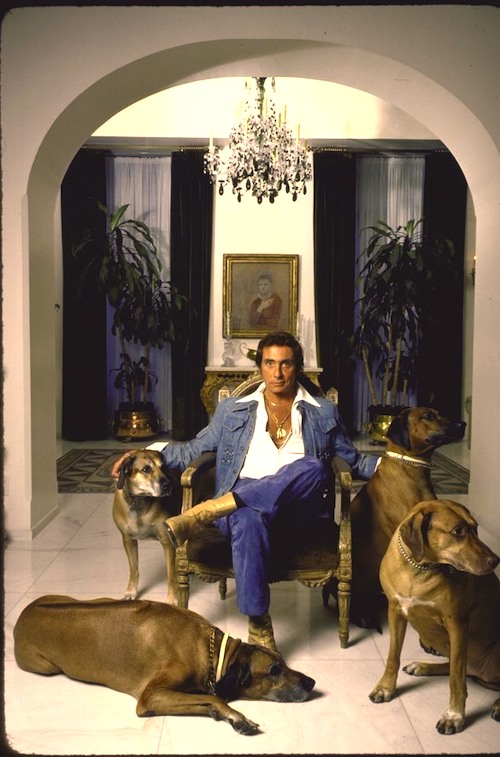
Bob Guccione back in the day.

By Joe Bendel. Bob Guccione hired a lot of science and science fiction writers for Omni Magazine. He published other stuff, too. Of course, that is what built his publishing empire and it is why he is now getting the documentary profile treatment in Barry Avrich’s Filthy Gorgeous: the Bob Guccione Story (trailer here), a selection of this year’s Toronto International Film Festival, which premieres tonight on EPIX.

Originally, painting was Guccione’s calling. He was more or less content to live the hand-to-mouth life of a struggling artist in Europe, but his first wife—not so much. Moving to fill a void, Guccione originally conceived Penthouse as the domestic British answer to Playboy, but he quickly recognized that the American circulation titan was vulnerable to upstart competition and moved in on its turf. Guccione initially served as the staff photographer, because he could not afford anyone else, but obviously those duties agreed with him. Readers (or whatever the correct term might be) seemed to agree, until things started to turn in the 1990s.

Frankly, Filthy is much more interesting when analyzing the collapse of the Guccione empire than celebrating its rise. An entire film could probably be made on the tempestuous production of Caligula and it would be far more watchable than the train wreck resulting from Guccione’s battles with Tinto Brass. There were also cash-draining misadventures with a cold fusion reactor scam and an aborted Atlantic City casino. More costly in the long term, Guccione fundamentally lacked a vision for the whole internet thing, just like his archrival, Hugh Hefner.

There is some fascinating, honest to goodness publishing history in Filthy. There are also plenty of reminisces about what a progressive gentleman Guccione was in his business dealings and how shy he was in private. That is all very nice, but it gets repetitive quickly. Likewise, attempts to position Guccione as yet another First Amendment crusader fall flat, notwithstanding the efforts of Alan Dershowitz. In fact, the lack of critical voices in Filthy is a serious flaw. There really should be someone somehow associated with Vanessa Williams tearing into him for the nude photo scandal.

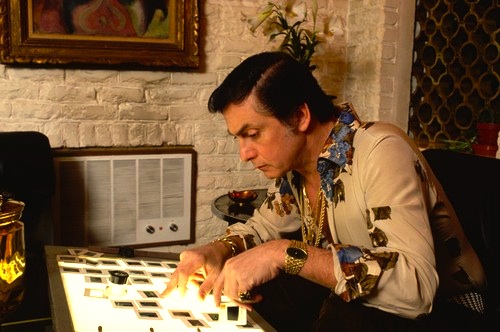
A man at work.

Naturally, Avrich periodically gives viewers peaks behind the magazine covers, because duh. Yet, the sequence that resonates the strongest describes attempts by Guccione, Jr. (a rather candid interview subject) and several of his father’s loyalists to take the magazine in a more demur Men’s Health or Maxim direction. There is something to their arguments that might have been explored in greater length. Needless to say, Guccione, Sr. went in the opposite direction, with dire financial consequences.

The magnitude of Guccione’s downfall is almost worthy of classical tragedy. As a posthumous profile, there is no escaping the inevitable, but the closing fifteen minutes or so are surprisingly sad. Still, there are some worthy object lessons for budding media moguls in Filthy regarding the importance of seizing opportunities and acknowledging seismic shifts in the marketplace. There are also pictures of naked women, scrupulously selected for their comparative tastefulness. Conspicuously one-sided but still consistently interesting, Filthy Gorgeous is recommended to mature viewers for the documentary equivalent of its articles when it airs on EPIX tonight (11/8).

LFM GRADE: C+

Posted on November 8th, 2013 at 3:06pm.

The Iranian New Wave: LFM Reviews Dead End

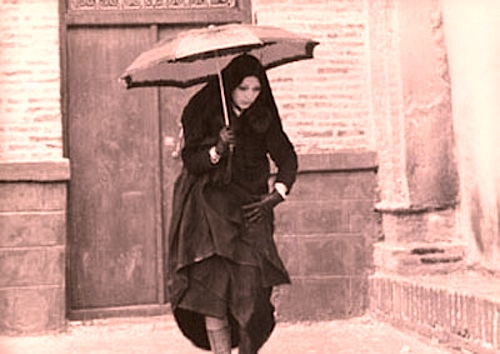
By Joe Bendel. It sounds creepy, but it was not uncommon practice for Iranian men to follow prospective wives as part of their due diligence. The men were supposed to be cautious and the women were supposed to be grateful. One revolution later, certain things remain the same, if not more so. As a result, one young woman jumps to conclusions when she recognizes a distinguished looking man haunting her street in Parviz Sayyad’s Dead End, which screens during the Asia Society’s Iranian New Wave 1960’s-1970’s film retrospective.

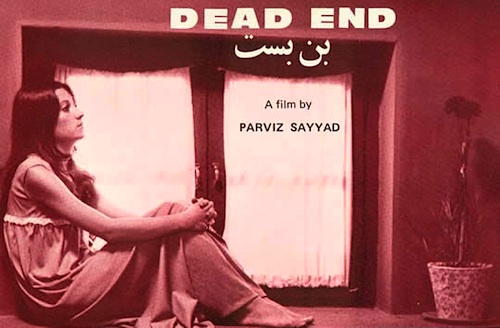
Pretty but hopelessly naïve, the young woman living with her widowed mother has strangely not received much attention from marriageable men. Initially, she is somewhat confused when she notices the tall mystery man loitering outside their flat. Since they live on the titular dead end street, there is not much to bring him to their neighborhood. Assuming he has honorable intentions, she quickly starts fantasizing about their potential union. However, Sayyad constantly slips viewers hints the unmarried woman’s hopes will not be consummated.

Considered a not-so veiled critique of the Shah’s rule, Dead End remains banned by the Islamist regime. It is not hard to see why, given its overt themes of surveillance. There is also a rather biting subtext regarding gender inequalities that is even more subversive under the Revolutionary government.

From "Dead End."

There is indeed plenty of open anger in Dead End, but it never sacrifices the highly personal drama for the sake of polemics. This is first and foremost the woman’s story, as painful and demoralizing as we expect it will be. Mary Apik’s lead performance is exquisitely sensitive, conveying a lifetime of disappointments and the acute vulnerability of her circumstances. It is a necessarily restrained performance, but it is hard to shake its quiet power. In contrast, Parviz Bahador projects an apt air of danger, yet is also quite charismatic in a coolly severe sort of way as the man following her.

While Jamsheed Akrami’s Lost Cinema provides some useful cultural context to fully appreciate Dead End, patrons should also bear in mind it gives away the emotionally devastating final twist. Still, many scenes take on additional significance when viewers know what fate ultimately holds in store for the woman. Regardless, both films are fitting selections for the Asia Society’s Iranian New Wave film series. In fact, Dead End is arguably a classic of world cinema that unquestionably ought to be more widely seen. Highly recommended, it screens this Saturday (11/9) with Sayyad and Akrami scheduled to participate in a Q&A session afterwards.

LFM GRADE: A

Posted on November 5th, 2013 at 11:11pm.

Because Life Wasn’t Weird Enough Without It: LFM Reviews The Visitor

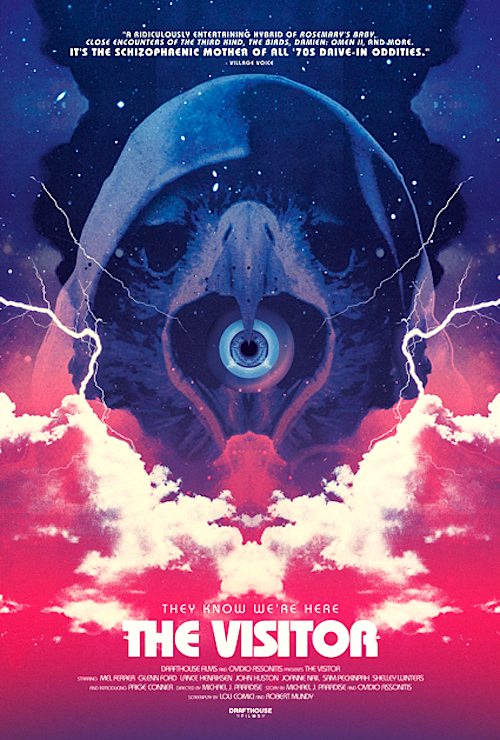
By Joe Bendel. Atlanta is a sinful city, where every damn street is called Peachtree. A cosmic warrior has come to straighten things out here. He will do battle with the pre-pubescent girl who has made the world such a crummy place in the ever-so strange 1979 Italian-produced sci-fi knock-off, The Visitor, directed by Giulio Paradisi as Michael J. Paradise, which has been re-mastered and re-released by Drafthouse Films.

In a dimension “beyond imagination,” a mysterious old man seeks out the remnants of the evil Sateen, a demonic entity he vanquished eons ago. Evidently, some of his old foe’s essence ended up on earth, specifically within Barbara Collins’s ancestors. She is one of the rare carriers who can give birth to his malevolent offspring. Unfortunately, she already has one child, the dreadful little Katy. Her boyfriend Raymond Armstead is pressuring her to get married and have more children, because he is part of an apocalyptic secret society that frequently holds awkward board meetings devoted to promoting evil. Collins resists, ostensibly for the sake of her freedom. However, she is also instinctively against anything Katy is for.

You might think the bad guys would do anything to protect the birthing abilities of the only woman who can deliver Sateen’s bad seeds. Well, obviously you are not part of an international satanic cult. Poor Collins is shot, partially paralyzed, run off the road, and attacked by a falcon. Yet, despite all the stress, her skin remains remarkably clean and radiant. As Armstead and Katy plot against her, the gaunt Jerzy Colsowicz arrives to do battle with Sateen’s spawn. That’s right, it’s a frail septuagenarian versus an eight year-old, so get ready to rumble.

It goes without saying The Visitor is a strange film. Everyone compares it to The Omen and Close Encounters, but Paradisi/Paradise probably rips-off The Birds more than anything else. For whatever reason, bird attacks seem to be the weapon of choice for good guys and bad guys alike. It is just plain baffling anyone thought this film could cash in on the late 1970’s sci-fi craze, but it boasts a truly once-in-a-lifetime cast, including John Huston (the John Huston), Lance Henriksen, Glenn Ford, Franco Nero (uncredited as the Christ-like figure), Shelley Winters, Switchblade Sisters’ Joanne Nail, Mel Ferrer, Sam Peckinpah (the Sam Peckinpah), and future Libertarian radio talk show host Neal Boortz. Get your head around that ensemble.

Frankly, Huston looks rather bemused in each of his scenes as Colsowicz and it is a good bet he never even bothered to watch the finished product. Ford and Winters soldier through like the old pros they are, playing the cop and the nanny, respectively. Eventual fan favorite Henriksen also shows an early affinity for scenery chewing as Armstead. In truth, aside from maybe Huston and Nero, nobody really phoned The Visitor in, but it is anyone’s guess what they thought they were doing in this convoluted, New Agey plot. There are times the film appears to be conceived as a showcase for Atlanta’s modernist architecture, which makes as much sense as any other explanation.

Visitor’s special effects are crude and confusing, even by 1970’s standards, but in its straight-forward dramatic scenes, the picture looks surprisingly slick. Naturally, even the music “borrows” from another film, but it must be conceded Franco Micallizzi’s riff on Strauss’ “Zarathustra” is oddly catchy, in a funky (arranger) David Matthews-Kudu Records kind of way.

If you don’t get The Visitor by now, you’re on your own. If you enjoy completely cracked cult cinema, this is your catnip. Impressive in its way, The Visitor demands to be seen to be believed. Recommended for those who can appreciate the sheer defiant spectacle of it all, The Visitor screens this weekend (11/8 & 11/9) at the IFC Center in New York.

LFM GRADE: B

Posted on November 5th, 2013 at 11:08pm.

Another Sleepless Night in Paris: LFM Reviews Paris Countdown

By Joe Bendel. Victor and Milan ought to stick to slinging drinks. Delivering a shipment of cash to a Mexican cartel predictably turns out to be really bad way to work off their debts. It leads to all kinds of problems in Edgar Marie’s Paris Countdown, which opens this Friday in New York.

It was all Milan’s fault and Victor is not about to forget it. Forced to accompany his partner to Juarez, Victor gets the worst of it when the Federales bust their hand-off. After a rough interrogation session, they are “convinced” to testify against their French contact, the psychotic Serki, whom the nightclub proprietors know will come looking for revenge if he ever gets out of prison. That is exactly what happens six years later.

Victor has not talked to Milan since their Mexican misadventure. He still bears the scars and the hearing aid from his close encounter with a power drill. Yes, he is carrying a grudge, so when Wilfried, his mobbed-up sushi restauranteur colleague, offers him the chance to set-up Milan, he matter-of-factly agrees. However, Victor finds betrayal is far more difficult once he comes face-to-face with his former friend again. Against his better judgment, Victor will flee into the night with Milan, trying to stay one step ahead of Wilfried’s henchmen and the slightly put-out Serki.

From "Paris Countdown."

Countdown is aesthetically reminiscent of several recent French noirs, including Frederic Jardin’s more action-oriented Sleepless Night and Philippe Lefebrve’s massively cool, character-driven Paris By Night. In terms of style, Countdown essentially splits the difference between the two. Frankly, it is not as accomplished as either, but it still has its merits. In fact, the world-weariness of its primary protagonists and general vibe of nocturnal angst are quite compelling. Neither Milan nor Victor is any sort of action hero. Clearly, both are physically past their prime, struggling to deal with their night of madness.

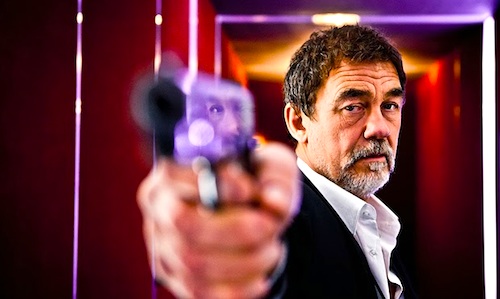
Olivier Marchal (the director of the similarly hardboiled 36th Precinct) is appropriately haggard yet appealing roguish as the exceptionally irresponsible Milan. Jacques Gamblin clearly has less fun as Victor, but he is convincingly nebbish as the sad sack. Unfortunately, Carlo Brandt’s Serki looks even older and more broken down than they do, making him a problematic villain.

As a thriller, Countdown has enough atmosphere and attitude to get the job done. For his feature directorial debut, Marie shows a competent command of the elements, but the MVPs are clearly Marchal and cinematographer Danny Elsen, who gives it a fitting Miami Vice-like sheen. Recommended for fans of French thrillers, Paris Countdown opens this Friday (11/8) in New York at the Cinema Village.

LFM GRADE: B

Posted on November 5th, 2013 at 11:05pm.