LFM Reviews Dancing on the Edge; Premieres Sat. (10/19) on Starz

By Joe Bendel. Louis Lester’s band swings so hard, many of their fans assume he is an American, but he is really a born and bred British subject. Several high society types will take an interest in them, but that will not always be a good thing during the course of Stephen Poliakoff’s Dancing on the Edge, a six night mini-series beginning this Saturday on Starz.

Stanley Mitchell is a progressive jazz fan, but he is also a bit of an operator. He sings the praises of the Lester band, hoping his magazine Music Express will rise with their tide. While not to the manor born himself, Mitchell knows many of the right people, like Arthur Donaldson, a man of leisure who happens to appreciate real deal jazz. Through Donaldson’s connections and Mitchell’s glad-handing, the Lester band books some high profile gigs, eventually becoming the house band at the formerly staid Imperial Hotel.

For a while, it seems like everyone will enjoy the good life together, especially when the mysterious American tycoon, Walter Masterson, starts inviting the band to his lavish parties, along with the wealthy but somewhat emotionally codependent Luscombe siblings. The interracial romance brewing between Lester and Sarah, a photographer close to the Luscombes, obviously portends future trouble, but the erratic Julian Luscombe’s reckless pursuit of the band’s lead singer will lead to more immediate problems.

Chiwetel Ejiofor is about to become an Oprah superstar through 12 Years a Slave, but his turn as Lester is arguably his best work since Dirty Pretty Things. In many ways, it is a treatise on “cool” as a defense strategy and a personal aesthetic. Rigidly controlled, Ejiofor still shows us all the gears turning in his head. Arguably, the major historical influences on his Lester are the suave sophistication of Ellington (whose 1930’s small big band could be a model for the Lester outfit) and the not-so-passive aggressive aloofness of Miles Davis to come in later years.

In contrast, Matthew Goode gives Mitchell a slightly manic edge, nicely playing off the tightly wound Ejiofor in their smartly written scenes together. (If you’re asking whether he rings to someone who has written about and championed jazz, the answer is yes.) Probably nobody is more over-exposed for Anglophiles than Tom Hughes right now, but while he was conspicuously miscast in About Time, The Hollow Crown, and The Lady Vanishes, he is sort of perfect for the boyishly creepy Julian Luscombe. Like Hughes, John Goodman brings out the messy human dimensions of grandly indulgent Masterson, a role that could have easily descended into gross caricature.
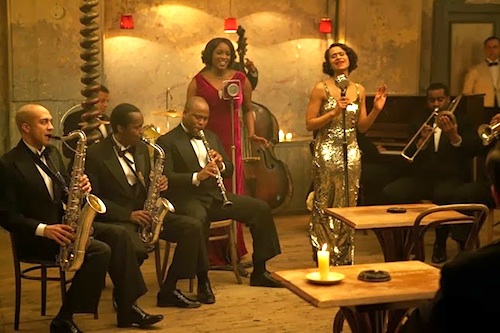
From "Dancing on the Edge."

In fact, one of writer-director Poliakoff’s great strengths is the manner in which he preserves some degree of audience sympathy for all his characters despite their often horrid actions. Shrewdly, he also maintains considerable ambiguity regarding certain relationships, instead of beating viewers about the head, as a less artful production might. Dancing does right by the music as well, featuring a soundtrack of original era appropriate swingers and ballads, recorded by real life working jazz and studio musicians, who also appear in character as the Lester band. If jazz advocates will have any gripe with Dancing it will be the lack of development for the musicians, besides Lester and his two vocalists.

Like the best of television, Dancing quickly hooks in viewers and keeps them emotionally invested throughout. Poliakoff captures the exhilaration of the after-hours jam, but also incorporates pointed references to the ominous rise of National Socialism, Britain’s lack of military preparedness, and the rather dubious character of the future temporary Edward VIII.

Nicely crafted in all respects, Dancing on the Edge is recommended for fans of swing music and British television when it premieres this Saturday (10/19) on Starz. As a note, the fifth installment is technically the finale, but an epilogue follows the next week (11/23), which purports to collect Mitchell’s aborted interviews with Lester. Initially, it seems to be a DVD-extra kind of thing, but it might conceivably set up a sequel series in its final moments.

LFM GRADE: A-

Posted on October 17th, 2013 at 9:49am.
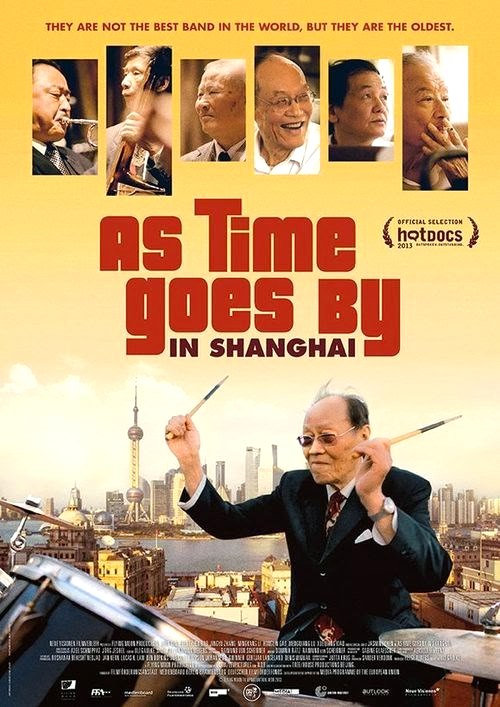
LFM Reviews As Time Goes By in Shanghai @ The Margaret Mead Film Festival

By Joe Bendel. Jazz musicians are forward-looking by temperament, constantly anticipating the next gig or recording. For a group of elderly Chinese swing musicians who endured the Cultural Revolution, living in the here-and-now rather than the past is not merely an aesthetic choice, it is a survival strategy. The Peace Old Jazz Band is Guinness-certified as the oldest continually performing band and they will finally have their spotlight moment in Uli Gaulke’s As Time Goes By in Shanghai, which screens during the 2013 Margaret Mead Film Festival at the American Museum of Natural History.

When five out of six band members are nicknamed “Old” (as in “Old Sun” or “Old Li”), it is pretty clear what you’ve got here. For the last twenty years, they have hit nightly at Shanghai’s Peace Hotel, following in the grand tradition of the big bands of the Swing Era. Accustomed to playing for dancers, most of the band is not inclined to start experimenting now. They might sound like “moldy figs,” but they have a right to stick to their thing. After all, the Cultural Revolution was a living nightmare for any musician performing decadent jazz and Western classical music.

When booked to play the North Sea Jazz Festival in Rotterdam, the Peace Old recruits a younger vocalist to perform standards as well as a few jazz renditions of traditional Chinese songs. Naturally, they shamelessly flirt with Yin “Yasmin” Chen—we would worry about them if they didn’t. Clearly, this gig will be a career zenith for the band, but they seem to take it in stride.

At first, As Time Goes By seems to be another documentary chronicling the late life triumphs of a group of plucky oldsters. However, it progressively deepens over time. The Peace Old musicians are understandably reluctant to talk about their experiences during the Cultural Revolution (after all, it never officially happened), but when Gaulke catches them alone, they start to open up and when they do it is heavy.

Frankly, the Peace Old’s technique is just kind of okay overall, but Holy Cats, do they play with feeling. While it is difficult for them to talk about their experiences verbally, it all comes out through their instruments. Gaulke mostly has the good sense to focus on the band and stay out of the way, but his transition shots capture a sense of the less affluent side of go-go Shanghai. The Peace Old can relate to both worlds, but do not quit fit into either.

As Time Goes By is deeply moving, both in musical and personal terms. It is rare to find a film that speaks so directly to both the gigging life and the residual collective emotional baggage of the Cultural Revolution, but it certainly does. Gulke’s doc should particularly resonate with working musicians in any major city. Wonderfully wise and bittersweet, As Time Goes By in Shanghai is very highly recommended.  A highlight of this year’s Margaret Mead Fest, it screens this Saturday (10/19) at the AMNH.

LFM GRADE: A

Posted on October 16th, 2013 at 10:25am.

One of the Scary Season’s Best: LFM Reviews Haunter

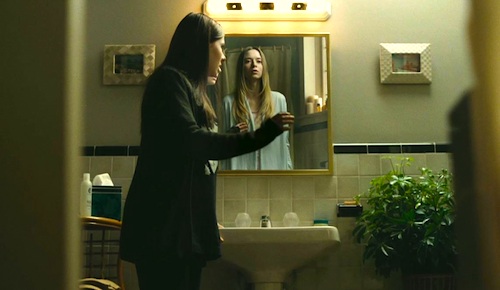
By Joe Bendel. Imagine watching the same episode of Murder She Wrote over and over again. If that isn’t Hell, it is probably close enough. Maybe a Columbo wouldn’t be so bad, but Lisa Johnson’s parents have pretty vanilla tastes. Do not judge them too harshly for being stuck in the 1980’s, because they are sort of dead. Recovering awareness of their eternally looping existence, Johnson will reach out to other girls like her in hopes of breaking a pernicious supernatural cycle of terror in Vincenzo Natali’s Haunter, which opens this Friday at the IFC Center.

The Johnson family was murdered in 1986. Every day since, they relive that fateful Sunday, unaware of their paranormal condition. At least they still have a cool President. Somehow, their daughter has awakened, to some extent. Cognizant of the wicked déjà vu happening, she starts having what might be described as ghostly experiences. Soon she suspects other families are trapped in a similar stasis within the house, but in different time periods. Eventually, she will make contact with teen-aged girls in both the past and the future, but her consciousness does not go unnoticed.

Haunter is easily one of the best horror films of this Halloween season. Natali maintains an overwhelming vibe of creeping dread, while Brian King’s screenplay ranges into surreal, mind-bending territory. The closest comparison film would probably the metaphysical horror of H.P. Mendoza’s ambitious indie I Am a Ghost, but Haunter has a more mainstream, Nightmare on Elm Street dimension to it.

Regardless, Haunter is the freshest horror outing probably since Mendoza’s film. It delivers about a half dozen game-changing twists and they each work surprisingly well. There is no padding in King’s script. Everything happens for a purpose. Perhaps most importantly, it keeps viewers on edge from start to finish.

From "Haunter."

As Johnson, Abigail Breslin is on-screen front-and-center more or less the entire time, so the film largely depends on her. Fortunately she is convincingly smart, resilient, and increasingly freaked out as the young protagonist. Stephen McHattie also brings a fittingly severe presence as the mysterious figure simply billed as the “Pale Man.” However, if there is one misstep in Haunter it comes in showing too much of him. More mystery is always better.

Frankly, this is a perfect example of the direction more indie genre films ought to take. There is hardly any gore or special effects to speak of in Haunter, yet it completely gets under your skin. Smart and tightly focused, Haunter is easily the horror movie pick of the month. Highly recommended for fans, it opens Friday (10/18) at New York’s IFC Center.

LFM GRADE: B+

Posted on October 16th, 2013 at 10:21am.

LFM Reviews All is Lost

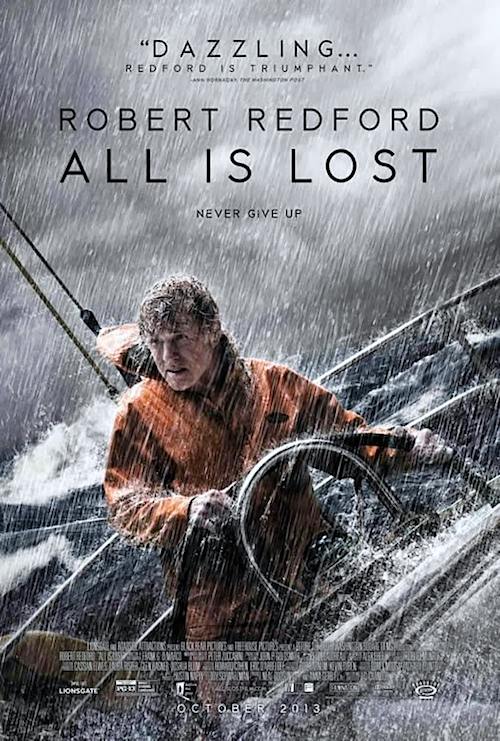
By Joe Bendel. There is an old man and the sea—sans marlin. There is no tiger, either. Instead, it is an errant workaday cargo container that leads to a mortal and existential crisis in J.C. Chandor’s All is Lost, which opens this Friday in New York.

“Our Man,” as he is simply billed, is in the midst of a solo cruise through the Indian Ocean when his small yacht is struck by said container. He wakes to find his boat taking on water and the electronics, including the radio, shorted out. He is able to patch up the gaping hole and bail out most of the water, but lasting damage has been done. Sailing blindly as a result, Our Man unknowingly proceeds towards a Sebastian Junger-level storm.

Considering it arrives so soon after Ang Lee’s Oscar winning Life of Pi, viewers might assume Lost is just more of the same. However, there is a muscular leanness to Chandor’s film that frankly compares favorably to its predecessor. All the New Age allegories and comforting sentimentality are stripped away, leaving a mere man to face the elements alone.

On one level, Chandor’s screenplay is relatively simple, with almost no dialogue to be heard from start to finish. Still, despite the limits of the water-bound location, Chandor dexterously introduces one darned thing after another to torment his sole character. Being the one and only face of a film is always a considerable challenge, but the shockingly haggard looking Robert Redford (showing his full seventy seven years) rises to the occasion. Rather than acting out and raging against fate, he vividly portrays the man’s slow deflation, which is far more compelling over time.

If not as visually arresting as Pi, Lost fully conveys the cold, damp, claustrophobic crumminess of Our Man’s precarious situation. Technically, it is quite an accomplished film, with particularly credit due to the Tahoe, the Tenacious, and the Orion, the three vessels that sailed their last as stand-ins for Our Man’s ill-fated Virginia Jean.

If nothing else, Lost should convince viewers not to look in the middle of the Indian Ocean if they want to go find themselves. It is surprisingly gripping stuff, buoyed by a remarkably disciplined performance from its craggy star. Recommended for those who appreciate a realistic man versus the elements survival story, All is Lost opens this Friday (10/18) in New York at the Angelika Film Center.

LFM GRADE: B+

Posted on October 15th, 2013 at 12:17pm.

LFM Reviews This Ain’t No Mouse Music @ The Margaret Mead Film Festival

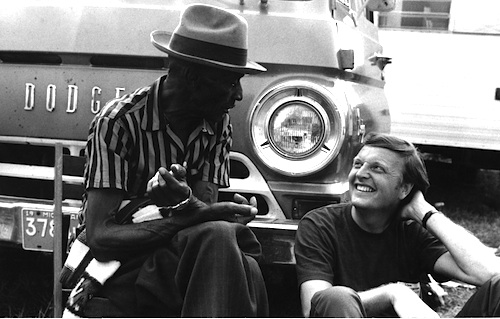
By Joe Bendel. Chris Strachwitz was born to an aristocratic family in Lower Silesia, but WWII drastically altered his destiny, turning him into the song-hunting heir of Alan Lomax. News that the advancing Soviet army was summarily executing “capitalists” convinced his family to emigrate west. Encountering New Orleans Jazz and Delta Blues as an American teen, he subsequently founded Arhoolie Records (named after a form of field holler Lomax recorded) to seek out and preserve the earthy sounds that spoke to him. Fifty years later, Strachwitz looks back on it all in Chris Simon & Maureen Gosling’s This Ain’t No Mouse Music, which screens during the 2013 Margaret Mead Film Festival at the American Museum of Natural History.

“Mouse Music” is a vague term Strachwitz uses for the sort of slick, mass produced music he can’t abide. His musician friends cannot really define it either, but they know you don’t want to be it. Like Lomax, Strachwitz did much of his recording in the field, tracking down many of the real deal Blues, Cajun, Creole, Cajunto, and Appalachian musicians that had slipped through the modern world’s cracks. The first time out, he hit major pay dirt, “discovering” Mance Lipscomb. Thanks to Arhoolie, artists like Big Joe Williams, post-“Hound Dog” Big Mama Thornton, Mississippi Fred McDowell, Michael Doucet, and Clifton Chenier would find a dedicated national audience.

From "This Ain’t No Mouse Music."

During his travels, Strachwitz met and collaborated with filmmaker Les Blank (to whom Mouse Music is dedicated) and became a family friend to scores of musicians. Evidently, Strachwitz largely picked up the Bay Area politics surrounding him, but Simon and Gosling mostly steer clear of potentially divisive subjects. However, they cannot resist including the story of how Strachwitz obtained publishing rights to Country Joe McDonald’s “I Feel Like I’m Fixin’ to Die Rag.” Evidently, the folk-rocker needed to lay down the future Woodstock ditty quickly and was referred to Strachwitz’ living room-studio by friends. In lieu of payment, Strachwitz accepted publishing rights, proving former Silesian aristocrats are better businessmen than hippies.

Simon and Gosling keep up with the only slightly manic Strachwitz quite well, conveying a good sense of the man and his label’s roster of artists.  While not everything Arhoolie releases will be to everyone’s tastes, the depth and breadth of it is quite impressive. Indeed, there is something very Whitman-esque about Strachwitz’s far-ranging pursuit of this roots music. The doc also provides a nice Blues fix, which is tough to get through mainstream media outlets. Recommended for fans of unvarnished musical Americana, This Ain’t No Mouse Music screens this Friday (10/18) as part of this year’s Margaret Mead Film Festival at the AMNH.

LFM GRADE: B

Posted on October 15th, 2013 at 12:14pm.

LFM Reviews Embrace of the Vampire; Now Available on Blu-ray/DVD

By Joe Bendel. There’s one thing vampires dig almost as much as blood. Lurking about a hormonally stoked college campus is as good a place as any to find it. It isn’t even spring break yet, but college life is distinctly feverish for one innocent freshman coed. There will be blood and nudity. The details will sound vaguely familiar to those who fondly remember the erotic cult favorite that forever changed how film geeks thought about Alyssa Milano. Remade for a new generation, Carl Bessai’s unrated Embrace of the Vampire (trailer here) releases today on DVD and Blu-ray (where it so obviously belongs).

Right, if you’re still with me after that, then sweet, let’s do this. Like so many disadvantaged orphans before her, Charlotte Hawthorn is determined to fence her way to a better life. However, the scholarship student feels out of step with the hedonism enjoyed by her trampy roommate, Nicole and her mean girl BFF, Eliza. At least Hawthorn has a nice barista job lined up, working for her sensitive frat boy café manager.

Strangely, as soon as she arrives, Hawthorn starts experiencing sexually charged dreams and visions. It gets so bad, so quickly, she soon has trouble distinguishing reality. The fencing team hazing rituals do not help either. However, one upper class teammate is willing to shield her from the worst of it: Sarah Campbell, the bisexual nymphomaniac. Every fencing squad should have at least one. Meanwhile her coach and mythology professor seems to take an intense interest in her “stance.”

Add in a bit of warmed over vampire slayer mumbo jumbo and there you have it. Except, Bessai’s execution is better than you would expect. Granted, the flashbacks to the old country look like outtakes from a Syfy Channel original movie, but the contemporary campus sequences sort of work. The location is perfect. Every building seems to have an exterior staircase, and surrounding woods encroach on every corner. It is a bit unusual for the women’s fencing team to be at the top of the school’s social pyramid, but the film’s student power dynamics are as well realized as that in the overrated All the Boys Love Mandy Lane. The new Embrace is also less of a tease, pretty much delivering what it promises.

From "Embrace of the Vampire."

Be that as it may, this is not the film that will establish Sharon Hinnendael as the screen thespian of her generation. It is not really her fault, though. Most of her scenes involve her groggily coming to after falling into various states of altered consciousness. Unfortunately, Victor Webster’s Prof. Cole is a pretty cheesy excuse for a Byronic brooder. Still, C.C. Sheffield, Chelsey Reist, and Olivia Cheng play the catty fencing femmes to the hilt.

Embrace commits one cardinal sin. At one point, Cole refers to Hawthorn’s foil as a “sword.” That is a big no-no. Still, the target market is not apt to notice and even less likely to care. Bessai has some legit credits to his name (most notably Emile starring Sir Ian McKellen) and keeps the silly indulgences moving along at a decent pace. By now you should know what you’re getting, but it is still more entertaining than many of the genre underachievers limping in and out of theaters this month. Recommended for those who enjoy horror movies with plenty of naughty bits, the new Embrace of the Vampire is now available for home viewing.

LFM GRADE: C+

Posted on October 15th, 2013 at 12:05pm.