Afghanistan Live and Direct: LFM Reviews The Network; Now Available on VOD

By Joe Bendel. TOLO TV is like the Al Jazeera of Afghanistan, except it is critical of terrorism. Founded by Saad Mohseni, his brothers Zaid and Jahid, and their sister Wajma to be an agent of change, TOLO TV is the first and largest media outlet in Afghanistan. For three months, filmmaker Eve Orner documented the Mohsenis and many of their 900 employees at work and on their guard in The Network, which releases on VOD platforms today.

If TOLO TV sounds familiar, you might remember Havana Marking’s Afghan Star, the behind-the-scenes look at the pop idol reality show produced by that station. Marking followed the travails of a particular contest who faced death threats for modestly swaying to her music. Several years later, contestants regularly show off a few non-twerking moves and often appear sans head trappings. This constitutes progress and it was made possible by TOLO.
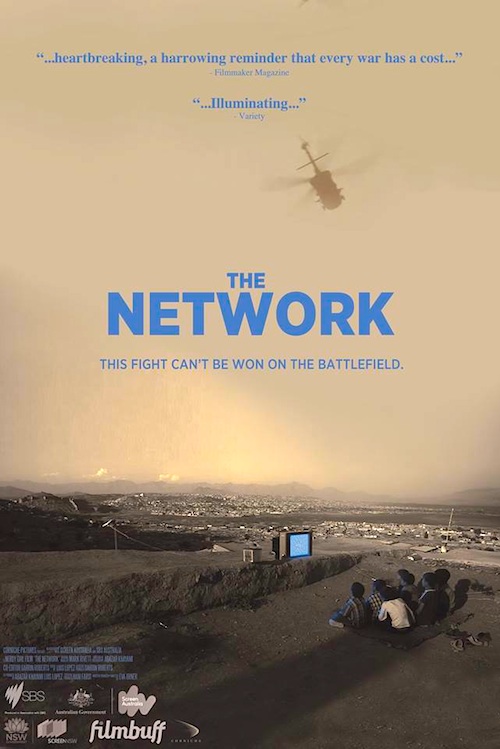
Growing up in exile as a result of the Soviet invasion, the Mohsenis, especially London-born Saad, are clearly entrepreneurs on a mission. Arriving in Kabul with waves of returning expats, they shared the general euphoria following the fall of the Taliban. Perceiving a need and an opportunity, they started the radio station that would eventually blossom into the TOLO mini-empire. It was a risky venture, because there was absolutely no media whatsoever in the country at the time. None. Zero. The Islamist Taliban had forbidden such a sacrilege. As one TOLO reporter dramatically recalls, the only sanctioned form of entertainment during the regime were public executions. Yet despite the years of doing without, the Afghan people immediately took to TOLO’s offerings.

On one hand, The Network is a success story, charting TOLO’s growth as a business and a cultural phenomenon. However, an uneasy pessimism hangs over the film. The Mohsenis and their employees openly fear the consequences when the western military powers cut-and-run. After all, TOLO personnel have definitely become targets of the Taliban and their allies. Orner documents many of the tight spots they just barely survived. Ironically, some of the most tragic episodes were instances when TOLO staffers were literally caught in the crossfire.

Arguably, Saad Mohseni is a media visionary. Yet, TOLO often walks a fine line to avoid angering the Islamist element. Their answer to Dr. Phil is particularly problematic, but one could make a case that the open criticism expressed by TOLO’s female employees of his “just be virtuous” advice is a promising sign. Granted, their melodramas look rather cheesy, but not as amateurish as the grade-Z Pashto films gonzo documentarian George Gittoes produced. TOLO also challenges many pre-conceptions viewers might hold, especially with regards to the success they have had with their anti-terrorist cop show, partly underwritten by the U.S. embassy.

Indeed, there is little anti-American sentiment in The Network, per se, and there is absolutely no nostalgia for the Communist regime. This is fascinating stuff, with far reaching social, economic, and geopolitical implications. Orner captures plenty of telling moments and conveys a good sense of the increasingly uncertain vibe in-country. It is a smart doc that is all muscle and no fat. Highly recommended for Middle East watchers and strategic thinkers, The Network is now available for VOD viewing.

LFM GRADE: B+

Posted on October 8th, 2013 at 11:05am.
LFM Reviews Gloria @ The New York Film Festival

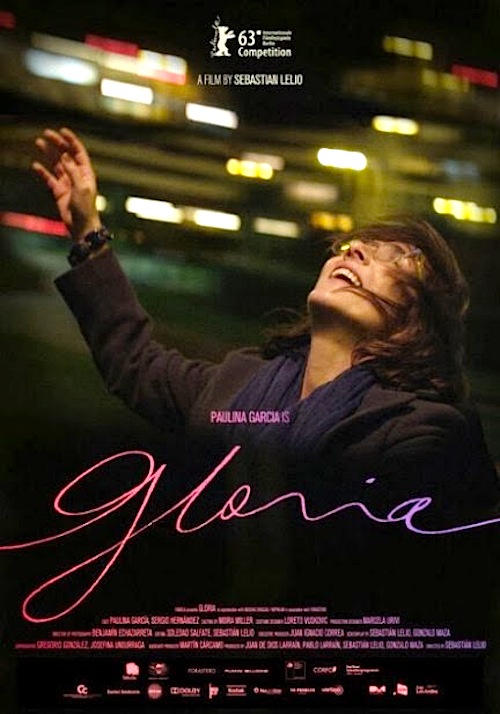
By Joe Bendel. Gloria is a musical name. Hip readers will know Umberto Tozzi was topping the international charts long before his pop song was drastically re-written for Laura Branigan. The bittersweet lyrics of love heard in Tozzi’s original version will nicely suit the protagonist of Chile’s latest foreign language Oscar submission. However, Van Morrison’s “Gloria” never factors into Sebastián Lelio’s Gloria, which screens during the 51st New York Film Festival.

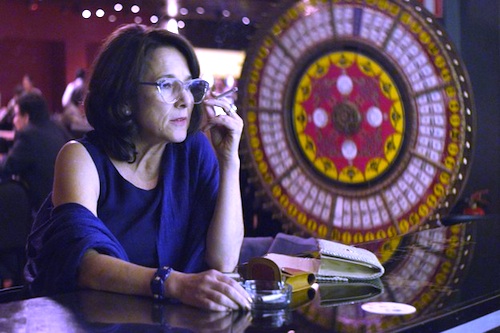
Gloria Cumplido is no stranger to discos. She often haunts them during singles nights. The fifty-eight year-old divorcee always finds a dance partner for the night, but she is looking for something more substantial. She thinks she might have found it in Rodolfo Fernández. They catch each others’ eye across the dance floor and one thing duly leads to another.

Happily, his charm does not evaporate in the morning. In fact, he is rather determined to pursue a relationship with Cumplido, but he has issues. His ex-wife and grown daughters are still unhealthily co-dependent and he continues to enable their behavior. At least, that is the charitable interpretation. Regardless, he gets distinctly flaky at the most inopportune times.

Gloria is small in scope and thin in narrative development, but it has a dynamite lead in Paulina García’s Cumplido. Refreshingly, she is nobody’s victim. She is a woman of a certain age with a reasonable degree of sexual confidence, trying to chart a third act for her life, now that her grown children are preoccupied with their own lives. García brings out her vulnerability, but consistently plays her as smart and resilient, so we never lose patience with decisions.

From "Gloria."

There are a few laughs here and there (most memorably the odd cat creation story her housekeeper spins out of Noah’s Ark), but Gloria a serious film by-and-large, because it addresses some serious business—love and aging. At times, Lelio is far too enamored with the daily routine of his central character, but he has a keen sense of how to use music. When he finally unleashes Tozzi’s hit tune, it makes the moment. He also shrewdly incorporates a rendition of Jobim’s “Waters of March,” whose lonesome imagery and hopeful spirit nicely reflects her alone-in-a-crowd experiences.

Lelio’s one hundred ten minute running time is far longer than it needs to be. We would most likely get it just as well somewhere closer to ninety. He probably fell in love with his character and lead actress, which is understandable. She carries the film with her boldly revealing performance. Those who have a phobic reaction to unvarnished nudity should be forewarned, but it will strongly resonate with viewers who identify with mature characters and their emotional circumstances. Recommended respectfully (but not wildly enthusiastically) for the target audience, Gloria screens tonight (10/6) at the Walter Reade and tomorrow (10/7) at the Francesca Beale as a main slate selection of this year’s NYFF.

LFM GRADE: B-

Posted on October 7th, 2013 at 12:31pm.

LFM Reviews Real @ The New York Film Festival

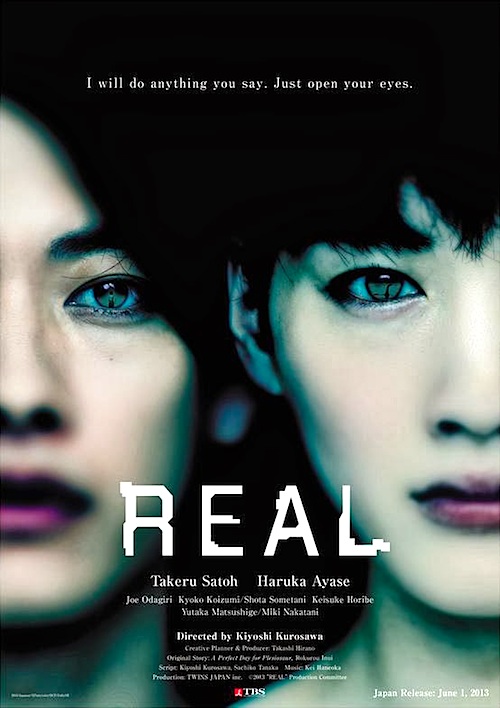
By Joe Bendel. Overlooked in the only Jurassic Park that matters, the pleisiosaur finally gets its big screen close-up, courtesy of the other Kurosawa. Initially, it is only a metaphor, but it becomes significantly meaningful and pressing to the young lovers in Kiyoshi Kurosawa’s Real, which screens tonight at the 51st New York Film Festival.

Initially, Koichi Fujita and Atsumi Kazu look like the ideal couple. Kazu seems perfectly sweet, but the comic artist specializes in grisly serial killer mangas. Unfortunately, while suffering a persistent case of writers block, Kazu tried to take her own life, falling into a coma instead. Hoping to assist her recovery, Fujita has agreed to a new procedure known as “sensing,” by which he will enter her subconscious.

If Fujita gently probes the circumstances surrounding her attempted suicide, he can encourage her conscious mind to re-awaken. The early sessions go relatively well, but Fujita is increasingly alarmed by the residual phantom images intruding on his reality as a result of the sensing. He also carries back a concrete mission to perform in the real world. Kazu yearns to see the pleisiosaur drawing she gave him while they were both children living on the provincial island of Hikone.

As Kurosawa’s title suggests, there will be many questions about the nature of reality throughout Real. However, every twist and revelation serves to advance the story (adapted from Rokuro Inui’s novel), so they never feel cheap or forced. While perhaps less of a departure for the horror auteur than his previous outing, the dark family drama Tokyo Sonata, Real is best considered in the tradition of Richard Matheson writing in his What Dreams May Come and Somewhere in Time bag. In fact, what is most striking about Real is how deeply Fujita and Kazu feel about each other while being so reserved in the manner they express it.

From "Real."

Frankly, Takeru Sato’s work could be uncharitably categorized as a bit stiff or awkward, but to be fair, Fujita is supposed to be a step slow in the intuition department. On the other hand, Haruka Ayase’s performance as Kazu is acutely sensitive. In fact, she handles her game-changing pivot with considerable grace. It is also a bit surprising to see a major star like Miki Nakatani (truly mesmerizing in Memories of Matsuko) in the comparatively straight forward supporting role of Dr. Eiko Aihara, but she makes the most of it.

Real is a text book example of how special effects can and should be subservient to story and character development. There is plenty of head-tripping and reality-bending, but it is the love story drives the film. Nicely supported by Kei Haneoka’s elegant musical themes, Real is far more accessible for general audiences than most of Kurosawa’s films. Highly recommended, it screens tonight (10/7) at Alice Tully Hall as a main slate selection of the 2013 NYFF.

LFM GRADE: A-

Posted on October 7th, 2013 at 12:26pm.

LFM Reviews Whiplash @ The New York Film Festival

From "Whiplash."

By Joe Bendel. He is a big band director who out Buddy Riches Buddy Rich.While Rich’s band members always contended the famous drummer’s profane bark was worse than his bite, Fletcher is a dread terror with a baton. One freshman drummer learns this the hard way in Damien Chazelle’s Whiplash, which screens as part of Shorts program 3 at the 51st New York Film Festival.

It is Andrew Neiman’s first day with the jazz orchestra of an elite conservatory. He will do newby stuff like tuning the kit and turning pages, but he will also get a turn with the sticks. It will be a real trial by fire. Before he even gets his shot, Neiman will witness one band-member getting the public ax. The choice of tune will not do him any favors either. It will be Hank Levy’s “Whiplash” (which Don Ellis recorded on his Soaring album). An arranger and composer for the Ellis and Stan Kenton big bands, Levy often experimented with odd time signatures, while delivering the big sounds those leaders were known for. Good luck, kid.

Even though the portrait of Rich hanging above him would seem to signify good luck, Neiman is in for it. However, Whiplash has already had considerable good fortune. An expanded feature film version is proceeding on track after it won the short film jury award at this year’s Sundance. While high profile executive producers like Jason Reitman and Jason “Insidious” Blum did not hurt, its real trump card is the jaw-dropping work of J.K. Simmons.

Recognizable from jillions of supporting parts (including J. Jonah Jameson in the Spiderman franchise), Simmons calls and raises both Buddy Rich and former Drill Sergeant R. Lee Ermy. As Fletcher, he is certainly intimidating, but also disturbingly manipulative. Yet viewers cannot write him off completely, because there is very clearly a passion for the music burning within him. Regardless of what you make of the character, it is a tour de force performance from Simmons.

The late Hank Levy also deserves credit for helping Whiplash the movie work. Even (or especially) to a non-musician, his composition sounds hard to play and the chart looks impossible. Yet, the Hank Levy Legacy Band still swings it hard for the film’s soundtrack.

Musician turned filmmaker Chazelle is clearly intimately acquainted with this world. His stylish feature debut, Guy and Madeline on a Park Bench also employed jazz, while shrewdly examining the private lives of musicians. He also co-wrote the screenplay for The Last Exorcism Part II, so there’s range for you.

The eighteen minute Whiplash might feel like a brief episode in a longer story (because it more or less is), but it is an encounter that will resonate deeply for many former music students (and they have our sympathies). However, everyone should be able to appreciate Simmons’ virtuoso turn and anyone with open ears can dig the use of the title tune. Highly recommended in its short film form, Whiplash screens this Thursday (10/10) at the Howard Gilman Theater, as part of the 2013 NYFF’s Shorts Program 3.

Posted on October 7th, 2013 at 12:15pm.

LFM Reviews Tim’s Vermeer @ The New York Film Festival

From "Tim’s Vermeer."

By Joe Bendel. The sheer scarcity of Johannes Vermeer’s paintings is guaranteed to maintain the art world’s fascination. It was partly why the notorious forger Han Van Meegeren was able to pass off a reportedly terrible fake on his National Socialist buyers—demand always outstrips good sense. However, one entrepreneur might just stand the polite art world on its ear when he suggests he can paint brand new Vermeers using Seventeenth Century technology. Jenison’s buddy Penn Jillette basically dared him to prove it for posterity. Jenison’s results are duly documented in Teller’s Tim’s Vermeer, which screens during the 51st New York Film Festival.

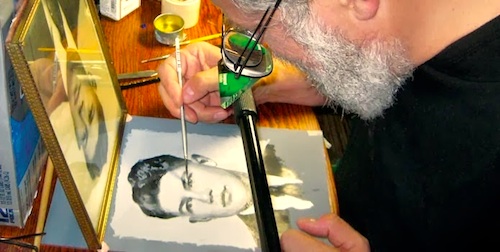
Building on the research of artist David Hockney and academic Philip Steadman, Jenison argues it is simply impossible for the human eye to perceive the photorealistic detail that distinguishes Vermeer’s paintings. Using the scientific process circa 1650, Jenison develops a method to duplicate the Vermeer look. It is complicated, but like the best magic, it involves the use of mirrors.

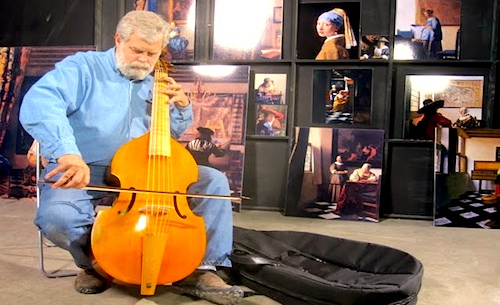
Both Hockney and Steadman agree Jenison is on to something, but to really prove the point, he embarks on an audacious experiment. He will recreate the setting of Vermeer’s The Music Room in a San Antonio warehouse, where he will use his proposed technique to recreate rather than forge the Vermeer masterwork. However, what started as an intellectual pursuit becomes an endurance challenge over time.

From "Tim’s Vermeer."

Director Teller and producer-narrator Jillette strike a shrewd balance throughout Tim’s Vermeer, injecting enough caustic humor to satisfy their fans, but never upstaging Jenison’s story. Frankly, it is a surprisingly provocative film that questions many widely held assumptions regarding the nature of art. Hockney’s participation is a particular coup. When he more or less buys into Jenison’s system, it carries considerable weight.

Essentially, Jenison argues Vermeer was the original photographer. The composition of The Music Room is still a work of art. He simply used a somewhat mechanical method to render it on canvas. Of course, he still had to do the work, which Jenison proves is a painstaking process.

Thanks to the developments in digital video, Teller and his associates were able to take an eccentric idea and fully follow through on it. It might shake up stodgier Academy members to hear Penn & Teller tipped for Oscar consideration, but they deserve to be in the mix. Consistently entertaining and rather shockingly erudite, it proves documentaries can cover prestigious subject matter, but still be fun to watch. Recommended for Penn & Teller fans and fine art connoisseurs, Tim’s Vermeer screens again this Wednesday (10/9) as an “Applied Science” documentary selection of the 2013 NYFF.

LFM GRADE: B+

Posted on October 7th, 2013 at 12:14pm.

LFM Reviews Layla Fourie @ The Goethe Institut’s German Currents Fest in LA

By Joe Bendel. Lies and deceit hang heavy in the South African air. That should be good for Layla Fourie’s career. She is a freshly certified polygraph operator. Unfortunately, she also ensnares herself with a web of lies in Pia Marais’ Layla Fourie, which screens as part of the Goethe Institut’s German Currents: Festival of German Film in Los Angeles.

Fourie is a single mother with limited resources, but she stands on the brink of a better life. Hired by a polygraph company, she is sent to a large provincial casino to screen their next batch of prospective employees. Tragically, while in transit, Fourie runs down a stranded motorist she mistakenly takes for a carjacker. It was a dark and stormy night, and Fourie initially tries to do the right thing. Eventually, though, she just dumps the body and covers up her crime as best she can. Of course, there is a witness: her horrible brat of a son, Kane.

Duly proceeding with her work, Fourie starts polygraphing applicants, including Eugene Pienaar, one of the few white job seekers. He immediately resents her intrusive questions, but is also somewhat attracted to her. These responses make Fourie profoundly uneasy around him. As Fourie reluctantly comes to know Pienaar, she realizes his missing deadbeat father was the man she crashed into. The more time she spends with Pienaar, the more her conscience torments her. To make matters worse, Kane turns out to be a natural born blackmailer.

The ethically compromised polygraph operator is a fresh and intriguing noir premise, but Marais and co-writer Horst Markgraf never fully capitalize on its potential. Frustratingly, the polygraph machines entirely disappear after the first act. Still, the relationship that uneasily develops between Fourie and Pienaar is sharply written and smartly played by Rayna Campbell and August Diehl, respectively. They share some real screen chemistry, but also convey all the thorny collective history making them instinctively wary of each other.

From "Layla Fourie."

LF really crackles when Campbell and Diehl share the screen. Regrettably, there is also an awful lot of utterly dreadful Kane, who makes a compelling case for child abuse. Frankly, his behavior never rings true. After all, kids are usually highly attuned to their parents’ circumstances and prone to show solidarity.

Conversely, the lawless milieu of LF feels very true to life. Ruthlessly naturalistic in her approach, Marais holds a mirror up to nature and finds its reflection bitter and two-faced. Now based in Germany, Marais split her childhood years between South Africa and Sweden. Clearly, she is not entirely sanguine about the prospects for her partial homeland’s social fiber. After all, nearly everyone in LF is morally suspect—the only question is to what extent.

LF vividly immerses viewers in its harsh reality. Cinematographer André Chemetoff nicely frames the character’s intimate angst and the harsh beauty of their surrounding environment. It might be a bit of a ringer at German Currents, but the work of Campbell and Diehl should still pull in viewers expecting something more like Young Goethe in Love. (It is also part of the trio of Match Factory films screening during the festival.) While not without flaws, Layla Fourie is consistently bracing. Recommended for those who prefer their cinema without any extraneous sentimentality, it screens this Sunday (10/6) at the Egyptian Theatre as part of this year’s German Currents.

LFM GRADE: B-

Posted on October 5th, 2013 at 1:50pm.