LFM Reviews A Complicated Story @ The San Francisco Film Society’s Hong Kong Cinema Series

From "A Complicated Story."

By Joe Bendel. It was supposed to be a simple temp job. A mainland university student in dire need of money agrees to be surrogate for an anonymous couple of considerable wealth. However, when Liu Yazi’s Hong Kong employers mysteriously cancel the contract, her maternal instincts kick in with full force. She might be a country naïf, but Liu will not be easily intimidated by wealth and privilege throughout Kiwi Chow’s A Complicated Story, which screens during the San Francisco Film Society’s annual Hong Kong Cinema film series.

For Liu, carrying the mystery couple’s child is about the only way she can pay for her older brother’s operation. She will temporarily defer her education, as she lives in luxurious isolation. Liu sees almost nobody except the couple’s doctor, her personal assistant, and Kammy Au, the lawyer who overseeing the entire sort of legal arrangement. After befriending the young woman, Au is forced to break the bad news to her: the divorcing couple demands she abort her pregnancy.

Not inclined to cooperate, Liu seeks out her own medical advice, which leads to the first of several revelations. Liu in turn will surprise her minders when she slips away, finding shelter at a combined women’s shelter-medical clinic. It turns out the father, Yuk Cheung, is not such a bad guy. Tracking down Liu, he makes it clear he intends to do the right thing. He and she just happen to have very different ideas of what the right thing might be. On the other hand, his ex-wife, actress Tracy T, is the sort who always makes matters more difficult.

Complicated probably sounds like sudsy soap opera fodder on paper, but its execution is admirably restrained and archly observant of HK social dynamics. It could also be the year’s most pro-life film without an overtly religious agenda, but third act developments will still limit its appeal to the evangelical market. Regardless, in terms of emotion, it certainly lives up to its apt but nondescript title.

From "A Complicated Story."

Helmed by first-time director Chow with nine colleagues from the Hong Kong Academy for Performing Arts’ film masters program contributing as crew, Complicate was conceived as a foot-in-the-door career calling card, but it looks far more polished than most American pseudo-indies. Obviously, executive producers Johnnie To and William Kong (producer of Hero, Fearless, and Crouching Tiger) lend it all kinds of credibility, along with marquee movie star Jackie Cheung.

No mere celebrity cameo, Cheung’s considerable screen time as Yuk is unusually disciplined in its understatement, yet deeply powerful. Likewise, the strong but not showy Liu should be a breakout role for Zhu Zhi-ying (who was excellent in the little seen Zoom Hunting). Still, it is Stephanie Che who ultimately defines the film with her richly complex performance as Au.

Granted, there are times when Chow’s adaptation of the Yi Shu novel (co-written with three other screenwriters) seems to be throwing out plot points just to force the drama. Nevertheless, it is rather nuanced in its social criticism, portraying upward social mobility as well as inequality. Featuring great turns from Che and Cheung, as well as a lovely slightly-more-than-a-cameo from the great Deannie Ip, A Complicated Story is one impressive “student film.” Recommended for those who appreciate complex relationship and social issue dramas, it screens this Sunday (10/6) at the Vogue Theatre, as part of the SFFS’s annual Hong Kong Cinema series.

LFM GRADE: A-

Posted on October 4th, 2013 at 9:55am.
LFM Reviews Measuring the World @ The Goethe Institut’s German Currents Fest in LA

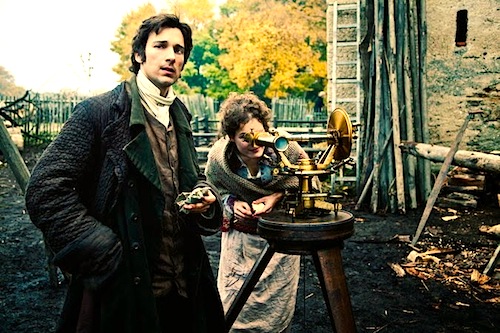
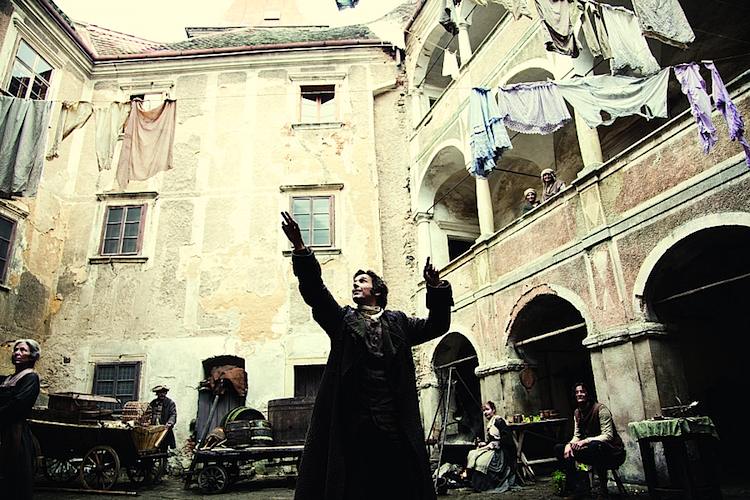
By Joe Bendel. You know Gauss’s bell curve and you know Humboldt’s monkey. They were two of the most celebrated intellects of the Nineteenth Century German states. In addition to a common patron, Austrian Daniel Kehlmann’s fictionalized dual-biography suggests they also perhaps shared an intertwined fate. Adapted for a big, big screen by the novelist himself, Detlev Buck’s Measuring the World, has its American premiere this Friday as the opening night film of German Currents 2013 in Los Angeles.

Carl Friedrich Gauss was born into desperate poverty, but the boy’s stern schoolmaster recognized his remarkable gift for mathematical analysis. With a name like Friedrich Wilhelm Heinrich Alexander von Humboldt, the future Prussian naturalist-explorer was clearly a child of privilege. However, the Duke of Brunswick supported both lads’ education at an early age.

After Gauss and Humboldt meet by chance as children, Measuring splits into two wildly divergent narratives. A mathematician in the purest form, Gauss will spend his life within the German states. He is difficult by nature, yet somehow the uneducated but supportive Johanna consents to marry him. Meanwhile, Humboldt embarks on a Latin American expedition that will make his name. His most significant companion will be his colleague and uneasy friend, Aimé Bonpland, the French botanist. As the title suggests, both men will take vastly different approaches to quantifying our earthly bounds through their work. Eventually, Humboldt and Gauss will meet again in their twilight years, carrying the baggage of two eventful lives.

From "Measuring the World."

For a prestige period production, Measuring has a surprisingly idiosyncratic sensibility. With its archly ironic narration and fits of absurdist humor, the film often feels like a distant cousin of Gilliam’s Munchausen. Visually, it is often quite inventive and the sheer scope of its wanderings is rather impressive. Yet, there are some nice, quiet moments shared between Florian David Fitz and Vicky Krieps, as the Gausses. At times, Albrecht Abraham Schuch risks veering into Fraser Crane territory as the adult Humboldt, but Jérémy Kapone’s earthier Bonpland helps compensate for and undercut his mannered fastidiousness.

Ironically, one of the most recognizable faces in Measuring for American audiences will be Karl Markovics (lead actor in Stefan Ruzowitzky’s The Counterfeiters), who is quite good in the very supporting role of young Gauss’ teacher, Büttner. Cineastes will also be intrigued to hear that the film was lensed by Krzysztof Kieslowski’s longtime cinematographer Sławomir Idziak. Measuring does not look like a Kieslowski, but it has a distinctive sheen nonetheless.

With Idziak and his talented crew, Buck immerses viewers in an era Americans do not often have the opportunity see on screen. Granted, Measuring is somewhat inconsistent in patches, but when it works, it works on a very high level. Recommended for fans of cerebral historicals, like Longitude and Pillars of the Earth, Measuring the Earth screens this Friday (10/4), kicking off this year’s German Currents at Egyptian Theatre. It should also be noted in closing: Measuring is one of three Match Factory films screening as part of the celebration of German cinema, along with Gold and Layla Fourie.

LFM GRADE: B

Posted on October 3rd, 2013 at 5:16pm.

LFM Reviews AKA Doc Pomus

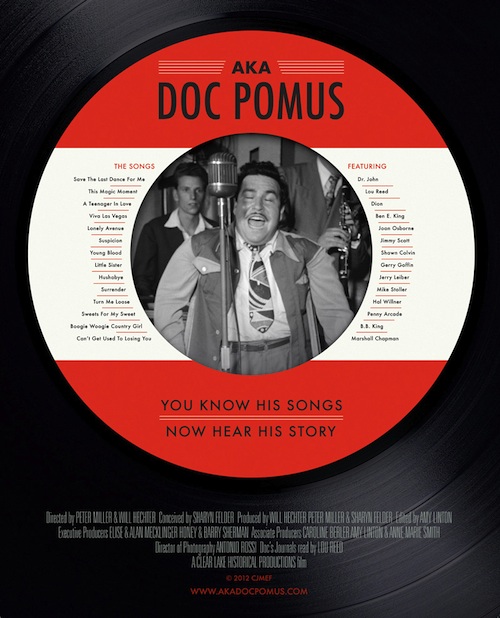
By Joe Bendel. Doc Pomus was one of the first legit white blues singers and he had some legitimate blues. However, he would make his lasting mark on the music business as a songwriter. The man who brought soul to the Brill Building is affectionately profiled in Peter Miller & Will Hechter’s A.K.A. Doc Pomus, which opens this Friday in New York.

The man born Jerome Solon Felder might not sound like much of a blues or R&B vocalist, but soulful African American music just spoke to the young Jewish boy stricken with polio. After serendipitously discovering his talent, Felder redubbed himself “Doc Pomus,” embracing music as a calling he could still pursue. Unfortunately, he was not exactly the major labels’ idea of a front man, but he could write a tune.

You will know his songs, even if you don’t know his name. Without Pomus, the world would not have “Lonely Avenue,” “Viva Las Vegas,” “This Magic Moment,” “There Must Be a Better World,” or “Save the Last Dance For Me,” the Ben E. King hit that serves as the film’s touchstone song.

Conceived and co-produced by Pomus’s daughter, Sharyn Felder, AKA is an unusually revealing look inside the creative psyche. Incorporating Pomus’s uncomfortably candid journals (read by Lou Reed), Miller and Hechter create an unflinching portrait of an artist prone to severe bouts of depression. The Felder family participated in force, with Pomus’s daughter Sharyn, his Broadway actress ex-wife, and his brother Raoul Felder, the celebrity lawyer, all discussing their relationships with the larger than life songwriter. Plenty of his musical colleagues and admirers also duly pay their respects, including Ben E. King, Dion, and Jimmy Scott, whose career Pomus posthumously rejuvenated. Nearly forgotten by the industry, Scott was signed by Sire Records after his moving performance at Pomus’s memorial.

AKA is often a deeply personal film, but its musical analysis is still pretty on target, especially the defense of the soulfulness of Pomus’s “Sweets for My Sweet,” as performed by the Drifters (James Moody also recorded a wonderfully funky instrumental version with Gil Fuller’s big band). Well assembled and surprisingly frank, it is a good cut above most installments of American Masters. Recommended for fans of the blues and American pop music, A.K.A. Doc Pomus opens this Friday (10/4) in New York at the Village East.

LFM GRADE: B

Posted on October 3rd, 2013 at 5:11pm.

LFM Reviews Butter Lamp @ The New York Film Festival

By Joe Bendel. He is like an Old West daguerrotypist capturing the faces of the vanishing frontier, except this barnstorming photographer travels through Tibet. Viewers will watch him work in Hu Wei’s Butter Lamp, which screens during Shorts Program 2 at the 51st New York Film Festival.

At first it looks rather surreal. A quick succession of Tibetan nomads assembles for family photos shot in front of the photographer’s wildly anachronistic fake backdrops, such as Disneyland and the Great Wall of China. Every time the shutter clicks Hu skips ahead to the next family. The older nomads still don traditional formal dress and wield their prayer wheels, but in each subsequent photo sessions, the younger, impatient generation more frequently wears blue jeans and western sportswear.

While the format is simple, Butter offers a shrewd commentary on globalization and the deliberate marginalization of Tibetan culture. While an elderly woman will prostrate herself before the image of Potala Palace, most of the photographer’s customers chose something reflecting a more consumerist lifestyle. Yet, some customs are still observed.

Straddling the boundaries between dramatic narratives, documentaries, and cinematic essays, Butter Lamp is visually inventive and decidedly zeitgeisty (particularly at a time when the Tibetan language is struggling for survival, per government policy). Patrons on a New York budget may not feel Hu’s fifteen minute film alone justifies the price of a ticket, but it is an accomplished production, well worth acknowledging. It screens this Sunday (10/6) and next Thursday (10/10) as part of the 2013 NYFF’s Shorts Program 2.

Posted on October 3rd, 2013 at 5:06pm.

LFM Reviews Gold @ The Goethe Institut’s German Currents Fest in LA

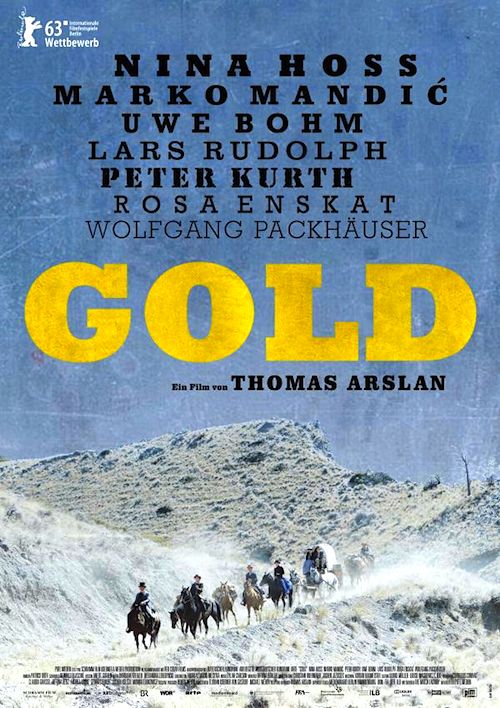
By Joe Bendel. Is it worth risking life and limb for the chance to go bust in the Klondike goldfields? A party of German immigrants believes so. They will endure exploitation and the elements for their dreams of precious metal in Thomas Arslan’s Gold (trailer here), which screens as part of the Goethe Institut’s German Currents: Festival of German Film in Los Angeles.

There is gold in those hills some place. Unfortunately, Laser, a German promising to take a ragtag group of prospective prospectors up to the remote gold-crazed town of Dawson, is a total phony. Although Emily Meyer has few illusions about their guide’s reliability, she continues on the journey. Like the rest of her group, the divorced former domestic servant has no life to go back to.

At least Laser hired a dependable packer. Carl Boehmer has never been so far north either, but he has cause to make himself scarce. As the harsh conditions take a toll on the travelers, a quiet mutual attraction percolates between Meyer and Boehmer, but it is a halting flirtation, due to reasons of privacy and privation.

Gold certainly demonstrates how ugly survival can get. There is at least one scene that will surely have audience members talking afterward and may unfairly come to define the film. Following in the tradition of revisionist westerns, Gold is pensive but never pokey. In fact, it observes western conventions when you least expect it.

Nina Hoss is a brilliant choice to play the reticent but resilient Meyer. Following up remarkable work in Barbara and A Woman in Berlin, she once again delivers a tightly controlled but infinitely suggestive performance. She finds a fitting partner in Slovenian actor Marko Mandić, who has a real Viggo Mortensen vibe going on as Boehmer.

Gold is rather fascinating as an example of the Old World engaging with the New World. It looks terrific, thanks to cinematographer Patrick Orth’s John Ford-worthy vistas. Dylan Carson’s reverb-heavy electric guitar score also evokes the haunted past, while sounding ultra-retro-contemporary. Finely crafted and gritty as trail dust, Gold is a good film as well as a curiosity piece. Recommended for fans of naturalistic westerns and German cinema (two sub-sets that do not often overlap), Gold screens this Sunday (10/6) at the Egyptian Theatre as part of this year’s German Currents.

LFM GRADE: B+

Posted on October 2nd, 2013 at 9:33pm.

The Man Who Threw The Shot Heard ‘Round the World: LFM Reviews Branca’s Pitch; Now Available on DVD

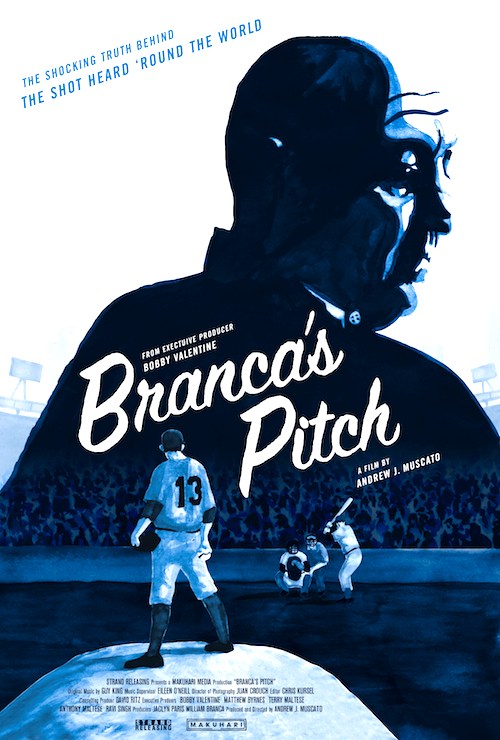
By Joe Bendel. In its heart of hearts, baseball is a neurotic sport. The best games, decided in the late innings, all come down to a simple question—who will choke, the pitcher or the batter? The statistics always favor the pitcher, but fans live in constant hope of that dramatic walk-off home run. We have been conditioned to it after seeing so many of them over the years. None is as indelible in sports fans’ collective memory as the ninth inning game-winner Bobby Thomson hit off Ralph Branca to secure the 1951 National League pennant for the New York Giants—the so-called “Shot Heard ‘Round the World.” However, Branca had not cracked. He made his pitch: high and inside, a terrible home run ball. Thomson just knocked it out anyway.

There is more to this story than fans realized, but Branca had to live with the results just the same. Viewers will learn the truth behind baseball’s most iconic game and how it changed the three-time All-Star’s life in Andrew J. Muscato’s documentary profile, Branca’s Pitch, now available on DVD from Strand Releasing.

For years, every time Thomson’s home run was replayed on television, Branca grinned and bore it, like a good soldier. A family man with a prosperous life insurance business, Branca’s post-baseball career was considerably more successful than most of his contemporaries, but that one moment in 1951 dogged him nonetheless. Finally, Branca decided to tell his story, enlisting the help of prolific ghostwriter David Ritz.

You might very well have some of Ritz’s work on your shelf. Originally inspired by Billie Holiday’s Lady Sings the Blues, Ritz has somewhat specialized in co-writing the memoirs of jazz, blues, and R&B artists like Jimmy Scott, Ray Charles, Buddy Guy, Nathalie Cole, and B.B. King. Ritz also happens to be a Brooklyn guy, so he and Branca get along famously.

In addition to a sports doc, Pitch also explores the largely overlooked relationship between a famous memoirist and their ghostwriter (or credited co-writer in Ritz’s case). Cynically, we often assume this is a rather cold-bloodedly commercial relationship, but a genuine friendship blossoms between Branca and Ritz. At one point, Ritz describes Branca’s voice as quite intelligent and well educated, but still a little bit “street,” which seems to fit the co-writer’s sensibilities like a mitt.

Ritz and Muscato both convey a sense that Branca can go days or even months without thinking of the fateful pitch, but as the macro years pass, he still bitterly resents being defined by that one pitch, especially since facts have since come to light suggesting that the Giants late season surge just wasn’t cricket. (Well reported in numerous sources, readers can reference Joshua Prager’s The Echoing Green for specific details, or wait for Pitch to reveal all in due course.)  He is both at peace with the past and deeply outraged—a contradiction Ritz argues he is wholly entitled to.

Executive produced by oh-so former Mets manager Bobby Valentine, Pitch nicely captures baseball’s influence on American culture and the cathartic relief Branca experiences when his side of the story finally enters the public discourse. It is a sports doc, but also a publishing story. Recommended for baseball fans and New Yorkers of all stripes, Branca’s Pitch is now available for home viewing from Strand Releasing.

LFM GRADE: B

Posted on October 2nd, 2013 at 9:29pm.