LFM Reviews Blind Detective @ The San Francisco Film Society’s Hong Kong Cinema Series

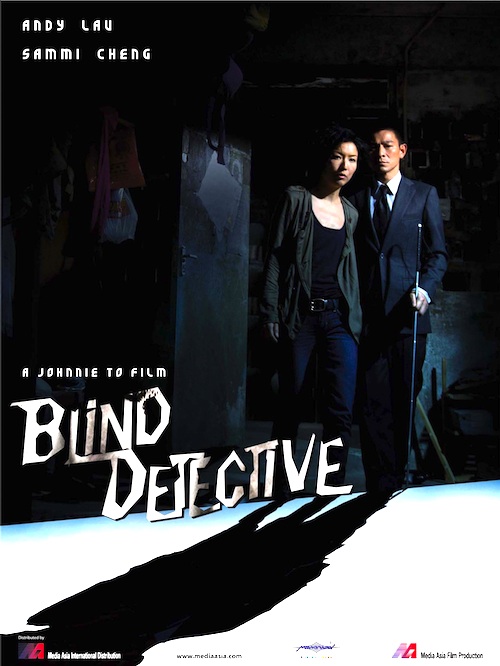
By Joe Bendel. He is sort of a consulting detective, whose bedside manner is about as warm and friendly as Holmes at his chilliest. Chong “Johnston” Si-teun has a sizeable ego and an even larger chip on his shoulder, but he is not without empathy—for the dead. Somehow, he still might find love with a far less deductive copper (his personal Lestrade) in Johnnie To’s genre blender, Blind Detective, which screens on the opening night of the 2013 edition of the San Francisco Film Society’s annual Hong Kong Cinema series.

Johnston’s sudden onset of blindness forced him to retire as police detective, but he still solves crimes for a living. He now relies on reward bounties, particularly those still valid for cold cases. Impressed by his results, Inspector Ho Ka-tung retains his services to find her long missing high school friend, Minnie. She has always been good with firearms and martial arts, but the cerebral side of detective work has always troubled her. Promising to teach her his methods, Johnston moves into her spacious pad, but immediately back-burners Minnie’s case in favor of several expiring bounties.

The half-annoyed Ho indulges Johnston for a while, eventually embracing his extreme re-enactment techniques. Blind arguably reaches its zenith when Johnston and Ho recreate a grisly murder conveniently set in a morgue, strapping on helmets and whacking each other over the head with hammers. If you ever wanted to see the Three Stooges remakes Silence of the Lambs, To delivers the next closest thing. Of course, their search for Minnie soon percolates back to the surface, when Johnston starts to suspect she fell victim to a serial killer preying on broken-hearted young women.
Much like the old cliché about the weather, if you don’t like the tone of Blind Detective, just wait five minutes, because it will change. You do not see many films incorporating elements of romantic comedy, slapstick farce, and dark serial killer thrillers, probably for good reason. To gives roughly equal weight to all three, yet it all hangs together better than one might expect.

Sammi Cheng is a major reason Blind works to the extent that it does. It is great to see her Inspector Ho act as the film’s primary action figure and her radiant presence lights up the screen. She develops decent chemistry with Andy Lau’s Johnston, but he looks profoundly uncomfortable in the intuitive curmudgeon’s skin. However, To fans will be relieved to hear Lam Suet duly turns up as a fugitive gambler hiding out in Macao.

To also delivers plenty of bang for the audience’s bucks in the third act. There are some distinctly creepy bits and a fair amount of suspense. On the other hand, a drawn out subplot involving Johnston’s long held crush on a dance instructor chews up plenty of time but serves little purpose except to telegraph the feelings beginning to stir between the odd couple detectives.

Thanks to two well executed showdowns, Cheng’s winning performance, and some evocative Hong Kong locales, Blind Detective chugs along steadily enough for a while and picks up mucho momentum down the stretch. Recommended for To fans and those with a taste for comedic mysteries, Blind Detective screens this Friday night (10/4) at the Vogue Theatre as part of the SFFS’s 2013 Hong Kong Cinema series. Action aficionados should also check out Chow Yun-fat’s massive return to form in Wong Jing’s The Last Tycoon screening Saturday (10/5) and Sunday (10/6) at the same venue.

LFM GRADE: B-

Posted on September 30th, 2013 at 5:37pm.
LFM Reviews The Missing Picture @ The New York Film Festival

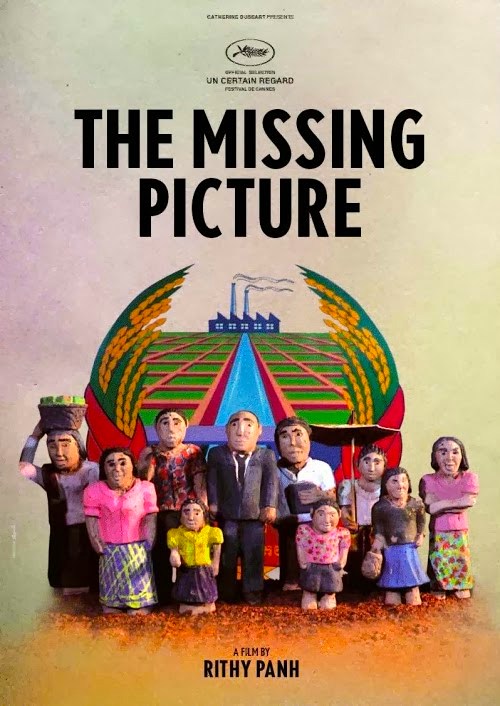
By Joe Bendel. According to estimates, the Maoist Khmer Rouge regime executed ninety percent Cambodia’s creative artists and performers. During their reign of terror, the nation’s once thriving film industry was also literally decimated. Decades later, a filmmaker and a sculptor combined their talents to chronicle Cambodia’s years of madness with unusual power and grace. Rithy Panh is arguably the foremost documentarian chronicling the crimes of the Khmer Rouge, but to tell his family’s story he enlisted the skills of French Cambodian artist Sarith Mang. Where once there were no surviving images, Mang’s carved figures bring the tragic past back to life in Panh’s The Missing Picture, which screens during the 51st New York Film Festival.

While the Khmer Rouge churned out plenty of propaganda, they were more circumspect in documenting their own crimes. That left plenty of holes for Panh to fill in, as his title suggests. With the help of Mang’s coarse yet eerily expressive clay figurines, Panh recreates the torturous conditions he somehow lived through, but which claimed the lives of his parents, nephews, and little sister, one by one.

Panh’s decision to use Mang’s figures and richly detailed diorama backdrops might sound bizarrely hyper-stylized, but it is shockingly effective. Frankly, the scenes depicting the horrifying death of Panh’s sister are nothing less than devastating. It is an unlikely approach, but it directly conveys the emotional essence of the circumstances.

To better understand the extent of what was lost, Panh periodically looks back at happier, pre-Khmer Rouge days, as well. Again, he compellingly evokes of tactile sense of those innocent times. Viewers can practically smell the spices at the neighborhood parties as they listen to a hip local rendition of Wilson Pickett’s “Midnight Hour.”

Rarely has a documentary ever been so exquisitely crafted. Each and every one of Mang’s figures is a work of art, perfectly lit and lensed by cinematographer Prum Mésa to bring out their full eloquence. Composer Marc Marder supports the visuals with what might be the most mournful film score since Schindler’s List. It is a film that resounds with raw pain and defiant honesty (aside from a dubious bit of moral equivalence regarding western capitalism, probably tossed out to mollify festival programmers).

Not a film to be shrugged off, The Missing Picture holds viewers completely rapt and haunts them for days after viewing. Recommended for a considerably wider audience than traditional doc watchers, it screens this coming Monday (9/30) at the Beale Theater and Tuesday the eighth at the Gilman as an official selection of the 2013 NYFF.

LFM GRADE: A-

Posted on September 27th, 2013 at 3:20pm.

LFM Reviews Fifi Howls from Happiness @ The New York Film Festival

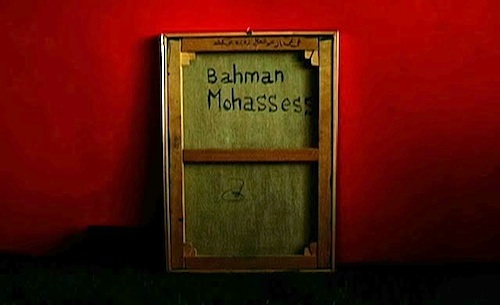
By Joe Bendel. Given his darkly surreal imagery and his penchant for destroying his own work, there is definitely something Kafkaesque about the late Iranian expatriate artist Bahman Mohasses. For years he had removed himself from the world. Yet, he was ready, perhaps even eager to talk when Mitra Farahani tracked him down for her documentary profile, Fifi Howls from Happiness, which screens during the 51st New York Film Festival.

Mohassess is clearly out of step with the current Islamist regime in Iran. It seems his large scale nude statues were not compatible with the post-Revolutionary standards of “decency.” He also happened to be gay, but in a defiantly politically incorrect way (marriage was not exactly a priority for him). However, his first extended period of self-imposed exile began shortly after the Shah’s ascendency.

Eventually, Mohassess returned to his homeland, where the Shah’s wife became one of his leading patrons. A far cry from a fundamentalist, Mohassess still gave the Islamic Revolution a fair chance, but eventually tired of the gauche scene. Before he left, Mohassess destroyed a significant portion of his oeuvre, taking only a few pieces with him (most notably including the painting that supplies the title of Farahani’s film).

On one hand, Mohassess’s actions echo the existential self-negation of a Dostoyevsky character, yet at other times one suspects it is all a calculated attempt to create mystique. It almost seems like Mohassess has been waiting for someone like Farahani to take his bait. Regardless, she develops a considerable rapport with the artist, but never sounds nauseatingly fawning.

From "Fifi Howls from Happiness."

While not quite deleted from Iranian history books, Mohassess’s place in the nation’s collective consciousness is decidedly ambiguous, which makes Fifi a valuable cinematic record. Clearly, there are still Mohassess collectors, like Rokni and Ramin Haerizadeh, prominent Iranian artist-brothers working in Dubai. Through Farahani, they visit Mohassess to commission what may or may not be his last great artistic statement.

Since Fifi is almost entirely shot in Mohassess’s residential hotel, the film is visually somewhat static. Still, it is fascinating to see the stills of his work, accompanied by his artist commentary, especially considering most of said pieces no longer survive. Farahani cleverly incorporates her subject’s unsolicited directorial advice, ironically following it to the letter. Her extended allusions to Balzac’s The Unknown Masterpiece and Visconti’s The Leopard also add literary flair.

Indeed, Farahani earns great credit for working with and around Fifi’s inherent limitations. Mohassess is a difficult subject, who never sounds like he is really “for” anything or anyone, not even himself. Yet, Farahani does him justice, convincing the audience he is an odd character to visit, but one well worth saving from the memory hole. Recommended for connoisseurs of art documentaries and Mohassess’s work, Fifi Howls from Happiness screens tomorrow (9/28) and Tuesday (10/1) at the Gilman Theater as part of the Motion Portraits section of the 2013 NYFF.

LFM GRADE: B

Posted on September 27th, 2013 at 3:12pm.

LFM Reviews Afternoon of a Faun—Tanaquil le Clercq @ The New York Film Festival

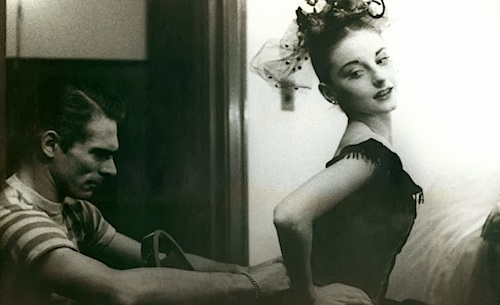
By Joe Bendel. She changed the way George Balanchine thought about ballerinas. Essentially, that means she changed ballet. Tanaquil Le Clercq’s life took a unfortunate turn worthy of her tragic characters, but she would have a third act. Nancy Buirski surveys her entire life and art in Afternoon of a Faun: Tanaquil le Clercq, which screens during the 51st New York Film Festival.

A cosmopolitan prodigy, Le Clercq was discovered by Balanchine while she was a difficult student at School of American Ballet. According to her friends, the legendary choreographer first encountering her sulking about the halls after her teacher ejected her from class. Her sophisticated looks certainly caught his eye. Although her height and long limbs were unusual for dancers at that time, Balanchine started tailoring his ballets to her strengths. Soon she was his featured dancer and wife. Then disaster struck.

Ironically, Le Clercq had danced in a special polio-themed March of Dimes fundraiser performance shortly before she was stricken with the disease herself. She would never dance or even walk again. However, she would eventually re-emerge as a teacher at Dance Theatre of Harlem. As for her relationship with Balanchine—it was complicated.

Frankly, it would have been easy for Buirski to cast Balanchine in a villainous light, but Faun is rather remarkable for its evenhanded and forgiving treatment of the dance titan. Taking its lead from Le Clercq’s closest friends, Faun gives him credit for supporting her when she most needed help and eventually re-starting some sort of intimate relationship with his former muse. It was indeed complicated, but maybe not so much for Jerome Robbins, her fair weather ambiguously romantic friend.

From "Afternoon of a Faun—Tanaquil le Clercq."

Buirski’s sympathetic depiction of Balanchine reflects the humane spirit of film as a whole. While it is eventually destined for American Masters, the elegant and often elegiac dance footage elevates its cinematic-ness. Buirski calls on a relatively small cast of talking heads, but they each clearly knew Le Clercq very well. Perhaps most moving are the remembrances of Jacques d’Amboise, Le Clercq’s partner for many of her defining performances.

Viewers will be surprised at the emotional punch Faun packs. Granted, Buirski follows the tried-and-true documentary filmmaking approach, but she marshals all her elements with considerable style and understanding. The participation of co-producer Ric Burns and project advisor Martin Scorsese should further reassure film snobs. A satisfying viewing experience, Afternoon of a Faun is recommended for dance connoisseurs and anyone with a taste for cultural documentaries. It screens this coming Monday (9/30) at the Walter Reade, as well as the 11th and 13th, as part of the Motion Portraits section of the 2013 NYFF.

LFM GRADE: B+

Posted on September 27th, 2013 at 3:09pm.

LFM Reviews The Spy: Undercover Operation

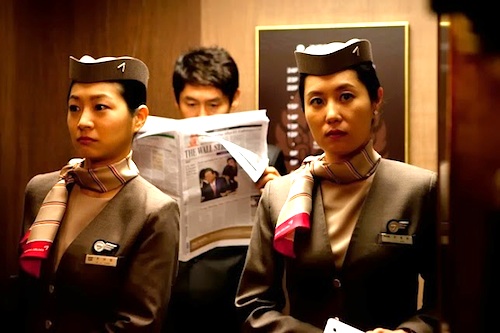
From "The Spy: Undercover Operation."

By Joe Bendel. Sure, they get to kill people, but spies are still civil servants. The hours are long and there is frequent travel, but they are still paid according to their government grade. Agent Kim Chul-soo’s wife does not realize he is out saving the country. She only knows he is not around very much, with little to show for it. However, she will find herself in the middle of his latest assignment when an enemy operative targets her in Lee Seung-jun’s The Spy: Undercover Operation, which opens today in Queens, New York.

The latest round of six-party talks is fast approaching. Once again, re-unification seems to be just around the corner, until a high-ranking North Korean official’s plane is blasted out of the sky by a stinger missile. His daughter, Baek Sul-hee, decides to defect to the South to expose the international conspiracy responsible. She also happens to be a nuclear scientist, making her a very valuable commodity. Kim and his sidekick-like department head Jin will manage the operation, but the normally reliable operative will be uncharacteristically distracted by his fraying marriage.

Frankly, the North Koreans are the least of their worries. The Chinese, American, and Japanese intelligence services are all circling around Baek. However, a mysterious freelancer named Ryan represents the gravest threat. Sort of the male model version of Javier Bardem’s Raul Silva in Skyfall, Ryan has been putting the moves on Kim’s unsuspecting wife AhnYeong-hui for nefarious purposes. This rather annoys Kim, for multiple reasons.

Essentially, The Spy incorporates elements of Mr. & Mrs. Smith and Athena: Goddess of War, adding a liberal dose of broad, henpecked humor. Helmed by last minute stand-in Lee Seung-jun (the assistant director on Quick), it boasts several nicely executed action scenes, but the jealous husband gags are strictly sitcom stuff.

If the Korean film industry is serious about expanding their share of the American market, The Spy is a rather perverse choice to export, given its anti-American inclinations. It is hard to imagine a film whose hero deliberately shoots CIA agents dead is likely to break out at the American box office, especially since fans of the action and rom-com genres tend to be more heartland, whereas the audience for provocative art-house films like Kim Ki-duk’s Pieta will not be interested, regardless. Perhaps American actor Daniel Henney (best known for the previous Wolverine film) was considered crossover friendly, but he is hardly a household name.

From "The Spy: Undercover Operation."

Henney makes a decent villain as Ryan, but prestige screen-thesps Sul Kyung-gu and Moon So-ri look distinctly uncomfortable with the mugging and pratfalls required of Kim and Ahn, respectively. Somehow, though, Han Ye-ri’s Baek is a figure of intelligence, seriousness, and resourcefulness. Conversely, Ko Chang-seok (another Quick alumnus) is right at home with Jin’s rubber-faced reaction shots.

There is some impressive stunt work in The Spy, but it is hamstrung by its dubious humor and geopolitical analysis. Not likely to have a long run, diehard Henney fans (if they’re out there) should see it this weekend, but go in with low expectations when The Spy: Operation Undercover opens today (9/27) at the AMC Bay Terrace in Flushing.

LFM GRADE: C-

Posted on September 27th, 2013 at 3:05pm.

A Voice from Theresienstadt: LFM Reviews The Last of the Unjust @ The New York Film Festival

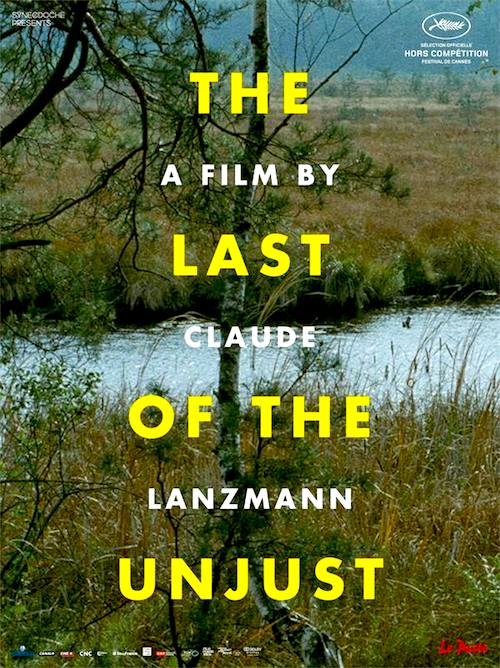
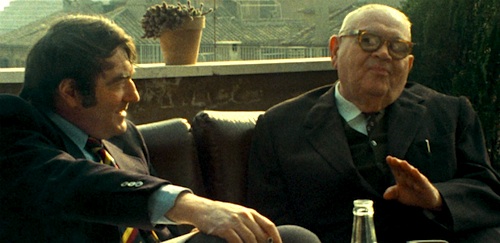
By Joe Bendel. He was a figurehead in a Potemkin village. Set up as a “model ghetto” to deceive the International Red Cross and the unaligned world at large, Theresienstadt hid its brutality from public view, but it was there just the same. Benjamin Murmelstein had the dubious distinction of being appointed the third and final President of Theresienstadt’s Jewish Council, or the “Elder of the Jews,” as the National Socialists dubbed them. A resourceful or perhaps expedient leader (depending on one’s point of view), Murmelstein remained a figure of controversy throughout his life. Shoah director Claude Lanzmann returns to the hours of interview footage he shot with Murmelstein in 1975 for his documentary profile, The Last of the Unjust, which screens during the 51st New York Film Festival.

When Murmelstein was appointed as the Elder of Theresienstadt, he did not have much say in the matter. With no practical authority, Murmelstein did his best with his powers of persuasion, going toe-to-toe with an often manically demonic Eichmann—a far cry from what Arendt made him out to be. Murmelstein estimates he saved over one hundred twenty thousand lives during the war years by arranging mass emigration to what is now Israel. On the other hand, the seventy-hour work weeks he instituted, in hopes of making the Theresienstadt prisoners too valuable to be “deported east,” was a double-edged sword.

In his lengthy discussions with Lanzmann, Murmelstein is both his best and worst character witness, but he steadily wins the documentarian over, at least to some extent. Unquestionably, his testimony and Lanzmann’s supplemental evidence will help viewers understand the precariousness of his position. Clearly, Lanzmann hopes viewers will speculate how they might respond if placed in similar circumstances.

From "The Last of the Unjust."

Is Murmelstein worthy of an in-depth biographical treatment? Without reservation, the answer is yes. Nonetheless, at 218 minutes, the Spartan Unjust is a demanding viewing experience. Even Lanzmann’s towering Shoah, with its considerably wider scope, is better digested in installments.

Unjust is rich with insight and offers more than a few eye-opening scoops. However, Lanzmann makes the film longer and therefore more arduous than necessary by frequently including multiple accounts of incidents with little appreciable variation. There is a personal quality to this film, which tested his editorial sensibilities. Lanzmann admits right from the top that Murmelstein’s story has haunted him for years. Indeed, the contrast between Lanzmann in 1975, still quite the dashing figure at age fifty, and the gray-haired documentary statesman of today heightens the film’s keen sense of history. Recommended for those who are prepared for its intellectual and aesthetic rigors, The Last of the Unjust screens Sunday (9/29) at Alice Tully Hall as an official selection of the 2013 New York Film Festival.

LFM GRADE: B

Posted on September 25th, 2013 at 3:58pm.