Sam Rockwell Goes Hunting: LFM Reviews A Single Shot

By Joe Bendel. Call it a simple improvisation rather than a simple plan. Nobody thinks too far ahead or particularly deeply in this criminal morality tale. As a result, there is a mess of trouble for everyone in David M. Rosenthal’s roughly passable backcountry noir, A Single Shot, which opens today in New York.

John Moon is an unemployed loser, whose wife Jess has filed for a divorce. Aside from some occasional farm labor temp jobs, Moon mostly puts food on his table through hunting. While stalking his game one fateful morning, Moon inadvertently kills a young woman squatting in the woods. Attempting to cover-up the accidental shooting he discovers a large stash of cash.

Now Moon has enough money to retain Pitt, the town’s slimiest lawyer, and throw some look-I’m-not-a-deadbeat-money Jess’s way. Of course, this is not exactly the best way to maintain a low profile. Suddenly he is on Cro-Magnon drug dealer Waylon’s radar, in a bad way. Everyone else around him is also acting rather suspiciously, but Moon is not so quick on the up-take.

Shot has a number of moody and atmospheric scenes that work quite well, but the tension always dissipates rather than growing and compounding. Perhaps the greatest problem is its dubious premise. An experienced hunter would never fire off the reckless shot that ignites this film. Someone like Moon, who has been hunting longer than Rosenthal has been making movies, knows never to pull the trigger unless you are absolutely certain of what you have in your sites.
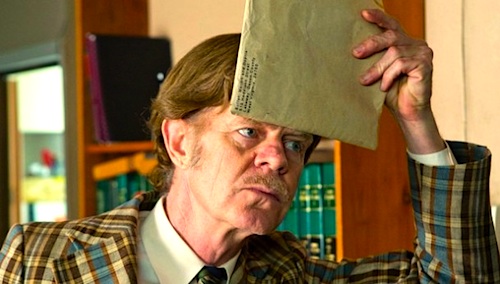
From "A Single Shot."

Still, Rockwell is convincingly slow-witted yet simultaneously slow-burningly intense as Moon. It is largely his work that will keep viewers invested in Shot, at least to some extent. William H. Macy is rather amusing as Pitt, but he might as well be credited as a “special guest star.” In contrast, the potentially interesting Jason Isaacs is completely wasted as Waylon, buried under a Wookie’s worth of greasy locks.

There are no big secrets or revelations in Shot, so despite some well executed bits of skullduggery, there is little suspense overall. Basically, it is a bad idea to come between a drug dealer and his illicit cash. Nor is it a winning strategy to pick a fight with an anti-social mountain man who lives and breathes hunting. As a result, everyone learns something in Shot, except the audience, who come in way ahead of everyone on-screen. Just sort of okay but not great, A Single Shot opens today (9/20) in New York at the AMC Empire.

LFM GRADE: C

Posted on September 20th, 2013 at 1:22pm.
The Future is on Ice: LFM Reviews The Colony

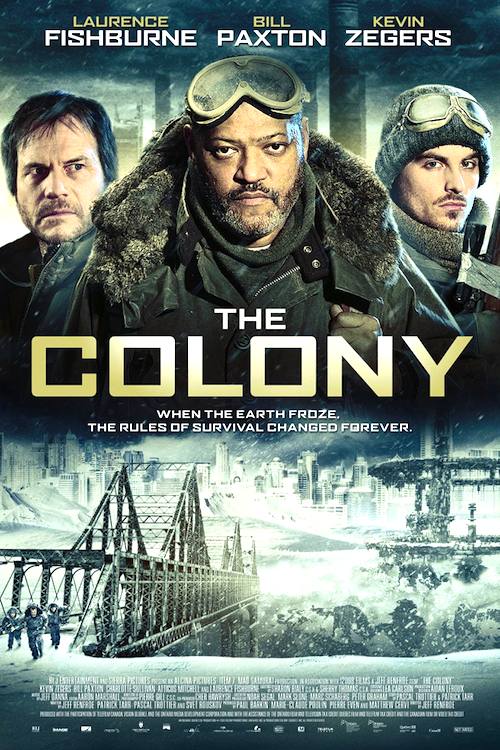
By Joe Bendel. The future will be nasty, brutish, and snowy. To combat global warming huge weather controlling machines were invented, but tragically they got stuck on snow—or something like that. On the positive side, summers in New York have become almost bearable. Cash out your 401K’s now, because if that all weren’t bad enough, cannibalism starts to spike in Jeff Renfroe’s The Colony, which opens tomorrow in New York.

So, its pretty cold out there. Only scattershot handfuls of humanity survive in underground colonies, hoping to somehow outlast the big freeze. Given their cramped living conditions, flu has become a matter of life and death. Basically, if you cough, you are sent out to die. The overzealous Mason is the one in charge of “quarantine,” a fact that does not sit well with Sam, the sensitive handyman. He takes the issue up with Briggs, Colony 7’s commander, who inconveniently has more pressing concerns.

Their sister colony sent a distress signal, ominously followed by radio silence, so Briggs takes Sam and an easily winded teenager out to investigate. After making the arduous journey past a series of surprisingly cool looking matte paintings, the expeditionary party discovers their allied colony was over-run by a pack of cannibals. Despite descending into savagery, they prove to be dashed difficult to kill.

It is rather ironic this tale is climate catastrophe is Canadian-made, because the weather will look rather temperate to half that country. Yet, the northern location shoots, filmed at an old, mothballed Canadian NORAD facility, are what work best for Colony. Likewise, the hulking, frost-encrusted weather machines are quite striking looking. Unfortunately, the script (credited to Renfroe and three others) feels like it was cobbled together from Roland Emmerich’s slush pile.

For a derivative film, Laurence Fishburne’s performance as Briggs is largely derived from his work in the superior Event Horizon, but frankly, that is not entirely bad. Similarly, Bill Paxton recycles his “game over, man” persona for Mason, but with less successful results. Kevin Zegers and Charlotte Sullivan are pretty bland as Sam and his potential love interest, Kai, the seed archivist and computer specialist – but at least her character listens to Duke Ellington, so you have to tip your hat to that. Considering Dru Viergever’s character is only credited as “Feral Leader,” it is probably safe to assume not much of an awards campaign is being planned on his behalf. Nevertheless, he certainly looks the part.

To call The Colony a meathead movie would over-praise it. Visually, it accomplishes much with its limited resources, but never rises above mediocrity in any other criteria. Just kind of whatever (at best), it is hard to imagine anyone will pay Manhattan ticket prices to see it when The Colony opens tomorrow (9/20) in New York at the AMC Empire.

LFM GRADE: C-

Posted on September 19th, 2013 at 11:23am.

My Lucky Star: LFM Reviews Zhang Ziyi’s Sophie Returns

By Joe Bendel. It is hard for a comic book artist to navigate a Sex in the City world, especially a hopeless romantic like Sophie. At least her work provides her an outlet for her frustrations, but not a steady income. However, Sophie will finally meet her real life international man of mystery in My Lucky Star, Dennie Gordon’s stand-alone sequel to Sophie’s Revenge, which opens this Friday in New York.

Sophie is a talented artist, but the world’s worst travel agent. Her day job boss tells her so, frequently. When she wins the “My Lucky Star” sweepstakes’ luxury vacation to Singapore, her man-eating friends convince her to take the plunge. As soon as she arrives, the clumsy knockout stumbles into the arms of David Yan, who happens to be the spitting image of her comic book super spy. He also happens to be in the same line of work—a fact Sophie is painfully oblivious to.

Before long, Sophie’s attempts to pursue Yan put her smack dab in the middle of a caper involving a massive stolen diamond. It happens to be perfect for refracting a WMD laser, which is why the notorious Black Widow arms dealer is out to acquire it. Yes, she is also hot and Yan happens to have some complicated history with her. The indomitable Sophie will have to knuckle down if she is going to win the man of her dreams and save the world (or at least Bermuda).

From "My Lucky Star."

The first domestic Chinese production helmed by an American woman (Gordon, best known for Joe Dirt and her DGA Award winning work on Tracey Takes On), Lucky incontrovertibly establishes Zhang Ziyi looks cute in a gondolier’s costume. You might have suspected as much, but here’s the proof. In fact, she has more wardrobe changes than Anne Hathaway hosting the Oscars. That is really what this film is all about: fab clothes, the picturesque opulence of Singapore and Macao, and a spot of vicarious romance.

Sophie’s Revenge was a monster hit in China, so producer Zhang’s title character is back to feed the appetite she helped create (but viewers need not be familiar with the first film to follow the second). However, for American audiences, it is rather ironic to see her playing a lovelorn klutz so soon after her exquisitely tragic, massively butt-kicking turn in Wong Kar Wai’s The Grandmaster. She is clearly versatile—and quite appealing in both very different films.

Wang Leehom, the American-born Taiwanese pop idol, is a game straight man, looking credible enough in his action sequences. Ruby Lin and Chen Yao also return from Revenge, adding attitude and sex appeal as Sophie’s BFFs. However, Terri Kwan sort of steals the show as the Black Widow.

Indeed, aside from an overbearing boss here and a henchman there, everyone in Lucky is outrageously good looking. This is definitely escapist fare. However, fans of Revenge will miss Sophie’s unapologetically macabre animated fantasies. Gordon doubles down on the slapstick humor instead, which, ironically, does not travel as well. Never particularly deep or memorable, My Lucky Star offers up plenty of sugary confections for the eye and a dash of plucky empowerment. If that suits your movie going purposes, it opens this Friday (9/20) in New York at the AMC Empire, courtesy of China Lion Entertainment.

LFM GRADE: C+

Posted on September 17th, 2013 at 11:50am.

LFM Reviews Closed Curtain @ The 2013 Toronto International Film Festival

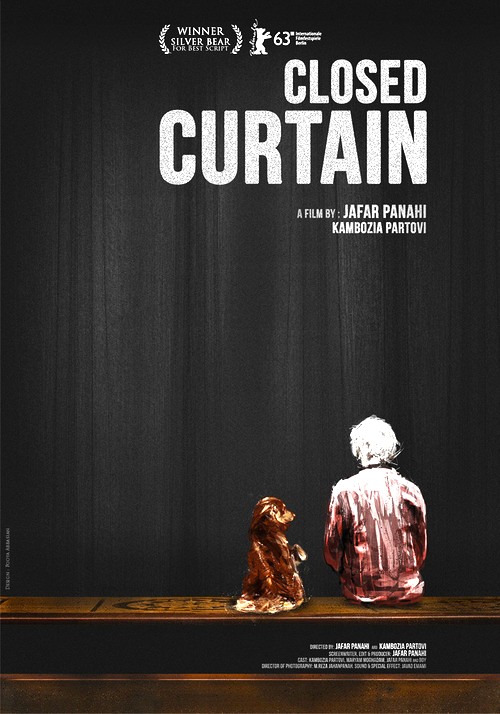
By Joe Bendel. For most filmmakers of his stature, bringing two films to the international festival circuit over the last three years would be considered reasonably prolific. For Jafar Panahi, who was sentenced to a twenty year filmmaking ban by the Islamist Iranian government, it is quite extraordinary. Panahi has been awarded the Camera d’Or at Cannes, the Silver Bear for Best Director at Berlin, and the Sakharov Prize for Freedom of Thought. Although he was not allowed to return to Berlin this year, he added to his list of accolades the Silver Bear for Best Script with his latest film, Closed Curtain (trailer here), co-directed by lead actor Kambozia Partovi, which screens again tomorrow as part of the 2013 Toronto International Film Festival.

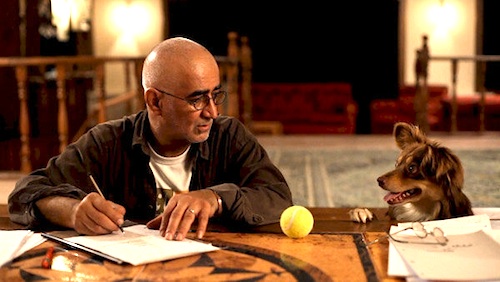
A man arrives in a fashionable villa on the Caspian Sea. The views are spectacular, but he immediately hangs heavy black fabric over the gauzy curtains, completely sealing the house off from the outside world’s prying eyes. As a screenwriter and a dog owner, he has two strikes going against him. Initially, he seems most concerned about Boy, his four legged companion. The state just renewed its campaign against “unclean” “anti-Muslim” dogs, so the television news is filled with grisly images of secret pets that have been rounded up and killed by the police. Yet, the screenwriter seems to carry his own distinctly personal secrets as well.

After shaving his head to alter his appearance, the man settles in to write his screenplay. Much to his shock, his refuge is interrupted by a young man and his suicidal sister. They claim they were chased by the police who raided their beach party, but their very presence troubles the screenwriter. Could he have been so negligent he left the door open as they claim?

Panahi established his reputation with gritty proletarian dramas, filmed out in the real world, at street level. Sadly, films like The Circle (written by Partovi) are impossible for Panahi these days, so he has moved inside for intimate works, like his protest documentary This is Not a Film and his latest collaboration with Partovi. In fact, the first two thirds of Curtain plays like an Iranian Pinter production. As the screenwriter verbally spars with his unexpected guests, darkly unsettling questions emerge. Just how did they breach his house and if she really is familiar with his case history, just what does that imply?

If viewers were not off-balance enough, Panahi himself walks into the third act, much like Rod Serling. It seems the screenwriter and the sister are his characters. They can observe Panahi tending to his mysteriously damaged beach house, but they cannot interact with him—at least not exactly.

From "Closed Curtain."

There are pro’s and cons to the meta-turn Curtain takes. In a way, Curtain becomes a fictionalized sequel of sorts to This is not a Film, picking up on its themes and frustrations. The same sense of claustrophobia is present in Curtain, but it is expressed more acutely. Frankly, the scenes in which the occupants hold their breath as the police scour around the deceptively darkened house are so effective it seems like a bit of a shame to shift away from that micro story and Partovi’s restrained but deeply powerful performance.

Panahi’s pet iguana Igi might be telegenic in Not a Film, but Boy the Dog is probably the best animal screen performer of the year. If a distributor picks up Curtain (and somebody really ought to), his notices might rival that of Uggi in The Artist. Still, there is no doubt Curtain is a profoundly serious film, expressing the themes of confinement and oppression that hold particularly meaning for Panahi, but also have resonance for a great many Iranian citizens at large. Highly recommended, Closed Curtain screens again tomorrow night (9/15) as this year’s TIFF comes to a conclusion.

LFM GRADE: A-

Posted on September 14th, 2013 at 3:06pm.

For 9/11: LFM Reviews The Rugby Player @ NewFest 2013 in New York

From "The Rugby Player."

By Joe Bendel. Arguably, he is the best known passenger of the most tragically famous commercial flight in American history. He was one of the heroes (yes, that is the appropriate word) who sacrificed their lives to sabotage their hijackers’ heinous plan for United flight 93. Yet, the example of Mark Bingham’s life continues to inspire Americans, beyond the fateful events culminating in that Pennsylvania field. Not content to let one moment define Bingham, Scott Gracheff presents a comprehensive and highly personal documentary portrait of the increasingly symbolic man throughout The Rugby Player (trailer here), which fittingly screens this solemn day as part of NewFest 2013 in New York.

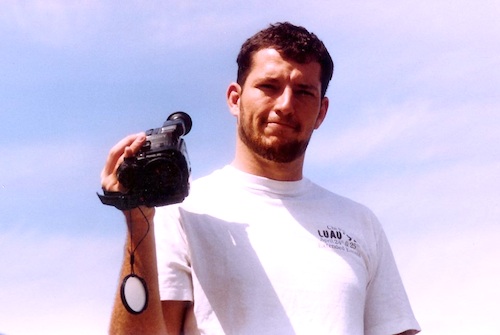
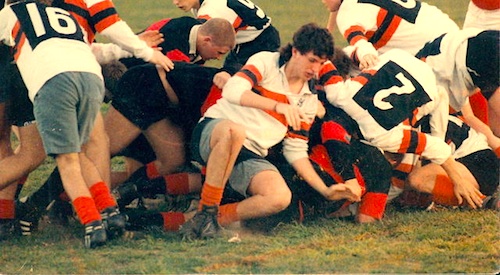
Bingham and close friend Todd Sarner (who served as Rugby’s technical advisor) often had video cameras on-hand to record life’s highlights and lowlights as they happened. As a result, Gracheff had a wealth of candid footage of Bingham, from his middle school years up until his final weeks. Raised by his single mother, Alice Hoagland, Bingham was a dutiful son, who always tried to shield her from the worst of his meatheaded student pranks. In high school, he took to rugby like a fish to water, playing in leagues all his life. During college, he was a reserve on Cal’s championship team and was elected president of his fraternity. He was also gay, which is why Rugby screens as part of NewFest.

From "The Rugby Player."

As an enthusiastic high school, college, and club rugby player, Bingham has become a role model for athletic GLTB community members, both in and out of the closet. As a supporter of John McCain’s 2000 presidential campaign, he has also become an inspiration to Log Cabin Republicans (a fact that does not seem to interest Gracheff much). Regardless, the film conscientiously maintains an intimate focus on Bingham and Hoagland, who tirelessly advocates for increased airline safety and GLTB rights. As a result, audiences will feel they have a very real sense of who Bingham was as an individual.

Indeed, it is critically important to document the stories of 9-11 on a personal level. Watching Rugby Player will help viewers understand the pain resulting from Bingham’s senseless murder. Then multiply that by over 3,000.

Gracheff mostly but not entirely avoids current political controversies, while handling Bingham’s still grieving friends and family with appropriate sensitivity. Although unjustly cut short, Bingham’s life was well led, easily sustaining the eighty minute documentary.  tylistically straight forward and genuinely touching, The Rugby Player is recommended for those who insist on remembering and paying tribute to the lives lost on September 11th. The clear high point of this year’s NewFest, it screens tonight (9/11) at the Walter Reade Theater.

LFM GRADE: B

Posted on September 11th, 2013 at 11:42am.

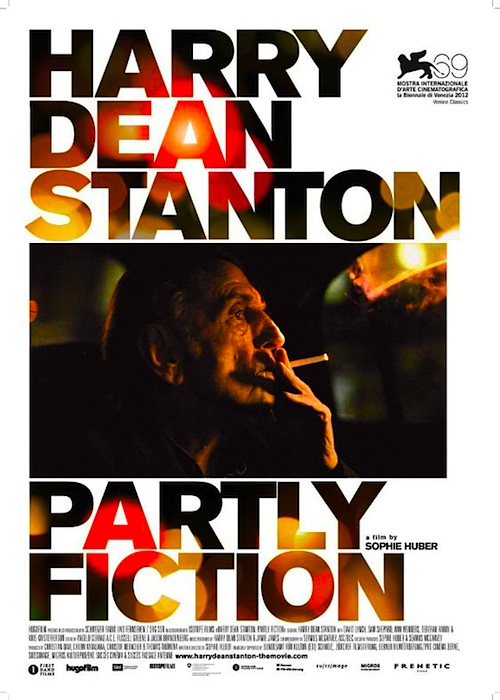
LFM Reviews Harry Dean Stanton: Partly Fiction

Harry Dean Stanton: Partly Fiction Official Trailer from Adopt Films on Vimeo.

By Joe Bendel. He has some of the coolest credits ever, including Alien, Escape from New York, Red Dawn, Repo Man, and Wild at Heart. However, appearing as himself is a role he is not so comfortable with. As a result, Sophie Huber’s documentary treatment, Harry Dean Stanton: Partly Fiction is a rather impressionistic portrait that opens this Wednesday in New York.

Stanton is not the sort of fellow to sit down in front of a camera and commence name-dropping, but Huber, his friend and colleague, knew that coming in. Foregoing the conventional approach, she scored at least one coup. Up until now, Stanton declined offers to record his traditional vocals and harmonica playing, but she was able to capture many of his intimate performances. Frankly, that alone should constitute a respectable cinematic legacy for Huber.

Indeed, Stanton’s voice is truly mesmerizing on old time favorites like “Blue Bayou,” “Blue Moon,” “Just a Closer Walk With Thee,” and the positively eerie closing rendition of “Danny Boy.” Stanton’s clear affinity for songs of loneliness and loss marries up perfectly with Huber’s portrait of a haunted backwoods Zen master.

Unfortunately, the scenes without music lack the same quiet power. At times, Huber merely tries of soak up the ambiance of Stanton’s life, which gets a bit snoozy. The lack of any standard biographical treatment also occasionally leads to frustration, as when Stanton off-handedly comments on the unforgettable wildness of his years living with Jack Nicholson and hanging with Marlon Brando. Right, we can only imagine.

Huber incorporates some commentary from Stanton’s famous friends, perhaps most notably David Lynch, whom we see visiting with his chum. She also includes some film clips, relying heavily on Wim Wenders’ Paris, Texas, openly inviting audiences to conflate Stanton with his pseudo breakout role.

There are few outright scoops in Fiction, aside from Stanton’s disclosure (now widely remarked upon) that he once dated Rebecca De Mornay, before she made Risky Business and got involved with Hollywood’s favorite Scientologist. Who knew? One gets a sense Stanton guards a treasure trove of such revelations, but Huber never tries to dig them out. Still, the film has a stylishly evocative look, thanks to cinematographer Seamus MacGarvey’s striking black and white sequences.

Huber might leave many of Stanton’s fans scratching their heads, but at least they will know their man can sing. Periodically beautiful, Harry Dean Stanton: Partly Fiction is for diehard fans of Stanton and those who appreciate Americana folk songs when it inexplicably opens this Wednesday (9/11, probably the last date anyone would want to go to the movies) in New York at the Village East.

LFM GRADE: B-

Posted on September 10th, 2013 at 12:34pm.