A Woman’s Plight in Afghanistan: LFM Reviews The Patience Stone

By Joe Bendel. For a woman in Afghanistan, an incapacitated husband is both dangerous and liberating. The unnamed man was never much of a husband, at least as westerners would understand the term, but he will finally become a good listener in Afghan expatriate Atiq Rahimi’s The Patience Stone, which opens this Wednesday in New York.

It was a loveless arranged marriage. Her grizzled old husband acquired her when she was really just a child. At least he was not around much during the early years of their marriage. Instead, he was off fighting whomever, only periodically returning to lord over her. Over time, they had two daughters, but they never “learned to love each other.” Yet, when a tawdry dust-up leads to a bullet in his neck and a subsequent coma, she loyally tends to her former tormentor.

Sending their children to live with their worldly aunt, the woman spends her days maintaining their battle-damaged home and watching over her comatose husband. She must keep him hidden from sight, lest the roving bands of warlords recognize her defenseless position. Unfortunately, a small contingent of soldiers eventually barges in, with the intent of forcing themselves on her. Understanding the perverse nature of her country’s misogyny, she claims to be a prostitute, causing most of them to lose interest. As her aunt explains, those sharing their virulent Islamist mentality take manly pride from raping virgins, but are repulsed by sexually experienced women.

However, the shy one eventually sneaks back, hoping to hire the woman’s services. She does not exactly agree at first, but they soon share intimate encounters on a regular basis. In fact, she starts to enjoy them, both as a sexually liberating experience and a passive aggressive salvo against her husband. She does indeed confess each assignation to him, as well as the rest of her deepest, darkest secrets. He has become her “Patience Stone,” the mythological vessel that retains all the sorrow the owner divulges, until it finally shatters.

What a lovely corner of the world this is. Women are treated like chattel, forced to wear burqas, and consequently blamed for the predatory behavior of men. Atiq’s film, based on his French language Prix Goncourt winning novel, quite boldly examines the pathological sexism of Islamist society. If it sounds vaguely homoerotic when the young soldier confides to the woman his commander puts bells on his feet and makes him dance in the evenings, it should. Atiq is rather circumspect in his handling of this issue, essentially using it to establish the woman’s sense of compassionate outrage. Fair enough, but there is only so much of that which can easily fit in to an intimate chamber drama such as Stone.

Essentially, Stone is a two-hander, but the second hand spends nearly the entire film in a persistent vegetative state. Fortunately, Golshifteh Farahani, the Iranian exile based in Paris (seen in Chicken and Plums and in Ridley Scott’s mullah-offending Body of Lies), is extraordinarily compelling as the woman, largely carrying the film on her shoulders. It is a profoundly vulnerable yet surprisingly sensual performance, likely to equally inspire her fans and outrage the theocrats in her Iranian homeland. Still, Mossi Mrowat has some quietly powerful moments as the young, naïve soldier.

True to the limits of the woman’s world, Stone has a two-set, four-character staginess that it just cannot shake loose. Nevertheless, it powerfully crystallizes all the anguish and rage pent-up inside exploited women like Atiq’s protagonist. He and Farahani might be exiles, but with Stone they vividly hold a mirror up to their respective societies. Recommended for those concerned about the state of women’s rights in the Islamic world and fans of Farahani, Patience Stone opens this Wednesday (8/14) at New York’s Film Forum.

LFM GRADE: A-

Posted on August 12th, 2013 5:31pm.
LFM Reviews The Man Who Watched Trains Go By @ The Cine-Simenon Retrospective

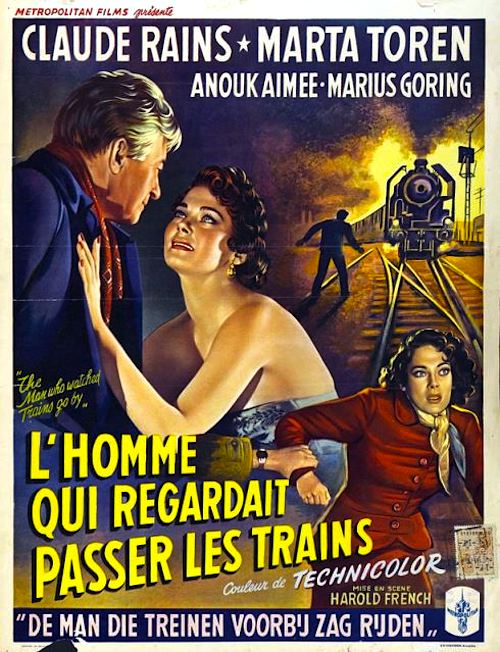
By Joe Bendel. Those Frenchies are always trying to corrupt their guileless provincial European neighbors. Georges Simenon certainly would have known. Technically, he was Belgian, but he was an expert on Parisian fast living. One timid Dutch clerk gets his own crash course in Harold French’s The Man Who Watched Trains Go By (a.k.a. Paris Express), which screens during the Anthology Film Archives’ Cine-Simenon retrospective.

Kees Popinga was born to be a bookkeeper. Quiet and detail-oriented, he spends his weekly night out at the chess club, where his boss, Julius de Koster, is also a member. His only eccentricity is a passion for trains, whose timetable he has memorized. One day, Inspector Lucas visits his firm from Paris as part of a mysterious investigation. It seems to involve the beautiful French woman Popinga happened to spy de Koster affectionately seeing off at the train station.

Confronting the haughty de Koster, Popinga learns he has looted the company in order to abscond with his French lover. An altercation ensues, spurring the unprepossessing Popinga to take flight. Assuming one Dutchman with a suitcase full of cash is as good as another, Popinga sets out to find the femme fatale, Michele Rozier. He is right of course, but not in a happily-ever-after kind of way. Better understanding the shady characters conspiring against him, Inspector Lucas will scramble to find the naïve Popinga before his mad interlude completely spirals out of control.

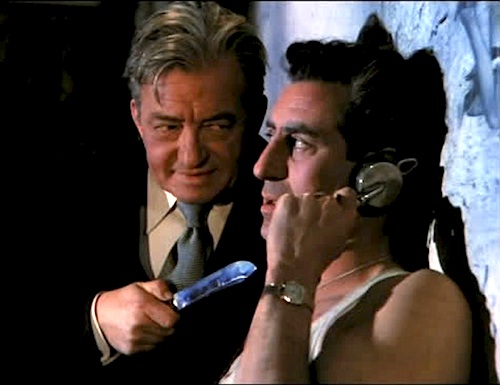
Trains might not be the absolutely best noir ever filmed, but it boasts two Phantoms of the Opera: Claude Rains (star of Universal’s 1943 color remake) as Popinga and Herbert Lom (featured in the 1962 Hammer production) as the hypocritical de Koster. Future international movie star Anouk Aimée also steals all her brief scenes as the alluring Jeanne, a “professional” colleague of Rozier’s.

From "The Man Who Watched Trains."

There is also plenty of Simenon-ness to Trains, particularly the cat-and-mouse game played by Popinga and the Inspector. Indeed, Lucas is a good copper, balancing cunning and compassion in the Maigret tradition. The underappreciated Marius Goring is one of Train’s best assets, playing Lucas with considerable intelligence and flair.

Of course, Rains is perfectly dependable, if not career-defining, as the mild-mannered Popinga. His convincing slide from respectability to manic self-destruction recalls some of his early Universal work, like in Edwin Drood. Frankly, despite her greater screen time and stylish villainy, Märta “the next Ingrid Bergman” Torén’s Rozier is overshadowed by Anouk (as Train simply billed her).

The Man Who Watched Trains Go By is a presentable noir, distinguished by its tragic tone and the decency of its sleuth. Nicely representing the themes and motifs of Simenon’s “roman durs,” his psychologically complex, non-Maigret novels, it makes a good fit for Anthology’s Cine-Simenon series. Recommended for fans of Rains and noirs in general, it screens today (8/12) and Wednesday the 21st at Anthology Film Archives.

LFM GRADE: B-

Posted on August 12th, 2013 at 5:28pm.

LFM Reviews The Bottom of the Bottle @ The Cine-Simenon Retrospective

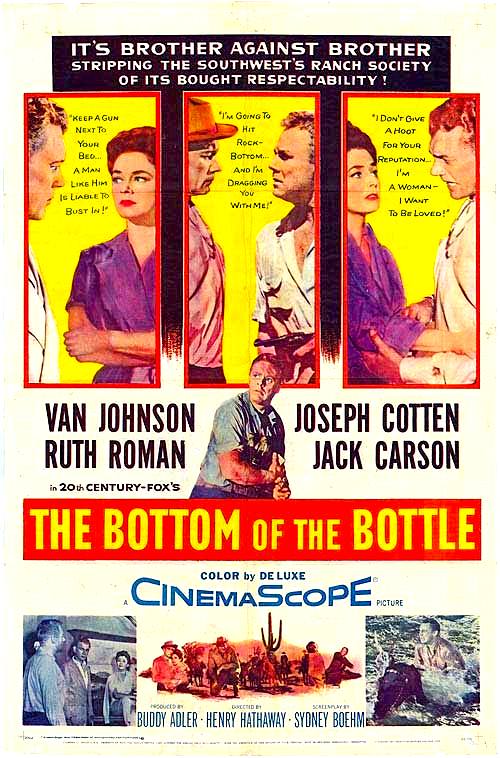
By Joe Bendel. After the war, Georges Simenon whiled away some pleasant days in Nogales, Arizona. Presumably, he appreciated the charms of bordertown life. It also became the setting of a somewhat un-Simenon-like tale of fraternal dysfunction. The spirits will flow in Henry Hathaway’s adaptation of The Bottom of the Bottle, which screens during the Anthology Film Archives’ Cine-Simenon retrospective.

It rarely rains on the ranchland outside Nogales, but when it does, the Santa Cruz floods, cutting them off from the rest of the world. For Paul “P.M.” Martin and his fellow landowners, this means it is time for their traditional floating house parties. However, the sudden appearance of his brother Donald puts a damper on his mood. While they never really got along, the whole escaped convict thing particularly irks the status conscious P.M.

Of course, nobody knows about the black sheep sibling he will introduce to his wife Nora and their friends as Eric Bell. With the river running high, the Martin brothers will just have to bluff their way through until Donald can slip across to his waiting family. Unfortunately, the younger Martin brother is a recovering alcoholic, under severe stress, and about to attend his first rainy season party, which will be all about getting pie-faced hammered.

This is an odd film, but it is a big film, rather dazzlingly shot in Cinemascope by Lee Garmes. It starts out as a desert noir, segueing into Lost Weekend, then marital strife melodrama, and finally shifts into a modern day western, as the highway patrol posse saddles up, chasing the fugitive Martin into the hills.

Granted, Bottle is not a classic classic, but it is rather strange that it is not programmed more frequently. It would certainly make an interesting double bill with Touch of Evil, the classic bordertown noir directed by Joseph Cotten’s old comrade, Orson Welles. Sort of conceived as a follow-up to Hathaway’s Niagara, also starring Cotten, Bottle is nowhere near as gripping as those two films. Still, it has Dragnet’s Harry Morgan as a kindly barkeep, who plays Ellington’s “Don’t Get Around Much Anymore” during the morning hours.

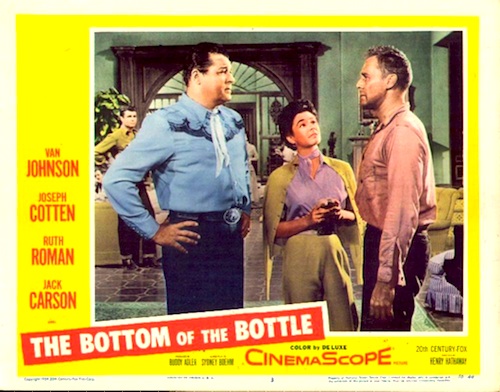
There are flashes of mordant wit throughout Bottle (the doorbell that rings “How Dry I am” might have been the work of an acerbic stagehand, but it still counts) and Hathaway makes the most of his southwestern locations. He also shrewdly manages to shoehorn in one amazingly cinematic mission church as often as possible. Indeed, this is a finely crafted production, particularly the Martin’s richly appointed ranch house, which makes the Southfork look like a welfare hotel. And speaking of Dallas, Jack Davis (a.k.a. Jock Ewing) turns up in a minor role as a member of the Martin’s boozy social circle. Nonetheless, Bottle’s depiction of the local Hispanic population (probably considered broadmindedly sympathetic at the time) is pretty cringy for contemporary viewers.

Cotten has the right look and presence for P.M. Martin, even if his ascot-looking bandanas are a wardrobe mistake. Van Johnson also stretches his chops quite notably as the sad sack brother. Surprisingly though, it is Ruth Roman who really stands out as the assertive but family-oriented Nora Martin, who is rather impressive holding P.M.’s feet to the fire. It is a smarter character and performance than one expect in what is essentially a “helper” role.

So Bottle might not be a good film, per se, but it is entertaining in its way. A late product of the old school studio system, it demonstrates both the merits and drawbacks of the era, cramming enough interesting stuff into a misconceived vehicle to maintain viewers’ attention the all the way through. It is definitely the ringer of AFA’s Cine-Simenon, but it still makes sense to include it, because when else could they show it. Those intrigued should definitely check it out when it screens tomorrow (8/13), Wednesday (8/15), and Sunday (8/18) at Anthology Film Archives.

LFM GRADE: C+

Posted on August 12th, 2013 at 5:24pm.

LFM Reviews The Man on the Eiffel Tower @ The Cine-Simenon Retrospective

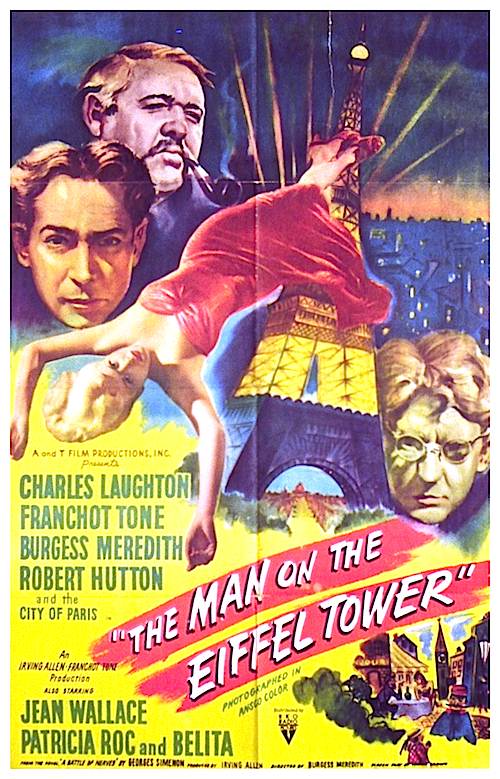
By Joe Bendel. Georges Simenon remains one of the best known Belgian writers, but his signature detective, French Police Commissaire Jules Maigret, has been played by French, British, Dutch, Italian, Armenian, Czech, Russian, and Japanese actors. British born Hollywood legend Charles Laughton also picked up Maigret’s trademark pipe for a memorable one-off, The Man on the Eiffel Tower, directed by the Burgess Meredith, which screens as part of Anthology Film Archives new retrospective, Cine-Simenon.

It is post-war Paris, where expat Bill Kirby has a wife, a mistress, a rich but prickly old aunt, and an aversion to work. After he complains about the old dear’s longevity in a crowded café, a mystery man slips him a note. His problem can be solved for 100,000 Francs. He need only mail her key to an anonymous postal drop—and so he does.

For Maigret, the most suspicious aspect of the crime scene is how thoroughly it implicates Joseph Heurtin. The bespectacled knife-grinder simply does not strike Maigret as a killer. Playing a hunch, the Inspector allows Heurtin to escape, hoping he will lead the police to the master criminal pulling his strings. Maigret soon concludes the real murderer is the Czech Johann Radek, a dissolute former medical student. However, proving it will be a trickier matter. Thus commences a game of cat and mouse that will indeed take both men to the famous Parisian landmark.

All AFA screenings will be in 35mm, which is good to know, since there are some pretty scruffy prints of Eiffel in circulation. Evidently it was one of the few films shot on a certain brand of color stock that has not aged gracefully. Nonetheless, it is a jolly good little suspenser, as well as an evocative time-capsule of post-war Paris.

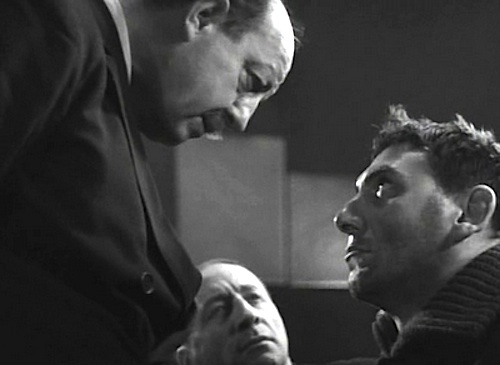
From "The Man on the Eiffel Tower."

Frankly, it is a shame Charles Laughton went one-and-done as Maigret, because he fits the part like a comfortably rumpled suit. It would make a good double feature with his classic performance as the not-quite-as-crafty-as-he-thinks-he-is Sir Wilfrid in Billy Wilder’s Witness for the Prosecution. In addition to helming with economy and style (reportedly with the occasional assist from his two big name co-stars), Burgess Meredith is effectively squirrely as Heurtin, even foreshadowing hints of Henry Bemis in the classic Twilight Zone episode Time Enough at Last. Yet, perhaps the greatest revelation is Franchot Tone’s diabolically manic Radek.

Indeed, Laughton’s shrewd persona, Simenon’s clever plotting, and the still impressively dizzying climax promised by the title are a hard combination to beat. An all-around entertaining classic, Eiffel does right by the source novel, which was also the basis for an earlier French adaptation duly included in Cine-Simenon as well. Highly recommended regardless of the condition of its surviving prints, The Man on the Eiffel Tower screens this Friday (8/9) and Sunday the 18th at the Anthology Film Archives.

LFM GRADE: A-

Posted on August 8th, 2013 at 1:39pm.

LFM Reviews A Man’s Neck @ The Cine-Simenon Retrospective

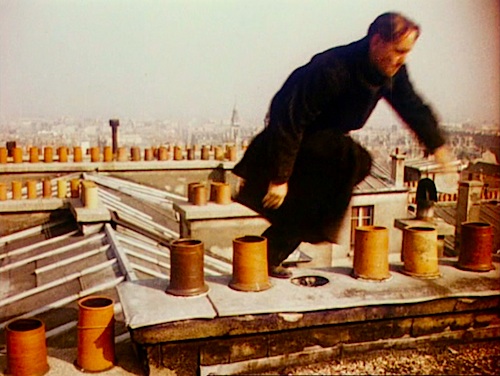
From "A Man’s Neck."

By Joe Bendel. Georges Simenon led a colorful life. There might have been a few women and some fast living. After the war, he also faced allegations of collaboration, but his defenders always maintained he was too self-absorbed for such matters. Harry Baur was one of a multitude of actors to play Simenon’s signature detective, whose wartime experience is tragically above suspicion. Imprisoned and roughly interrogated after ill-advisedly appearing in an early 1940’s German film, Baur either succumbed to injuries sustained or was helped along the way shortly after his release. His biographic details add further tragic context to Julien Duvivier’s A Man’s Neck, which screens during the Anthology Film Archives’ Cine-Simenon retrospective.

Willy Ferrière has a rich aunt who refuses to die, but a mystery pen-pal offers to help the old dear along for 100,000 francs. The freelance killer also has a scapegoat lined up to take the fall: the clueless Joseph Heurtin. Yes, this is the Maigret case Burgess Meredith later adapted as The Man on the Eiffel Tower, but it is simultaneously similar and different in intriguing ways.

As it happens, both films also serve as time capsules of Paris, pre- and post-war. Not surprisingly, though, the earlier French film is darker and somewhat franker than the RKO production. The stories run along parallel lines, but diverge on key points, such as the complicity of Ferrière’s mistress in Duvivier’s film. Indeed, there is little innocence per se in this distinctly dark crime drama.

Both Baur and Laughton look like world weary civil servants, but the latter could not help playing the part with panache. He was Charles Laughton, after all. In contrast, Baur’s Maigret is a down-trodden bureaucrat often at risk of fading into the background, until roused to outrage by the psychotic Radek. It is a close call, but in a head-to-head match, Laughton probably takes it by a jowl.

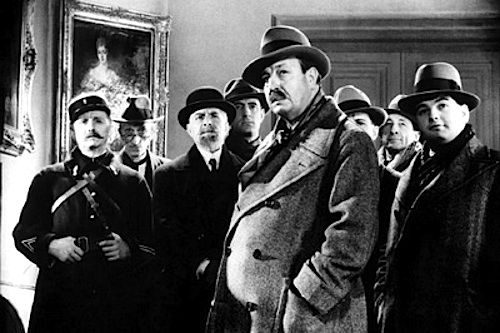
From "A Man’s Neck."

Likewise, Meredith’s Heurtin is a truly unique portrait of a man made vulnerable by his acutely anti-social nature. Alexandre Rignault’s Heurtin is also quite effective, but we have seen such simple-minded hulks before and since. However, Valéry Inkijinoff’s frenzied and lusty Radek is something else entirely. Franchot Tone exceeds expectations in Eiffel Tower, but the Russian Inkijinoff is truly creepy.

In fact, both are very good films.  Duvivier shows an eye for procedural detail, giving viewers an unromanticized look inside the Paris gendarmerie. While more naturalistic and generally jaundiced in his portrayal of human nature, Duvivier also shoehorns in small, elegantly telling moments, as when Maigret and Radek take time out from their verbal sparring to listen to his Chanson-singing neighbor.

Neck is a lean, mean film noir that packs surprising punch. It depicts a deeply flawed world, but not one in which moral judgments are impossible. Recommended by itself or in conjunction with Meredith’s Eiffel Tower (showing separately), A Man’s Neck screens this Saturday (8/10) and next Wednesday (8/14) as part of Cine-Simenon, now underway at Anthology Film Archives.

LFM GRADE: A

Posted on August 8th, 2013 at 1:36pm.

David Tennant Investigates: LFM Reviews Broadchurch; Premieres Wednesday (8/7) on BBC America

By Joe Bendel. It is the drama that made Twitter explode in the UK. Fox has plans for an Americanized version for the 2014-15 season, but intrigued viewers only have to wait eight weeks to find out who did it. The ensuing investigation might just cost the investigating detective a sizable chunk of his soul. Nevertheless, all will eventually be revealed when the eight week Broadchurch airs on BBC America, beginning this Wednesday.

Young Danny Latimer has been murdered. His body was found dumped at the beach, but the Socos (CSI) quickly determine that this is not the original crime scene. Beth and Mark Latimer did not realize that their son is missing until it was too late, merely assuming he was off on his morning paper route. Dogged Detective Inspector Alec Hardy soon discovers other family secrets that kept certain Latimers preoccupied.

Hardy is either the best or the worst DI for this investigation. In his last posting, the detective worked an eerily similar case. Precise details will emerge over time, but it clearly ended badly. Hardy had come to the small Jurassic Coastal town of Broadchurch to escape the media spotlight and recuperate his ailing body and psyche. While fraught with career perils, the Latimer case represents possible redemption for the controversial copper. However, he will have to work it with the distinctly resentful Detective Sergeant Ellie Miller, who came back from her vacation to find Hardy in place of her anticipated promotion.

There will be no shortage of suspects in Broadchurch, including Danny’s father; his friend and colleague Nigel Carter; Jack Marshall, the local newsagent; the insomniac vicar Rev. Paul Coates, and a nasty late middle-aged woman living in mobile home not far from the crime scene. DS Miller’s own son Tom also acts rather oddly upon learning of his friend’s murder. Series creator Chris Chibnall will focus suspicion on just about everyone before the big finale, but Broadchurch is just as much about the grief and guilt resulting from the Latimer murder as it is a mystery procedural.

From "Broadchurch."

Broadchurch will be of particular interest to Doctor Who fans, starring former Doctor David Tennant as DI Hardy, former companion Arthur Darville as Rev. Coates, and guest star Olivia Colman as DS Miller. Frankly, Broadchurch might just eclipse the Doctor as Tennant’s career defining role. Again, he makes a convincingly intelligent screen presence, but where the dashing figure he supposedly cut in Spies of Warsaw was a bit of a stretch, he is darkly compelling as the haggard, sullen, world-weary, angst-ridden Hardy. Yet Colman also holds her own in their scenes together quite well as the increasingly disillusioned DS Miller.

To their credit, both Darville the actor and Chibnall the writer make Rev. Coates a legitimate suspect, while still avoiding all the easy clergy clichés. They even allow him some surprisingly powerful sermons that essentially function as the conscience of the series. Yet it is Jodie Whittaker who really personifies Broadchurch’s emotional devastation as the distraught Beth Latimer.

Broadchurch is grabby right from the start, but it is written with greater depth and psychological insight than conventional mystery series. Doctor Who alumni James Strong and Euros Lyn helm their installments with admirable sensitivity and the music of hardcore drummer-turned contemporary classical composer Ólafur Arnalds sets an unusually elegiac tone. Quality television in every way, Broadchurch is highly recommended for fans of ambitious mystery series, like The Killing, Twin Peaks, and Top of the Lake. It commences its American premiere this Wednesday (8/7) on BBC America.

LFM GRADE: A

Posted on August 5th, 2013 at 11:37pm.