LFM Reviews Smash & Grab: On the Trail of the Pink Panthers

By Joe Bendel. This international ring of jewel thieves was brought to you by the bureaucrats at the EU. It is a complicated story, but Havana Marking has her sources. Using animation to protect their anonymity, a handful of former members explain the inner workings of their loosely structured organization in Marking’s Smash & Grab: the Story of the Pink Panthers, which opens this Wednesday in New York at Film Forum.

Marking is careful not to unduly glamorize the high-end jewelry thieves that came to be known as the Pink Panthers, in honor of the Blake Edwards franchise. Yes, they always avoided bloodshed on their jobs, at least so far. Yet, they have always been armed robbers, rushing into each score loaded for bear. They have never exactly been Robin Hoods either, simply divvying up the proceeds from each job amongst themselves.
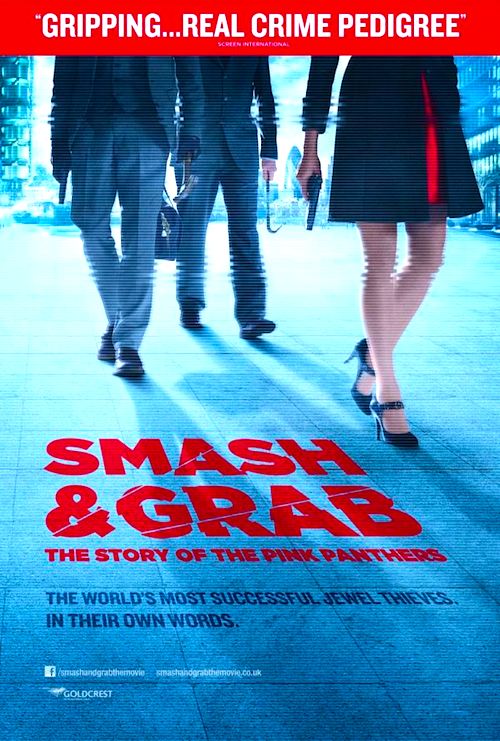
These were professionals, who invested significant time and money to meticulously plan each heist. Of course, they were not just men. Every caper started with a woman—a striking femme fatale, who would not look out of place trying on expensive jewelry as she cased the joint. Marking talks at length with one such scout. She goes by the name “Lela” for the purposes of the film and like many Panthers, she hails from the former Yugoslavia.

The shadowy group’s roots lie in the Balkans’ tragic war years. With Serb Socialist Party boss Slobodan Milosevic stoking the fires of ethnic hatred, the EU responded by imposing a punitive economic embargo on the entire Yugoslavia. Apparently Brussels hoped the widespread suffering would appeal to Milosevic’s heretofore unseen compassion, compelling him to behave better. Instead, it gave rise to an extensive black market, where future Pink Panthers learned the essentials of illicit commerce.

Reportedly, the Panthers largely consist (or consisted) of Serbians and Montenegrins, like “Mike,” Marking’s star witness. However, she presents a conscientiously balanced portrait of the various Balkan nationalities involved. In fact, Milena Miletic, a Serbian journalist and veteran of the anti-Milosevic protests, is clearly one of Marking’s most sympathetic and authoritative talking heads.

Even though Marking’s animated interviews with Mike and Lela look somewhat similar to those roto-scoped Charles Schwab commercials, they still serve as an effective counterpoint to the very real surveillance footage of the Panthers getting down to business. Unlike most true crime programming, there is nothing lurid or exploitative about Smash. Nevertheless, Marking’s eye for ironic imagery adds a bit of dash to the proceedings.

Leanly constructed and briskly paced, Marking’s film gives viewers a vivid sense of the scope and tick-tock professionalism of the Panthers’ operations. Fascinating and often darkly comic, Smash is a good documentary for viewers who do not ordinarily enjoy documentaries. Recommended for popular audiences, Smash opens this Wednesday (7/31) at New York’s Film Forum.

LFM GRADE: B

Posted on July 30th, 2013 at 11:22am.
The Toll of Human Trafficking: LFM Reviews The Trail from Xinjiang @ The Asian American International Film Festival

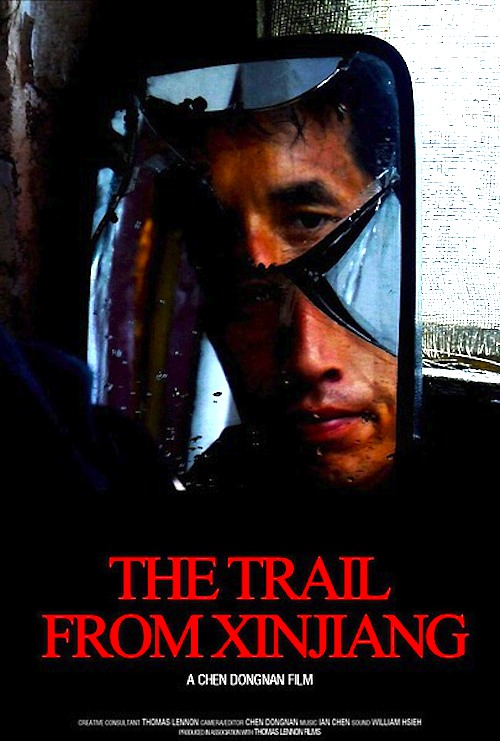
By Joe Bendel. The combination of an authoritarian government and a strict religion ought to make Musa a scrupulously law-abiding citizen. Unfortunately, he is one of many disenfranchised Uyghurs impressed into pickpocket gangs. Filmmaker Chen Dongnan captures the tragic human stories of those derisively referred to as “Xinjiang thieves” in the documentary short The Trail from Xinjiang, which screens during the Enduring Encounters programming block at this year’s Asian American International Film Festival in New York.

Like many youths from Xinjiang, Musa was lured to the big city with false promises. He quickly found himself involuntarily immersed in a world of petty thievery and drug dealing (by fellow Xinjiangnese). His friends Ali and Little Musa seem to have a more natural aptitude for crime, but that is not exactly a blessing. Between the three of them, they will experience the worst of nearly every imaginable urban pathology, including drug addiction, AIDS, and violent crime—everything that does not exist in China according to government propaganda.

Chen set out to humanize the marginalized Uyghurs, so she largely maintains her focus on Musa and his friends. Yet, Jiaquan, the founder of the Anyang Anti-Pickpocket League, emerges as the film’s most intriguing figure. Viewers might initially see him as Anyang’s answer to George Zimmerman, patrolling the streets with his twenty League volunteers. However, as Jiaquan came to recognize Musa and his accomplices, he started to sympathize with their exploitative circumstances. It is obviously a heavy commentary on Chinese social services when the Xinjiang thieves’ vigilante-nemesis becomes the closest thing they have to a social worker-advocate, but such is the state of things. Frankly, his story seems ripe for a full documentary follow-up, particularly in light of the film’s concluding “where are they now” recap.

At thirty-six minutes, Trail has more tragedy and raw, cautionary depictions of vice than scores of full length exposes. It is a decidedly humane exercise in muckraking, but it is still not for the squeamish. An unflinching film that puts viewers squarely in Musa’s shoes, The Trail from Xinjiang is highly recommended for China watchers when it screens this coming Thursday (8/1) at the Anthology Film Archives, as part of the 2013 AAIFF’s Enduring Encounters short film program.

LFM GRADE: A-

Posted on July 29th, 2013 at 12:21pm.

LFM Reviews The Past is Still Ahead @ The 2013 Midtown International Theatre Festival in New York

From "The Past is Still Ahead."

By Joe Bendel. It remains unclear whether the suicide of poet Marina Ivanovna Tsvetaeva was staged by the Soviet NKVD or merely the result of their constant threats and intimidation. Frankly, it hardly matters—Stalin and his obedient secret police are morally culpable, either way. Playwright Sophia Romma squarely faces the truths and tragedies of Tsvetaeva’s life with a new production of The Past is Still Ahead, mounted as part of the 2013 Midtown International Theatre Festival in New York.

As a small girl, Tsvetaeva met the Tsar at the opening of what would become the Pushkin Museum of Fine Arts, founded by her father. Obviously, none of that would stand her in good stead with the Soviet regime. Tsvetaeva married Sergey Yakovlevich Efron, who became a prominent White Russian Officer. He was also half-Jewish. Those were probably more than enough strikes against Tsvetaeva to brand her a class enemy, but her epic verse honoring the White resistance essentially closed the book on her. Yet, at Efron’s insistence, Tsvetaeva returned to Russia, predictably enduring a dire existence of internal exile.

As the play opens, Tsvetaeva has little illusions regarding her limited future. Increasingly resigned to her fate, she is visited by visions from her past, including Efron, her domineering mother Maria Meryn, and her lovers, the guileless Osip Mandelstam and the scandalous lesbian poet Sophia Parnoc. Yet, it is the memory of Rainer Maria Rilke, the soul mate she only knew through their correspondence, that offers her the greatest comfort.

Although Past portrays Tsvetaeva’s life in impressionistic fragments, it incorporates decades of Soviet history, accurately reflecting the chaos and oppression of the era. The unequivocal depiction of the Party’s anti-Semitism is particularly eye-opening. Likewise, Tsvetaeva’s anguished memories of Moscow’s post-Revolutionary famine dramatically illustrate the human costs of ideology.

From "The Past is Still Ahead."

While little of Tsvetaeva’s actual verse is heard throughout Past, it nonetheless celebrates the power of language. This is most certainly true of her scenes with Rilke, which tantalizingly imply how their shared literary sensibilities might have led to greater fulfillment. However, given the relatively short running time, it seems like Past devotes more than enough time to Maria Meryn and her severe piano lessons. In contrast, it seems strange her friend and champion Boris Pasternak never enters her reveries, especially given his continuing literary prominence.

Regardless, Alice Bahlke gives a remarkable performance as Tsvetaeva. A smart, sophisticated portrayal that also conveys how brittle and profoundly damaged Tsvetaeva became, Bahlke makes it impossible to hang any pat label on Tsvetaeva, like “victim” or “counter-revolutionary,” which is clearly the whole point. Tosh Marks is also quite engaging as Rilke, Mandelstam, and Efron, developing some real stage chemistry with Bahlke in each role.

Having debuted at Mayakovsky Academic Theater in Moscow with subsequent stagings produced in New York, Geneva, and Montreal, Past is now being presenting with its first all-American cast. They do well by Tsvetaeva’s story. An intelligent piece of theater, featuring stand-out work from Bahlke and Marks, The Past is Still Ahead concluded its MITF run last night (7/28) at the Jewel Box Theatre.

Posted on July 29th, 2013 at 12:20pm.

LFM Reviews Bushido Man @ The 2013 Fantasia International Film Festival

By Joe Bendel. Toramaru is like the Anthony Bourdain of martial arts. Before challenging a rival, he first eats what they eat. There is some wisdom to that approach, but there is considerably more mayhem to be found in Takanori Tsujimoto’s Bushido Man, which screens tomorrow during the 2013 Fantasia International Film Festival.

Gensai, the sensei of the Cosmic Way school of holistic martial arts, has sent his number one student forth into the world to challenge seven specialized masters and hopefully claim their ancient scrolls of secret wisdom. Things must have gone relatively well, since Toramaru has returned to tell his tales to his appreciative teacher. Based on the details of his prep meal, Gensai is able to guess the identity of the master to be challenged.

While Bushido probably cost less to produce than dinner for one at Nobu, action director Kensuke Sonomura stages some epic mano-a-mano showdowns. Sonomura himself starts things off briskly as Yuan Jian, the Chinese kung fu master and Kazuki Tsujimoto makes quite a memorable Zatōichi surrogate as the blind swordsman Muso. Yet the honor-stoked adrenaline reaches its purest, highest point when Masanori Mimoto appears as Eiji Mimoto, the Yakuza dagger master. To his credit, Tsujimoto also has a good sense of fair play, allowing Miki Mizuno to rack up an impressive body count as the pragmatic arms-dealing femme fatale, M.

From "Bushido Man."

Bushido is all about fighting, periodically taking timeout for some goofball humor. If you’re looking for narrative logic here, just don’t. In one scene, Toramaru strolls through the sunny streets of contemporary Tokyo, yet the next moment he is trudging through the scarred wasteland of a post-apocalyptic Yokohama. It does really matter, though. Everything in Bushido is there to facilitate the food and fighting.

Held together by Mitsuki Koga’s action cred and straight man persona, Bushido Man delivers the goods for martial arts-samurai-yakuza movie fans. It nicely demonstrates how a scrappy low budget action production can overcome its budget constraints with energy and a clever concept. Recommended for established genre fans, it screens tomorrow (7/27) at the Imperial Theatre as part of this year’s Fantasia Festival in Montreal.

LFM GRADE: B

Posted on July 26th, 2013 at 12:41pm.

LFM Reviews After School Midnighters @ The 2013 Fantasia International Film Festival

By Joe Bendel. The Scooby gang has nothing on these three little girls. They will absolutely terrorize the supernatural beings haunting St. Claire’s Academy. Sugar & Spice massively trumps the things that go bump in the night throughout Hitoshi Takekiyo’s animated feature After School Midnighters, which screens tomorrow as part of this year’s Fantasia International Film Festival.

While touring their prospective new elementary school, Mako, Miko, and Mitsuko take a detour into the soon to be dismantled science room, where they basically have at the poor visible anatomy dummy. However, after night falls, the uncanny dummy stalks the halls of St. Claire’s as the fearsome Louis Thomas Jerome Kunstlijk.

Rather put out by the treatment he received from the terrible trio, Kunstlijk sends out a pack of gun-toting Mafioso rabbits to lure the girls back to St. Claire’s. Of course, both he and the bunnies will get more than they bargained for.

Despite Kunstlijk’s efforts to scare the willies out of them, the innocent motor-mouthed Mako and the entitled elitist Miko are too absorbed in their own little worlds to fully appreciate the situation, whereas Mitsuko, the goth girl, is basically down with it all. The girls are so unfazed, Kunstlijk’s skeleton crony, “Goth,” tries to recruit them for a supernatural scheme to save the science lab, sending them careening about St. Claire’s like pinballs. Nevertheless, Kunstlijk still has a hard time letting things go.

Midnighters is so off the charts frenetic, it must be the product of a creative team consuming nothing but Red Bulls and Pixie Stix. Sure, there is plenty of “girl power” in Midnighters, like the Power Puff Girls hopped up on amphetamines. Frankly, by computer animation standards, Takekiyo’s characters have quite a bit of personality. Yet it is hard to judge how appropriate the film is for younger viewers. Many of the supernatural elements are surprisingly sinister looking, but they only make the three girls giggle with glee.

Chocked full of goofy humor and strange little macabre details, there is never a quiet moment in Midnighters. You really have to admire the sheer manic inspiration of Takekiyo and screenwriter Yōichi Komori. Beyond breakneck, their hyper pacing allows no time for logic to ever kick in. Recommended for anyone up for a cheerful descent into bedlam, After School Midnighters screens this Saturday (7/27) at the Imperial Theatre as the 2013 Fantasia Festival continues in Montreal.

LFM GRADE: B+

Posted on July 26th, 2013 at 12:39pm.

LFM Reviews Together @ The 2013 Asian American International Film Festival

From "Together."

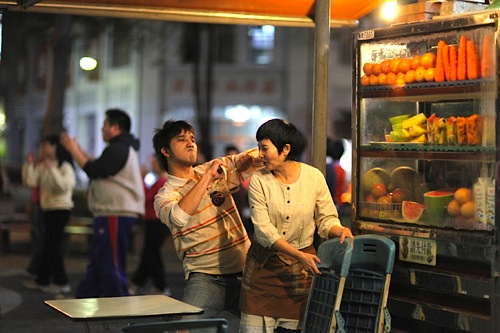
By Joe Bendel. The teenaged Xiao Yang is not exactly Cyrano de Bergerac. Nevertheless, he will do his best to recycle both love letters and lovers. The course of true love never runs smooth, but he will sometimes help it along in Hsu Chao-jen’s multi-character rom-com, Together, which screens this Saturday during the 2013 Asian American International Film Festival.

Scooping up his classmate’s discarded love letter, Xiao Yang is determined to put it to good use. Perhaps his buddy Ma Chih-hao can re-purpose it. Having just dumped his girlfriend, Ma pines for the cute cashier working at their favorite bakery, whose manager in turn nurses a crush on Xiao Yang’s older sister. Of course, she is already involved with a rich jerk, who does not think much of Xiao Yang.

Yes, this is the sort of film where viewers could use a flowchart to keep track of who likes whom. However, his parents’ relationship is easy to pick-up on. The magic has left the easy going Bin’s marriage toward the more assertive Min-min. Ironically, the print shop proprietor soon finds himself producing wedding invitations as his own marriage takes a chilly turn. The free-spirited Lily has recently returned to their Taipei neighborhood to marry Haru, the staid owner of the local Japanese bookstore. Yet the strangely ambiguous chemistry between her and Bin is still there.

From "Together."

Despite all the romantic confusion, the tone of Together is much more bittersweet than cutesy. In fact, for domestic audiences, it is downright nostalgic, given the casting of Kenny Bee and Lee Lieh as Xiao Yang’s parents, who were amongst the break-out co-stars of the classic melodrama The Story of a Small Town. Of course, it is all headed toward a happy place, but there are more surprises and less sentimentality in the third act than one might expect.

Happily, Huang Shao-yang’s Xiao Yang grows on viewers over time, as his character starts using his brattiness for good rather than ill. His presence somewhat suggests a young Taiwanese Leonardo DiCaprio, except he is already considerably more manly (as is everyone else in the cast). Bee remains charismatic in middle age, nicely crooning the film’s signature love song. Supermodel-actress Sonia Sui lights up the screen as Lily, while developing some reasonably believable chemistry with the significantly older Bee. Lee Lieh also does her best to punch-up Min-min, despite her somewhat problematic scoldiness.

Indeed, Hsu definitely favors Bee’s Bin over the rest of the large ensemble. Still, he invests the film with a forgiving vibe that is rather endearing. His unhurried pace might be a bit too languid for slavishly conventional viewers, but Hsu has a good eye for composition and Blaire Ko’s slightly latin-ish score helps it all go down quite smoothly. Recommended with a fair degree of affection for those who enjoy slightly offbeat love stories and family dramas, Together screens this Saturday (7/27) at the New York Institute of Technology, as part of this year’s AAIFF.

LFM GRADE: B+

Posted on July 25th, 2013 at 1:07pm.