LFM Reviews Confession of Murder @ The 2013 New York Asian Film Festival

By Joe Bendel. It is the kind of capricious perversity of the legal system that a Victorian novelist would admire. After the statute of limitations expires for his crimes, a serial killer comes forward—ostensibly to repent. However, the cop in charge of the investigation doubts both his sincerity and his veracity in Jung Byoung-gil’s Confession of Murder, which screens today during the 2013 New York Asian Film Festival.

Det. Choi Hyung-goo still bears the scar from his close encounter with a masked serial killer. The case became personal for him—real personal. When Lee Doo-suk steps forward claiming to be the serial killer he is not impressed. Neither are the families of his victims. In marked contrast, the public eats up his phony contrition act, turning Lee into a media phenomenon. Unfortunately, there is little Choi can do, but the families are not so passive.

Directed by Jung, who is best known to NYAFF patrons for Action Boys, his documentary about Korean stuntmen, Confession has its share of big, adrenaline charged chases and fight scenes. However, it is not the stunt work bacchanal one might expect. Instead, Confession plumbs some murky psychological depths. Rather than an action thrill ride, it compares more closely to Kim Jee-woon’s I Saw the Devil.
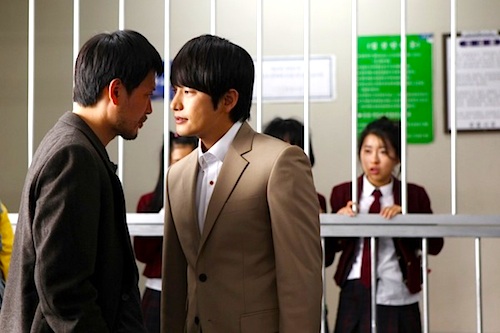
From "Confession of Murder."

Jung maintains the stark tension throughout the film, but he unleashes a barrage of revelations in the third act. Indeed, viewers might kick themselves for not guessing a few, but Confession serves as an object lesson in how not to telegraph your big twists by keeping everyone distracting with breakneck pacing. This is a really well constructed film, but it is not for those with delicate sensibilities. Yes, there is a fair amount of physical conflict, but the emotional violence is far more unsettling.

Jung Jae-young is all kinds of hardnosed as Det. Choi, yet he also perfectly conveys the damaged cop’s tragic nature. Television star Park Si-hoo is suitably cold and creepy as the serial killer-teen idol. Their scenes together have serious zing, but they are also backed-up by a strong supporting cast that really helps sell the twists and turns.

Presumably most viewers will not be experts in South Korean criminal law, so it is easy to suspend disbelief over its initial MacGuffin. While in America the statute of limitations never expires for murder, Confessions is such a nifty, high concept thriller, it seems ripe for a Hollywood remake nonetheless. (Perhaps a liberal judge in the Dirty Harry tradition could issue a preemptive ruling granting the killer impunity.) Regardless, Confession of Murder is a muscular thriller that ventures into some unusually dark places. Very highly recommended, it screens this afternoon (7/3) at the Walter Reade Theater, as part of the 2013 New York Asian Film Festival.

LFM GRADE: A-

Posted on July 3rd, 2013 at 1:17pm.
LFM Reviews Feng Shui @ The 2013 New York Asian Film Festival

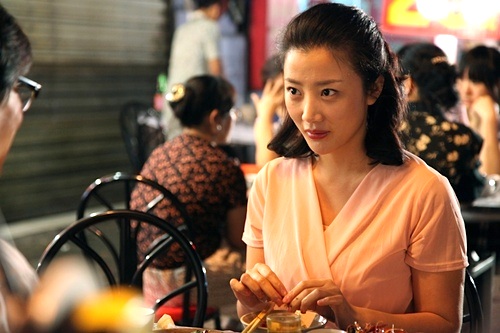
From "Feng Shui."

By Joe Bendel. Feng Shui is a traditional Chinese spiritual and aesthetic practice meant to maximize the flow of positive chi in living spaces. The principles of shrewishness are also pretty universal. Both phenomena contribute to a bossy wife and mother’s bad karma in Wang Jing’s Feng Shui (trailer here), which screens tonight during the 2013 New York Asian Film Festival.

As soon as they move into their new flat, Li Baoli starts tearing into her passive husband, Ma Xuewu. Suddenly, neither he nor their studious young son Xiabao seem to do anything right. After about a day of this, Ma declares he wants a divorce, but this only further antagonizes his wife. Launching an emotional cold war against her husband, Li succeeds in pushing him into the arms of his factory colleague Zhou Fen, with disastrous results for the family.

Flashforward ten years: Li is now the primary breadwinner for her resentful son and her grey-haired mother-in-law. Slaving like a dog as a yoke-bearing street porter, Li lives for the day the high achieving Xiabao takes his university entrance exams. However, the teen has a general idea of what transpired between her and her father and he definitely holds it against her.

Basically, Feng Shui is divided into two distinct halves. Initially, Li Baoli is so foul-mouthed, insensitive, and downright mean-spirited that she will have viewers reeling. Surely, no movie character has used the expression “dog-f___er” as much as her. Yet, somehow Yan Bingyan makes us care about her rather deeply during the redemptive karmic payback portion of the film.

From "Feng Shui."

Yan Bingyan is frankly amazing as Li, smoothly segueing from hot mess on wheels to a weathered self-sacrificing maternal goddess in the Ruan Lingyu mold. She makes some extreme extremes look perfectly believable and totally exhausting.

As befitting a woman’s story, Feng Shui’s richest supporting turns mostly come from women. He Minglan gives a wonderfully subtle and humane turn as the mother-in-law who can see both the bad and the good in Li. Likewise, Wang Moxi has some brief but powerful moments as Ma’s almost-mistress. Zhao Qian also adds some seasoning to the film as Li’s best friend, an aging trophy wife (who blames her less fortunate friend’s troubles on bad feng shui). However, for an ostensibly smart kid, the teenaged Xiabao does not seem to have much going on in his head, besides an awkward surliness.

Feng Shui is based on a novel by Fang Fang, whose work is either reminiscent of Neil LaBute or Ozu, depending on which half of the film you judge by. Clearly, Li Baoli’s trials and tribulations are intended to underscore the difficulty realizing social mobility in contemporary China. It might be a stark reflection of reality, but it is a good film. Recommended for those who enjoy a quality tearjerker with an edge, Feng Shui screens tonight (7/3) at the Walter Reade Theater as part of the 2013 NYAFF.

LFM GRADE: B+

Posted on July 3rd, 2013 at 1:16pm.

LFM Reviews Countdown @ The 2013 New York Asian Film Festival

By Joe Bendel. Technically, this is not a home invasion film, because they invited him in. Nor is this psycho dug-dealer exactly whom he seems to be—except maybe the psycho part. Regardless, three privileged Thai expats are in for a really crummy New Year’s Eve in Nattawat Poonpiriya’s Countdown (trailer here), which screens tonight during the 2013 New York Asian Film Festival.

Bee, her boyfriend Jack, and their flat-mate Pam are not big on consequences. They live the bohemian life in New York and their long-suffering parents’ pay the bills. Ironically, their small-time dealer friend sets all the drama in motion when he resolves to clean up his act. Snoopy Jack thinks he found his connection’s ripped up business card, but it is missing a digit. Bee adds a 3 in honor of the New Year of 2013 and presto, Jesus (that is with the Spanish pronunciation, mind you) is on his way over with fresh weed.

From "Countdown."

For a while, the three entitled kids enjoy smoking up with the scraggly looking dealer, despite the rather odd remarks he occasionally lets slip. As the more responsible one, Bee slowly picks up on Jesus’s bad vibe, but with Jack and Pam out-of-their-minds high, she is no match for the large, angry man. Ominously, he also seems to know secrets about them that a garden variety dealer should have no way of knowing. Man, are these cats going to miss Dick Clark.

Countdown starts in a hip Kevin Williamson bag, but things quickly get biblical. Following in the tradition of old school E.C. Comics morality tales, Bee, Jack, and Pam have been bad kids, so viewers will not be overly disturbed when Jesus puts the screws to them. Still, Poonpiriya takes the action to some thematically dark places and does not skimp on the physical violence.

As Jesus, David Asavanond makes a killer villain, so to speak. He struts about and delivers his heavy dialogue with the authority befitting an avenging whatever. However, Jarinporn Joonkiat also does some real acting as Bee. She actually makes her a complex, believable character, which is quite impressive in a neo-exploitation genre mash-up. Essentially, Pachara Chirathivat plays Jack as the character demands: weak and annoying. Likewise, Pattarasaya Kreuasuwansri certainly looks and acts the part as the shallow but photogenic Pam. Indeed, the small, game cast does what they need to do to keep the bloody mayhem on track.

Countdown has the potential to become a midnight movie perennial. Poonpiriya incorporates his New Year’s Eve countdown motif in clever ways, while Asavanond’s gleefully Mephistophelian turn is tailor-made for cult-fandom. Recommended for experienced NYAFF patrons, Countdown screens tonight (7/3) at the Walter Reade Theater, but repent before you go.

LFM GRADE: B

Posted on July 3rd, 2013 at 1:14pm.

LFM Reviews Ip Man: The Final Fight @ The 2013 New York Asian Film Festival

By Joe Bendel. Ip Man was such a powerful kung fu master, he could actually warp time. Fans can only assume as much if they wish to justify the conflicting timelines of the various Ip Man films released in recent years. The dates and places might change, but Ip Man remains the grandmaster of masters. Herman Yau dramatizes his twilight years in Ip Man—the Final Flight, which was a hot ticket last night at the 2013 New York Asian Film Festival.

In the 1950’s and 1960’s, Hong Kong’s go-go economy had yet to blast off. Master Ip earns little more than a subsistence living teaching his Wing Chun style of kung fu to students. Well known throughout the city, Master Ip could probably do a brisker business were it not for his own self-imposed restrictions. Kung fu is a way of life for him—not a commodity to be commercialized.

In a way, The Final Flight is a bit Gumpish, casting Master Ip as an observer of two decades of Hong Kong’s growing pains, including the rise of trade unionism and the rampant gangsterism within the Walled City. However, when it finally gets down to fighting, Final delivers some spectacular street melees.

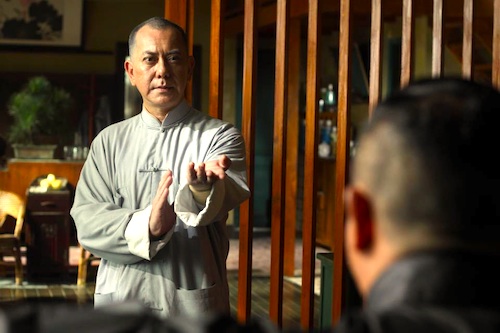
While produced independently of Wilson Yip’s Ip Man films, Anthony Wong is not a bad likeness for Donnie Yen in his AARP years. Wong might not look particularly spry, but he is a steely old cat, so it is easy to buy into him as the veteran martial artist. After all, the genre has a long history of butt-kicking greybeards.

Anthony Wong in "Ip Man: The Final Fight."

Indeed, Wong’s Zen-like gravitas is perfect for the venerable Ip. He also develops some appealingly ambiguous chemistry with Zhou Chu Chu, playing a scandalous nightclub singer attracted to his old bad self. However, the film is overstuffed with Ip’s disciples. You would think half the city was studying under him. Regardless, Jordan Chan adds real hardboiled heft to the film as Tang Shing, a not completely corrupt copper and former student of Ip’s. He creates a spinoff-worthy character should the filmmakers wish to further complicate the Ip Man universe.

Festival special guest Yau should satisfy fans with his gritty street action and humanistic portrayal of the Ip family. In fact, Ip’s son, Ip Chun, served as a technical advisor and appears in a small supporting role. Final Fight is also bolder than its predecessor films in depicting Ip’s most famous student, Bruce Lee. Although never named as such, it is hard to miss the implication when Master Ip meets with a former student turned famous actor, whom the audience only sees from behind, sporting conspicuous sunglasses.

It was the apostolic connection to Bruce Lee that launched the Ip Man filmmaking craze to begin with, but the Master has since taken on a media life of his own. Nicely choreographed with a wistful vibe that sets it apart from the pack, Yau’s latest Ip Man is a worthy addition to the Ip canon. Recommended for martial arts fans with a strong appreciation of tradition, Ip Man—the Final Fight screened last night (6/30) as part of the 2013 New York Asian Film Festival.

LFM GRADE: B+

Posted on July 1st, 2013 at 11:22am.

Stargazing: LFM Reviews Baikonur @ The 2013 Marfa Film Festival

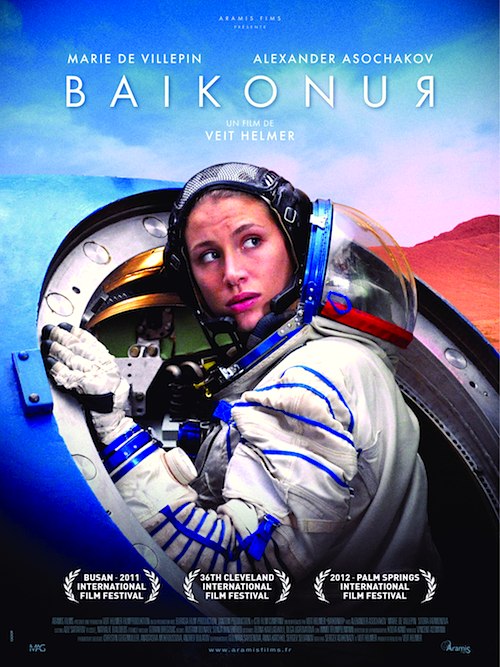
By Joe Bendel. Just like their Soviet counterparts used to do, Russian cosmonauts watch the Central Asian caper movie White Sun of the Desert before each lift-off from the Baikonur Cosmodrome in Kazakhstan. Not the surprisingly, the locals have an ambiguously symbiotic relationship to the Russian space program. One young Kazakh misfit harbors ambitions regarding love and space travel in Veit Helmer’s Baikonur (trailer here), which has its Texas premiere this Saturday at the 2013 Marfa Film Festival.

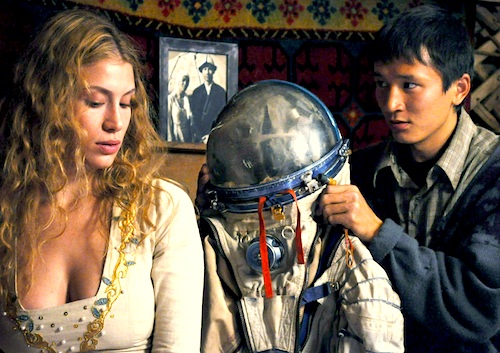
The men of Iskander “Gagarin” Orinbekov’s village have only one source of employment—salvaging metal cast-off from rocket launches. A self taught engineer, Orinbekov usually gives them an edge over their competition. They have a saying: “what drops from the sky is a gift from God.”  Tragically, falling space debris also killed Gargarin’s parents when he was young. Yet he still dreams of joining the cosmonauts. Then one day, Orinbekov discovers French space tourist Julie Mahé’s missing space capsule with her strapped inside. When she finally comes to, she has a tempting case of amnesia. Since she fell from the sky, Orinbekov wonders if he can really keep her.

Filmed on location at Baikonur and Star City outside Moscow, Baikonur captures the grand scale of the Russian space facilities. Helmer instills a real sense of place in the film and evokes the idealism many people still feel for the daring pursuit of space exploration. He and cinematographer Kolya Kano frame some striking images throughout the film, juxtaposing the traditional trappings of Orinbekov’s village with the hulking rocket scraps. Unfortunately, Baikonur eventually runs out of steam, slumping into a rather standard issue star-crossed love tale down the stretch.

Central Asia has been a region of fertile inspiration for Helmer, the German helmer, whose previous film was the likable fable Absurdistan. However, he loses perspective occasionally in Baikonur. It is hard to imagine most women in the audience will find the offers to buy Orinbekov’s “fiancée” a funny ha-ha turn of events.

From "Baikonur."

Nonetheless, Alexander Asochakov is engagingly earnest as Orinbekov, despite his limited dialogue. Conversely, Marie de Villepin (daughter of Sarkozy’s nemesis, Dominique de Villepin) is somewhat vanilla as Mahé. However, Erbulat Toguzakov has some nicely wry moments as Orinbekov’s grandfather, Rustam. At one point he tartly laments: “the young are so clever and the world is so dumb.”

When celebrating stargazers and space travelers, Baikonur’s innocent spirit of wonder is genuinely charming. The question of whether Orinbekov will win back Mahé or possibly start to notice his old childhood friendemy Nazira is considerably harder to get caught up in. At least the look and the feel of the film are rather special. Recommended for space program enthusiasts and boosters, Baikonur screens this Saturday (6/29) during the 2013 Marfa Film Festival.

LFM GRADE: B-

Posted on June 28th, 2013 at 12:41pm.

Statham Hits London’s Mean Streets: LFM Reviews Redemption

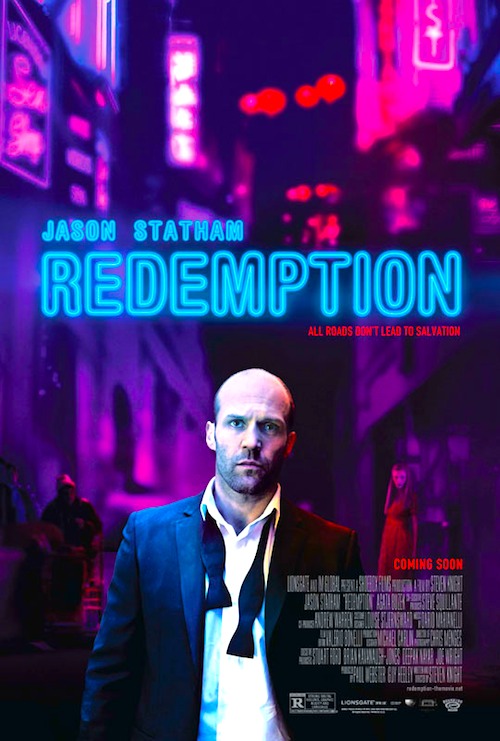
By Joe Bendel. It is not exactly “Garbo Talks,” but as hooks go, “Statham Cries” is pretty good. The action star’s big close-up comes in the right vehicle. In a throwback to the angry young anti-hero films Michael Caine cut his teeth on, Statham prowls the mean streets of London in screenwriter-director Steven Knight’s Redemption, which opens this Friday in select cities.

Haunted by his war crimes, a shell-shocked former Special Forces soldier lives a homeless existence to evade a certain court martial. Deeply traumatized by his experiences, he often suffers from flashbacks and hallucinations. Terrorized by local thugs, “Joey” finds unlikely refuge in an exclusive hipster flat. Unfortunately, his companion Isabel is captured and consigned to a low-end brothel.

Using the resources of his unwitting host (conveniently abroad for the season), Joey cleans himself up and takes work as an enforcer for a Chinese crime syndicate. With the reluctant help of inner-city mission nun Sister Cristina, Joey Jones (as he now calls himself) tries to track down Isabel. Yet, despite his erratic behavior, a strange relationship develops between them.

Granted, the “troubled” vet is always a problematic device. However, the film is rather sensitive in its depiction of Joey Jones, while never absolving him of his sins. There are definitely beatdowns in Redemption, but the film is more concerned with mood and character development. Knight demonstrates a keen understanding of tension-and-release, so when the violence flares up, it never feels gratuitous.

Clearly, Oscar winning cinematographer Chris Menges loves the neon lights and shadows of Redemption’s nocturnal world, getting all the Miami Vice he ever had in him out of his system. The film looks great, aside from a few awkward scenes of Jones’ delirium. Statham is also surprisingly good as Jones, convincingly portraying his violent unpredictability. Viewers are never quite sure how he will react in a given situation, which is a major reason why Redemption works so well.

Statham also shares some richly intriguing chemistry with Agata Buzek (the daughter of former Polish Prime Minister and Solidarity activist Jerzy Buzek), whose intelligent but tightly wound performance adds significant depth to the film. The notion that Jones and Sister Agata are sharing a mutual “wild patch” in their lives may not exactly ring true, but it still works within the film’s dramatic context.

Knight nicely maintains the tragic logic throughout Redemption, but the NSA-ish surveillance motif book-ending the proper narrative feels wholly out of place in his street level tale. Nonetheless, Redemption is a stylishly executed over-achiever that is only really missing the Roy Budd-inspired soundtrack. Recommended for fans of Statham and old school payback movies, Redemption opens this Friday in New York at the Village 7.

LFM GRADE: B+

Posted on June 25th, 2013 at 12:07pm.