LFM Reviews Daphne Du Maurier’s The Scapegoat on PBS

By Joe Bendel. If her uncle had not been such an idiot, Elizabeth II never would have been Queen. Due to his dubious judgment, his brother’s daughter will soon ascend to the throne. The caddish Johnny Spence half-jokingly describes the days leading up to her coronation a period of monarch-less anarchy. It will indeed make a fitting backdrop for Charles Sturridge’s completely Anglicized adaptation of Daphne Du Maurier’s The Scapegoat, which airs in syndication on participating PBS stations, including Chicago’s WTTW this coming Saturday night.

John Standing has just been downsized out of a job as a boarding school teacher. With no family to support and lacking any significant ambitions or prospects, he sets out on a vaguely defined walking tour. Stopping at a seedy public house, he is startled to come face to face with his dead ringer, the wastrel Johnny Spence. After a night of imbibing with the charming but overbearing Spence, Standing is surprised to wake up and find the man has absconded with his anonymity, leaving him to take his position of wealth and privilege.

Unfortunately, Standing soon deduces that the Spence family fortunes are sagging. His doppelganger was hoping to save their glass foundry with a Hail Mary business deal, but he rather doubts the playboy pulled it off. However, he is quite charmed to meet the man’s spirited young daughter (Mary Lou, a.k.a. Piglet) and his nervous wife Frances. Conversely, he is quite uncomfortable around Nina, Spence’s sister-in-law with whom he seems to be having an affair with. Yet nobody seems to suspect his reluctant impersonation, not even his resentful brother Paul or their morphine addicted mother, Lady Spence. Frankly, the family might just be better off with the new and improved Johnny Spence, but the old one is still out there, up to no good.

From "The Scapegoat."

Produced by ITV, Scapegoat is a nifty little thriller that had a spot of film festival play before its American television run. Transferred from the south of France to post-war Britain, Sturridge’s adaptation is tightly paced and uses the impending coronation as a clever metaphor. As the director of most of the beloved Brideshead Revisited miniseries as well as the masterful A Handful of Dust, Sturridge has a keen feel for Twentieth Century British period pieces. He displays a nice touch with Scapegoat, combining a Downton-esque vibe with film noir-ish elements.

Logically, Sir Alec Guinness (the master of multiple parts) had first crack at the Standing/Spence role in Robert Hamer’s 1959 feature film. Yet, Matthew Rhys (now probably best known for FX’s The Americans) steps into his shoes admirably well. In fact, this might be his strongest small screen work, eclipsing his suitably brooding John Jasper in The Mystery of Edwin Drood. His Spence is charismatically wicked, but he also makes a convincingly confused and depressed everyman as Standing. Alice Orr-Ewing is a bit vanilla as poor Frances, but Andrew Scott (Jim Moriarty in Sherlock) adds some edgy energy into the mix as Paul Spence. Yet Sturridge’s wife and Brideshead co-star Phoebe Nicholls occasionally upstages everyone as the smart-than-her-employers housekeeper, Charlotte.

Altogether, The Scapegoat is quite cinematic by television standards. Handsome looking and intelligently written, it is definitely recommended for fans of Brit mysteries and literary dramas when it airs on select PBS stations later in the month.

LFM GRADE: B+

Posted on June 17th, 2013 at 12:52pm.
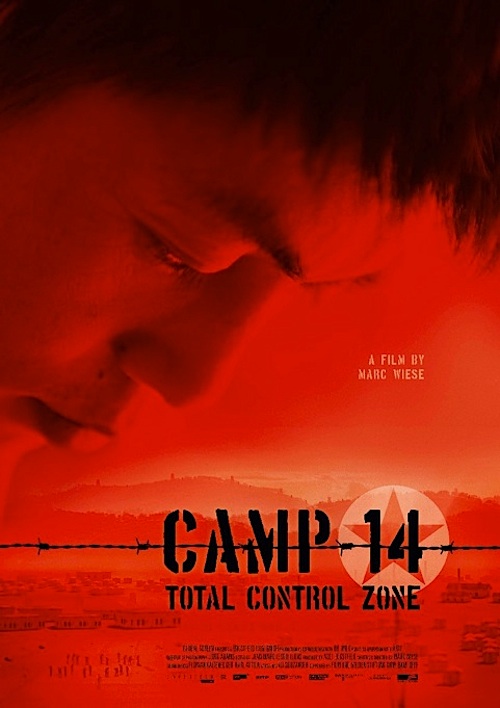
Born in a North Korean Labor Camp: LFM Reviews Camp 14: Total Control Zone @ The 2013 Human Rights Watch Film Festival

By Joe Bendel. As a child born into a life in North Korea’s prison camps, Shin Dong-huyk thought nothing was amiss when he witnessed the three hour beating of an eight year old girl caught with five grains of wheat in her pocket. Evidently Dennis Rodman, the regime’s newest apologist, has no problems with it, either. However, all viewers of good conscience will be horrified by the stories Shin and two former DPRK officials have to tell in Marc Wiese’s documentary Camp 14—Total Control Zone, which screens during the 2013 Human Rights Watch Film Festival.

That poor girl died from the injuries she sustained from her “teacher.” Her case is the norm rather than the exception. Children born to prisoners (because a guard either raped their mothers or arranged a coupling as a reward for heavy toiling) have a short life expectancy. Shin beat the odds surviving Camp 14 into his teen years, but at a price. At one point, Shin’s brainwashing led him to make a decision that still haunts him today.

Hyuk Kwon was a guard at Camp 22, where he tortured and executed prisoners on a daily basis. Oh Yangnam was a member of the secret police, who regularly rounded-up and interrogated suspects on the thinnest of pretexts. Both have defected to South Korea, yet they worry they might see some of the prisoners they once tormented should the two Koreas ever unify. Their accounts match Shin’s experiences, chapter and verse.

Through their testimony, sometimes illustrated by Ali Soozandeh’s stark animated sequences, Control conveys the breadth and depth of the Communist regime’s thought control. Clearly, any notion of human rights is absolutely foreign to North Koreans. Ostensibly, Control ends on an ironic note, with Shin expressing his ambivalence about the free South. Yet his remarks really prove just how profoundly broken he is as a human being.

Wiese has assembled a riveting examination of oppression and its lasting impact on the human psyche. While he maintains an intimate focus on his interview subjects, Soozandeh’s animation is grimly evocative, adding a truly cinematic dimension to the documentary.

This is a very good film, but also a very depressing one. The picture of North Korea that emerges is truly the closest thing on Earth to Orwell’s 1984—a dystopian state with complete disregard for its citizens’ well being. However, it points viewers towards Liberty in North Korea (LiNK), a rescue and advocacy organization Shin is affiliated with. Frankly, this is exactly the sort of film HRWFF needs to program more often (instead of Occupy Wall Street polemics). Highly recommended, it screens this coming Thursday (6/20) at the IFC Center and next Friday (6/21) at FSLC’s Francesca Beale Theater.

LFM GRADE: A

Posted on June 14th, 2013 at 4:48pm.

Locked in Her Home for 20 Years: LFM Reviews Salma @ The 2013 Human Rights Watch Film Festival

By Joe Bendel. Evidently, Vitamin D is not a big priority in the provincial Muslim communities of southern India—women’s rights even less so. One prominent Tamil woman understands this from first-hand experience. For nine years, her family kept her locked away from the outside world until she finally consented to an arranged marriage. The poet-politician tells her story in Kim Longinotto’s documentary profile, Salma, which screens during the 2013 Human Rights Watch Film Festival.

The pre-teenaged Salma (as she is simply known) desperately tried to hide the onset of puberty, because she knew her parents would pull her out of school and sequester her until marriage. She actually valued learning, making her quite the problem child. She was also disinclined to marriage, holding out for as long as possible. Finally she acquiesced, only to find her circumstances largely remained the same. Only her jailers changed.

From "Salma."

Secretly, at great risk of physical abuse or worse, Salma starting writing poetry, which a sympathetic family member furtively submitted to a publisher (not completely unlike Jafar Panahi’s This is not a Film, smuggled out of Iran in a cake). Her powerful verse became a sensation, scandalizing the village and outraging her family. However, it also made her a celebrity, forcing her in-laws to let her out into the world, setting the stage for an unlikely political career.

Salma is an eloquent advocate for reform and her experiences are almost unfathomable for the Twenty-First Century. She is well worth listening to, but Longinotto allows her to leave obvious 800 pound gorilla questions unanswered. Most notably, just about every viewer will wonder why she remains silent on the nature of the religion used to justify her oppression. In fact, she is still outwardly quite devout. Is it all for the sake of her political career? Longinotto never pushes her on the issue, despite all the fundamentalist misogyny expressed by her grown nephew, among others.

Nonetheless, reality speaks for itself in every frame of the film. Indeed, the implications of Salma’s personal history are inescapable. Longinotto nicely incorporates Salma’s verse, adding a literary dimension to the film. Informative and bravely intimate in a burqa-less way, Salma screens today (6/14) at the IFC Center and tomorrow (6/15) at the Francesca Beale Theater.

LFM GRADE: B

Posted on June 14th, 2013 at 4:47pm.

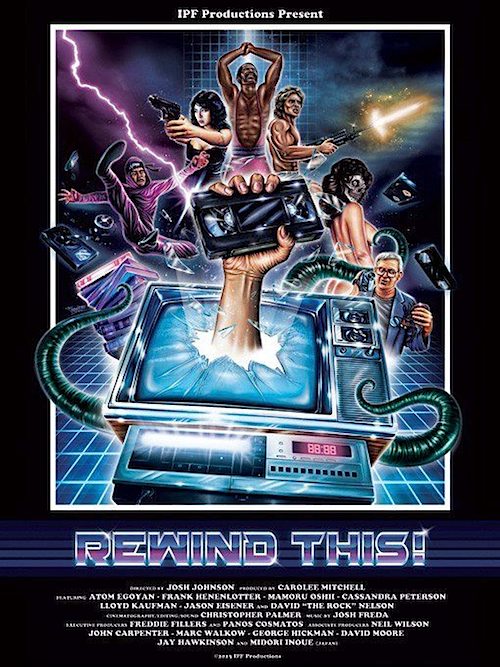
Rewinding the VHS Revolution: LFM Reviews Rewind This! @ Awesome Fest 2013

By Joe Bendel. The classic 1980’s movie hero was a commando who could inexplicably bury himself in mud, yet spring up at exactly the right time to ambush an enemy army. Today’s prototypical protagonist is a man-child who tries to win back his elfin girlfriend by working in an organic food coop. How did we go so far wrong as a culture? Back in the ’80s, the best way to watch a bunch of crap blow-up was on VHS. It still is for some die-hards. Josh Johnson profiles the VHS tape and the people who love it in Rewind This, which screens during the 80’s themed Awesome Fest in Philadelphia.

There are scads of oddball films that were released on VHS, but have yet to get the DVD treatment. Partly this is because the big studios were late to the party (like they were right on time for the digital download thing), leaving the field open to bargain hunting independents. More importantly, the voracious demand of mom-and-pop rental stores across the country required a constant stream of new product, regardless of good taste or logic. Those zero budget wonders are a major reason why some collectors bitterly cling to their VHS tapes.

Johnson gives a good overview of VHS’s origins and its triumph over Betamax. While he covers the love affair between VHS and porn, he does not belabor the point, preferring to focus on the old school action and horror movies that became mass market commodities thanks to home video. In addition to a motley crew of blogger-collectors, Rewind features commentary from legendary grindhouse director Frank Henenlotter, Cassandra “Elvira, Mistress of the Dark” Peterson, Lloyd “Troma” Kaufman, David “The Rock” Nelson, and dudes from SXSW, Something Weird, Twitch, Severin Films, Cinefamily, and Alamo Drafthouse. There is also a Japanese contingent, including Shinji Imaoka, the director of Underwater Love, probably the most endearing Pinku Eiga film ever.

Rewind does not skimp on the vintage clips, reveling in the aesthetics of direct-to-video exploitation movies with lushly painted pre-Photoshop covers. Unfortunately, the not infrequent whining about big media corporations quickly grows tiresome. It is also rather off the mark. No distributors were bigger cutthroat capitalists than Golan-Globus, yet they brought us VHS milestones like the American Ninja franchise. Sadly, viewer tastes just shifted from red meat to vegan comfort food.

Despite the occasional eye-rolls, Rewind This offers some heartfelt nostalgia for some of the scrappiest films ever haphazardly released. Good, kind-of-clean fun overall, Rewind This! is recommended for all cult cinema fans when it screens Monday night (6/17) as part of Awesome Fest, which also totally deserves your support for their 30th anniversary screening of The Adventures of Bob & Doug McKenzie: Strange Brew on July 8th.

LFM GRADE: B

Posted on June 14th, 2013 at 4:47pm.

John Guare’s Separation Anxiety: LFM Reviews 3 Kinds of Exile

By Joe Bendel. It is an insidious tool used to control dissent, yet sometimes it comes as a relief. Whether voluntary or forced, separation from one’s homeland is a difficult proposition to face. Playwright John Guare explores the phenomenon in his new theatrical hybrid triptych, 3 Kinds of Exile, which officially opened this week at the Atlantic Theater Company’s Linda Gross Theater.

Exile’s first segment, Karel, quickly establishes the minimalist tone through a brief but captivating monologue. An unnamed actor relates the experiences of his friend, a former kindertransport refugee. Despite the success he found as an adult, the first exile’s guilt eventually manifests itself in a rather macabre fashion. While the Kafka influence here is inescapable, it is still an intriguing tale. Martin Moran (who has appeared in several of his own one-man shows) tells it with confidence, nicely conveying the drama and angst of his friend’s situation as a second-hand reporter.

The middle piece of Exile will likely generate the most attention in the theater world, because it represents the first time the playwright has performed in his own play. In fact, Elzbieta Erased is all about stage and screen history, telling the mostly sad history of Elzbieta Czyzewska. Once one of Poland’s most acclaimed thespians, Czyzewska marriage to American journalist David Halberstam directly led to her exile and a sometimes brilliant but decidedly erratic career Off-Broadway, well before Off-Broadway was cool.

Essentially, Erased is a dramatic A-V presentation adapted from a previous Guare one-act, featuring the writer and Polish actor Omar Sangare detailing the trials and tribulations of Czyzewska’s life. However, it takes on unexpectedly heavy significance when both men start to reveal their connections to Czyzewska. In fact, it is hard to imagine a production of Exile without them. Sangare is an electric stage presence and Guare is the veritable personification of erudite sophistication. Hearing their tribute to Czyzewska is completely absorbing and genuinely moving, even with the pseudo-lecture hall staging.

Exile ends with a spot of musical theater, albeit of a somewhat absurdist variety. Inspired by his work, Funiage turns the spotlight on the Polish novelist Witold Gombrowicz. Not particularly well regarded at home, Gombrowicz accepts an offer to lecture Argentina’s Polish expatriate community on the greatness of proper Polish literature, on the eve of World War II. The expats did not think much of him either, but at least there were women to carouse with on the ship.

From "3 Kinds of Exile."

Ironically, Funiage is the most upbeat segment of Exile, even though it deliberately echoes Weil & Brecht’s productions. Indeed, Gombrowicz is an attractive figure, who was evidently largely satisfied working as a Buenos Aires bank clerk by day and writing in relative obscurity at night. David Pittu (who played Brecht in the Broadway musical LoveMusic) is wildly charismatic as Gombrowicz, while also expressing a sad, world weary earnestness.

Of course, Guare is best known as the writer of Six Degrees of Separation, which factors prominently in Elzbieta Erased3 Kinds of Exile is more avant-garde in form than his signature work, but the stories are still easily accessible and immediately engaging. There are some deep truths in each piece, as well as several dynamic performances.  Recommended for slightly adventurous patrons, it runs through June 23rd at the Linda Gross Theater.

Posted on June 13th, 2013 at 3:49pm.

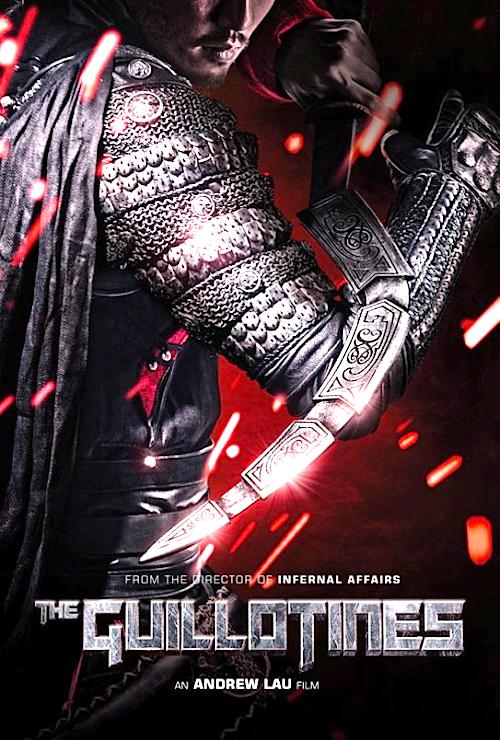
Heads Up: LFM Reviews The Guillotines

By Joe Bendel. Widely feared for their decapitation weapons, the Guillotines consider themselves the Emperor’s A-team for sensitive missions. Unfortunately, they find out they are simply expendable crewmen in Andrew Lau’s The Guillotines, which opens this Friday in New York.

Wolf is the ironically named leader of the rebellious shepherd gang, who seems to think his fate is connected to that of Leng, the Guillotines’ trusted squad leader. With Wolf imprisoned and scheduled for execution, Leng pays little heed to his captive’s mumbo jumbo. Unfortunately, a daring rescue operation frees Wolf, in the process taking prisoner Musen, their comrade and daughter of their revered commander.

Obviously, this is a black eye for the Guillotines, but it gets worse. The emperor has decided to sacrifice the Guillotines on an ostensive clean-up mission. As it happens, Leng is well acquainted with the man charged with his team’s destruction. He and Agent Du were recruited as young children to faithfully serve the emperor. While Du remains unswervingly committed to the royal sovereign, Leng feels a stronger kinship with his team. Ironically, he finds temporary shelter with his old nemesis, Wolf.

Considering the wicked, Krull-like weapons sported by the Guillotines, this pseudo-Shaw Brothers remake is surprisingly stingy with the martial arts throwdowns. Frustratingly, most of the action consists of large set piece massacres of Wolf’s ragtag contingent, which are really not much fun at all.

Indeed, The Guillotines follows in a long line of historical dramas that not so subtly suggest a strong centralizing authority is in the national interest because it provides stability. Of course, this is an attractive argument if you happen to be part of that centralized power structure. Still, the film incorporates the traditional Han and Manchu conflict in intriguing ways.

As Leng and Du, Ethan Juan and Shawn Yue develop a nice Cain-and-Abel tension, while Li Yuchun convincingly renders Musen’s awakening of conscience. In contrast, the rest of the Guillotines, though introduced individually in the cool credit sequence, are not meaningfully delineated as characters.

Frankly, there are just too many scenes of terrified peasants fleeing the Imperial war machine, followed-up with precious little payoff. It is a quality period production, but there is too much message and not enough old school entertainment. A disappointment for martial arts fans, The Guillotines opens this Friday (6/14) in New York at the IFC Center.

LFM GRADE: D+

Posted on June 13th, 2013 at 3:48pm.