LFM Reviews The Machine @ The 2013 Tribeca Film Festival

By Joe Bendel. There is a second Cold War on and China is winning. Britain’s defense establishment is convinced that their only hope lies in devising killer androids enhanced with artificial intelligence. Oh, but perhaps they succeed too well in Caradog James’ The Machine (see clip above), which screened as a Midnight selection of the 2013 Tribeca Film Festival.

Vincent McCarthy could make bank in the private sector, but he has personal reasons for laboring in a subterranean government facility somewhere in Wales. When Ava’s AI program comes darn close to passing the Turing Test, he recruits her for his double-secret research. However, on her very first day she cannot help noticing the dodginess of the place, particularly the guards, who double as guinea pigs. There seems to be something weirdly unspoken going on with the twitchy veterans who accepted AI implants to counteract their brain trauma.

When Ava is murdered under suspiciously suspicious circumstances, her pre-mapped brain is imprinted on “The Machine.” McCarthy coaches her/it to be human and humane – but Thompson, the ruthless project director, orders a battery of more lethal instructions. This leads to conflict.

It would be nice to see a film that considered the British and American military and intelligence services to be the good guys for a change, especially compared to the oppressive and increasingly militaristic Communist regime in China. Sadly, The Machine is not that film. There really ought to be an epilogue showing how China enslaves the world because of the resulting setbacks to the Free World’s R&D. Instead, we just get Messianic themes warmed over from the Universal Soldier franchise, which in turn were cribbed from Metropolis, R.U.R. and a host of apocalyptically promethean science fiction morality tales.

Nonetheless, Caity Lotz earns favorable notice for her dual role as Ava and The Machine. She presents two distinct personas, yet still credibly hints at connections between the two. Toby Stephens works well enough as the brilliant but short-sighted McCarthy. Sadly, Star Wars alumnus Denis “Wedge” Lawson is completely wasted as the dastardly Thompson, who seems to engage in unnecessary villainy solely to precipitate McCarthy’s crisis of conscience.

Very little of The Machine makes sense, starting with the moody Miami Vice ambiance. One would think a research laboratory ought to be well lit, but evidently this is not the case. Despite Lotz’s interesting performances, The Machine is predictable and heavy-handed. A disappointment, it screened this past weekend at this year’s Tribeca Film Festival.

LFM GRADE: D+

Posted on April 29th, 2013 at 3:17pm.
LFM Reviews Möbius @ The 2013 Tribeca Film Festival

By Joe Bendel. In Russia, today’s captain of industry is tomorrow’s rogue oligarch. Even sponsoring the next head of the FSB is not enough to protect one tycoon. Instead, it makes him a liability. An agent specializing in sensitive assignments will target the shadowy money man through an attractive employee, leading to all sorts of complications in Eric Rochant’s Möbius, which screens at this year’s Tribeca Film Festival.

Gregory Lioubov commands an FSB team pretending to be a Monaco police task force, attempting to turn Alice Redmund, a brilliant trader for with a scandalous past. Redmund works for Ivan Rostovski’s multi-national firm, but she also secretly reports to an American handler. Realizing the Russians are putting a play on Rostovski, the CIA instructs Redmund to play along with the task force she still assumes are local cops.

When Lioubov accidentally picks up Redmund to protect his cover[s], it compromises them both. Suddenly, Redmund is hiding their burgeoning affair from the jealous Rostovski while Moïse, as Lioubov calls himself, scrambles to keep his incompetent subordinates in the dark. Then things really get tricky.

Möbius is pretty steamy stuff by espionage movie standards. These spies definitely come in out of the cold. As Lioubov (or whoever) and Redmund, co-leads Jean Dujardin and Cécile de France have real chemistry and are not afraid to go all in. However, the rest of the cloak-and-daggering is not bad, either. While there seems to be a bit of an anti-American bias, at least it is rather muddled. The FSB on the other hand is clearly portrayed as a nest of vipers indistinguishable from its previous incarnation as the dreaded KGB.

In a change-up from his Oscar winning turn in The Artist, Dujardin brings a dark, brooding physicality to Lioubov. De France is a respectable femme fatale-anti-heroine, but Tim Roth nearly steals the show as the erratic, British-educated Rostovski.

Rochant nicely juggles all the feints and double-crosses as the film alternates between romanticism and cynicism – and cinematographer Pierre Novion gives it all a stylish noir polish that should satisfy genre fans. Recommended for patrons of French cinema and cerebral spy thrillers, Möbius screened this past weekend as part of this year’s Tribeca Film Festival.

LFM GRADE: B+

Posted on April 29th, 2013 at 3:15pm.

LFM Reviews Whitewash @ The 2013 Tribeca Film Festival

By Joe Bendel. Remember kids, don’t drink and plow. We’re especially talking to you up north. It causes plenty of grief for a sadsack countryman in Emanuel Hoss-Desmarais’s Whitewash, winner of the Best New Narrative Director Award at the 2013 Tribeca Film Festival.

Bruce Landry had a pretty depressing life to begin with. The alcoholic Canadian widower’s only source of income was the occasional freelance snowplowing gig. One dark and snowy night, he jumps into his plow with his flask and proceeds to run down a man trudging along the side of the road. In a drunken panic, Landry scoops up the body and drives into the woods, eventually crashing into a sturdy trunk of old growth.

While Landry stews over his predicament, we learn via flashbacks, Landry had some complicated history with the man on the business end of his plow. After Landry convinces the soon-to-be-late Paul Blackburn not to kill himself they sort of become friends—for a while.

One would think Landry could hole up in his plow for only so long, yet his self-imposed imprisonment never seems to end. Whitewash vividly illustrates the old adages about how the mind can create its own Hell. Unfortunately, the audience is condemned along with Landry.

Granted, Hoss-Desmarais masterfully sets the scene and maintains the mood of profound melancholy, but Whitewash is still agonizingly slow to watch. The understated Thomas Haden Church nicely fits the tone of the picture and excels in the odd comic interludes without undermining the overall existential vibe. Nevertheless, there is only so much he can do to punch-up the material while staying in character.

Whitewash bears comparison to trapped-men movies like Detour and Buried, but its claustrophobic setting makes much less dramatic sense. THC admirably rises to the challenge of carrying the film almost single-handedly, but how long do you really want to watch him muttering to himself?

Tribeca’s juried award winners are often head-scratchers and this year is no exception. One can understand the recognition bestowed on Hoss-Desmarais for the atmosphere he creates, but not necessarily for his sense of pacing. Mostly recommended for nationalistic Canadians, Whitewash screened over the weekend as an award winner at this year’s Tribeca Film Festival.

LFM GRADE: C+

Posted on April 29th, 2013 at 3:14pm.

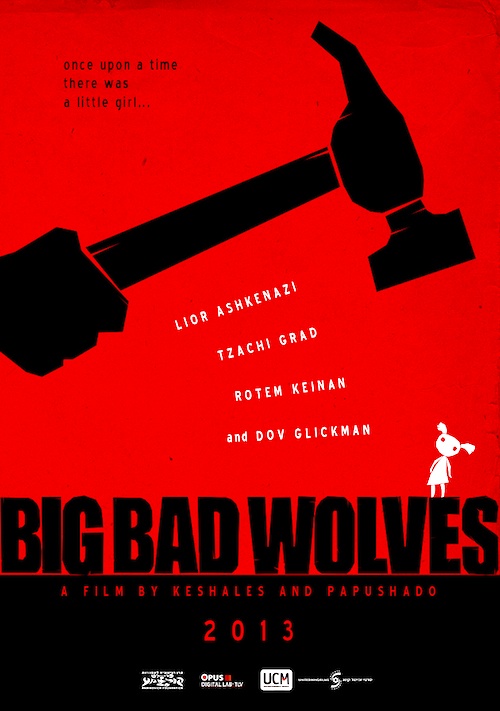
LFM Reviews Big Bad Wolves @ The 2013 Tribeca Film Festival

By Joe Bendel. An Israeli officer who survived the fog of war can go to some dark places if need be. A rogue cop and the school teacher they both suspect of being a serial killer will learn this in graphic terms throughout the course of Aharon Keshales & Navot Papushado’s Big Bad Wolves, which screened during the 2013 Tribeca Film Festival.

A sadistic murderer is preying on young girls. A cop about to snap thinks he has caught his perp. Unfortunately, his rough off-the-books interrogation is captured on video and posted on YouTube. Placed on wink-wink suspension, Micki intends to clean-up his mess by hook or by crook. However, a grieving father beats him to the punch.

Gidi is a veteran of the war in Lebanon, whose daughter was one of the victims. Although her body was recovered, her head cruelly remains missing. He hopes to recover it and thereby reach some closure. Renting an isolated farmhouse near an Arab village, he intends to get down to business in the cellar, after coming to an agreement with the disgraced cop. However, strange complications and interruptions keep coming up.

Keshales & Papushado, the duo behind Rabies, again demonstrate a mastery of one-gosh-darned-thing-after-another filmmaking. Considering how unremittingly tragic the subject matter is, Big Bad is unthinkably and disturbingly funny. Needless to say, it is humor of a decidedly black variety. They capitalize on the claustrophobic tension to build the tension and toss each successive curveball with sly dexterity.

It would be nice to see the Israeli film industry occasionally produce an inspiring portrayal of Israeli society. Yet, the fact that Israel exports films like Big Bad as well as ideologically charged documentaries critical of the government is a testament to the country’s openness. One will not see authority figures depicted in a like manner anywhere in the popular culture of Israel’s neighbors, for fear of permanent reprisals.

Tzahi Grad is a hardnosed standout, portraying Gidi with steely gravitas, yet showing a flair for deadpan absurdist humor. Rabies alumnus Lior Ashkenazi makes a suitable meathead foul-up as Micki. Yet, it is the ambiguous clamminess of Rotem Keinan’s accused serial killer that makes the film so devilishly effective.

It seems appropriate that Big Bad hits the festival circuit around the same time as the restoration of Fritz Lang’s M returns to revival theaters. While there are considerable narrative differences, the two films seem to speak to each other in strange ways, particularly in terms of the social chaos wrought by such horrific crimes. Recommended for fans of dark, subversive thrillers, Big Bad Wolves is sure to find extensive play in Israeli film showcases following its Spotlight screenings at this year’s Tribeca Film Festival.

LFM GRADE: B

Posted on April 29th, 2013 at 3:12pm.

LFM Reviews The Diplomat @ The 2013 Tribeca Film Festival

Olympic champion Katarina Witt.

By Joe Bendel. Once described as “the most beautiful face of socialism,” she would eventually pose for Playboy. As a back-to-back Olympic gold medalist, Katarina Witt represented the greatest success of the East German athletic program. Yet, in light of subsequent revelations, she might be the most deeply confused former East German about the Communist era. At least, such seems to be the case judging from Jennifer Arnold & Senain Kheshgi’s documentary profile, The Diplomat, produced as part of ESPN Films’ Nine for IX series, several of which screen during the 2013 Tribeca Film Festival.

Witt clearly had the X factor at an early age, attracting East Germany’s preeminent figure skating coach and abundant state support. She was duly grateful for both. As she began winning championships, Witt became an important symbol for state propaganda. She did her part willingly. Yet, she was always aware her opportunities to travel outside the closed country were a rare blessing.

What Witt did not realize until after the fall of the Wall was the level of surveillance the state maintained on her, despite her dutiful service. She was also shocked to learn several friends spied on her for the dreaded Stasi, including a remorseful fellow figure skater, whom Arnold & Kheshgi interview at length.

Although she remains an important international sports figure, Witt still seems unsure how to process everything that happened post-1989. We see how staggered she was by the outpouring of East German resentment when the size and extent of GDR state subsidies to athletes was revealed. She argues that Olympics medalists like her did something extraordinary on the world stage, thereby earning their compensation. That is a completely reasonable position, but a far cry from “from each according to his ability, to each according to his need.”

While they are understandably reluctant to dig-in and challenge Witt, Arnold & Kheshgi thoroughly establish the oppressive nature of the GDR and the intrusive methods of the Stasi, much to their credit. Some of their best talking head commentary comes from the post-Unification custodians of the Stasi Archives. For further creepy context, they also scored a sit down with Moscow’s final GDR hardliner Egon Krenz, who once headed the captive nation’s athletic machine, but would eventually be convicted for crimes committed against the German people.

For many Americans watching the Olympics, Witt was always a kind of ice queen. The Diplomat offers a fuller, more complicated picture. It is hard to say how much she was and still is in a state of denial. Yet, it is clear anyone born into such a system with any sort of talent would have to navigate some thorny situations. An intriguing portrait of a gifted athlete representing a system rife with “internal contradictions,” The Diplomat screens again as part of a double bill with No Limits this Saturday (4/27) during the 2013 Tribeca Film Festival.

LFM GRADE: B

Posted on April 25th, 2013 at 11:13am.

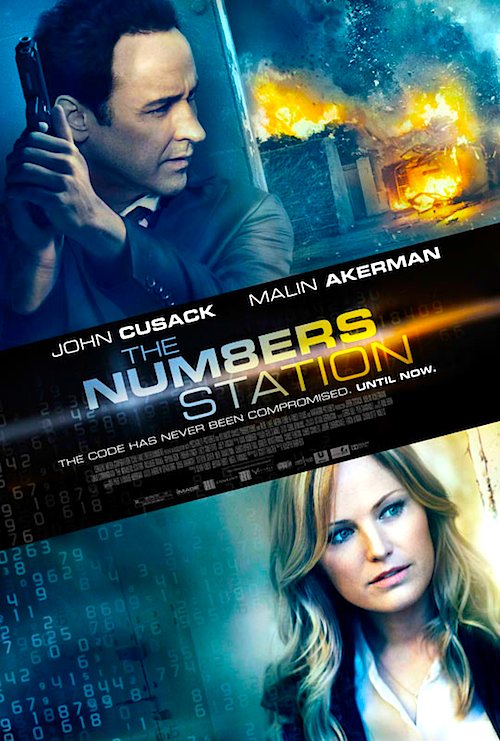
CIA Bingo: LFM Reviews The Numbers Station

By Joe Bendel. Forget about the jocks, the CIA prefers to recruit math geniuses. If they happen to be drop-outs with socialization issues, so much the better. Of course, they still need people who can kill – but any old losers can do that, even someone who looks like John Cusack. Unexpectedly, one such field agent babysitting a remote code transmitter will have to do what he does best in Kasper Barfoed’s The Numbers Station, which opens tomorrow in New York.

Short wave radio is untraceable, making it the perfect format to convey messages to operatives in the field. Periodically, conspiracy nuts and Democracy Now listeners get all worked up about mysterious “Number Station” broadcasts. Typically, they are simply a series of numbers that have no meaning to listeners without the code. After a dirty job gets downright ugly, Emerson Kent is reassigned to a station somewhere in the English countryside. He provides personal security to Katherine, who analyzes incoming code and reads out the resulting number sequences. Neither he nor she has any idea what any of it means.

Typically, they alternate with the other team every three days. However, when they arrive a few hours early in accordance with their new schedule, they find the station under siege. Thanks to Kent’s skills they are able to hole-up in the station. Ominously, though, they discover fifteen unauthorized messages have been sent.

A film like Numbers Station would do so much more business if it actually celebrated CIA agents’ service and sacrifice for their country. There are now 103 stars on the Memorial Wall in Langley commemorating officers who have fallen in the line of duty. However, screenwriter F. Scott Frazier is unmoved by that, preferring to represent as the Agency in the person of Kent’s boss, the ruthless Michael Grey, who constantly growls euphemistically about tying up loose ends. Those 103 stars deserve better than that, Mr. Frazier.

It is a shame too, because Numbers Station is a pretty tightly executed cat-and-mouse-game thriller. Barfoeld uses the claustrophobic constraints of the station bunker to build tension, shying away from conventional action sequences. Both couples’ developing extracurricular attractions also ring true, given the intimacy of their working environment.

Frankly, John Cusack is pretty convincing as the guilt-ridden, clinically depressed black ops agent. Perhaps Barfoed was reading a list of his recent direct-to-DVD credits to him off-camera. Likewise, Malin Akerman proves she can credibly play smart and attractive simultaneously, which should put her on a short list for bigger and better roles. Unfortunately, the usually super-cool Liam Cunningham is largely wasted as the generically villainous Grey.

Numbers Station features some better than average chemistry and respectable thriller mechanics. However, the constant demonization of the intelligence service is clumsy, didactic, and clichéd. Frankly, it is so familiar it makes a film with a few new ideas still feel old hat. The victim of its own self-sabotage, The Numbers Station opens tomorrow (4/26) in New York at the AMC Empire.

LFM GRADE: C

Posted on April 25th, 2013 at 11:12am.