Leonardo Decodes an Ancient Mystery: LFM Reviews Da Vinci’s Demons; Series Premieres on Starz, Friday 4/12

By Joe Bendel. Could Leonardo Da Vinci have been a member of a Persian mystery cult? The Sons of Mithras certainly seem to know him, even if he does not recognize them. The Vatican is also keenly aware of the Maestro, but he wants no part of the Church. However, it is not Da Vinci’s artistry that interests the Pope’s men. They believe he will lead them to the Book of Leaves, a mysterious volume of Faustian knowledge that serves as the MacGuffin of Da Vinci’s Demons, a new speculative historical series debuting this Friday on Starz.

Created and co-written by executive producer David S. Goyer (co-writer of the Dark Knight trilogy), Da Vinci’s Demons could be called a Da Vinci Code for Da Vinci. Throughout the series, he will be solving puzzles that are part of a larger ancient mystery. He must also navigate contemporary intrigues (circa 1476). Although hardly obsequious to the Medici family, Da Vinci is a proud Florentine, because the Republic is such an exemplar of Renaissance ideals. Of course, the Pope hates the city-state for exactly the same reason.

Seeing opportunity in crisis, Da Vinci offers his services to the Magnifico as a war engineer. Naturally, he makes all sorts of enemies in the process. He also accepts a commission to paint the portrait of Lorenzo’s mistress, Lucrezia Donati. She was already cheating on her husband with de Medici, whom she also starts to cheat on with Da Vinci. Indeed, there will be a fair amount of sneaking in and out of bedchambers and outright scandal in Demons.

Laura Haddock as Lucrezia Donati in "Da Vinci's Demons."

There are light fantastical elements in Demons, but it is closer in tone to shows like Rome and Spartacus, with a protagonist who could be the spiritual cousin of Benedict Cumberbatch’s Sherlock Holmes. We even see the world from a similar stop-time perspective through his eyes. Tom Riley takes a bit of getting used to as Da Vinci, but he grows on viewers (at least over the course of the first four episodes). He nicely captures that Sherlockian charismatic arrogance, which is quite entertaining when done right.

Demons also benefits from two attractive yet steely women characters to counterbalance its murderous cardinals and randy artists. Laura Haddock’s Donati brings a sultry noir vibe to the series, while Lara Pulver (Irene Adler in BBC’s Sherlock) is an intriguing master of realpolitik as Clarice Orsini, Mrs. de Medici. Despite his resemblance to Adrien Brody, Blake Ritson also makes a first class heavy as the Pope’s enforcer, Count Girolamo Riario.

Frankly, Da Vinci’s Demons seems to have about as low an opinion of the Church as Reelz’s World Without End, but at least the nefarious clerics enjoy their villainy. In contrast, the Ken Follett’s evil Brother Godwyn always looks slightly nauseous. Indeed, a little moustache-twisting and teeth-gnashing is always enjoyable. Combined with a Dan Brown-esque mystical backstory and some almost steampunky set pieces, Da Vinci’s Demons brings a lot to the table. It is an entertaining series that picks up steam, becoming more addictive as it progresses. Recommended for fans of Rome and The Da Vinci Code, Da Vinci’s Demons premieres this Friday (4/12) on Starz.

LFM GRADE: B

Posted on April 10th, 2013 at 12:39pm.
LFM Reviews Erroll Garner: No One Can Hear You Read, Now on DVD

By Joe Bendel. It is easy to do the jazz dichotomy thing for Erroll Garner. He was nicknamed “The Elf,” but he had a giant sound on the piano. During his lifetime, he was one of the most visible jazz artists on television and in concert halls, yet he has been largely overlooked by recent filmmakers attempting to tell the jazz story (do the initials K.B. ring a bell?). For a documentarian, the latter point is a golden opportunity. Atticus Brady capitalizes on the wealth of archival footage and the admiration of friends and colleagues the pianist-composer left as his legacy in the documentary-profile Erroll Garner: No One Can Hear You Read, which releases on DVD today from First Run Features.

In the latter half of the Twentieth Century, if you had only one jazz LP in your collection, it was probably Brubeck’s Time Out, Miles Davis’s Kind of Blue, or Garner’s Concert by the Sea (all released by Columbia, by the way). He was enormously popular, playing venues like Carnegie Hall, paving the way for Wynton Marsalis and the rise of curated jazz programming in the 1980’s.

Read nicely establishes Garner’s remarkable success and his roots in the Pittsburgh jazz scene that also produced Ahmad Jamal, Mary Lou Williams, and Stanley Turrentine. However, with his very title, Brady emphasizes Garner’s status as perhaps the last great ear-trained, non-music reading jazz greats. It is true, but it hardly seems like the fundamental essence of the man. Indeed, Steve Allen argues Garner had a remarkable harmonic sense and was woefully underappreciated as a composer. Of course, just about everyone knows at least one Garner standard: “Misty,” the inspiration for countless romances and Clint Eastwood’s directorial debut, Play Misty for Me (which happens to be screening this Friday and Saturday at the IFC Center).

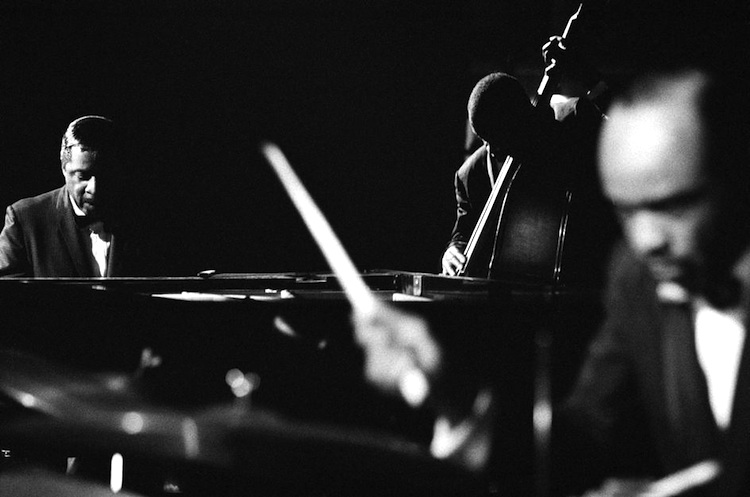
Jazz great Errol Garner (left).

Brady talks to a number of colleagues and experts with both musical credibility and name recognition, including Jamal, Allen, the other Allen (Woody), former Garner sideman Ernest McCarty, and Dick Hyman. More importantly, Brady has confidence in his subject, letting clips of Garner in action play for considerable lengths of time. That is the good stuff, after all.

Granted, Read never reinvents the jazz documentary, but who really wants that anyway? Brisk and entertaining, the hour-long Erroll Garner: No One Can Hear You Read is recommended for jazz lovers and general audiences as an introduction to the man and his music. It is now available for home viewing from First Run Features.

LFM GRADE: B

Posted on April 10th, 2013 at 12:35pm.

Super Wuxia Cops: LFM Reviews The Four, Now on DVD/Blu-ray

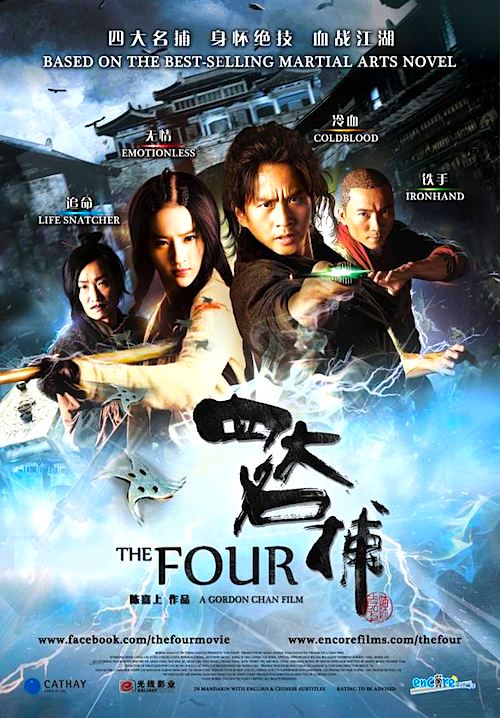
By Joe Bendel. Yes, they have exotic super-powers, but they really just have massive chi. They are members of the Divine Constabulary, tasked with fighting crime during the late Song Dynasty. Unfortunately, their more conventional colleagues in Department Six are less than thrilled to have them as competitors. There is also a super-villain to contend with in Gordon Chan & Janet Chun’s The Four (see clip here), which releases on DVD and Blu-ray today from Well Go USA.

Although based on a series of popular 1970’s novels, The Four will not escape comparison to the X-Men, especially considering the wheelchair-bound Emotionless’s Professor X-like psychic abilities. However, she is not running the show. The Divine Constabulary loyally follows her adoptive father, Zhuge Zhengwo, who reports directly to the Emperor.

Emotionless guides their inquiries and Iron Hands, a flesh-and-blood Colossus, works in the field, tapping into his network of underground contacts. He needs some back-up though, so Zhuge recruits Life Snatcher, a preternaturally spry debt-collector, and the lycanthropic Cold Blood, a former member of Department Six. One of many characters playing a double game, Cold Blood is actually working as an inside informer for Department Six’s head, the Sheriff King. Constable Ji Yaohua is supposed to be his back-up, but she is actually a mole planted by the evil mastermind An Shigeng (a.k.a. the God of Wealth).

Liu Yifei in "The Four."

The Four starts with a counterfeiting investigation, quickly escalating into a geopolitical conspiracy and eventually presents viewers an army of risen zombies. Instead of cheap scares, the latter are employed as shambling grist for the Four’s martial arts mill. This is definitely a kitchen sink movie, not particularly concerned about narrative detail. At one point, An Shiqeng tells Ji: “You can spend the rest of your life trying, but you’ll never guess what I’m up to.” Well, thanks for the warning.

Indeed, part of the charm of The Four is how wildly overstuffed it is with wuxia superhero steampunk elements. Action director Ku Huan delivers some gravity defying smackdown spectacle, relying more on leaping and kicking than chi-fireballs. Already the subject of several Mainland and HK television series, The Four was a couldn’t miss box office hit in China with sequels already announced. The superstar cast did not hurt either.

Anthony Wong does his Obiwan thing as Zhuge—and it is still kind of awesome. [Crystal] Liu Yifei and Jiang Yiyan (who look a bit like sisters, which is a blessing for them both) burn up the screen as Emotionless and Constable Ji, knowing rivals in both the machinations afoot – and for the affections of the brooding Cold Blood. For Jiang (who made such an impression with relatively little screen time in The Bullet Vanishes), it is a real star-making turn as the ruthless yet sensitive femme fatale.

Featuring zombies, uncanny martial arts, and a wonderfully ambiguous villainess, The Four has just about everything one could ask of a big popcorn movie. Wildly confusing fun, The Four is recommended for martial arts and superhero genre fans.  It is now available for home viewing from Well Go USA.

LFM GRADE: B

Posted on April 10th, 2013 at 12:34pm.

Skate or Die in East Germany: LFM Reviews This Ain’t California

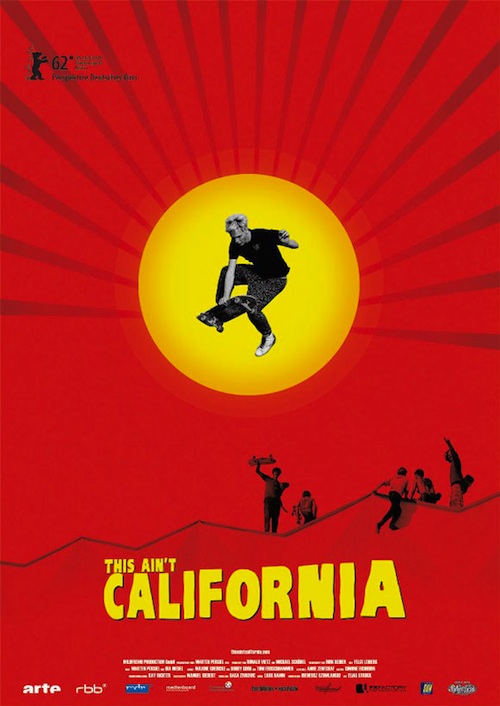
By Joe Bendel. The architecture of East Berlin was a crime against art. Yet, for skateboarders, all that monstrous concrete was practically a workers’ paradise. The East German skater subculture gets the full documentary treatment and then some in Marten Persiel’s This Ain’t California, which opens this Friday in New York.

Athletics were a big deal in the GDR, but a scruffy skateboarder like Denis “Panik” Paraceck was nobody’s idea of a Katarina Witt. He was supposed to be an Olympic swimmer, but his rebellious nature and flair for daredevil stunts drew him to the skater scene. Although the Stasi constantly spied on Paraceck and his cronies, the East German sports bureaucracy eventually tried to co-opt the movement when they discovered the burgeoning sport had its own circuit of international competitions. It seems Paraceck initially tried to play ball, but he quickly chafed under their authority. However, there is also a strong likelihood he never existed in the first place.

While TAC is structured as an elegy to Paraceck, a little digging raised serious questions about the film’s cross-its-heart-and-swear-to-die veracity. Evidently, Persiel now uses the term “documentary tale” and speaks of the broadening meaning for the genre. This is not an isolated case. After garnering considerable festival attention, Michal Marczak admitted At the Edge of Russia was kind of, you know, staged. (Considering I noted how surprising it was Russia granted a Polish filmmaker access to a remote military base as well as the cinematic look of his subjects, I would argue my review holds up pretty well in retrospect).

Regardless, the underground East German skater community is an established fact. It seems safe to assume they were on the business end of Stasi surveillance and the PR conscious Party probably did try to recruit them for propaganda purposes. As for the rest of TAC, you tell me.

In fact, some of the animated interludes are obviously intended to instill a fable-like vibe. Had Paraceck really burned down the GDR’s skater training facilities, it is doubtful he would have lived to see unification. Rather, Paraceck functions as a scapegoat-like creation myth of unification. Supposedly locked in a Stasi prison cell when the wall came down, he missed all the festivities. By the time he was released, Persiel and their cohorts had already moved on with their unified lives, leaving him behind.

There is definitely a measure of truth to TAC, but it is a fair question to ask how much. If nothing else, Persiel captures the milieu of the GDR era. Paraceck or those for whom he serves as a composite did not want to become political activists. Nonetheless, they became de-facto dissidents simply by careening about atop a small board with wheels. Visually striking, TAC combines talking head reminiscences, stark animated sequences, and some impressive archival skating footage (that may well have been recreated by Persiel and a cast of contemporary skaters). Recommended for those fascinated by the failed Communist experience (but as what I have no idea), This Ain’t California opens this Friday (4/12) in New York at the Maysles Institute Cinema.

LFM GRADE: B

Posted on April 8th, 2013 at 9:11am.

Surviving the Siege of Sarajevo: LFM Reviews 1395 Days without Red

By Joe Bendel. In an inspiring example of artistic resiliency, the Sarajevo Symphony Orchestra maintained their public performance schedule throughout the Bosnian War. Of course, getting to and from their concerts was often the most difficult part of the show, particularly for those traveling through “Snipers’ Alley.” The day-to-day life-and-death experience of pedestrians during the Siege of Sarajevo is recreated in Šejla Kamerić’s 1395 Days with Red, which screens this Thursday as part of Disappearing Act V.

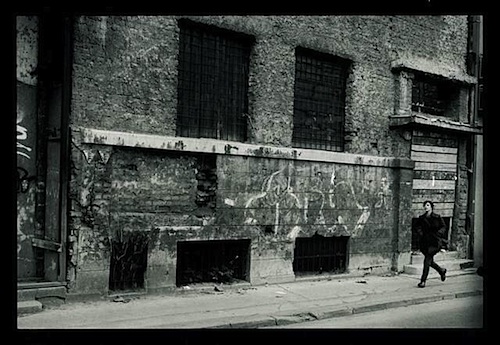
Originally conceived in collaboration with Albanian artist Anri Sala, the 1395 Days project resulted in two like-titled films. This is Kamerić’s, which is somewhat longer and features a little art-house star power. Maribel Verdu, the wicked stepmother of Blancanieves, appears as a woman trying to get from point A to point B. She seems to be walking through the peaceful (but still war-scarred) Bosnia of today, but she and those around her act as they did during the Siege. That means they avoid wearing bright colors and run for all their worth at each intersection. Her long walk is accompanied by the Sarajevo Orchestra rehearsing Tchaikovsky’s Symphony No. 6, Pathétique.

Essentially, Kamerić’s 1395 Days (the length of the Siege) is experimental, non-narrative filmmaking, but it represents the most accessible tip of the genre. There is a real point to the film, but it is not didactic or obtuse. Viewers can easily grasp what it has to say about the lingering post-traumatic stress of the Siege as well as the healing power of music. Indeed, the city’s Orchestra and the choice of the stirring but not overplayed Tchaikovsky symphony are quite powerful.

From "1395 Days without Red."

Likewise, Kamerić and cinematographer Patrick Ghiringhelli (ironically shooting with Red digital) create some striking visuals, well capturing the damage that continues to mar Sarajevo. Verdu also gives another silent but potent performance as the woman. We can see her body tense whenever she passes an intimidating looking man on the street, while her eyes speak volumes about the resolve required simply to cross a street during the siege.

However, 1395 might have benefited from a mild injection of narrative, such as establishing where she is coming from. Is it from work? If so, we can double her trek for a full day and then multiple by the 1,395 days, backing out weekends and days the fighting was too intense to leave home, thereby approximating the cumulative terror of the Siege.

1395 demonstrates how much the right music can add to a film. As a result, it is not a bad starter candidate for someone looking to dip a toe into experimental cinema. Nonetheless, 1395 Days without Red is only recommended for those who know they will be receptive to its aesthetic nature. It screens this Thursday (4/11) at Bohemia National Hall on the Upper Eastside. Films also screening during Disappearing Act V enthusiastically recommended for wider audiences specifically include the richly mysterious interconnected German trilogy Dreileben, which will screen the following Thursday (4/18) at the IFC Center, and Wojciech Smarzowski’s gritty and haunting post-war drama Rose (featuring Spies of Warsaw co-star Marcin Dorociński) screening at MoMI the following night (4/19).

LFM GRADE: B-

Posted on April 9th, 2013 at 9:10am.

LFM Reviews Ken Loach’s The Angel’s Share

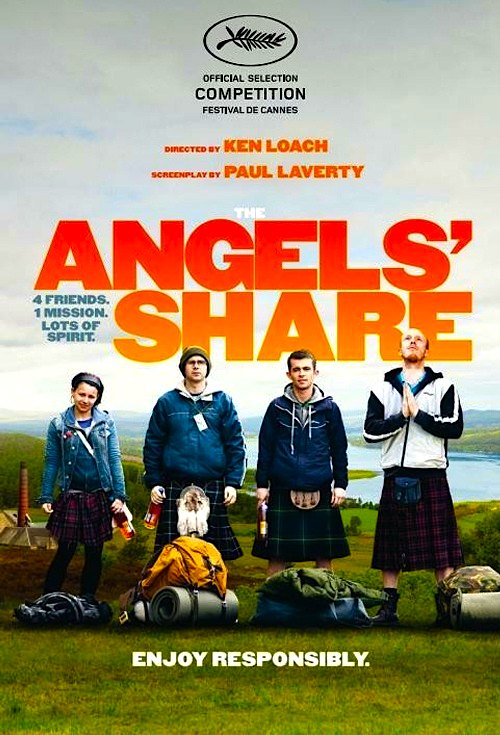
By Joe Bendel. You can always count on distillers for a lyrical turn of phrase. In their parlance, the vintage whiskey lost in the barrel to evaporation is called the “Angels’ share.” It is hard to anticipate how much those angels will partake. This opens the door for an unlikely scheme in Ken Loach’s working class comedy The Angels’ Share, which opens this Friday in New York.

Robbie has a temper and a pregnant girl friend. The former almost gets him sent to prison, but the latter helps keep him out. Sentenced to community service, Robbie falls under the supervision of Harry, an understanding middle-aged volunteer. Through Harry’s friendship, Robbie discovers he has a nose, if not necessarily a taste for fine malt whiskey. He also learns of an upcoming auction of one of the rarest vintages ever distilled in Scotland. With the dubious assistance of three losers from his community service, Robbie intends to nick a bit of the angels’ share.

The widely accessible Share follows in the tradition of Loach’s Looking for Eric. It is a crowd-pleasing comedy, but it remains faithful to the filmmaker’s proletarian aesthetic. Indeed, Loach takes his time, establishing his characters and their lack of prospects before launching into the caper. Yet, it is nowhere near as didactic as his socialist social issues dramas, which is a major reason why Share is so much more entertaining.

While looking the part of a troubled young man, Paul Brannigan has genuine screen presence as Robbie. The audience can sense there is a real fire within him, in both good and bad ways. John Henshaw is also quite appealingly down-to-earth and humane as Harry. Veteran character actor Roger Allam (recognizable from Endeavour, The Thick of It, and Parade’s End) adds a welcome splash of roguish sophistication as the mysterious whiskey broker, Thaddeus. Unfortunately, Robbie’s three co-conspirators largely come across like recycled stock characters from previous Loach films, but even at their most exaggerated, they cannot undermine the film’s charm.

The stakes are considerable and the milieu is rather grim throughout Share. Yet, it is an enormously satisfying, perfectly titled film. A “feel good movie” does not adequately describe it. “Feel giddy” comes closer. Naturalistic yet uplifting and consistently funny, The Angels’ Share is enthusiastically recommended for general audiences even more than for Loach’s usual admirers when it opens this Friday (4/12) in New York at the Lincoln Plaza Cinema.

LFM GRADE: A-

Posted on April 9th, 2013 at 9:09am.