LFM Reviews The Institute @ The 2013 Slamdance Film Festival

By Joe Bendel. What’s more fun than global conspiracy? If you ask former “inductees” of the Jejune Institute, you will likely get radically different responses. It seems it was all just a game, or was it? Indeed, truth is deliberately difficult to separate from fiction in Spencer McCall’s ostensive documentary The Institute, which screens during the 2013 Slamdance Film Festival in Park City.

Once upon a time, in 2008 to be exact, some strange leaflets began appearing around San Francisco—strange even by that city’s standards. The Jejune Institute was trumpeting its revolutionary scientific breakthroughs, like the personal force field, and inviting interested parties to inquire at their local offices. It turns out the Jejune Institute was headquartered in the heart of San Francisco’s glass-and-steel financial district. However, the office was nothing like Bank of America’s. Visitors were directed to a trippily appointed room, where they watched a video greeting from Jejune founder Octavio Coleman, Esq.
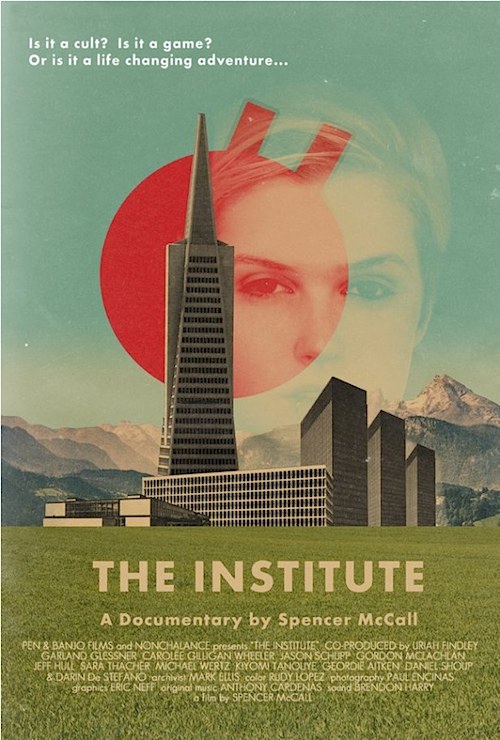
After a mind-bending intro to some of the basic Jejune buzz-words, inductees were sent on a scavenger hunt throughout the city, finding secret signs and clues amid the urban environment. Before long, inductees found themselves aligned with a rival faction seeking to liberate the power of “nonchalance” (the rough Jejune equivalent of The Force) from the megalomaniacal Coleman. Or something like that.

The thing is, it was all just a game, engineered by a conceptual artist to foster a sense of play in the city. Yet as soon as the behind-the-scenes architects come clean, McCall introduces a former player, whose tales of misadventures in the Bay Area sewers have to be part of the mythology. I mean, seriously.

Reportedly, McCall was brought in to document the final stages of the game and recognized a doc-worthy story when he saw one. By the same token, it seems safe to assume he is to some extent an accomplice to the mythmaking. There are enough digital tracks to suggest that the Jejune Instituters truly were running an Alternate Reality Game (ARG) that some players took very seriously. As for everything else in the film, maintain a healthy skepticism.

The thing of it is, the Jejune mythology is a great story. McCall taps into our deep, abiding interest in secret histories, conspiracy theories, and urban legends, as well as our fear of cults. For scores of players, the ARG was like submerging themselves in an Illuminatus! novel. Yes, some of them might have become obsessed to an unhealthy degree, but they might also be playing the parts.

While openly inviting comparison to Exit Through the Gift Shop, The Institute will appeal to viewers who enjoyed Resurrect Dead: The Mystery of the Toynbee Tiles. It might be strange and unreliable, but it is never dull. Recommended for those who appreciate postmodern fables, The Institute screens again tomorrow morning (1/22) at Treasure Mountain Inn, as part of this year’s Slamdance.

LFM GRADE: B+

Posted on January 21st, 2012 at 9:53pm.

A Call to Action: LFM Reviews Pussy Riot: A Punk Prayer @ The Sundance Film Festival

Nadezhda Tolokonnikova of the Russian girl-punk band Pussy Riot.

By Joe Bendel. Nadezhda Tolokonnikova is currently in prison for protesting the collusion between church and state. She also has a long history of demonstrating on behalf of women’s issues. One would think her face would be on countless hipsters’ t-shirts. Given her supermodel looks, her likeness would certainly be more appealing than ugly old Che. However, Tolokonnikova and the other members of her punk rock band were objecting to the authoritarian Putin regime’s increasingly brazen abuses of power. It might not interest professional activists in the West, but their ongoing plight is as dramatic as true stories get. The persecution of Russia’s most famous underground band is documented in Mike Lerner & Maxim Pozdorovkin’s Pussy Riot—A Punk Prayer, which screens during the 2013 Sundance Film Festival in Park City.

Sort of like a real world version of the musical tricksters seen in Simonsson & Nilsson’s films, the balaclava-donning Pussy Riot specialized in provocative, unannounced public performances. Critical of both the Putin regime and traditional Russian patriarchal (or chauvinistic) attitudes, their lyrics have always been pointedly political. While they certainly ruffled some feathers before, Pussy Riot’s decision to crash Moscow’s Cathedral of Christ the Savior was admittedly a profound miscalculation.

The Russian girl-punk band Pussy Riot.

While the thirty second performance was intended as a political commentary on the open alliance between the Russian Orthodox Church and Putin’s government, the resulting outrage amongst the faithful allowed prosecutors to come down on the band with the full force of the state. Soon thereafter, Tolokonnikova, Maria Alyokhina, and Yekaterina Samutsevich were behind bars, facing trial on vaguely defined charges.

The reasonably well informed should know the broad strokes of the regime’s campaign against Pussy Riot, but Lerner & Pozdorovkin give viewers a look beneath their brightly colored hoods. Over the course of the doc, the audience learns that the three imprisoned musicians are deeply steeped in the contemporary art scene and earnestly committed to causes like environmentalism and democratic reform. Far from being the maladjusted delinquents of state-sponsored propaganda, they are profoundly influenced by supportive, well educated fathers, who are quite compelling during their on-camera interview segments.

Sadly, Pussy Riot will not be performing at Sundance’s ASCAP Music Café. Although the story is still developing, Tolokonnikova and Alyokhina still remain behind bars. Indeed, Lerner & Pozdorovkin illuminate the twists and turns of the case quite well, while eschewing voice-over narration. Frightening and infuriating, Pussy Riot—A Punk Prayer is arguably the most important film selected at this year’s Sundance. It is very highly recommended when it screens again today (1/20), Wednesday (1/23), and Thursday (1/24) in Park City. However, it should also be a call for action. For starters, every Russian filmmaker who attends a western film festival should be asked to comment, as a fellow artist, on Tolokonnikova and Alyokhina’s continued imprisonment.

LFM GRADE: A+

Posted on January 20th, 2012 at 4:41pm.

LFM Reviews The Summit @ The Sundance Film Festival

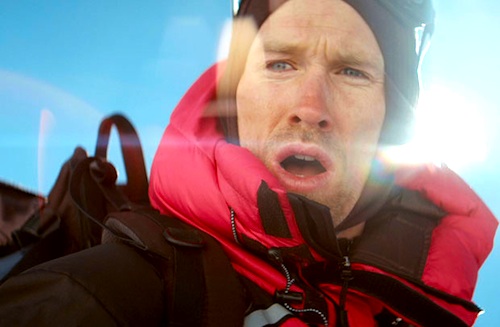
By Joe Bendel. For climbers, the math surrounding K2 is daunting. Twenty-five percent of those who reach the summit perish on the way down. It is a factor of altitude plus exhaustion. Nevertheless, the mortality rate for the international expedition scaling the mountain in August of 2008 was unusually high. While the sudden blizzard and subsequent avalanches obviously cost the climbing party dearly, many of the details of what transpired up there remain murky. It is a mystery that survivors and loved ones try to resolve in Nick Ryan’s The Summit (trailer here), which screens during the 2013 Sundance Film Festival in Park City.

Out of the twenty-four who ascended K2 that fateful day, eleven never made it back. That is forty-four percent—or sixty one percent of the eighteen who reached the so-called “death zone.” Gerald (Ger) McConnel became the first Irishman to summit K2. However, his ultimate fate is the driving question of Ryan’s documentary.

From "The Summit."

The tragic 2008 climb was not the first controversy surrounding K2. In fact, there was quite a bit of back-biting and finger-pointing after the first successful summitting. Esteemed Italian mountaineer Walter Bonatti never received proper credit for his contributions that allowed his countrymen to stake their claim for glory. Viewers learn this from journalist Concetto La Malfa, who intermittently tells the tale in the persona of Bonatti. Actually, that is not very clearly established in Summit, which is problematic for a documentary – but good golly what a rich voice he’s got.

Despite the flashing backwards and forwards, Summit keeps the audience riveted throughout. Incorporating home videos and footage shot during the climb, as well as staging some surprisingly cinematic dramatic re-enactments, Ryan conveys the personalities of most of the party members, often through their own words. This also increases the suspense as the mountain takes the ill-fated eleven one by one, And Then There Were None-style.

Visually arresting (with ample credit due to cinematographers Robbie Ryan and Stephen O’Reilly, as well as the climbers themselves), The Summit is a perfect doc for viewers who prefer narratives. It is about as story-driven as films get. Ryan’s documentary vividly captures a sense of the punishing Karakoram-Himalayan environment as well as the spirit of adventure that draws people to it. Enthusiastically recommended, The Summit screens today in Salt Lake (1/20), Wednesday (1/23) and Friday (1/25) in Park City, and Tuesday (1/22) in Sundance Resort as part of this year’s Sundance Film Festival.

LFM GRADE: A-

Posted on January 20th, 2012 at 4:39pm.

LFM Reviews Best Friends Forever @ The 2013 Slamdance Film Festival

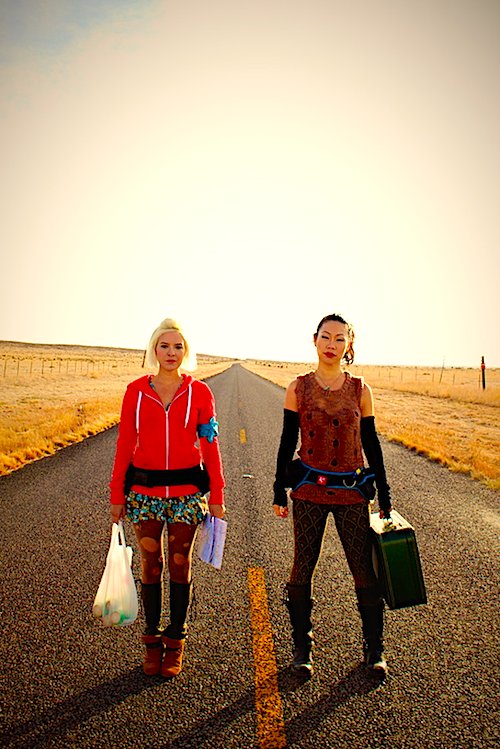
By Joe Bendel. When the apocalypse comes, books will definitely have an advantage over the internet. An aspiring grad student would agree. She was planning a career as a librarian. Unfortunately, the end of the world complicates matters. However, it takes a while for her and her hard partying BFF to notice Armageddon looming during their southwestern road trip in Brea Grant’s Best Friends Forever, which premiered last night in Park City at the 2013 Slamdance Film Festival.

Harriet is the sensitive one, who spent a short stint in a mental hospital following a suicide attempt. Following the long held tradition of low budget genre movies, her best pal Reba is kind of trampy. After graduation, Harriet packs up the AMC Pacer for grad school in Texas, convincing Reba to tag along for the ride. While they are on the road, a mysterious terrorist attack leads to a series of nuclear explosions. The two women are not listening to the news, though, preferring music and the occasional “Oprah” moment to reports from the outside world. Their first inkling something might be amiss comes when three hipsters carjack their Pacer.

From "Best Friends Forever."

Eventually, the breakdown of civilization strains their relationship. Of course, nobody is assigned responsibility for the cataclysmic act of terror, lest that offend anyone. In one awfully strange exchange, several characters want to blame North Korea, to which Reba replies that she is Chinese – as if the PRC were as benign as Luxemburg. Indeed, the third act threatens to undo much of the good will established by the co-leads, depicting a rather nasty nativist martial law sweeping across Texas.

Since Grant co-wrote and co-produced with her co-star Vera Miao, viewers are pretty much stuck with them as Harriet and Reba, respectively. Fortunately, they have some nice bickering buddy-buddy chemistry together. Still, this is clearly a genre film with a female audience in mind, casting men in exclusively either predatory or ineffectual roles. While Grant comes in with geek credentials from appearances in Heroes and Halloween 2, as well as her work co-writing the 1920’s zombie comic We Will Bury You with her brother Zane, neither of the two seems particularly comfortable with the odd action scene. Frankly, everyone in BFF would rather talk than do anything else, but the dialogue does not have the sort of snap it should.

Putting a Pacer in the center of an end-of-the-world road movie is pretty ingenious. Employing the apocalypse as a prism through which to examine personal and social relationships is also a promising strategy, yielding mixed results in this case. There are some appealing moments of friendship under extreme circumstance in BFF. Nonetheless, it never approaches the attitude or verve of Thom Eberhardt’s Night of the Comet, the gold standard for zeitgeisty generational Doomsday movies. More chick flick (deliberately referencing Thelma & Louise) than midnight movie, Best Friends Forever should satisfy those looking for the former, albeit with a bit of an edge. Flawed but interesting, it screens again at the Treasure Mountain Inn screening room this Monday (1/21) as part of this year’s Slamdance.

LFM GRADE: C+

Posted on January 20th, 2012 at 4:38pm.

LFM Reviews Fallen City @ The 2013 Sundance Film Festival

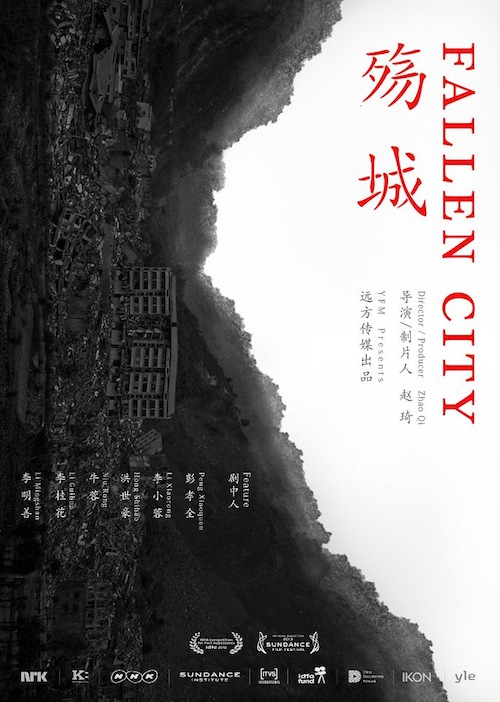
By Joe Bendel. When disaster strikes, government is there to step in and help, right? In today’s China, not necessarily. When the 2008 earthquake hit Sichuan, the town of Beichuan was simply leveled to the ground. Documentary producer turned director Zhao Qi records the ironies and indignities of the city’s rebuilding process in Fallen City, which screens during the 2013 Sundance Film Festival in Park City.

Once a community of 20,000 strong, the survivors of Beichuan now live in crude temporary housing as they await the shiny new city the state media breathlessly promises them. Each and every one of them grieves for multiple family members. Especially heartrending are the Pengs, who mourn their eleven year old daughter. Watching the inconsolable father pore over her drawings salvaged from their flat like holy relics is truly painful. They are not alone in their agony. The audience also sees in clear terms how the teenaged Hong’s behavioral issues are directly related to the loss of his father.

To add insult to injury, when the citizens of Beichuan seek traditional solace on the anniversary of the quake, the police physically prevent them from entering the “old city,” thereby undermining their attempts at closure through ritual. In fact, the disconnect between officialdom – as expressed by Orwellian newscasts – and reality is a theme running throughout Fallen.

In several ways, Fallen lets the government off the hook, scrupulously avoiding discussion of the so-called “Tofu Construction” causing the disproportionate collapse of school buildings, or the Party’s concerted efforts to prevent the release of an accurate death toll. Yet, the facts on the ground Zhao captures through his lens are impossible to miss. We see the media hypocrisy, institutionalized economic inequalities, and corrupt criminal justice system up close and personal.

Constantly documenting events since the 2008 disaster, Fallen represents a work of true documentary commitment from Zhao. Even those who think they have been de-sensitized by images of Hurricanes Katrina and Sandy will be staggered by the ghostly sight of old Beichuan. Nonetheless, it is the pictures and video of the children (negligently) killed during the quake that will really hit audiences in the gut. Powerful and profoundly troubling, Fallen City is highly recommended when it screens again this Monday (1/21), Wednesday (1/23), Friday (1/25), and next Saturday in Park City, as well as this Thursday (1/24) in Salt Lake as a World Cinema Documentary Competition selection of the 2013 Sundance Film Festival.

LFM GRADE: A-

Posted on January 19th, 2012 at 5:10pm.

LFM Reviews This is Martin Bonner @ The 2013 Sundance Film Festival

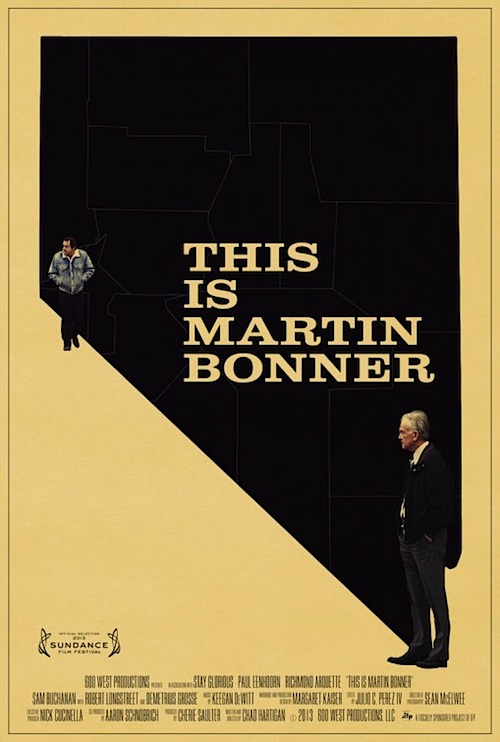
By Joe Bendel. It seems like the only job Martin Bonner can get involves doing the Lord’s work. He has decidedly mixed feelings about that. Yet, his own uncertainties make him a more accessible adviser for a remorseful ex-con in Chad Hartigan’s This is Martin Bonner, which screens during the 2013 Sundance Film Festival in Park City.

An Australian transplant in Reno, Martin Bonner is starting over. After a long period of unemployment, he now works for a Christian outreach program for recently released prison inmates. Technically, he is not Travis Holloway’s mentor, but he makes a tenuous connection when pinch-hitting for his assigned volunteer. It is not that Holloway does not like the devout Steve Helms – he is simply more comfortable with Bonner.

Bonner is a film that could have gone one way or another. We quickly learn Bonner was fired from his previous church job because of his divorce. However, Hartigan never really grinds that ax. Nor is the evangelical Helms presented in fanatical terms. Instead, the film could be called a study of questioned faith in action. Frankly, it offers some of the most mature and nuanced discussions of Christianity in everyday practice you are likely to see in any major film festival.

Paul Eenhoorn’s performance as Bonner is arguably Oscar caliber (unquestionably so, if Cooper and Jackman truly are so this year). This man is not a saint. He can even be a little prickly, but he is trying to do the right thing. Eenhoorn perfectly conveys that humanistic temporizing. Likewise, as Holloway, Richmond Arquette (yes, from the Arquette family) creates an unusually deep portrait of regret and pathos. In fact, the entire ensemble is small but powerful, especially including Sam Buchanan as Holloway’s estranged daughter Diana.

Bonner is a modest, quiet film, by any standard of measure. Yet it has moments of rare honesty. Aside from the scene of Bonner lip-synching to his teenaged garage band’s old 8-track (which feels a little too cute and calculated), Hartigan’s patience and sensitivity always pay-off with surprising interest. Recommended with a fair bit of enthusiasm for general audiences, This is Martin Bonner screens again Sunday (1/20), Tuesday (1/22), and Friday (1/25) in Park City and next Saturday (1/26) in Salt Lake, as part of the 2013 Sundance.

LFM GRADE: B+

Posted on January 19th, 2012 at 5:09pm.