Necks Don’t Get Much Redder Than This: LFM Reviews The Baytown Outlaws

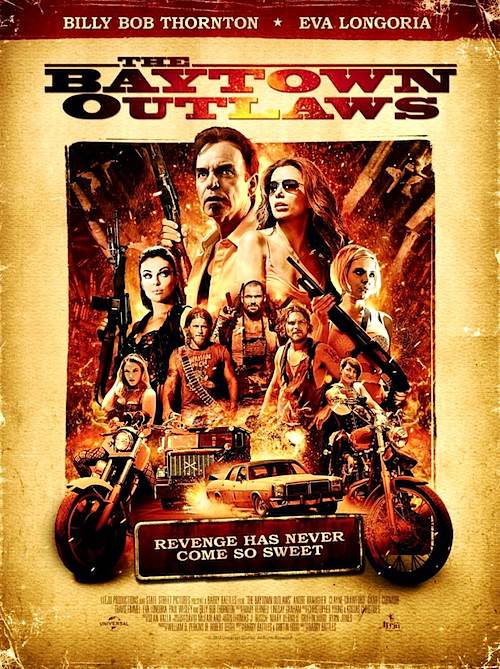
By Joe Bendel. Speak & Spells must have trouble with the word subtle, because the Oodie Brothers are clearly not familiar with it. It doesn’t seem to mean much to director-co-writer Barry Battles either, but he certainly knows his Skynyrd and how to stage an over-the-top shootout. Viewers are in store for plenty of redneck exploitation action when Battles’ The Baytown Outlaws (trailer here) opens this Friday in New York.

The Oodies are good at killing. Of course, it helps not having to worry about getting collared. They are the secret weapon of Sherriff Henry Millard, who turns the boys loose on every other deadbeat criminal in his county, thereby keeping the crime rate impressively low. As the film opens, they have made a minor mistake, wiping out the wrong house full of thugs. It is nothing Millard cannot cover-up, but there is a witness. Duly impressed, Celeste Martin and her Daisy Dukes hire the Oodie Brothers to whack her gangster ex-husband Carlos Lyman and safely return her godson, Rob. Complications and bodies ensue.

It turns out Rob is basically a human bearer bond. Presumably developmentally disabled and confined to a wheelchair, Rob will soon inherit a sizable trust fund, which will be controlled by his guardian. He is more than the Oodies bargained for. Nonetheless, they quickly warm to the lad in scenes that play like the Sons of Anarchy version of Savannah Smiles. Have no fear, sentimentality is not Baytown’s priority. Frankly, one gets the feeling the set erupted in laughter as soon as Battles yelled cut on the film’s big emotional scenes.

Baytown really bares its soul when five suggestively clad biker assassin babes tangle with the Oodies. Ranging somewhere between a Southern-fried indie and an outright midnight movie, Battles goes for defiantly violent laughs and gets almost as many as Django Unchained in about half the time.

This is no classic, but everyone is game, particularly Billy Bob Thornton, obviously enjoying every word of Lyman’s shamelessly politically incorrect dialogue. Although he never speaks a syllable (relying instead on said Speak & Spell), Daniel Cudmore (Colossus in the X-Men franchise) has a real physical presence as Lincoln Oodie. Clayne Crawford and Travis Fimmel also exhibit admirable energy as Brick and McQueen Oodie, respectively (but sometimes it is rather hard to tell them apart). Eva Longoria does not have much to do beyond wear her short shorts and shoot a few guns, but her performance as Martin still represents some of her best screen work, maybe ever.

Eschewing the faux vintage grindhouse look done to death in films like Hobo with a Shotgun, Battles keeps the meathead fodder snappy. The occasional animated snippets lend Baytown additional character. An entertaining guilty pleasure, The Baytown Outlaws is recommended for those who can appreciate its slightly sleazy charms when it opens this Friday (1/11) in New York at the Cinema Village.

LFM GRADE: B-

Posted on January 8th, 2012 at 11:13am.

Distilling The Soviet Experience: LFM Reviews How to Re-Establish a Vodka Empire @ New York Jewish Film Festival

By Joe Bendel. Who has a harder time adjusting to the capitalist system: a former Soviet republic or a documentary filmmaker? Needless to say, it is the latter, but he still has his mind set on importing Ukrainian vodka into the British marketplace. He feels a special connection to the distillery, because his family used to own it, up until the 1917 Revolution. Soviet, Ukrainian, and even Northern Irish history are explored from a decidedly personal perspective in Dan Edelstyn & Hilary Powell’s How to Re-Establish a Vodka Empire, which screens during the 2013 New York Jewish Film Festival, co-presented by the Jewish Museum and the Film Society of Lincoln Center.

Edelstyn knew little of his father’s side of the family, because he died when the filmmaker was quite young. His first real introduction to his Ukrainian heritage came through the letters and journals of his grandmother, Maroussia Zorokovich, shunted away in his mother’s attic. He discovered his grandmother was the progressive daughter of a well-to-do land-owning family. Regrettably, all her efforts teaching the local peasantry to read and write meant little to the conquering Bolsheviks.

Zorokovich’s story is truly remarkable, including stints entertaining the White resistance forces as a dancer, which is how she met Edelstyn’s grandfather. From her diaries, Edelstyn gleaned a sense of the family’s house and sugar factory. Drawn to his roots, Edelstyn was disappointed to find them in a state of disrepair and off-limits. However, he discovered another family holding that was still up and running—a vodka distillery.

Zorokovich never mentioned the family vodka empire, but with good reason Edelstyn presumes. Communist propaganda often demonized Jewish Russians as predatory purveyors of alcohol, constantly tempting the stolid peasants into drunkenness. It would be a lot easier for the Jewish Zorokoviches to identify themselves with the sugar plant rather than with a booze pipeline.

Disurbed by the town’s economic stagnation in the wake of the sugar factory’s closure, Edelstyn takes it upon himself to become the vodka company’s British agent. Of course, he knows nothing about importing spirits, but how hard can it be?

Edelstyn might be ridiculously naïve throughout Empire, but his instincts on how to help his ancestral Ukrainian home are surprisingly on-target. It is too bad he and his wife Powell were the ones behind the camera, though, because there was probably considerably more comedy to be mined from his attempts to navigate British customs bureaucracy.

As a result, probably the strongest sequences involve Grandmother Zorokovich. Blending various styles of animation with family heirloom photos, Edelstyn & Powell craft some Guy Maddinesque dramatic recreations of Zorokovich’s life. To their credit, they bring home the fear and arbitrary violence of Lenin’s reign of terror (yes, Lenin’s – not that of the subsequent tyrant, Stalin) with full force, as well as chronicle the Zorokovich’s complicated years in Belfast. It is an epic story to which they do justice.

While Edelstyn undeniably went out on a limb on behalf of the former family vodka company, there is still an awful lot of him in Empire. He is not a bad chap at all, but he is not exactly a riveting cinematic presence.Regardless, How to Re-Establish a Vodka Empire documents a fascinating intersection of commercial, political, religious, and family history that goes down rather smoothly.

It is preceded by Jack Feldstein’s brief but powerful Shards. An expressionistic, almost abstract representation of Peretz Markish’s similarly titled poem, Feldstein’s neon-animated short film serves as a stark elegy to the poet and to the other twelve Yiddish writers murdered by Stalin’s minions of terror in 1952. While only two minutes long, it powerfully conveys the essence of the Soviet experience. Both films are highly recommended when they screen this Thursday (1/10) and Saturday (1/12) as the 2013 NYJFF gets underway at the Walter Reade Theater.

LFM GRADE: A-

Posted on January 7th, 2012 at 1:56pm.

Bohemian Noir: LFM Reviews Beijing Flickers

By Joe Bendel. Like a put-upon Kafka character, San Bao has lost his voice. Life in go-go Beijing has not been kind to him. In relatively short succession, he lost his girlfriend, his dog, and his apartment. He really is not in the mood to talk, even as he silently forges unlikely new relationships. However, Zhang Yuan has plenty to say about the state of contemporary China in Beijing Flickers, which opens the 2013 Global Lens film series, once again launching in New York at MoMA, this Thursday.

It is hard to say whether getting dumped hurts more than his dog running away. And while it means little to him emotionally, San Bao’s eviction leads to the immediate issue of homelessness. He sort-of kind-of solves the problem short-term, by chomping down on a glass during a drunken bender. Of course, that also leads to hospital bills. Ironically, this turns out to be a good thing. The bar’s singer, You Zi, held onto his cell phone for safekeeping. When reclaiming it, he is struck by her ethereal voice and beauty. Somehow, a circle of friends develops around the two psueudo-lovers, incorporating her roommates – San Bao’s buddy from home, and the female impersonator with whom he is crashing.

Although not a musical per se, Flickers is like a Chinese version of Rent, in which dispossessed and Bohemian Beijingers band together to face the trials and tribulations of a highly stratified society. Much like his thematically similar Beijing Bastards, Zhang also includes plenty of music, including You Zi’s haunting signature number, further supporting the comparison.

Li Xinyun lights up the screen as You Zi.

It is doubtful very many Brooklyn hipsters could cut it in Zhang’s Beijing. On one hand, this is a predatory system of have’s callously exploiting the have-not’s. Yet, it is also a lawless environment, where the slightly less than stable San Bao periodically lashes out physically, with little fear of repercussions. It is like the worst of both worlds.

Granted, Flickers might sound grim (okay, it is grim), but Li Xinyun truly lights up the screen as You Zi. In addition to her distinctive look and sound, she brings dignified resiliency to the alt-torch-singer, rather than overly cute pluckiness. While she has far less screen time than the rest of the principals, Han Wenwen is also quite powerful as You Zi’s roommate Su Mo, giving the audience a bracing slap during the film’s one big jaw-dropper scene. As the more-silent-than-strong San Bao, Duan Bowen lends the film commendable cohesion, interacting with each member of the large ensemble with subtly different shades of either fierceness or sensitivity.

Although Zhang’s recent films have clearly been more pleasing to China’s popular audiences and government authorities, Flickers is very much a return to his in-your-face Bastards roots. Yet, the noir-ish style and seductive soundtrack make it a considerably more polished viewing experience. Basically, that is a win-win combo. Enthusiastically recommended for China watchers and aspiring bohemians, Beijing Flickers begins a week long run at MoMA this Thursday (1/10) as the opening selection of the year’s Global Lens (which also includes the highly notable Cairo 678).

LFM GRADE: A

Posted on January 7th, 2012 at 1:53pm.

LFM Reviews The Ballad of the Weeping Spring @ The New York Jewish Film Festival

By Joe Bendel. Musicians hate requests. Yosef Tawila is particularly disinclined, but he cannot refuse the dying wish of his former friend and band-mate. However, he will have to recruit some high caliber Mizrahi musicians to play the ambitious title symphony and time is running short in Beni Torati’s The Ballad of the Weeping Spring, which screens during the 2013 New York Jewish Film Festival, co-presented by the Jewish Museum and the Film Society of Lincoln Center.

Tawila has not touched his guitar since his glory days in the Turquoise Ensemble. Riddled with guilt, he is not a man who wants to be found. Nonetheless, Amram Mufradi tracks him down, bearing the Weeping Spring score. His father Avram is quickly succumbing to lung cancer and wishes to finally hear the extended composition he co-wrote with Tawila, as it was meant to be performed.

Unfortunately, Tawila cannot simply get the old band together again. Two members died in a car crash he was found responsible for. Their singer Margaret is now confined to a wheel chair, but she passed on her talent to Tamara, the daughter Tawila never knew. That is a hard recruiting stop for the absentee father to make, but Mufradi and the young singer hit it off rather well. For the rest of the band, it just a matter of haunting the right dive bars and red light districts. In one case, they will have trouble with a blind flutist’s Fagin, but people just seem to want to help the Tawila level his karma.

From "Ballad of the Weeping Spring."

While not essential for cineastes, Weeping Spring could easily be the biggest hit at this year’s NYJFF. There is plenty of camaraderie, redemption, and some elegant music, but Toraty never excessively milks the sentiment. In fact, the father-daughter rapprochement is surprisingly matter-of-fact and the attraction between the second generation Turquoise musicians is mostly hinted at. Of course, it ends with a big emotional concert, but again Toraty resists overplaying his hand.

Looking like the weight of the world rests on his shoulders, Uri Gavriel (the blind prisoner of the pit in The Dark Knight Rises) has gravitas to spare as Tawila. Established Israeli pop-star Ishtar displays a warm cinematic presence as Margaret and her voice nearly steals the entire show during the big climatic concert. For the most part, the large supporting cast of actor-musicians look appropriately colorful and slightly seedy, except for Dudu Tassa (seen during last year’s festival in Iraq ‘n’ Roll), here very earnest and clean-cut as young Mufradi.

While dubbed a Mizrahi Magnificent Seven, Weeping Spring actually includes an obvious riff on Marion Ravenwood’s drinking contest from Raiders of the Lost Ark, so it has that going for it. A modest but appealing drama with a striking soundtrack, Ballad of the Weeping Spring should have a long and fruitful life on the festival circuit and in specialty distribution. Sure to be a crowd pleaser, it screens this Saturday (1/12) and Thursday (1/24) at the Walter Reade Theater as part of this year’s NYJFF.

LFM GRADE: B

Posted on January 7th, 2012 at 1:51pm.

Sentimental Journey: LFM Reviews John Turturro’s Rehearsal for a Sicilian Tragedy, Now on DVD

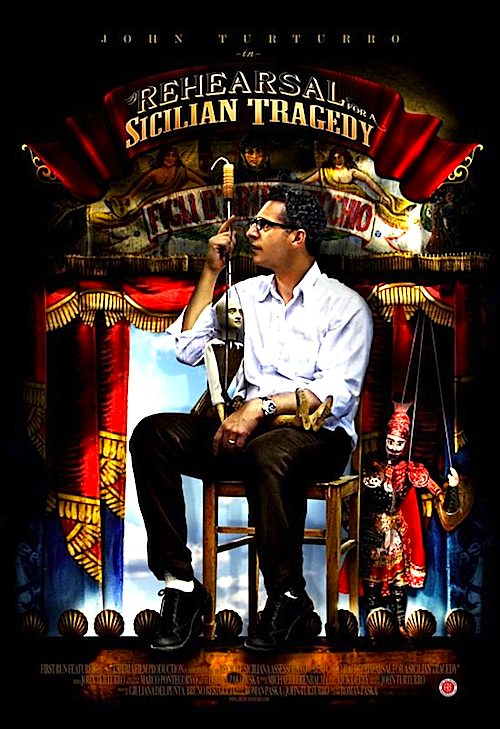
By Joe Bendel. They know something about rivalry in Sicily. For years, Orlando and Rinaldo have both vied for the affections of Angelica in Sicily’s puppet theaters. It is a tradition that partly inspires Italian-American actor John Turturro’s return to his ancestral roots. Puppeteer-filmmaker Roman Paska documents Turturro’s combination sentimental journey and spec research tour in Rehearsal for a Sicilian Tragedy. Now available on DVD from First Run Features, Paska’s film also kicks off the Winter 2013 season of Stranger Than Fiction this coming Tuesday at the IFC Center.

The first generation Turturro has an understandable affinity with his family’s homeland. Off and on, he has developed a project about a traditional Sicilian puppeteer, finding a mentor in Mimmo Cuticchio, who is widely considered the greatest living practitioner of the art (and can also be seen in a straight acting role in the forthcoming Terraferma). While Turturro’s prospective film has yet to come to fruition, he will indeed collaborate with Cuticchio on a production of Orlando’s tragic story.

Paska makes his wandering focus a virtue, leisurely alternating between Cuticchio’s Opera deo Pupi, Turturro’s emotional pilgrimage to sites of great family significance, dramatic readings, and talking head interviews on Sicilian culture. Not what you might call a tight film, it is rather pleasantly discursive. As a result, one gets an impressionist sense of the region’s rhythms and eccentricities instead of an information dump of names and dates.

Cuticchio and his pupi are ridiculously cinematic. Paska simply cannot miss when he has them in a scene. Likewise, Turturro comes across as a mostly likable, down to earth fellow, in touch with his familial legacy. Even scholar Gioacchino Lanza Tomasi looks interesting on camera, making some intriguing points on the shifting roles the Day of the Dead and Christmas have played in Sicilian culture.

Unhurried and disorganized in appropriately enjoyable ways, Rehearsal’s spirit fits its subjects. It offers considerable insights into art and tradition, capturing a few surprisingly touching moments along the way. Warmly recommended for fans of Italian cinema and puppetry, Rehearsal for a Sicilian Tragedy is now available on DVD and screens in New York this coming Tuesday (1/8) at the IFC Center, with both Turturro and Paska scheduled to participate in a Q&A.

LFM GRADE: B+

Posted on December 4th, 2012 at 12:41pm.

Andy Garcia Knows It’s Out There: LFM Reviews A Dark Truth

By Joe Bendel. Jack Begosian went from cover-ups to bottom-feeding. The former CIA agent now hosts a conspiracy theory driven radio program in Toronto. He claims the new gig eases his conscience. However, he will have the opportunity to atone for past sins with more direct action in Damian Lee’s A Dark Truth, which opens in Miami today.

To be fair, Begosian is not trafficking in space alien rumors, but he gets plenty of those calls on his late night talk show. Although his backstory is never fully spelled out, Begosian left the Agency under scandalous circumstances. A Congressional hearing was involved. Trying to live quietly with his frustrated wife and emotionally withdrawn son, Begosian is not looking for freelance gigs. Nevertheless, one comes his way.

Heiress Morgan Swinton suspects Clearbec, her family’s industrial water filtration company, is up to no good in Ecuador. She needs an independent hardnose to go down there and check things out. For Begosian, it represents karma coming full circle. According to reports, environmental activist Francisco Francis has incriminating evidence on Clearbec. That would be the same Francis who served time in a rather unpleasant Latin American prison thanks to Begosian’s behind-the-scenes maneuvering. Now his assignment is to get Francis and his wife safely out of the country and into a courtroom, despite the efforts of the Ecuadoran military and Clearbec’s enforcers.

Dark Truth largely recycles Hollywood’s standard issue corporate villainy plot, but Lee’s screenplay is less morally simplistic, portraying the culpable Swinton brother in relatively sympathetic terms. Yet, it is Andy Garcia who truly dominates the film as Begosian. He still has plenty of credibility in the adequately staged action scenes and brings the appropriate gravitas for Begosian’s “that’s the way it is” radio pronouncements.

Garcia is still one bad cat and so is Kevin Durand, who is coolly hardboiled as the unpredictable hitman, Torrance “Tor” Mashinter. Unfortunately, Forest Whitaker and Eva Longoria do not fare so well as the Francises, awkwardly trying to look noble as they scramble through the jungle. In contrast, Kim Coates makes an intriguingly human villain, nicely conveying Bruce Swinton’s guilt and desperation.

Lee, whose credits including producing Death Wish V, is not exactly a distinctive visual stylist, but if you’re filming a difficult scene in the Dominican rain forest, he can probably be relied on to get it in the can quickly. He also delivers some pretty good work from his cast, most notably Garcia, Durand, and Coates. An okay diversion on a commercial flight or as a VOD time killer, A Dark Truth is really just recommended for Garcia’s biggest fans. Conveniently, it begins its theatrical run at the O Cinema in Miami (where a fair number of them probably are) today (1/4), expanding to Lake Worth the following week. For New Yorkers, it is already available on-demand.

LFM GRADE: C+

Posted on December 4th, 2012 at 12:39pm.