Weaponized ESP Down Under: LFM Reviews Crawlspace

By Joe Bendel. In the 1980’s, the Soviets really did launch an ambitious “remote viewing” program, training psychic spies to watch and perhaps even read the American President’s mind. It is hard to imagine any hostile powers bothering with such efforts now, unless they had no other access to the latest news from ESPN. Nonetheless, the “technology” was taken seriously and it is about to blow up in the face of a clandestine Australian research institute, becoming the Macguffin of Justin Dix’s Crawlspace, which debuts on VOD and begins a series of midnight screenings at the IFC Center beginning today.

Echo Companies 1, 2, and 3 are approaching the double-secret Pine Gap facility buried beneath the Australian desert (where there are no pine trees). They have two missions: terminate the dangerous inmates let loose during a power failure and rescue the scientific personnel. It seems like it is a bad idea to combine a maximum security prison with a research lab, so maybe these prisoners are not whom they are billed to be. Oddly enough, one of them also appears to be the late wife of company leader Romeo, who apparently harbors a wee bit of guilt over her assumed death.
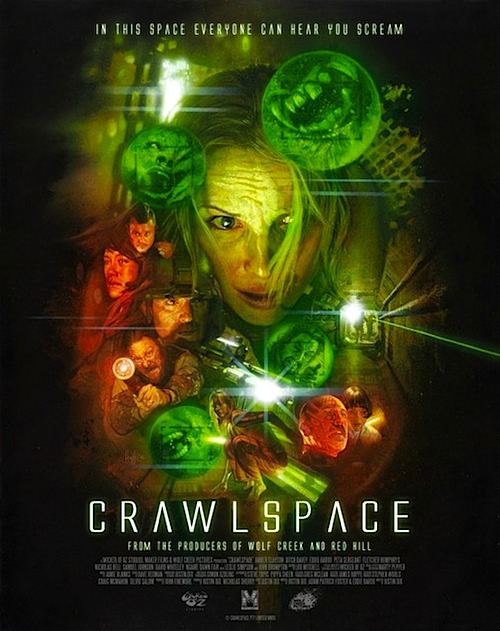
Much to his team’s surprise, Romeo goes rogue, deciding to protect E.V.E., as her wristband identifies her, rather than fulfill their mission objectives. This becomes particularly awkward when the monsters start attacking. It is not until they “rescue” a truly annoying group of scientists that the psychic battle unfolding around them is insufficiently explained. What does that make Eve? Dangerous.

The directorial debut of SFX artist Dix, Crawlspace liberally incorporates narrative elements from the original Alien and Solaris, but little of their artistry. It is long on atmosphere, though, taking viewers through air ducts, service tunnels, and all manner of passages requiring grown men to stoop. There are also several distinctively gruesome deaths for those who measure genre films by such standards.

Again, Crawlspace’s cast might not earn marks for distinction, but they get the job done. While not remarkably expressive, Ditch Davey (a name so awesome it must be Australian) is appropriately manly as Romeo. Strangely, both Peta Sargeant and Ngaire Dawn Fair exhibit more cinematic presences (as Wiki the commando and Emily the psychic blocker, respectively) than Eve, the pseudo-romantic co-lead, but Amber Clayton can at least act twitchy and roll her eyes back in her head when necessary.

Crawlspace is no genre classic but it is entertaining in a Big-Mac-with-fries kind of way. Basically, it is heavily armed people going nuts in confined spaces. Horror movie fans, particularly those with a taste for flicks with a light sci-fi seasoning, should have at it this Friday (1/4) when it screens Midnights at the IFC Center and hits VOD platforms.

LFM GRADE: B-

Posted on January 4th, 2012 at 12:35pm.
Storming the Barricades: LFM Reviews Les Misérables

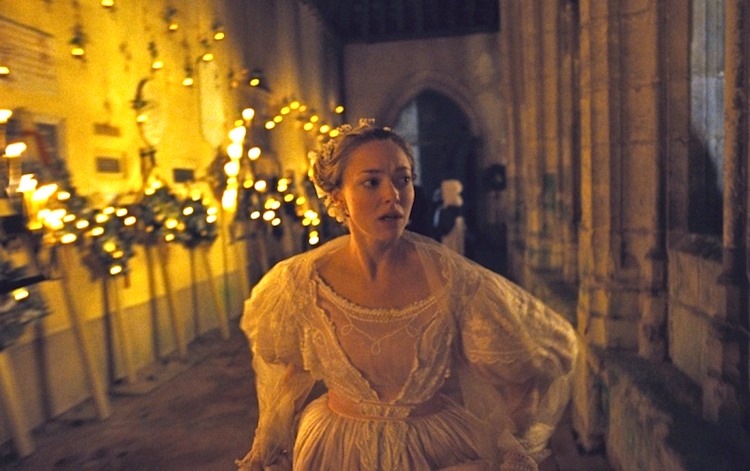
Amanda Seyfried in "Les Misérables."

By Joe Bendel. Even viewers who have not read Victor Hugo’s novel or seen Cameron Mackintosh’s stage musical know Jean Valjean spent nineteen years in prison for stealing a loaf of bread. Such a fate is undeniably unjust, but it is important to keep in mind that it was a very nice sourdough. For years it has defied cinematic adaptation, but now Tom Hooper brings the musical Les Misérables to the big screen, with all its bombast. It opened yesterday nationwide, so Merry Christmas everyone.

Distilled from Hugo’s cinderblock sized novel, Les Mis follows Valjean after he is released from prison. He has been freed from the unyielding Javert’s lash, but the terms of his parole make him a desperate outcast. He finds temporary refuge with the truly pious Monsignor, but he abuses the kindly cleric’s trust. Yet much to his shock, his betrayal is met with forgiveness.

Thanks to the Monsignor, Valjean reinvents himself under an assumed identity. He becomes a factory owner and the mayor of his hardscrabble community. Then Javert is transferred to his jurisdiction. For a while they circle each other warily, until Valjean confirms the copper’s suspicions to save an innocent man arrested in his place. Thus begins his life on the run (albeit a relatively well-heeled one) with Cosette, the daughter of a tragic former employee, in tow.

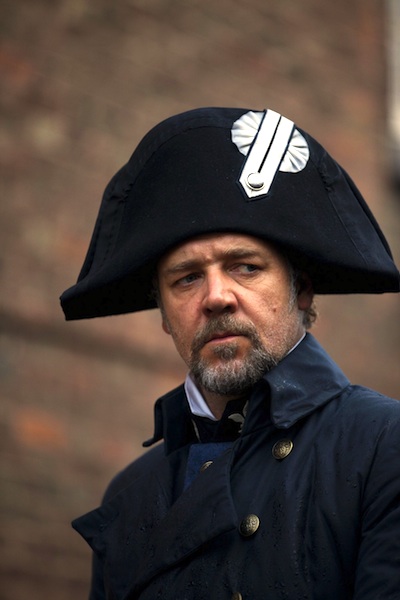
Russell Crowe in "Les Misérables."

Yes, this is Les Mis, a rather odd combination of Christian fellowship and proletarian solidarity. Barricades will definitely be stormed, but at least the church is not part of the apparatus of oppression. As the film’s publicity campaign is quick to point out, Hooper returned to old school movie musical production techniques, recording the actors in performance live on the set – rather than have them lip-sync to pre-recorded tracks. This allows them more in-the-moment interpretive freedom. However, as your TV talent show judges might say: “it gets a little pitchy, dog.” Frankly, it is hard to understand why they did not clean some of that up with Pro-Tools or a similar program.

Critical reaction to Hooper’s Les Mis is also something of spectacle, ranging from adulation to castigation. Word that Russell Crowe was making a movie musical may have led some to fear the worst. When Les Mis did not completely bite, many evidently concluded it must therefore be awesome. In truth, it falls somewhere in the middle.

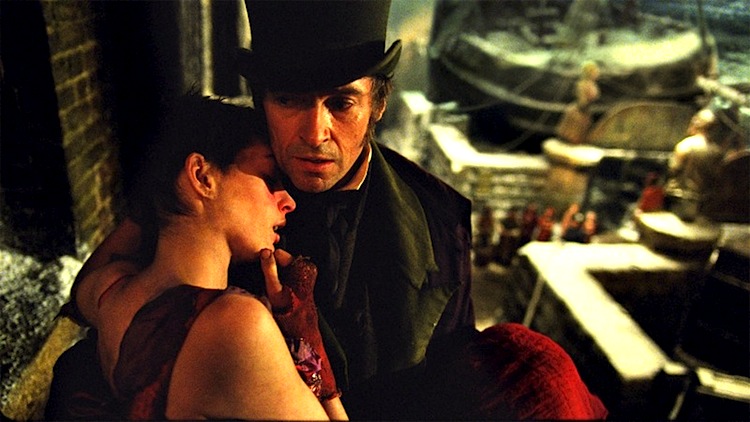
To be fair to Crowe, he has been unduly hammered as Javert (a small irony there), but in the story’s abbreviated stage form, his character’s actions during the third act are jarringly problematic. Also: likely Oscar contender Anne Hathaway knocks “I Dreamed a Dream” out of the park, completely reclaiming the signature tune from Susan Boyle, and then promptly exits the narrative. Hugh Jackman has the perfect presence for Valjean and his performances of “Who Am I” and “One Day More” are fairly stirring, but the show definitely peaks in the first act. Frankly, all the third act barricade songs and revolutionary anthems just blend into a faux Internationale blur.

While Jackman, Crowe, and Hathaway meet or exceed expectations, the rest of the supporting cast is a dramatically mixed bag. Eddie Redmayne sorely lacks romantic lead credibility as Marius, but his voice is not bad. The real standout though is British fan favorite Samantha Barks. She is the real deal as lovesick Éponine, probably boasting the finest voice of the ensemble.

In contrast, Sacha Baron Cohen and Helena Bonham Carter quickly become tiresome as the felonious innkeeper Thénardier and his wife, the show’s ostensive comic relief.  A little of them goes a long, long, long way. You know the Nile River? That long. They must have assumed they were in a Tim Burton movie when they saw the period sets, and started hamming it up accordingly. In fact, the Nineteen Century Paris recreated by the design team often looks like it was the work of the same Neo-gothic architect responsible for The Dark Knight’s Gotham, particularly when Javert compulsively paces about on high ledges.

Anne Hathaway and Hugh Jackman in "Les Misérables."

Nonetheless, Les Mis its moments, like “I Dreamed a Dream” and “One Day More,” which might be Hooper’s best staging, utilizing the cross-cutting toolkit of music videos more than traditional movie musical production numbers. Elements of the show, like the touching relationship between Valjean and Cosette, prove to be absolutely bullet-proof.

Hooper and screen-adapter William Nicholson also deserve a lot of credit for not watering down the themes of faith and redemption. Indeed, it is refreshing to see a senior man of the cloth depicted in an unambiguously virtuous manner. Oddly though, when everyone hits the barricades, it becomes something of a bore. Recommended primarily for Les Mis devotees and diehard movie musical fans, Les Misérables opened yesterday (12/25) across the country, including the AMC Empire in New York. Merry Christmas and to all a good night.

LFM GRADE: B-

Posted on December 26th, 2012 at 12:05pm.

Blondes in Peril: LFM Reviews Hitchcock

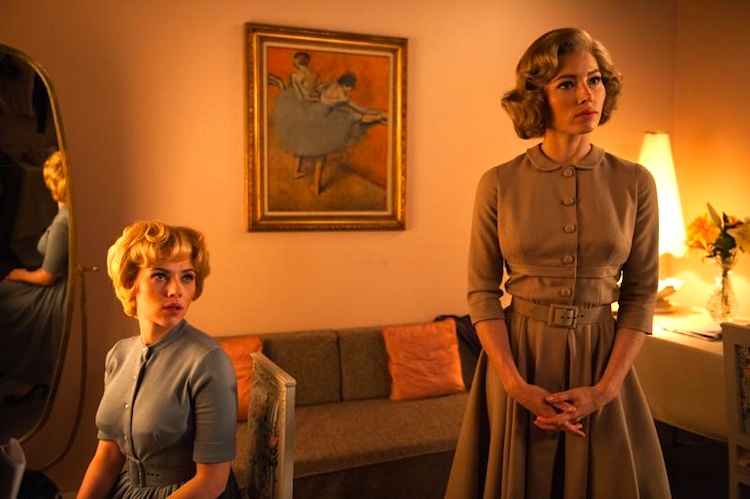
Scarlett Johansson and Jessica Biel in "Hitchcock."

By Joe Bendel. Alfred Hitchcock, the master of suspense, largely self-financed his notorious 1960 classic, Psycho. He picked the right film to literally bet his home on. A spectacular success by any standard, the film that would introduce Norman Bates to the world looked like it might be his swan song during its rocky development and production stages. Dramatizing the behind-the-scenes story of arguably his most iconic work, Sacha Gervasi’s sympathetic but bitingly witty Hitchcock is now in award contention for at least one and possibly two of its accomplished leads.

Hitchcock is not a story Hitch would have made. Since we know Psycho was completed to his satisfaction and became a monster hit at the box office, there is not a lot of suspense to the tale. However, the getting from point A to point B is quite fascinating. As we meet Hitchcock and his patient wife Alma Reville, he is basking in the triumph of North by Northwest, which somewhat bores them both. As a distraction, Reville starts doctoring a new spec script written by Strangers on a Train screenwriter Whitfield Cook, who is hoping she will convince Hitchcock to attach himself to it. Of course, he has his mind set on very different property.

Based on Robert Bloch’s novel, which in turn was inspired by Wisconsin serial killer Ed Gein, Psycho is the sort of film no respectable studio director would think of touching. That is exactly why Hitchcock is attracted to it. As the closing titles remind viewers, Hitchcock never won an Academy Award (a fact that could either help or hinder the film’s own Oscar campaign). Throughout Gervasi’s film, Hitchcock is clearly presented as a brilliant but ragingly insecure filmmaker. Resenting his lack of recognition, Psycho is convincingly framed as an effort to make an exploitation horror movie that is vastly superior to the prestige pictures the studios released. And so it was.

Yes, this Hitchcock is somewhat neurotic and there is no denying his eye for blondes. Yet John J. McLaughlin’s screen treatment is refreshingly forgiving of his foibles. He was indeed a man of expensive tastes (taste being the most apt word), but the audience also sees Hitch and Alma puttering about the kitchen in slippers, like relatively down to earth people.

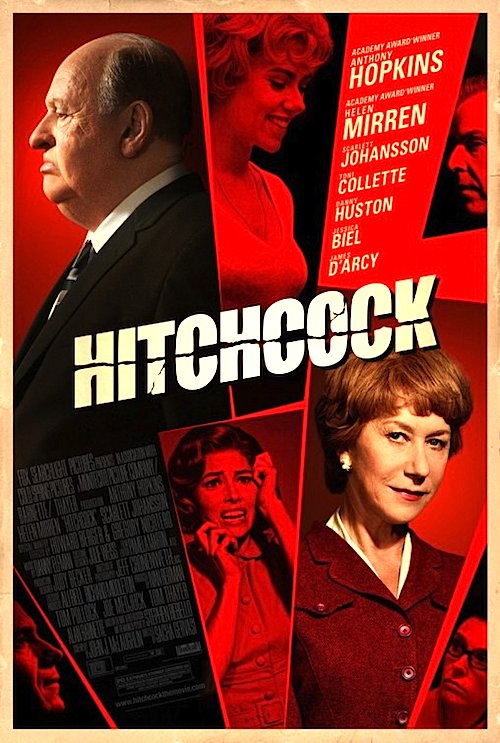
Both Sir Anthony Hopkins and Dame Helen Mirren are terrific as the first couple of suspense. As the title auteur, Hopkins is Hitchy without getting kitschy or shticky. Likewise, Mirren is the picture of mature sophistication as Reville. Listening to them bantering like an old familiar couple is one of the film’s great pleasures.

Yet the supporting work of Toni Collette and Scarlett Johansson really fleshes out the film, as it were. Collette’s smart, surprisingly attractive turn elevates what could easily have been the thankless role of the Hitchcock’s thankless assistant Peggy Robertson. Beyond being a spooky dead-ringer for Janet Leigh, Johansson also has some wonderful scenes with both principles that really deepen their humanity. While an Oscar campaign on her behalf might be pushing it, Hitchcock should definitely be on the bill for any future Johansson retrospective.

Gervasi commits a few missteps along the way, such as overplaying Hitchcock’s interior dialogues with the convicted and committed Ed Gein, perhaps hoping to throw genre diehards a bone. Still, the film pays off handsomely, especially for Hitchcock fans. In fact, you could say it has a real Hollywood ending. Deserving award consideration for the work of both Hopkins and Mirren, Hitchcock is recommended for the director’s admirers and those who enjoy films about the cinema. It is now playing nationwide, including at the AMC Empire in New York.

LFM GRADE: B+

Posted on December 26th, 2012 at 12:02pm.

Tibetan Buddhism Takes America: LFM Reviews When the Iron Bird Flies

By Joe Bendel. Niall Ferguson would say “I told you so.” For centuries, Tibetan Buddhism was largely confined to the Himalayan region. Then China invaded Tibet, precipitating an exodus of refugees. A few decades later, Tibetan Buddhists have earned growing ranks of converts around the world. Arguably, a bit of competition and Westernization has been beneficial. Victress Hitchcock explores the positive implications of their exile in When the Iron Bird Flies: Tibetan Buddhism Arrives in the West, which appropriately screens before and after New Year’s at the Rubin Museum of Art in New York.

It is a rather eerie prophecy in retrospect. In the Eighth Century, Guru Padmasambhava wrote: “When the iron bird flies and horse run on wheels, the Tibetan people will be scattered like ants across the face of the earth.” Communist China realized the prediction with the 1959 invasion. In many ways, it was absolutely devastating to Tibetan culture, particularly during the madness of the Cultural Revolution. Yet Hitchcock suggests it forced one of the world’s most isolated religions into contact with entirely new nations and peoples during the 1960’s, a period when popular Western culture was widely receptive to Eastern thought.

In Iron, Hitchcock challenges our traditional thinking on the Tibetan exile experience, suggesting it has invigorated, modernized, and spread their religious practice. She has a real point. If one took a survey of most American college dorms and neighborhoods, one would be far more likely to find books about Tibetan Buddhism than Mao’s Little Red Book, even in Berkeley. That is a defendable standard of victory, but it has certainly been costly.

Iron revisits subjects of several documentaries that have played at the Rubin over the last two years, including one covering the late E. Gene Smith’s game-changing campaign to preserve and digitize ancient Tibetan texts (fully documented in Dafna Yachin’s Digital Dharma) and another dealing with Chogyam Trunpa, Rinpoche, a learned teacher who adopted a Western business suit and lifestyle to popularize Tibetan Buddhism with the Western counter-culture (profiled in Crazy Wisdom, directed by Johanna Demetrakas, who served as a consulting editor on Iron).

If the learned Rinpoches became evangelists out of necessity, Iron spreads the Tibetan Buddhist “gospel” with the zeal of a convert. Hitchcock clearly hopes to convince Western audiences this once exotic faith speaks directly to the times in which we live. A little of that is all well and good, but she risks alienating the sympathetic by coming on too strong.

Still, Iron offers a fresh perspective on Tibetan Buddhism, capturing its efforts to shed centuries of male chauvinism. It is very definitely the result of Western contact, but also a reflection of the fundamental humanism of the Tibetan Buddhist establishment in exile. Do not hold your breath waiting for similar soul searching from the Islamic world. The wit, erudition, and humility of many exiled Tibetan leaders also help enrich Hitchcock’s portrait. Educational and surprisingly optimistic, When the Iron Bird Flies is definitely worth checking out when visiting the Rubin, home to the world’s leading collection of Himalayan art. It screens again this Wednesday (12/26), Saturday (12/29), and Sunday (12/30), as well as the 2nd and 23rd of January 2013.

LFM GRADE: B

Posted on December 26th, 2012 at 12:02pm.

Sorry, No Jazz Guitar Here: LFM Reviews Django Unchained

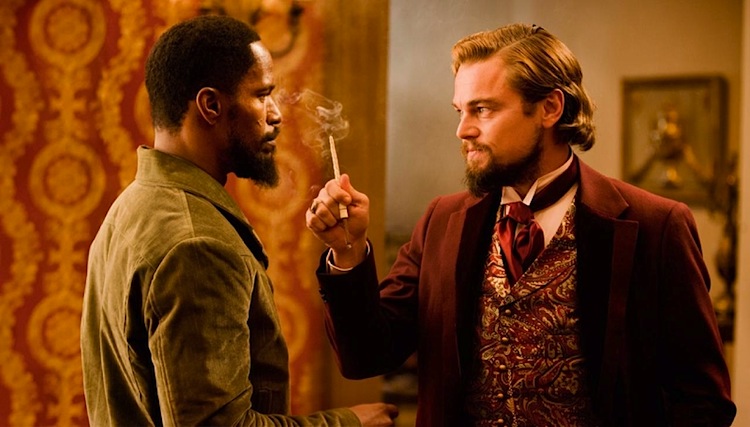
By Joe Bendel. The real question is where’s the Gatling gun? The nineteenth century machine gun certainly found its way into Sukiyaki Western Django, Takeshi Miike’s homage to Sergio Corbucci’s spaghetti western, Django. Considering the shtickiness of his supporting performance in Miike’s film, Quentin Tarantino has good reason to distinguish his Django pastiche from its predecessor. This he surely does, re-conceiving the gritty western as a blaxploitation revenge beatdown. Frontier justice gets a whole new look in Django Unchained, which opens Christmas Day nationwide.

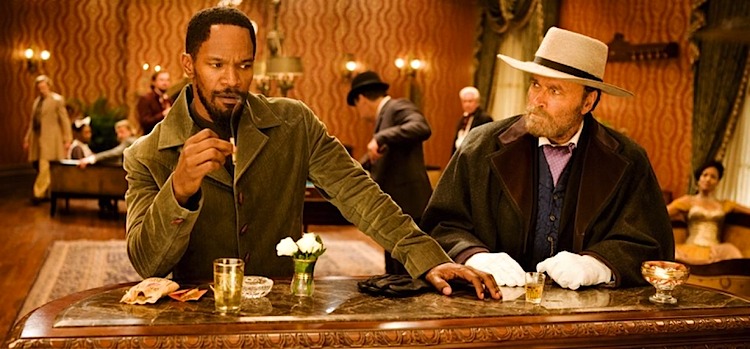
Dr. King Schultz is no ordinary dentist. The German expat has taken up the more lucrative work of bounty hunting. He also finds slavery appalling, so he has no qualms about liberating a slave to help him track down the Brittle Brothers, three of his former overseers who are now wanted by the law. That slave is Django, and when he teams up with Schultz, the Brittles do not stand a chance.

As everyone knows from Unchained’s media campaign, Django embraces bounty hunting because he gets paid to kill white people. However, he and Schultz make good partners, even becoming friends. After a profitable winter of killing outlaws, Schultz agrees to help the freeman liberate his wife, Broomhilda, who was taught German by her homesick former owner. Unfortunately, she was recently purchased by Calvin Candie, the master of the notorious Candyland plantation. A bit of subterfuge will be required to buy Broomhilda’s freedom, but Shultz has a suitably dubious plan.

They will masquerade as a prospective slave fight promoter and his free “Mandingo” advisor looking to buy one of Candie’s brawlers. Of course, the white racists of Candyland have trouble dealing with Django on civil terms, but the promise of Schultz’s cash keeps them temporarily in check. Unfortunately, Stephen (as in Fetchit?), the head house slave is instantly suspicious of Django and his partner.

The weird racial undercurrents detectable in Tarantino’s previous films build into a tidal wave in Unchained. On the surface, it is a scathing indictment of the antebellum era Deep South. There will be retribution of Biblical proportions, carried out in some of the best choreographed shoot-outs since John Woo’s Hard Boiled. However, before justice is served, Tarantino will thoroughly objectify African Americans, both men and women, and unleash a blizzard of racial epithets. Yet he will largely get away with it because of the film’s ostensibly politically correct sense of moral outrage.

Jamie Foxx encounters the original Django, Franco Nero.

When watching Unchained, one gets a sense Schultz and Candie represent two sides of the auteur’s persona. Schultz is the white trickster he wants to be, finding acceptance from African Americans through social conscience and hipster sensibilities. Yet, if you peeked into the dark recesses of his subconscious, one might find fantasies of the master slinking off to the slave quarters late at night.

While he looks a bit like Christopher Guest, Christoph Waltz thoroughly dominates the film as Schultz. Conveying a charismatic sense of danger, he is the only character who consistently surprises viewers, while serving as the film’s figure of tolerance. Waltz also has the perfect flair for Tarantino’s dialogue, which is razor sharp as ever. In fact, the period setting is something of a blessing, forcing him to avoid ironic pop culture references.

Jamie Foxx is appropriately flinty when going toe-to-toe with his racist antagonists, but lacks Waltz’s dynamic screen presence. Cruel but disturbingly subservient, Samuel L. Jackson’s Stephen is one of the most distinctive villains of the year. Yet on some level, it is oddly problematic that Unchained invites the most scorn for an African American character. Conversely, Leonardo DiCaprio and his pasted on mustache are simply ridiculous as Candie. Completely lacking gravitas or menace, he looks like he should have a surf board under his arm rather than a whip.

Tarantino delivers some spectacular mayhem and some wickedly clever lines. Still, there is a leering tone to the film that feels wrong when the bullets are not flying. Regardless, there is enough attitude and inventive bloodshed to satisfy the filmmaker’s fans, as well as a cool cameo from the original Django, Franco Nero – but the running time of one hundred sixty-some minutes is just excessive. By comparison, Corbucci’s Django unleashes just as much mayhem in nearly half the time. Recommended strictly for connoisseurs of violent exploitation films and spaghetti westerns, Django Unchained opens wide this Christmas.

LFM GRADE: B-/C+

Posted on December 21st, 2012 at 10:29am.

Accept No Substitutes: LFM Reviews Sergio Corbucci’s Original Django

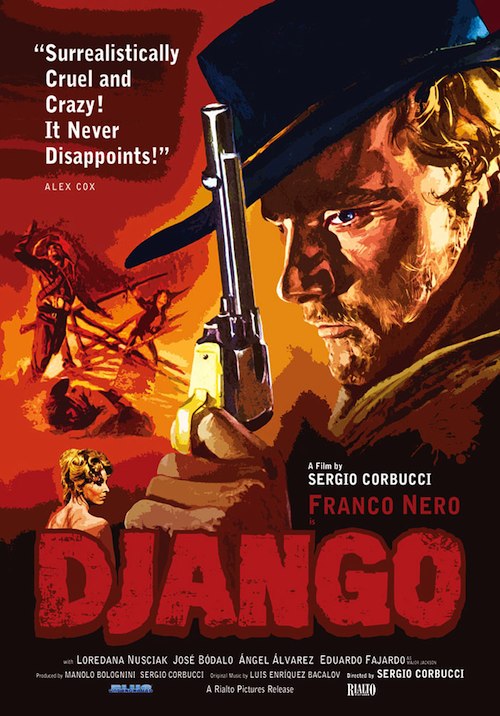
By Joe Bendel. Italian spaghetti western maestro Sergio Corbucci only helmed one official sequel to his classic 1966 western gundown Django, but scores of scruffy bootleg Django follow-ups were produced. In fact, they keep on coming, don’t they? None of them, including the recent homages from Takeshi Miike and Quentin Tarantino can hold a cigarillo to Corbucci’s original Django, which opens today in New York at Film Forum.

A stone cold killer comes to town wearing Union Blue and dragging a coffin. Much mayhem ensues. Basically, that is what the film boils down to. Like A Fistful of Dollars, there is an element of Yojimbo in Django, turning the title character loose in a town embroiled in a war between Maj. Jackson’s ex-Confederate white supremacists and a band of Mexican revolutionaries (who all look more or less the same), but attitude and action are more important than plot, per se.

Temporarily Django throws in his lot with his old associate, “General” Hugo Rodriguez, but that is only because he needs a few men to stage a daring gold heist from the Mexican army depot just across the border. He also holds a mysterious grudge against Jackson, whom he saves killing for last. Along the way, he rescues a fallen woman who duly falls for Django, but he is not really at a place in his life where he is looking for a serious relationship.

Notoriously violent in its day, Corbucci’s Django does not seem so shocking at a time when the Weinsteins will release Tarantino’s pseudo-reboot on Christmas Day (regardless of the unforeseeable national tragedy). However, its body count is still impressive. Django’s action scenes are not really shootouts, they are massacres. After all, that casket holds a heck of an equalizer, courtesy of Mr. Richard Gatling.

In a career defining role, Franco Nero is all kinds of steely badness as Django. There is something deeply existential about his presence, yet he is strictly business when it counts. Eduardo Fajardo is also thoroughly despicable as Jackson, providing the anti-hero with a worthy antagonist.

Frankly, some of the details do not make a lot of sense, like the racist Klansman Jackson being buddy-buddy with the Mexican army. At times, extras literally walk into the line of Gatling gunfire, which is awfully convenient of them. Yet, the metaphorically muddy environment and gritty action more than compensate for any pedantic grousing. Plus, it is truly impossible to watch Django and not hum the iconic theme song in your head for several days afterward.

Alex Cox suggests Django’s name is indeed a reference to the great Roma jazz guitarist Django Reinhardt, in a way that would be spoilerish to explain. If so, it adds another layer of cult weirdness to the film. Regardless, Django delivers enough unrepentant action to satisfy any genre fan. An essential Italian western, Corbucci’s 1966 original is the Django to see when it opens today (12/21) at Film Forum.

LFM GRADE: A

Posted on December 21st, 2012 at 10:29am.