Solidarity Strikes Back: LFM Reviews 80 Million, Submitted by Poland for the Oscars

By Joe Bendel. They called it a heist, but it was really withdrawal. They were union dues in an account the Solidarity representatives were the rightful signatories for. Yet not surprisingly, the Communist regime preferred to keep all funds under their control, so they could be immediately frozen should the need arise. On the eve of martial law, a handful of workers-turned-activists anticipate a looming need for that money in Waldemar Krzystek’s factually based drama 80 Million (trailer here), chosen by Poland as their official submission for this year’s foreign language Academy Award, which screens as the closing night selection of the Skalny Center’s 2012 Polish Film Festival at Rochester University.

Winter 1981 will be a cold one. Despite promises made, the Communists are not about to let Solidarity operate freely. So far, they have waged a war of small-ball provocation, desecrating Soviet war graves and the like in the guise of Solidarity activists. However, when four real Solidarity supporters bust them in the act, in front of cameras, the stakes precipitously rise.
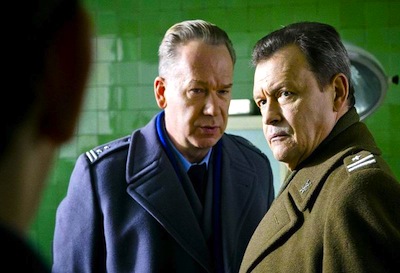
A repressive communist regime.

Perhaps too conveniently, there is a source offering government information to the Lower Silesia branch, but the dissident workers are not convinced they can trust him. Still, his information always pans out. Essentially warning them to expect a long siege, the quartet convinces each other that high liquidity is in order.

Of course, it’s never a good time to plan a major operation in a police state. Staszek’s very pregnant wife is an obvious vulnerability. Her high-ranking father can only protect her within limits. While Maks does not have the same concerns when he takes up with Natalia, a French journalist of Polish heritage, she is something of a distraction.

How refreshing is it to see a film that uses the word “Commie” as a term of denigration. It is equally appealing to see members of the Catholic Church playing a heroic role in the struggle to attain freedom and dignity for the people. In many sad ways, 80 Million is actually a timely film, reminding viewers of the consequences of a media too closely aligned with the state. Still, the film is largely optimistic in tone, more intent on celebrating Solidarity’s triumphs than mourning those lost during the dark days of Communistic oppression.

Life in the Solidarity movement had its moments.

Indeed, there is no nostalgia here for the old regime. At various times viewers see inside Communist torture chambers and eavesdrop on their ruthless scheming. Piotr Głowacki is particularly detestable as the serpentine SB Captain Sobczak. Not to be spoilery, but the manner in which he gets his is quite satisfying.

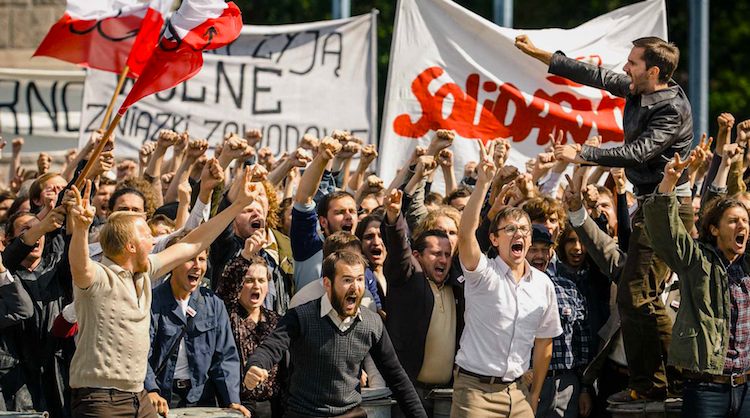
Frankly, Krzystek’s severe docudrama style limits the time for character development, but he sure can stage a massive protest. The tenor of the times certainly comes through loud and clear. Still, there are some memorable performances, most notably from Głowacki and Mariusz Benoit as “Kmicic,” the Deep Throat figure. Emilia Komarnicka also turns up the heat in a variety of notable ways as Natalia. Of our main co-conspirators, Wojciech Salarz’s worried father-to-be makes the strongest impression. Unfortunately, Olga Frycz, whose earnest presence and youthful good looks helped make Jacek Borcuch’s All that I Love so special, is almost criminally under-employed as Marta, an ex-girlfriend sheltering one of the fugitives.

Although Krzystek’s approach can be distancing now and then, he gives audiences more than enough to keep them emotionally invested in the not-really caper. Marek Warszewski’s design team convincingly recreates Jaruzelski era Poland. Again, that is nothing to be nostalgic for. (New Yorkers take note: the film includes gas rationing lines.) A well crafted recreation of a fascinating historical episode, 80 Million would be a worthy Oscar nominee. Recommended with a good deal of enthusiasm, it screens this coming Monday (11/19) as the closing night film of the Polish Film Festival at Rochester, which will also show Wojtek Smarzowski’s excellent Rosa this Saturday (11/17).

LFM GRADE: A-

Posted on November 16th, 2012 at 10:39am.
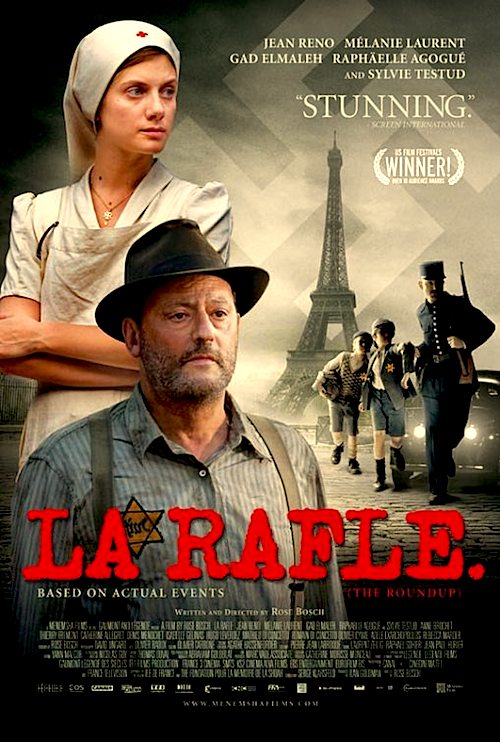
Occupation and Collaboration in France: LFM Reviews La Rafle (The Round Up)

By Joe Bendel. Conveniently, the infamous Winter Velodrome no longer stands in Paris. Yet, perversely, cycling races were still held in the venue as late as 1958, well after it served as a temporary holding facility for 13,000 Jewish Parisians, forcibly “rounded up” at the request of the occupying National Socialists. It was an episode of history France preferred to forget, since it was the Vichy authorities doing the rounding-up. While the actual event went scrupulously undocumented, Rose Bosch dramatizes the tragic events in La Rafle (The Round Up), which opens today in New York.

The fatality rate of those imprisoned in the Velodrome was nearly one hundred percent. Viewers will have no illusions where the captives are ultimately headed, but those in the Velodrome held out hope their next accommodations would be better. We come to meet many of the roughly detained, including children like Joseph Weismann and his friends, the Zygler brothers. While they used to run free through the streets of Montmartre, the boys suddenly find themselves enduring the heat and inadequate water and sanitation of the Velodrome. Fellow prisoner Dr. David Sheinbaum is the sole extent of the medical treatment available until the arrival of solitary Protestant charity nurse Annette Monod.

Based on years of research, Bosch takes pains to show both the good and bad sides of the French national character. While the Weismann’s anti-Semitic neighbors cheer their deportation, the Parisian fire department reacts with shock and empathy, struggling to improve conditions in the Velodrome, against the gendarmerie’s express wishes.

Those who have seen Sarah’s Key or read the novel on which it is based will be familiar with the 1942 Roundup. Designer Olivier Raoux’s recreated Velodrome has the look and feel of a real life, slightly past its prime building, collapsing under the weight of its involuntary guests. Bosch’s scenes within its confines have a visceral you-are-there impact. However, the intermittent depictions of Hitler and the craven Petain lack the same power, only serving as a wan indictment of their banal evil.

In a bit of a surprise, it is Jean Reno who masterfully serves as the film’s moral center, portraying Dr. Sheinbaum with a profound spirit of world weary humanity. The impossible romantic tension that develops between him and Mélanie Laurent’s Monod is also deeply touching. That sense of “if only thing were different” palpably hangs in the air between them as they labor to ease the suffering around them as best they can.

Post-Schindler’s List, there have been a number of well-meaning dramas that have addressed the Holocaust, with varying degrees of success. La Rafle ranks as one of the more accomplished due to its technical merit and Reno’s assured, anchoring performance. Recommended for connoisseurs of French cinema and WWII films, it opens today (11/16) in New York at the Quad Cinema.

LFM GRADE: B

Posted on November 16th, 2012 at 10:38am.

LFM Reviews Anna Karenina

By Joe Bendel. Anna Karenina won the game of Russian birth roulette. Born into privilege, she initially enjoyed all the benefits of her well structured life, but lost everything due to a reckless love affair. Such was the price of offending Russian society at a time when it was trying to act French. Notions of social role-playing have now inspired the hyper-stylization of Joe Wright’s take on Tolstoy’s classic Anna Karenina, which opens this Friday in New York.

Everyone is playing their socially expected role you see, so why not set Anna Karenina in a creaky old theater? From time to time, Wright will break away from the stagey confines, particularly when checking in on Levin, the rustic landowner and long suffering friend of Karenina’s ne’er do well brother. Of course, there are also trains – like the one taking the title character to Moscow, where she hopes to provide emergency marriage counseling for said brother and his justly aggrieved wife Dolly. It is sort of a pleasant trip spent in the company of the Countess Vronsky, whose cavalry officer son meets her at the station.

The mutual attraction between Karenina and Vronsky are immediately evident, only intensifying at an eventful Moscow society ball. Having thrown over the plodding Levin in hopes of landing Vronsky, Dolly’s younger sister Kitty is deeply hurt when the officer ignores her in favor of the married Karenina. Spooked by the prospect of scandal, she hastens back to St. Petersburg and her husband Karenin, a progressive but culturally traditional government official. As everyone should know, Vronsky follows her—and so does scandal.

There have been enough movie and television treatments to support a lengthy compare and contrast session here. In many ways, Tom Stoppard’s adaptation is quite distinctive, establishing a strong contrast between country simplicity and urban hypocrisy, while finally giving Levin his due. However, Wright’s stylistic conceit is far too distracting, taking viewers out of the story time and time again. The theatrical device is not even particularly original, having been used to greater effect in Manoel de Oliveira’s Satin Slipper, Louis Malle’s Vanya on 42nd Street, and several Shakespearean films. Frankly, it is a rather baffling aesthetic choice, considering the whole appeal of a novel like Anna Karenina is the big messy sweeping grandeur of it all.

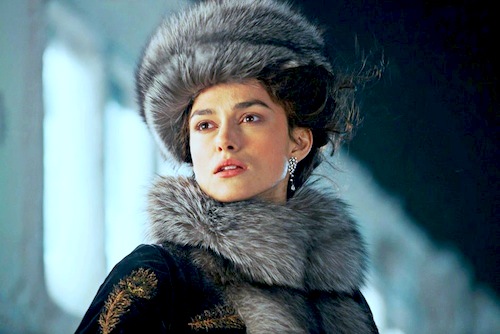
Nonetheless, there are several outstanding performances in Wright’s film, especially from his lead, Keira Knightley. It is hard to think of anyone else with the same brittle beauty and aristocratic bearing, who can convey burning self-destructive passion and guilt-ridden anguish with comparable power. Yet the real surprise of Wright’s Karenina is Jude Law’s performance as Karenin, the wronged husband. Even though he looks considerably younger than the Karenin as described in the source novel (about twenty years older than his wife), Law creates a deeply sympathetic portrait of a fundamentally decent man, trying to act accordingly, despite the painful embarrassment of the circumstances.

Keira Knightley in "Anna Karenina."

In contrast, the casting of Aaron Taylor-Johnson as Vronsky is a head-scratcher. In truth, Wright lets his Vronsky off rather easily. In previous versions, Vronsky is something of a shallow cad, but here he is more or less a dumb kid who fell in love too young, but that creates a host of dramatic problems. Essentially, Anna Karenina is supposed to fall for Vronsky, because he is manlier than her husband, not vice versa. What she sees in this Vronsky is hard to fathom. I got stuff in the fridge that looks older than Taylor-Johnson and I’m not ready to throw it out yet.

Granted, Wright’s visual approach lends itself to some dramatic transition shots, but it never lets the film settle in and put down roots. Watching it makes one wonder what the director had in mind. Perversely, it is like Wright elicited award caliber performances from Knightley and Law, but then deliberately undermined them the postmodern theatricality and a maddening case of miscasting. There is room for some experimentation when tackling Tolstoy, but it should serve the interests of the picture. For instance, Sergei Solovyev’s relatively recent Russian production of Anna Karenina was considerably more expressionistic than traditional costume dramas, while staying true to the novel’s tone and story.

It is a shame Wright had to be so showy, because there is quite a bit of good stuff in Stoppard’s screenplay and the mostly impressive work from the accomplished ensemble cast. Recommended mostly for Knightley and Law’s diehard fans, Wright’s frustrating Anna Karenina opens this Friday (11/16) in New York at the AMC Loews Lincoln Square.

LFM GRADE: C+

Posted on November 14th, 2012 at 11:14am.

Hippy Apocalypse: LFM Reviews First Winter

By Joe Bendel. When the end of the world comes, Manhattan will be the first to go. Some people may think that’s a blessing. By contrast, it would be a fate worse than death to be trapped with the yoga hippies communing upstate in Benjamin Dickinson’s slightly apocalyptic First Winter, which opens in Williamsburg (of course it does) this Friday.

There is only one reason Paul’s yoga groupies should not be considered a cult; that would imply a degree of organization they lack. Basically, he leads yoga sessions in between getting stoned and sleeping with the women of his choice, until the world ends. Caught up in their own little universe, the yoga minions sort of miss the big bang when it happens. They just see a bit of smoke and wonder what happened to their friends who never came back from town.

They try to carry on as usual, but sexual issues threaten to spoil the scene. For some reason, Paul dumps the cute (particularly for this group) Jen in favor of Marie, a comparatively drab old flame, who reappeared after the apocalypse. Oh, and their supplies are dwindling. Will the hippies be able to become self-sufficient? They live on a farm, after all. Or will they die a cold, hungry death?

Frankly, it is really hard to care – and why should we? Nobody seems too broken up about the unfathomable human tragedy that presumably happened around them. You might think the prospect of no more Phish tours or Deepak Chopra books would get them down, but everyone is more concerned about who is in Paul’s bed, including the jealous but drug addled Matt.

Why anyone would be attracted to the pasty white, scraggly-haired bargain basement guru remains a mystery throughout the film. It certainly cannot be explained by his self-absorbed personality. Unfortunately, the narrative does not offer much snap to distract viewers. In fact, the big climax comes and goes without viewers even realizing it at the time. Ordinarily, this would be a major dramatic shortcoming, but for First Winter, an abrupt ending is a happy surprise.

In all truth, the most interesting thing about First Winter is the controversy surrounding a deer the production reportedly shot out of season for the big hunting scene, without a proper license. Featuring shallow characters and a listless pace, First Winter is a hard, unpleasant slog. Jennifer Kim and Haruka Hashimoto bring some charisma to their namesakes, but it is arguably out of place amongst the rest of the dull cast of characters.

A failure on multiple levels, First Winter makes the presentable but not classic The Road seem like a masterpiece in retrospect. Both films are vague about the nature of “the end,” but in the case of John Hillcoat’s adaptation of the Cormac McCarthy novel, it works in context. In contrast, the Brooklyn hipster’s lack of curiosity is a conspicuous strain on viewer credibility. Not recommended in any way, shape, or form, First Winter begins a six day run at Videology this Friday (11/16) in the County of Kings.

LFM GRADE: F

Posted on November 14th, 2012 at 11:13am.

LFM Reviews My Amityville Horror @ DOC NYC

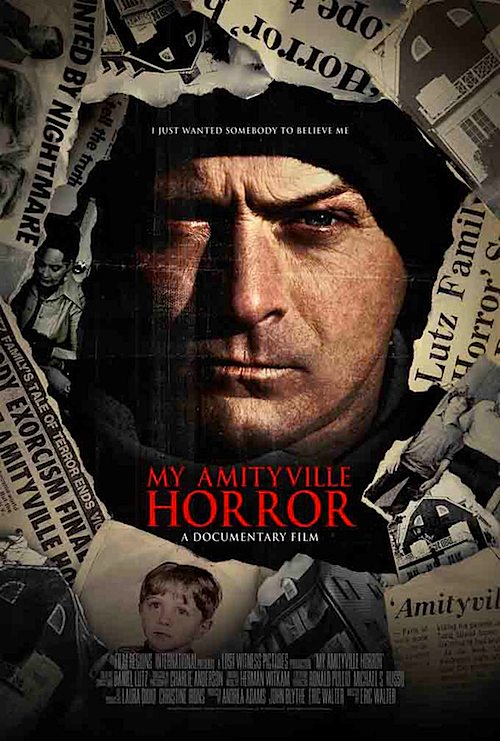
By Joe Bendel. Long Island used to be considered a great place to settle down and raise a family. That was before Buttafuoco and Frankenstorm. However, the thing that really freaked people out was the incident known as “The Amityville Horror” in a raft of books and movies. Now a grown man, the eldest son of the terrified Lutz family, finally breaks his silence on their twenty-eight days spent at the notorious Ocean Avenue address in Eric Walter’s My Amityville Horror, which screened over the weekend at this year’s DOC NYC, closely following word it had been acquired by IFC Midnight.

Daniel Lutz is a heck of an interview subject. Not afraid of a little salty language, he sounds a lot like a typical Long Island knucklehead – until you hear his story. Although there is a fair amount of skepticism expressed by others in the film, no one doubts his sincerity. Clearly, he never enjoyed being known as the kid from The Amityville Horror. Listening to him unburden himself in what appear to be staged counseling sessions, audiences might surmise the subsequent notoriety was as traumatic for him as whatever might have happened in the house itself. The same may well be true for the circumstances surrounding his mother’s marriage to his stepfather, George Lutz, whose name he was forced to adopt.

New Yorkers will be especially interested to learn the extent to which local Channel Five (now Fox 5) owned the Amityville story before Jay Anson’s “true story” novel and the release of the films. Marvin Scott (now with the City’s CW affiliate) even helped introduce the film and appears at length, along with his former colleague, Laura DiDio. Having spent a mostly uneventful night there, Scott remains largely incredulous, whereas DiDio sounds like she gives it all considerably more credence.

Scoring a series of interviews with Lutz was certainly a coup, but it is precisely that tension between belief and skepticism that really distinguishes Walter’s film from a History Channel special or DVD extra. Yet, the documentary still has plenty of creepy moments (particularly with regards to George Lutz and his reported background with the occult), despite Walter’s level headed approach. Many viewers will likely conclude there was definitely something evil in that house, but whether or not it was supernatural is an open question.

Even for us doubting materialists, My Amityville is fascinating stuff, featuring a truly compelling central character in Daniel Lutz. An intriguing nonfictional twist on the horror genre, it would make a strange but fitting double feature with either Rodney Ascher’s Room 237 (as a one-two examination of the cultural impact of well known horror movies) or Joshua Zeman & Barbara Brancaccio’s Cropsey (as the Long Island-Staten Island axis of real life horror stories). Eerie but entertaining and always open-minded, My Amityville Horror is definitely a satisfying doc for genre fans. Recommended accordingly, it should be coming back to the IFC Center relatively soon, courtesy of IFC Midnight.

LFM GRADE: B+

Posted on November 13th, 2012 at 3:47pm.

Rolling Russian War Machines: LFM Reviews White Tiger, Submitted By Russia for Oscar Consideration

By Joe Bendel. Ivan Naidyonov could be called the tank whisperer. He seems to have the mystical power to commune with armored vehicles, but his environment is pure blood and guts. War is still war, except more so on the Eastern Front in Karen Shakhnazarov’s White Tiger, which Russia has chosen as their official submission for this year’s foreign language Academy Award.

Hoping to put the debacle of last year’s submission (Friend of Putin Nikita Mikhalkov’s universally panned Burnt By the Sun 2: Citadel) behind them, Russia has opted for another well-connected standard bearer in Mosfilm head Shakhnazarov. However, in this case the quality of the film and the director’s critical reputation represent a considerable step up.

Picking through the remains of a routed Russian tank division, soldiers find a charred driver who is somehow still breathing. Despite suffering severe burns to ninety percent of his body, the tank mechanic makes a full recovery, except for his acute amnesia. Rechristened Ivan Naidoyonov (“found Ivan,” roughly), he is sent back to the tank corps. He is a whiz at fixing and operating tanks, but he is a little spooky. Naidyonov claims tanks speak to him and even starts praying to the “God of tanks” enthroned in the big garage in the sky. Yet he is just the man to track down and destroy the white German super tank that seemingly materializes out of nowhere to wreak destruction on blindsided armored columns.

For Naidyonov it is personal. The spirits of the destroyed tanks have spoken to him about the White Tiger. So perfect are its maneuvers, he is convinced its crew is “dead.” He can sense it before it appears and it seems to be hunting specifically for him.

White Tiger might sound like Life of Pi in a tank, but at every battlefield juncture, Shakhnazarov chooses grit over woo-woo. Everyone thinks Naidyonov is nuts, but they secretly suspect there might be something to him – particularly Major Fedotov, the counter-intelligence officer in charge of the hunt for the White Tiger. The resulting vibe is like The Big Red One as re-written and Russified by Melville.

With his studio’s resources at his disposal, Shakhnazarov stages some fantastic tank battles, vividly conveying their force – and also their limitations. During the first two acts, White Tiger is a completely original, totally engrossing war film. Strangely, though, the final third is largely dominated by completely unrelated scenes of the German surrender and Hitler’s ruminations in the face of defeat. It is like White Tiger won the war, but lost the peace. Still, since it is a war movie, the former is more important.

When Naidyonov and his obsession are center stage, White Tiger is genuinely riveting, with a good measure of credit due to its primary leads. Aleksey Vertkov is perfect as Naidyonov. Refraining from distractingly ticky or showy behavior, he is compellingly “off” in a way that could believably be recycled back into the Soviet war machine. Even though in reality his character would have probably been purged halfway through the film, Vitaliy Kishchenko’s work as the square-jawed Fedotov is similarly smart, understated, and intense.

It is hard to understand why Shakhnazarov would establish such a powerfully focused mood, only to break it up down the stretch. Still, White Tiger boasts two excellent performances and some impressive warfighting sequences, which is more than many of its fellow contenders can offer. Academy voters certainly love them some WWII, so it is probably worth keeping an eye on. Shakhnazarov has also had American distribution for past films like Vanished Empire, so White Tiger should have international legs. Regardless of its odd flaws, it is a film of considerable merit that ought to find an audience.

LFM GRADE: B

Posted on November 9th, 2012 at 2:20pm.