LFM Reviews Lines of Wellington @ The New York Film Festival

By Joe Bendel. Torres Vedras was not exactly Waterloo, but don’t tell the Portuguese that. It was there Gen. Wellington and the combined British and Portuguese troops he commanded defeated Napoleon’s invading army behind secretly commissioned fortifications. An epic campaign that still resonates on the Iberian Peninsula, Wellington’s military sojourn in Portugal was perfect fodder for a grandly sweeping Raúl Ruiz film, but it was not to be. Passing away during a stage of either late development or early pre-production, Ruiz’s widow Valeria Sarmiento stepped into the master’s shoes, helming Lines of Wellington, which screens during the 50th New York Film Festival.

Wellington has just shocked the French with tide turning victory at Buçaco, yet he is retreating anyway. Despite the demoralized state of the Bonaparte forces, they simply have an overwhelming numerical advantage. The British and their Portuguese allies will dig in behind the Torres Vedras ramparts, letting time fight the battle for them.

This is classic Nineteenth Century warfare, attracting spectators and hanger-ons. For British evacuee Clarissa Warren, it is the perfect opportunity to find an officer-grade husband. The distinguished Major Jonathan Foster looks like a good candidate, but he is not necessarily in the market for a trophy wife. Wounded soldiers will recuperate, romances will blossom, combatants will ravage the local populace, and spies will be dealt with. Yet the real story for LOW’s domestic audience is scorched earth – damaged wrought by the French and British on their native land.

Condensed from a longer Portuguese miniseries for the international festival circuit, a la Ruiz’s brilliant Mysteries of Lisbon, LOW is a rangy narrative, featuring scores of prestigious cast members, entering and exiting in maddeningly quick succession. Unlike Mysteries, viewers will definitely feel like there are holes in LOW, at least in its current festival edit. There are numerous promising subplots here, including Foster’s relationship with the rather forward Warren. Yet, after being introduced early on, they disappear from the film until the closing scenes. Likewise, when Chiara Mastroianni appears as Hussar, sort of a Bonapartist Emma Peel, it looks like a promising development – but her mere seconds of screen time do not appreciably advance the story.
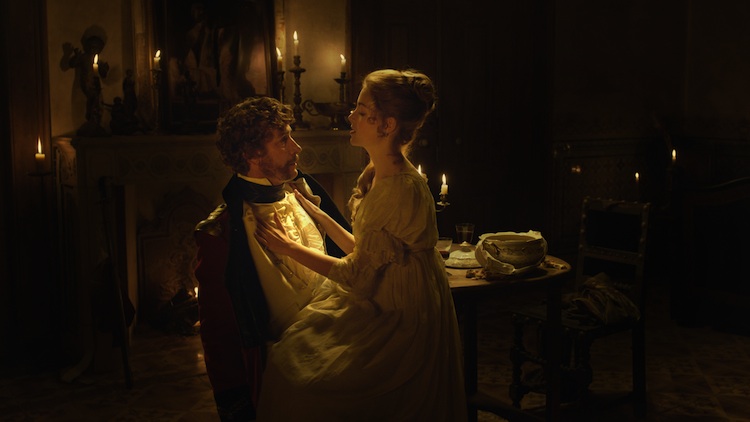
From "Lines of Wellington."

The only characters getting a puncher’s chance at development are the General himself and Francisco Xavier, a dispossessed farmer now serving as a Sergeant in Wellington’s Portuguese auxiliary and as the film’s primary POV character. Fortunately, Nuno Lopes has the right rugged, world-weary presence as the disillusion soldier, while John Malkovich chews the scenery like an old pro as the British commander.

LOW definitely has its moments, including a genuinely moving conclusion. Not intended as an action movie, it powerfully recreates the aftermath of battle, rather than the actual warfighting. Yet, one wishes it had delved more deeply into the strategic chess game in play, particularly Wellington’s penchant for strategic retreats, which suggest he might have learned something from a certain General Washington.

Even at one hundred fifty-one minutes, there still seems to be something missing from LOW. It has plenty of the elements to satisfy fans of historical costume drama, but the Around the World in Eighty Days style cameos from the likes of Michel Piccoli, Isabelle Huppert, Catherine Deneuve, and Mathieu Almaric are more frustrating than satisfying. Laudably ambitious, Lines of Wellington is ultimately more notable for what it represents than as a self-contained film. Nonetheless, interested viewers ought to satisfy their curiosity, because they may not have many opportunities to see LOW in any form. It screens this Monday (10/8) and Tuesday (10/9) as a main slate selection of the 2012 New York Film Festival.

LFM GRADE: B-/C+

Posted on October 8th, 2012 at 2:20pm.
Yakuza Badassery: LFM Reviews Outrage Beyond @ The New York Film Festival

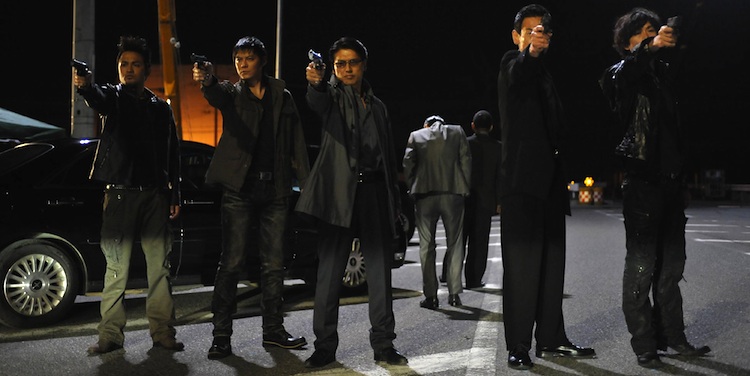
By Joe Bendel. The Sanno Yakuza clan has practically become Japan, Inc. through the shrewd investment strategies of turncoat underboss Ishihara. His rise to power was ruthless, as the scars of a handful of surviving foes attest. Lead actor-director Takeshi Kitano (a.k.a. Beat Takeshi) gives a grateful world another dose of Yakuza badassery with Outrage Beyond (trailer here), the more restrained sequel to last year’s Outrage, which screens as a midnight selection of the 50th New York Film Festival.

If they know what’s good for them, viewers will be fully aware the last time we saw Kitano’s ultra-hardboiled Otomo, he was on the business end of a rather fatal looking prison attack. However, it will take more than a shiv in the yard to dispatch a hardnose like Otomo. Things are looking up as OB opens. Otomo is about to get an early parole thanks to the scheming of the contemptible Det. Kataoka. By kicking Otomo loose, the crooked cop hopes the gangster will do what he does best. If nothing else, it is sure to alarm Ishihara.

Not proud of the things he was ordered to do in Outrage 1, Otomo is reluctant to get back in the game. Yet, he is convinced by an unlikely new ally, Kimura, the man on the other end of the shiv. Frankly, Otomo does not blame him. He was the one who permanently scarred his former rival’s face. Rather put out by the way their former bosses manipulated them, Otomo and Kimura agree to Kataoka’s dodgy plan to wage war against the Sanno – with the suspect backing of the Hanabishi clan. But of course, it gets way more complicated than that.

Kitano is still the Miles Davis of Yakuza movies. Nobody else is so rivetingly stone cold cool, while saying so little. Once again, his shark-like relentlessness and knowing resignation are wholly sufficient to carry the film on his shoulders. OB is far less action-driven than its predecessor, but it nicely matches the world-weariness of its protagonists. Still, the opening act is a bit talky and heavy on the exposition. Nonetheless, the intriguing relationship between Kitano’s Otomo and Hideo Nakano’s Kimura, putting the honor back into the underworld, elevates the second Outrage above the Yakuza field.

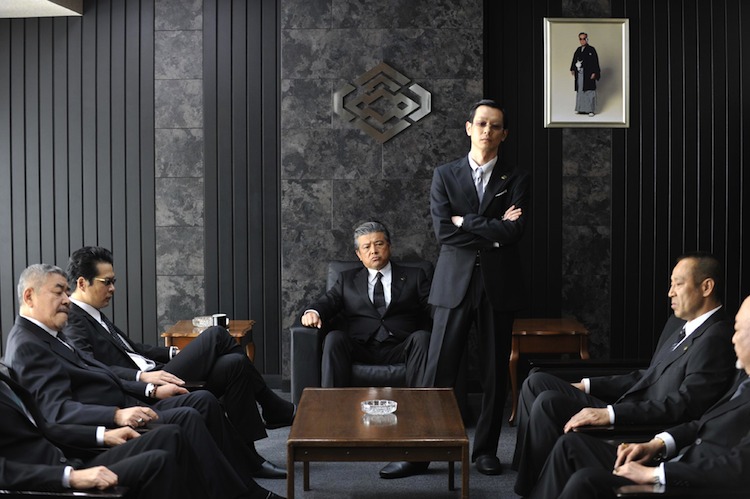
From "Outrage Beyond."

While Kitano is the definitive star of the film and possibly the entire genre, he has some colorful support from the overwhelmingly male dominated cast. As Kataoka, Fumiyo Kohinata is still a hissably audience-pleasing sleazebag. Coming more to the fore in OB, Ryo Kase also takes a heck of a villainous turn as the oily, borderline psychotic Ishihara.

Like the previous film, Kitano presents the Yakuza world as a chilly, severe environment, dominated by ritual and rich – yet Spartan – decors. Fans will be happy to hear that it is also rather violent. Though it might not be as slam-bang as they would prefer, it payoffs in a big way. Although not quite as inspired as its predecessor, Outrage Beyond is a cerebral excursion into gangsterism from a master of the genre, making it a fitting choice for NYFF’s inaugural Midnight section. It screens this Friday (10/12) and Saturday (10/13) at the Walter Reade and Francesca Beale Theaters, respectively.

LFM GRADE: B

Posted on October 8th, 2012 at 2:19pm.

LFM Reviews Memories Look At Me @ The New York Film Festival

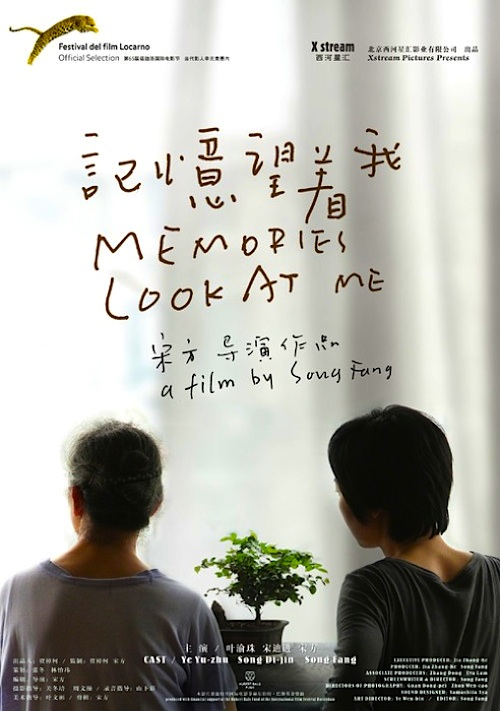
By Joe Bendel. It turns out you can go home again, but you’re likely to get antsy after awhile. A grown daughter and her aging but still vital parents gently reminisce in Song Fang’s Memories Look at Me, produced by trailblazing independent Chinese filmmaker Jia Zhangke, which screens tomorrow as a main slate selection of the 50th New York Film Festival.

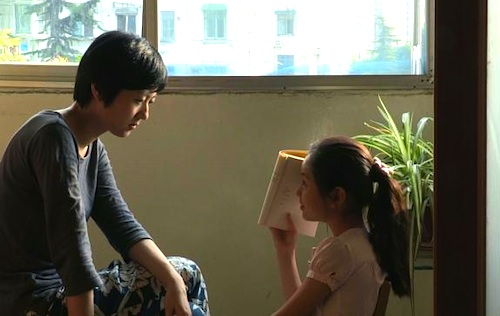
Song Fang plays herself, as do her parents, Song Di-jin and Ye Yu-zhu, as well as her brother, Yuan. Since they are really related, the on-screen relationships are all quite believable. Yet there is hardly a hint of family dysfunction here. Visiting from Beijing, Song stays in her parents’ Nanjing flat, which looks quite livable. Her brother drops by as does her bright young niece. Frankly, her parents appear to be the model of middle class respectability and their granddaughter should have a promising future ahead of her. Song, though, is less sure of her place in the world.

Memories is like a Digital Generation attempt at an Ozu movie. That is all very nice, but it leaves the audience with a raft of questions. First and foremost, how did her borderline bourgeoisie parents survive the Cultural Revolution, which they were surely old enough to witness first hand? Yes, they share memories of hard times, including hunger and hospitals, but are these oblique references to Maoist persecution or merely the experiences of those who have lived through an era of sharp economic contraction?  As a close second, the thirty-ish Song’s status as one of three siblings in One Child China begs for further explanation as well.

From "Memories Look at Me."

Nonetheless, Song presents an intriguingly oblique view of the new China, through discussions of the relative merit of different forms of insurance (isn’t the Party insurance enough for everyone?) and the hectic on-the-go lifestyle of Beijingers. Memories also subtly reminds audiences of the importance of family, in an almost Confucian sense, without ever remotely approaching didacticism.

Of the many hats writer-director-editor-co-producer Song wears, her lead performance as her pseudo-self is easily the most impressive. She has moments of simple, straight forward regret that are truly honest and powerful. However, her sense of pacing is a bit sluggish, making some of her mentor Jia’s more deliberate films seem almost break-neck by comparison. The DIY dGenerate digital cinematography is what it is. Those who have seen a number of Chinese art films will know what to expect. Well acted but a tough go for most viewers, Memories Look at Me is best saved for die-hard China-watchers and Sinophiles when it screens tomorrow afternoon (10/7) at Alice Tully Hall, as part of the 2012 New York Film Festival.

LFM GRADE: C+

Posted on October 6th, 2012 at 9:38am.

What a Crime: LFM Reviews The Paperboy @ The New York Film Festival + Opening Today

By Joe Bendel. In the Deep South, there is not much to do except have graphic sex and commit senseless acts of violence – at least, that is the portrait Lee Daniels chooses to paint in The Paperboy. However, the biggest mystery of his adaptation of Pete Dexter’s 1995 crime novel is why anyone would screen it as part of a gala tribute to co-star Nicole Kidman. Yet that is exactly what happened Wednesday night at the 50th New York Film Festival.

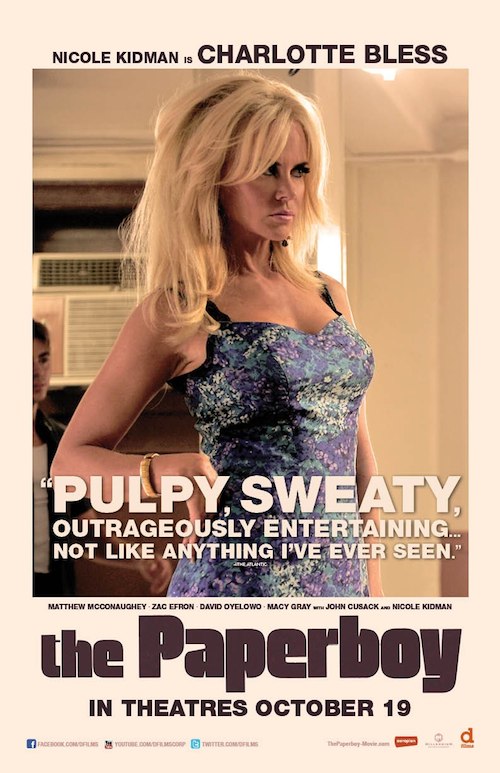
It is the late 1960’s or so in Florida’s swamp country. Tarty death row groupie Charlotte Bless has convinced a pair of Miami newspapermen to look into her “boyfriend” Hillary Van Wetter’s case. Ward Jansen is actually coming home to the town where his father W.W. publishes the local birdcage liner, and his younger brother Jack does not really do anything at all. Of course, the junior Jansen will fall head over heels for the sleazy femme fatale as he shuttles her, his brother, and Ward’s African American colleague Yardley Acheman about town.

There is a crusading journalist-legal thriller in Paperboy somewhere, but it often gets lost in Daniel’s heavy-handed but discursive narrative – told in flashback by the Jansen’s family maid, Anita Chester, who is never in any position to witness the events she relates. Instead, we see Bless going number one on young Jansen’s jellyfish stings and sit through several scenes of autoerotica. Eventually showing the audience Matthew McConaughey’s elder Ward Brother naked on the porcelain throne, Daniels will clearly spare us nothing.

This is bad movie, but Daniels does his best to dress up his lurid material with some visual flare and a soulful R&B soundtrack. It helps, but only so much. Too preoccupied with sex and race, Daniels often lets the crime story founder, distracted by his characters’ hang-ups.

Frankly, it is rather baffling why Kidman would accept the role of Bless. Regardless of her box office track record, she is one of the few actresses in Hollywood who can play it smart and classy, as well as sexy. However, the lingering aftertaste of Paperboy could damage that image. In truth, she is not bad revisiting To Die For terrain, provided viewers are okay with the obscure motivations and rash decision-making endemic to all the film’s characters.

Zac Efron is also adequate enough as young Jansen, largely reprising his bid for respectability in Me and Orson Welles, but with more sex and less earnestness. As the supposedly mercurial Van Wetter, John Cusack just looks like a sad Muppet. Deep dark secrets notwithstanding, McConaughey does his regular Lincoln Lawyer thing as Brother Ward. Most frustratingly, the great Scott Glenn is criminally wasted as old man Jansen.

Just a big humid mess, viewers will want to shower after seeing The Paperboy. Yet, it is hard to turn away from it, like the sight of a wrecking ball demolishing a building. Call it a career-wreck. Not recommended, The Paperboy opens today (10/5) in New York at the Landmark Sunshine and AMC Loews Lincoln Square, following its gala screening at the 2012 New York Film Festival.

LFM GRADE: D

Posted on October 5th, 2012 at 12:13pm.

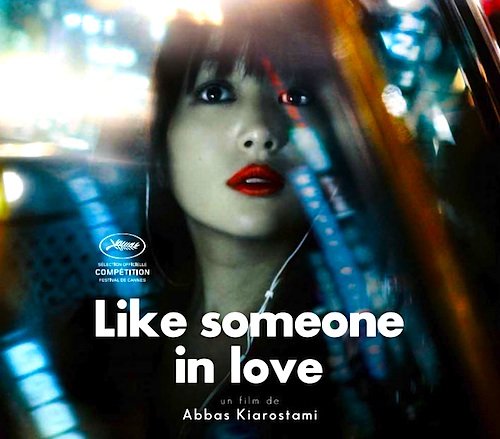
LFM Reviews Abbas Kiarostami’s Like Someone in Love @ The New York Film Festival

By Joe Bendel. Japan is a part of Asia, an obvious but convenient fact for Abbas Kiarostami. After the elegant Tuscan setting of Certified Copy, it seemed advisable to avoid the evil “West” for his next project filmed outside his native Iran. It was probably fortuitous, considering the official Iranian film establishment is indulging in a paroxysm of insanity, withdrawing its official foreign language Academy Award submission in protest of a YouTube video only a handful of people saw, the very year after the breakout victory of Asghar Farhadi’s A Separation. Yet, like Copy, there is still plenty of narrative gamesmanship afoot in Kiarostami’s Like Someone in Love, which screens during the 50th New York Film Festival.

Akiko does not appear to be inclined towards emotional involvement, so her escorting gig is probably a reasonable option to cover her college tuition. Putting off her boyfriend and blowing off her visiting grandmother, she is about to meet a new client. However, retired professor Takashi is only interested in the sort of chaste intimacy she constantly rejects. Nonetheless, she lets her guard down with the old man, falling asleep in his flat. The next morning he drives her to class, where their paths cross that of her boyfriend – and complications ensue.

Kiarostami clearly has an affinity for Japanese cinema, having paid tribute to Japanese auteur Yasujiro Ozu with his cinematic-essay Five Dedicated to Ozu. While there is definitely a kernel of the great master’s work in the way Prof. Takashi relates to Akiko, Someone is a distinctly colder fish. In fact, it presents a rather pessimistic view of humanity, compared to Ozu’s forgiving humanism.

For an apparently simple story, Someone guards its secrets vigilantly, which gets frustrating after time. Nonetheless, Kiarostami still coaxed some excellent performances from his small ensemble, despite the language barrier. Rin Takanashi (also excellent in the disturbing Isn’t Anyone Alive) takes a star-making turn, so vulnerable yet also such a passive-aggressive presence as the brittle Akiko. Conversely, Tadashi Okuno nearly approaches the pathos of Ozu’s aging protagonists as the lonely professor.

Stylishly lensed by Katsumi Yanagijima and featuring a soundtrack of moody jazz classics (the most apt being Duke Ellington’s “In My Solitude,” rather than Ella Fitzgerald’s rendition of the song lending its title to the film), Someone looks and sounds great, almost lulling the audience into a hypnotic trance. Yet, even with the fine work from Takanashi and Okuno, Kiarostami is just too demur and elliptical in his narrative approach to fully engage viewers. Accomplished in many ways, but certainly not a masterwork, Like Someone in Love is recommended mainly for the filmmaker’s dedicated admirers when it screens again this coming Monday (10/8) as a main slate selection of the 2012 NYFF.

LFM GRADE: B-/C+

Posted on October 5th, 2012 at 12:02pm.

A Grindhouse Classic Restored: LFM Reviews Wake in Fright

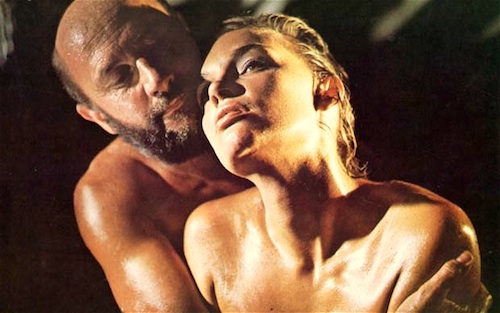
By Joe Bendel. The good citizens of Bundanyabba (“The Yabba,” like The Bronx or The Hague) will be happy to buy a drink for any visitor. It is a matter of civic pride. However, The Yabba seems to amplify the worst in human nature throughout Ted Kotcheff’s long lost grindhouse for the art-house Wake in Fright, which opens in all its restored glory this Friday at Film Forum.

John Grant’s heart would not be in teaching, even if he were posted to a school in Sydney. Unfortunately, he is financially bound to the outback during his term of service. With the semester break starting, he will finally be able to visit his attractive girlfriend in  the city. He just has one night to kill in the Yabba before continuing on his way. Oh, but there will be complications.

After losing his term’s pay in a glorified game of heads-or-tails, Grant falls in with a gang of lowlifes led by the town’s unapologetically boozy doctor, Tydon. A whole lot of alcohol will quickly hasten Grant’s slide into the dark side. At least he isn’t a kangaroo – because when Grant’s dubious new mates set out on a hunting trip, the carnage is famously disturbing.

Not exactly a thriller or a horror film, Wake is a brutally pessimistic morality play. In the Yabba, the veneer of civilization is rather chipped and faded. An intellectual like Grant ought to be a model of man’s progressive perfectability, but Doc Tydon and his running mates reduce him to his nasty, brutish core in a matter of days. Yet, it is never clear whether the Yabba yobs are really out to break him down or if he is just a puppet of fate.

Donald Pleasence and Slyvia Kay in "Wake in Fright."

Whether it is the blinding sun, the hallucinatory kangaroo hunt, or the stone cold humiliations meted down on Grant, Kotcheff maintains a visceral intensity throughout Wake, controlling the vibe like a master puppeteer and framing some powerful visuals. One of only two films to be twice selected for Cannes, it makes a convincing argument Kotcheff might just be the world’s most underappreciated auteur. Indeed, his oeuvre also includes Rambo: First Blood, Uncommon Valor, The Apprenticeship of Duddy Kravitz, and Weekend at Bernies, which is what we call a career in mi casa.

The late Gary Bond, who would eventually become an Andrew Lloyd Webber regular on the West End, sure looks like a tool who needs to be taken down a peg or two. Still, he takes his character to some pretty scary depths. Donald Pleasance plays his doctor-tormentor – which is so perfect, there is no need to explain further. In his last screen appearance, Chips Rafferty also adds further authentic flavor as Jock Crawford, the ostensibly welcoming local peace officer.

It is important to bear in mind no ‘roos were hurt for the sake of Wake. Kotcheff just tagged along with a regularly scheduled commercial hunting outing. The results stand in sharp contradiction to the Paul “Shrimp on the Barbie” Hogan image, assiduously crafted by the tourism bureau. Of course, for fans of Ozploitation the restored Wake is a can’t miss release. A surprisingly challenging work, Wake is recommended for all patrons of cult cinema when it opens this Friday (10/5) at New York’s Film Forum, with Kotcheff on hand to receive his overdue ovation at the 7:30 screening.

LFM GRADE: A-

Posted on October 5th, 2012 at 11:56am.