Fear the Tree: LFM Reviews Hollow on Tribeca VOD

By Joe Bendel. For W.G. Sebald, Suffolk was the perfect place for the famous walk and literary digressions that became The Rings of Saturn. For two dysfunctional couples, it will become a place of supernatural menace. The hanging tree will get its due in Michael Axelgaard’s found footage shocker, Hollow, which is now available through Tribeca Films’ VOD platforms.

Emma has come to close the country cottage of her beloved late minister grandfather. For company, she has brought along her smug fiancé Scott, her torch-carrying childhood chum James, and Lynne, the girlfriend he hardly seems to know. Evidently for estate reasons, Emma wants James to document the process as her videographer. Considering we are watching footage recovered by the East Anglia constabulary, it is safe to say their weekend does not go well.
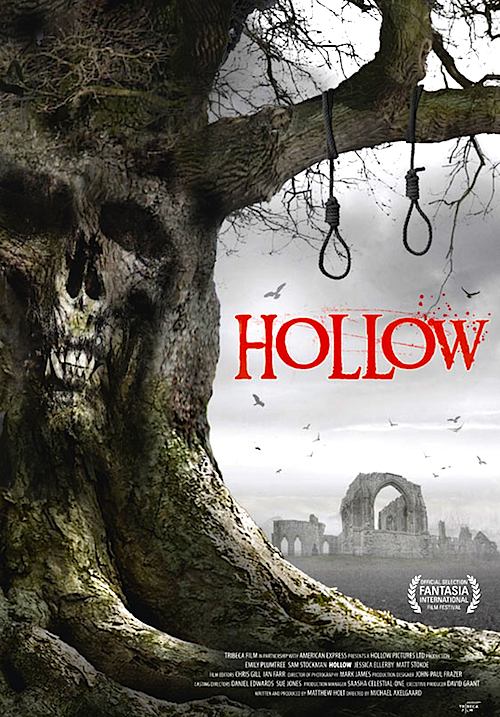
James’ camera was found in a large hollow tree that always gave Emma the creeps—and for good reason. According to legend, a monk and his illicit lover hung themselves there centuries ago. Ever since it has attracted suicidal couples like an evil magnet. Obviously, circumstances will lure the quartet back to the notorious spot, but not before they get high and indulge in a spot of strip poker. However, the power has already been shut off at the cottage, so they will rely on candles and the spotlight on James’ camera for illumination.

Frankly, the full backstory of Hollow is pretty distinctive and the sequences shot in the ruins of the nearby monastery are genuinely creepy. The James’ increasingly apparent instability further cranks up the tension. However, Axelgaard hews too closely to the Blair Witch playbook during the rather predictable third act. Still, producer-screenwriter Matthew Holt’s dialogue has a little snap to it (that’s a little, not a lot).

Whitechapel co-star Sam Stockman decently portrays James’ ambiguously off mental state without doing the full Norman Bates. As Scott, Matt Stokoe unleashes his inner cad, which is something. While Jessica Ellerby’s Lynne is not a total victim waiting to be strung-up, Emily Plumtree’s Emma sort of is, making the female characters a wash overall.

It is important to know Hollow is not exactly tactful in its treatment of religious themes. The late grandfather’s successor is definitely not portrayed in a sympathetic light. Likewise, Scott the hedonist shows a disrespect for the cross that would probably cause riots throughout the Muslim world had it been directed towards the Koran. Yet somehow, Americans will be able to shrug it off and get on to their lives (of course, there is also a strong likelihood he will pay for his excesses in proper E.C. Comics fashion).

Despite its flaws, Axelgaard shows a decent command of horror movie mechanics throughout Hollow. Flawed but watchable, it is now available for voracious genre fans via Tribeca’s on-demand services.

LFM GRADE: C-

Posted on October 5th, 2012 at 11:54am.
LFM Reviews Room 237 @ The New York Film Festival

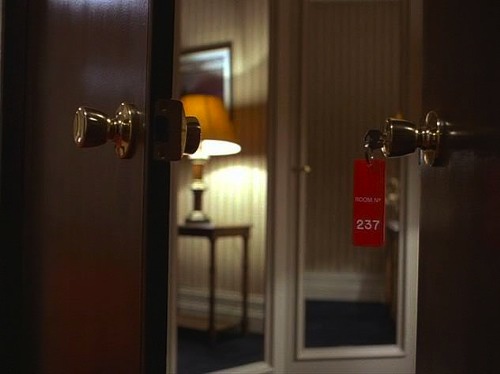
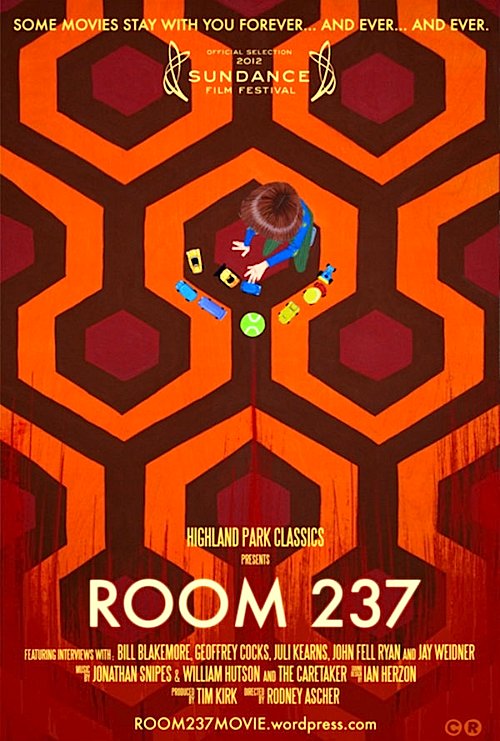
By Joe Bendel. The demarcation between unconventional online commentary and outright crackpottery is thin and porous. Five enthusiastic experts on Stanley Kubrick’s The Shining swerve back and forth over that line like a politician at a sobriety check in a documentary examination of the film and those who over-analyze it. People truly say the darnedest things about the 1980 horror classic in Rodney Ascher’s Room 237 (trailer here), which screens as part of the 50th New York Film Festival’s Cinema Reflected sidebar.

We never see Ascher’s five experts, but seriously, that is probably just as well. Several claimed to have been initially underwhelmed by the film on their first viewing, but started teasing out strange hidden meanings in the years that followed. Yes, Kubrick was known for his painstaking attention to detail, but some of Room’s disembodied voices often seem to be obsessing over continuity errors healthy viewers would never notice. At one point, Ascher holds a freeze frame, double-dog daring viewers to see the subliminal portrait of Kubrick the auteur supposedly embedded in the opening credit sequence.

Some commentators are truly masters of the logical quantum leap, arguing amongst other things, that The Shining is an allegory for the Native American genocide – due to the presence of a Calumet baking soda tin in the film. Yes, the Overlook Hotel is well appointed with Native American themed paintings and such, but that is not unusual for a mountain lodge in Colorado. Indeed, we know full well it was built atop a Native burial ground, generating all kinds of bad karma, in a manner predating Poltergeist. Nonetheless, perhaps Occam’s razor suggests that the spirits are just restless.

Still, some of the mysterious analysts make some intriguing points. Most notably, Juli Kearns mapped out every shot, proving the physical impossibility of the Overlook as the audience sees it. In effect, the hotel is just as much a labyrinth as the notorious shrubbery outside, but a malevolent, ever-shifting one.

Room 237 in Stanley Kubrick's "The Shining."

Room 237 is an amusing but affectionate tribute to cult film geekery. Ascher’s approach is simultaneously subversive and nostalgic, similar in tone to The S from Hell, his short film homage to Screen Gems’ hideous logo. His strategy to eschew talking heads also works rather well, relying instead on the visuals of The Shining, as well as other related films, such as the master’s Eyes Wide Shut.

One would not exactly call Room 237 convincing per se, but it is quite provocative and engaging, in a scruffily eccentric kind of way. Somewhat tricky to classify, it debuted at Sundance as part of their vaguely experimental New Frontiers track, was acquired by IFC for its Midnight line, but quite logically screens during NYFF as part of the Cinema Reflected sidebar. Recommended for all serious cult film fans, it plays today (10/4) and next Monday (10/8) as the 50th New York Film Festival continues.

LFM GRADE: B

Posted on October 4th, 2012 at 10:36am.

LFM Reviews Deceptive Practice: The Mysteries and Mentors of Ricky Jay @ The New York Film Festival

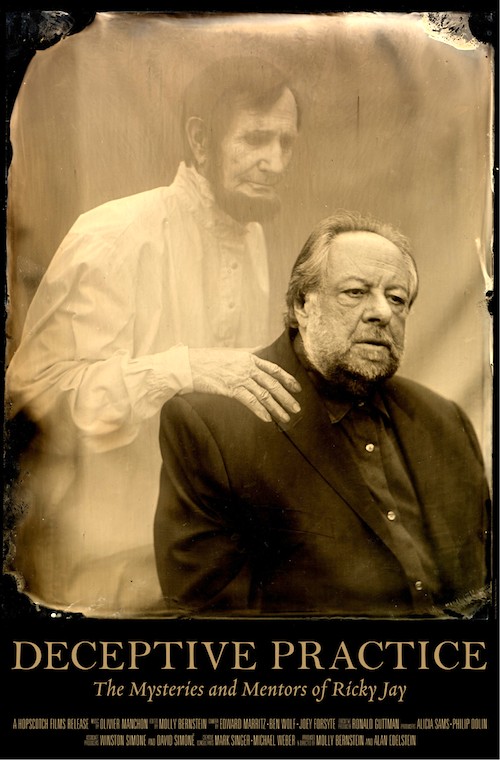
By Joe Bendel. Centuries ago, magicians tactfully called themselves jugglers. Both talents require dexterity, but the latter was less likely to get practitioners burned at the stake, or what have you. Just ask Ricky Jay. The illusionist and Mamet film regular is an expert in the history of his craft, as viewers quickly learn straight from the source in Molly Bernstein & Alan Edelstein’s documentary profile, Deceptive Practice: the Mysteries and Mentors of Ricky Jay, which screens as part of the 50th New York Film Festival’s On the Arts sidebar.

Ricky Jay can make a deck of cards sing and dance. He is also an old hand with the cup and balls. Magic effects with gambling implications are clearly his specialty, but he is well grounded in the entire tradition of illusionism. He had some talented teachers, beginning with his grandfather, an amateur magician who counted many professionals among his closest friends. It was from such storied figures as Al Flosso (the Coney Island Fakir) and Dai Vernon that Ricky Jay really learned the secrets of his craft.

While Ricky Jay is certainly seen doing plenty of effects (to use the preferred terminology), Deceptive is more about his work as a historian of magic and his relationships with his mentors and colleagues. Fortunately, the professional performer definitely knows how to tell a story. For the uninitiated, it also offers an intriguing peak into an exclusive but collegial world, where headliners and hobbyists rub shoulders and forge friendships based on their mutual passion for magic.

Deceptive has its serious moments, gingerly probing its subject’s strained relationship with his parents, but mostly it is just fun stuff. Featuring vintage clips of Ricky Jay performing on The Dinah Shore Show as well as interviews with the likes of David Mamet, Steve Allen, and other admirers of the magician, it is an entertaining introduction to the nimble-fingered card specialist. Recommended for his fans as well as those fascinated by colorful subcultures, Deceptive Practices screens this todday (10/4) as part of the 2012 New York Film Festival, with Ricky Jay himself  scheduled to appear in person.

LFM GRADE: B+

Posted on October 4th, 2012 at 10:34am.

LFM Reviews Life of Pi in 3D @ The New York Film Festival

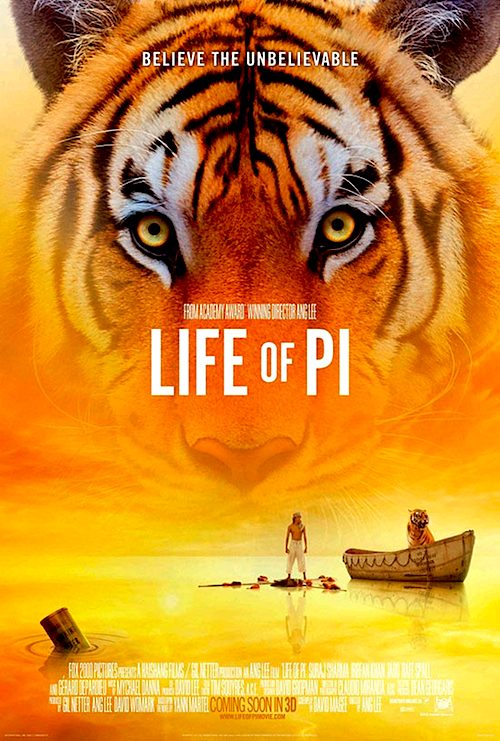
By Joe Bendel. In 3D, New Age platitudes look like they are coming straight at you. At least Taiwanese auteur Ang Lee makes them stunning to behold. The tiger does not hurt, either. Generating significant buzz, Lee’s they-said-it-couldn’t-be-done adaptation of Yann Martel’s Life of Pi officially opened the 50th New York Film Festival, now underway at several Lincoln Center venues.

Growing up in India’s French quarter, Pi Patel was named for a Parisian swimming pool, but embraced mathematics as a means of truncating the embarrassing Piscine. As a boy, religion was his hobby, practicing Hinduism, Christianity, and Islam Furr’s Cafeteria style (but no love for Buddhism, evidently). He also picks up a few animal training pointers from his zookeeper father, which will stand him in good stead.

Much to Patel’s chagrin, his father decides to immigrate to Canada, where he and his brother will enjoy better future opportunities. Tragically, their ship sinks en-route – which is how, through an unlikely set of circumstances, Patel finds himself sharing a life boat with the family’s ferocious Bengal tiger, Richard Parker.

Pi is not exactly a story of a boy and his tiger. Despite the character’s avowed spirituality, he never hopes to change the tiger’s nature. Richard Parker begins and ends the film as a wild beast. However, Patel will attempt to train him with the techniques he learned from his father, in order to survive. They will not cohabitate, though. Patel will spend most of his time in a makeshift raft lashed to the lifeboat, ceding the larger vessel to Richard Parker.

For those who were wondering where Ang Lee has been, he has spent the last four years or so in a wave tank in Taiwan. Not surprisingly, the man who helmed Crouching Tiger has a keen sense of how to incorporate 3D to best serve the on-screen action. As dramatic as the tiger sequences are, it is the way he realizes depth and scope that are particularly arresting. He and his team create a spectacular fantasy world in the middle of the ocean.

Unfortunately, the narrative settles into a second act doldrums, largely repeating its Robinson Crusoe-Grizzly Adams motifs in what seems like an endless loop. Yet, in contrast to the film’s frequent heavy-handedness, Lee’s payoff hits the mark, precisely because of his tasteful understatement.

Indeed, there are many elements that work quite well in Pi, particularly its nostalgic portrayal of French India. For many viewers conditioned by Jewel in the Crown to think of pre-1949 India solely in terms of the British Raj, this is fertile ground, worth exploring in further films. Lee also nicely establishes the Patel family history, especially the role played by his dashing honorary uncle, Mamaji (played by the distinctive Elie Alouf). The wrap-around framing device is also quite effective, featuring a relatively brief but moving performance from Irffan Khan as the adult Patel, relating his story to a Martel-like novelist. For hardcore film geeks, Pi even features an unusual aspect ratio shift.

Pi has its merits, but it also illustrates the perils inherent in films confined to lifeboats. Visually, it is quite the triumph, but Lee’s young cast-members are not all some more enthusiastic critics are billing them to be. Ultimately, much of Pi is like a 3D painting—dazzling to soak in, but rather static. Better filmmaking than story-telling, Life of Pi certainly deserves technical consideration during awards season. Recommended for those interested in 3D as legitimate creative medium, Life of Pi launched this year’s NYFF on Friday, with a theatrical opening already scheduled for November 21.

LFM GRADE: B-

Posted on October 1st, 2012 at 11:56am.

Preserving India’s Film Heritage: LFM Reviews Celluloid Man @ The New York Film Festival

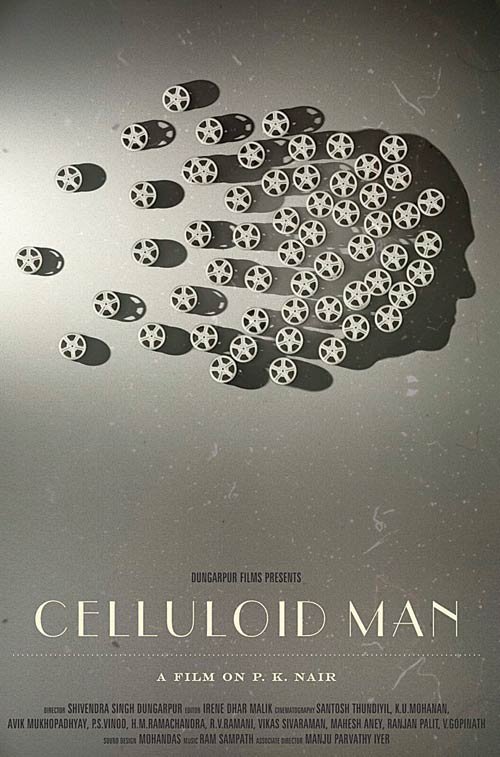
By Joe Bendel. Here in America, we have the Library of Congress, MoMA, and Martin Scorsese – amongst others – all working on behalf of film preservation. In India, they had P.K. Nair. Now retired, Nair was an institution unto himself. Shivendra Singh Dungarpur profiles the curator, while bemoaning the current state of the archive his subject tirelessly assembled in Celluloid Man, which screens as part of the Cinema Reflected sidebar during the 50th New York Film Festival.

Accepting a research position at the Film and Television Institute of India (FTII), Nair initially harbored his own filmmaking ambitions. However, with the formation of the National Film Archive of India (NFAI), Nair found his destiny as a archivist. For over a quarter of a century, he played a central role acquiring prints of historically significant Indian films, representing all of the country’s regional and linguistic traditions, as well as prints of important works from around the world, for FTII students and faculty to analyze and devour.

Following lead after lead, Nair tracked down many of the only surviving prints, or in some cases mere fragments, of what were popular and critical successes of their day, but are now largely lost. Of an estimated 1,700 films produced during India’s silent era, only nine have been saved for posterity—entirely through Nair’s efforts.

Indeed, Celluloid is pointedly critical of the lack of attention and resources devoted to the preservation and restoration of classic cinema in contemporary India, which is something of a shock given Bollywood’s economic vitality and its attendant publicity machine. Yet, according to Celluloid’s interview subjects, after Nair’s retirement, the NFAI has fallen into a dreadful state of neglect and Nair himself has essentially been declared persona non grata, for internal political reasons.

Film preservationist P.K. Nair.

That is a reasonably intriguing story, particularly for those well versed with classic Indian cinema traditions. The problem with Celluloid is its unwieldy one hundred sixty-four minute running time.  Time after time, talking heads echo each other, almost verbatim, to emphasize points under discussion. It is a quality cast of commentators, including Krzysztof Zanussi, Naseeruddin Shah, and Shyam Benegal – we just get it already.

An active supporter of the BFI’s restoration efforts, Dungarpur obviously takes this subject to heart. He also incorporates some interesting film clips into Celluloid, even for viewers not so deeply steeped in Indian film history. While some disciplined pruning would have tightened and strengthened the overall package, it is nonetheless a worthy cinematic tribute. Superior to These Amazing Shadows, the documentary tribute to the work of National Film Registry, but lacking the dramatic heft of Golden Slumbers, Davy Chou’s moving elegy for the Cambodian film industry destroyed by the Khmer Rouge, Celluloid Man fits quite nicely into this year’s Cinema Reflected sidebar. It screens this Thursday (10/4) at the Francesca Beale Theater as part of the 2012 NYFF.

LFM GRADE: B-

Posted on October 1st, 2012 at 11:54am.

LFM Reviews Beyond the Hills @ The New York Film Festival

By Joe Bendel. Alina is either tragically co-dependent or possessed by the Devil. Radically different measures would be required depending on the diagnosis – but either way, she will visit a host of trials upon her girlfriend Voichita and her fellow Orthodox convent residents in Cristian Mungiu’s Beyond the Hills (see clip above), Romania’s latest official best foreign language Oscar submission, which screens as part of the main slate of the 50th New York Film Festival.

Meek and pious, Voichita appears perfectly suited to a cloistered life. Alina is a different story. However, since her former friend has no real family, Voichita arranges for her to stay temporarily in her quarters. Yet as soon as she arrives, Alina starts badgering her former friend to leave with her (see clip above). Gently rebuffing her, Voichita watches in alarm as her visitor’s behavior becomes increasingly erratic and disruptive, eventually manifesting in several public meltdowns. The priest and the nuns do not want to abandon a soul in need, but after the medical establishment washes their hands of Aline, there seems to be only one remaining course of action: exorcism.

Mungiu implies a great deal in Hills, very definitely including the nature of Aline and Voichita’s relationship, while leaving just as much open to interpretation. It would also have been very easy to portray the priest and good sisters as stereotypical zealots dangerously convinced of their own infallibility. However, Hills constantly reasserts the messy humanity of each character. In fact, the ambiguity of the “possession” gives the film quite a distinctive flavor. Frankly, after about two hours of Aline acting out, most viewers will be ready to throw their lot in with the nuns, holding down the devil-woman as the priest reads the purification scriptures over her.

From "Beyond the Hills."

With a running time of 150 minutes, Hills often feels like what it is: a product of the Romanian New Wave of independent filmmaking. It probably would not have killed anyone had Mungiu shaved off twenty minutes or so. Nonetheless, he elicits several riveting performances, the most notable being Cosmina Stratan as Voichita, the confused innocent. As Alina, Cristina Flutur is also scarily convincing engaging in all manner of aggressive, self-destructive behavior. Yet it is Valeriu Andriută’s work as the priest, simultaneously severe and sympathetic, that really forestalls snap audience judgments.

Based on a novelized account of a real life incident in Moldova, Hills is not a kneejerk attack on Eastern Orthodoxy. Nonetheless, as the Russian Orthodox Church hemorrhages international credibility due to its perceived alliance with the Putin regime, it is hard not to invest Hills with an additional layer of meaning, whether or not Mungiu intended it. Given its ambiguous but evocative treatment of monastic life and supernatural possession, Beyond the Hills would be a fascinating film to see in conjunction with Jerzy Kawalerowicz’s Mother Joan of the Angels. Challenging in multiple ways, Beyond the Hills is recommended for hardy cineastes with at least a couple of Romanian New Wave films already under their belts when it screens tomorrow (10/1), next Sunday (10/7), and the following Thursday (10/11), as part of the 2012 NYFF.

LFM GRADE: B+

Posted on October 1st, 2012 at 11:52am.