LFM Reviews The Bullet Vanishes

By Joe Bendel. In the 1930’s, forensic science had not really caught on yet with the Shanghai police force. However, Song Donglu is no ordinary copper. As an assistant prison warden, his interest in criminal psychology spurred him to challenge many convictions. To be proactive, or to spare themselves further embarrassment, his superiors have transferred him into the field to help the Shanghai police get it right the first time. He will be initiated with a particularly sinister case in Lo Chi-leung’s The Bullet Vanishes (trailer here), which opens this Friday in New York.

There has been a shooting at the local bullet factory—several actually. It might be a testament to their craftsmanship, except the bullets in question seem to disappear upon entry. Many of the workers believe it is really the curse of a worker unjustly accused of stealing product. The autonomous factory owner dealt with the case per their traditional method: a friendly game of Russian roulette. When those who wronged the woman start turning up dead, the other workers get a bit spooked, setting production even further behind.

Song does not believe in ghosts. He is a man of science. Still, he has some rather mysterious circumstances on his hands, like corpses with gunshot wounds but no discernible bullets to analyze. Before long, he will also have to wrap his head around a classic locked room murder. At least his new partner, Guo Zhui, has his back. They can’t say the same for their superior officers.

Mi Yang in "The Bullet Vanishes."

Though there are a lot of familiar Holmsian elements in Bullet, Lo and co-writer Yeung Sin-ling consistently give them a fresh spin. Perhaps most intriguing is Song’s ambiguous relationship with a convicted black widow murderess (played by a glammed down but terrific Jiang Yiyan), who could either be his Irene Adler or Hannibal Lecter. Determining which could be fertile ground for a sequel.

In fact, Bullet is pretty unusual for a big screen murder mystery, because it values atmosphere and procedural process (as antiquated as it might be by our standards) over formulaic chases and phony suspense. Viewers might have a general sense of where it is headed, but at least the film makes an effort to hold onto its secrets. There are still several well mounted period action sequences sprinkled throughout the film, but the overall vibe of Bullet is refreshingly cerebral.

With Song, Lau Ching-wan brings to life a great character. Yes, he is a bit socially awkward at times, but the detective is his own man, far more compassionate than Holmes ever was, particularly in his scenes with the mariticidal inmate. As the more action-oriented Gui, Nicholas Tse is in his element, also developing some nice romantic chemistry with Mi Yang’s Little Lark, the fortune teller. Together as cops with contrasting styles, Lau and Tse have an appealing give-and-take rapport going on. As for Boss Ding, the primary villain and focus of viewer scorn, Liu Kai-chi certainly is not shy chewing the scenery, vaguely suggesting elements of both the psycho and comedic Joe Pesci. That is not a bad thing.

From Chan Chi-ying’s stylish noir cinematography to Stanly Cheung’s natty 1930’s-era costumes, Bullet is a great looking film. It is also smart and old-fashioned in a good way. Recommended with enthusiasm for mainstream mystery fans, The Bullet Vanishes opens tomorrow (8/31) in New York at the AMC Empire and Village 7, as well as in San Francisco at the AMC Cupertino and Metreon, courtesy of China Lion Entertainment.

LFM GRADE: A-

Posted on August 30th, 2012 at 1:24pm.
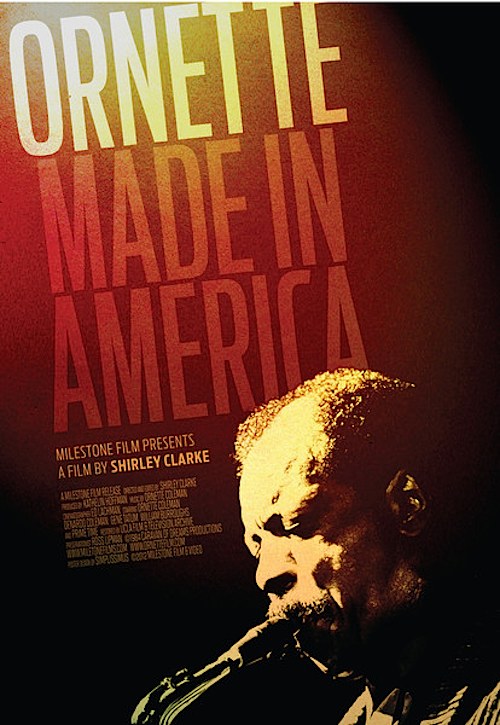
LFM Reviews Ornette: Made in America

By Joe Bendel. Ornette Coleman won the Pulitzer Prize for musical composition and performed live on Saturday Night Live. Although neither event is covered in Shirley Clarke’s classically idiosyncratic documentary-profile, viewers still get a memorable sense of the artist and his music in Ornette: Made in America, which opens in New York this Friday at the IFC Center, as part of Milestone Films’ Project Shirley restoration and rerelease program.

Explaining Coleman’s place in the jazz world would take some doing, especially in 1985, before his late career Grammy and Pulitzer accolades finally came cascading in. Coleman was one of the pioneers of the Free Jazz movement, whose legendary engagement at New York’s Five Spot club sharply divided the jazz world. However, you will not find his creation story here. Instead, Clarke’s approach to Coleman the man and the musician is deeply rooted in the then-current moment, yet is also rather timeless.

In the mid 80’s, the establishment (broadly defined) was just starting to understand that Coleman was a force to be reckoned with. As the film opens, the mayor of Fort Worth presents Coleman with a copy of the key to the city (the original, he explains, had been sent up into space or something), in the hours before the alto saxophonist-multi-instrumentalist will debut Skies of America, a major new composition integrating a symphony orchestra with his avant-garde electric combo Prime Time. Hizzoner’s speech might strike New York hipsters as a bit corny, but his drummer-manager-son Denardo is quite pleased his father is finally being recognized.

In fact, there is something all-encompassing and Whitmanesque about Coleman’s deeply blues-influenced music that is perfectly represented by a title like Skies of America, as well as the mayor’s patriotically Texan remarks. Shrewdly, Clarke uses this fairly accessible work as the musical centerpiece for the film, much like Sonny Rollins’ concert premiere of Concerto for Tenor Saxophone and Orchestra dominates Robert Mugge’s Saxophone Colossus.

There was probably no documentarian better suited to Coleman’s personality and aesthetic than Shirley Clarke. Her style of filmmaking perfectly reflects his music—fragmentary and baffling to the willfully uninitiated, but with a strong compositional conception underlying it all. Her visual sensibility might be far from infallible (a kid with an iPad could put her space age special effects to shame these days), but she demonstrates a rock solid command of Coleman’s acutely syncopated rhythms, and had a keen insight into his creative milieu.

Indeed, except for perhaps Clint Eastwood, no filmmaker can equal Clarke’s position as a filmmaker whose work promotes and is informed by America’s great original art form. The Connection, which launched Project Shirley, is a milestone (if you will) of independent filmmaking, in large measure due to Freddie Redd’s absolutely classic tunes. Likewise, her viscerally naturalistic social issue drama, The Cool World, derives considerable power from Mal Waldron’s soundtrack (which in turn was rerecorded by Dizzy Gillespie’s combo for the official OST LP version). There was even the non-narrative short, Bridges-Go-Round, featuring the music of Teo Macero. Ornette is sort of a summing up of her jazz evangelism, shining a spotlight on one of the most controversial yet at the time underappreciated artists to ever set foot on the bandstand.

Time and again, Clarke alternately emphasizes Coleman’s blues roots and hardscrabble early life (even filming young actors portraying the alto saxophonist in dramatized vignettes of his formative years) and his compulsively forward looking – almost futuristic – orientation. The fact that most of Coleman’s philosophizing makes little to no sense is hardly important. No, he never really explains his theory of harmolodics in Ornette and she wisely never pushes him.

The Coleman seen in Ornette matches the accounts I have personally heard from musician-friends who have had conversations with him and say it was the coolest thing ever, even though they have no idea what he said. Any film conveying that experience is worth seeing, but Ornette has considerably more to offer. A highly entertaining time-capsule of a jazz documentary, Ornette: Made in America is recommended for anyone who wants their ears stretched a bit when it opens this Friday (8/31) at the IFC Center.

LFM GRADE: A-

Posted on August 28th, 2012 at 12:15pm.

LFM Reviews Calm at Sea @ The 2012 World Film Festival of Montreal

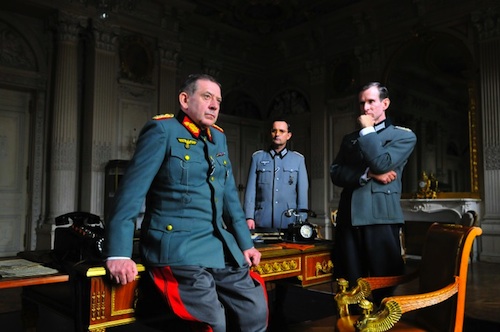
By Joe Bendel. It is just about unifying Europe—or at least a handful of refined National Socialist officers would like to believe. Of course, it is hard for them to kid themselves when Berlin is ordering mass reprisal executions. Based in part on the diaries of the old line German war hero-novelist Ernst Jünger’s diaries, Volker Schlöndorff dramatizes a notorious episode of Vichy-era French history in Calm at Sea, which screens as part of the 2012 World Film Festival of Montreal.

On the orders of the Communist French resistance faction, two high-ranking German officers are to be assassinated. They realize the occupying Germans will likely retaliate. In fact, that is part of the point. It will help radicalize the general populace. Unfortunately, one of the shoddy guns supplied to the triggermen jams, leaving a target alive. While the actual gunmen escape, the occupying power intends to set an example. If the partisans in question are not turned over to the authorities, one hundred “hostages” will be executed.

The figure of one hundred was the result of a bit of diplomatic negotiating on the part of Jünger and his superior officer, cutting down the literal death list from one hundred fifty. These are not randomly selected names—they are political prisoners, roughly divided between Gaullists and Communists, like the seventeen year-old Guy Môquet, who would become a martyr figure for French leftists.

From "Calm at Sea."

Surely, that should not be a spoiler to anyone. Indeed, Sea becomes something like the Môquet passion play in its slow, overwrought third act. That is a bit of a shame, because the second act offers a surprisingly insightful and intriguing perspective on some pretty familiar cinematic terrain. In addition to clearly suggesting the mass executions were exactly what the Communist leadership had in mind (except more so), several of their imprisoned partisans openly question whether allying themselves with the National Socialists during the Hitler-Stalin alliance was possibly a mistake in retrospect. You think maybe? Likewise, Jünger pointedly asks if mass executions will prove to be counter-effective as they try to win French hearts and minds. Hmm, perhaps. Yet, the disdainful Jünger’s reluctance to stick his neck out is in turn challenged by the sophisticated French woman he is pursuing—the only sort of conquest that interests him.

A French-German television co-production, Sea is still relatively cinematic and boasts a big screen cast. As the reluctant Nazi Jünger (officially rehabilitated in the 1950’s), Ulrich Matthes is smart, cool, and riveting in every second of his screen time. Veteran French character actor Jean-Pierre Darroussin (the hardware merchant in The Well-Digger’s Daughter) also elevates the otherwise disappointing endgame, appearing as an anti-Vichy Catholic priest, who compassionately ministers to the doomed men, by not ministering, per se. Indeed, his work is welcome and notable as a sympathetic depiction of a man of the cloth. Unfortunately, the prison ensemble is stuck portraying symbols rather than characters.

At its best, Sea is a fascinating film, critically exploring the murky psyches of conflicted Germans like Jünger and the collaborating gendarmerie France is still apologizing for. However, it can also be as blatantly manipulative as a made-for-TV movie – which in fact, it is. Though not nearly as powerful as Schlöndorff’s underappreciated Polish Solidarity docudrama Strike, Calm at Sea is an interesting little film with somewhat more merit on its side. Worth considering, it screens today, Wednesday, and Thursday (8/28-8/30) during this year’s World Film Festival in Montreal.

LFM GRADE: B-

Posted on August 28th, 2012 at 12:14pm.

Drinking in The Wheel of Life: LFM Reviews Samsara

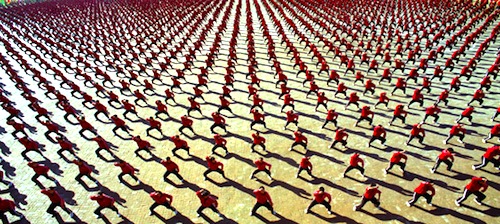
By Joe Bendel. Shooting footage in twenty-five countries around the world, documentarian-visual essayists Ron Fricke and Mark Magidson must have met thousands of fascinating people. Yet, you will not meet any of them on a personal level in their latest 70mm spectacle. Their aesthetic favors the people en mass and dehumanized over messily unpredictable individuals. As their follow-up to 1992’s Baraka, director-cinematographer-co-writer-co-editor Fricke & producer-co-writer-co-editor-co-musical director Magidson’s Samsara takes viewers to some awe-inspiring sites all over the globe, intending it all to signify the great cosmic wheel of life, as the title translates from Sanskrit. Those who want to see it should see in a theater, the way it was meant to be seen, when Samsara opens today in New York.

Think of this as The Wall for politically correct Volvo-driving health nuts. Deeply steeped in Eastern religious traditions, Samsara captures some amazing images, such as the opening Balinese dancers, the archaeological wonderland of Petra, and the Tibetan Buddhist monks of Thikse creating impermanent sand mandalas. It would probably deepen any viewers’ appreciations to hear the dancers discuss their incredibly disciplined collective choreography, or to have the monks explain what the mandalas symbolize according to their faith, but Fricke and Magidson are not going there. There will be no talking and no text in the film.

Samsara brings to mind an old airline commercial from years ago, in which a charming old Southwestern artist tells viewers that the young painters who move to New Mexico and are blown away by the landscape are missing the point—it is the people who are really interesting. Fricke & Magidson are like those landscape painters, duly filming the sweeping awesomeness of nature. Yet, in a way, this makes things so much neater and tidier. When images of the disfigured are contrasted with scenes of armament factories, we cannot help but get the unsubtle message. Yet, the more we knew about individual cases might make it far harder to indulge in sweeping generalizations.

From "Samsara."

Some of the sequences in Samsara are absolutely arresting, like the shots of the Bagan temples in Burma, which did indeed grant the filmmakers access, after quite a bit of diplomatic and bureaucratic hoop-jumping. Sadly, when North Korea said “no,” Kim really meant “no,” so Fricke and Magidson were unable to film one of the giant choreographed stadium airangs. That’s too bad, because it would have fit right in with the rest of Samsara.

Without question, Samsara is lovely to look at (except when it is being deliberately ugly). There was obviously a conscious intent guiding the assemblage of the images, but they are still just images. Ultimately, the film is all surface and precious little substance. Any deeper meditations it might spur are solely due to viewer’s highly individualistic responses to the natural, sacred, and profane visuals it presents. Recommended just for those who enjoyed previous wide-screen picture books, like Baraka and Godfrey Reggio’s Koyaanisqatsi (on which Fricke served as cinematographer), Samsara opens today (8/24) in New York at the Landmark Sunshine.

LFM GRADE: B-/C+

Posted on August 24th, 2012 at 10:37am.

LFM Reviews Manhunt @ The 2012 World Film Festival of Montreal

By Joe Bendel. Corporal Wydra is the designated executioner in his Polish resistance unit. He is a sensitive soul, yet very good at his job. This is the contradictory nature of war and it will only get more treacherous for the soldier in Marcin Krzyształowicz’s Manhunt, which screens today and tomorrow as part of the 2012 World Film Festival of Montreal.

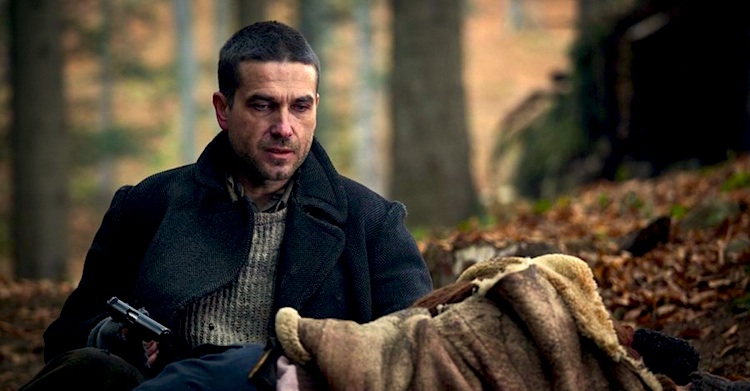
Captured National Socialists are lucky if Wydra is the man taking them out. He is not a sadist or a vengeance taker. He is a freedom fighter with a grim task to complete. We get a good feel for the complicated man at work as the film opens. His next assignment, though, will be considerably thornier. He is to go into town and bring back a prominent businessman turned informant, the hard way or the easy way, for trial and presumed execution. However, Wydra has some decidedly personal history with the thoroughly compromised Henryk Kondolewicz.

Meanwhile, a member of the unit has betrayed Wydra’s comrades, funneling information through the very snitch he has been dispatched to deal with. The Corporal will be too late to help his fallen brothers-in-arms, but he will be able to put together the pieces and possibly dispense some retribution.

From "Manhunt."

In fact, Manhunt is a bit of a narrative jigsaw puzzle, constantly flashing backwards and forwards, providing more context with each successive time shift. Actually the crosses and double-crosses are relatively straight forward, but the existential depth of Wydra’s character really distinguishes Manhunt from thematically related WWII dramas.

While not completely dissimilar to the grizzled Home Army veteran he played in Wojtek Smarzowski’s Rose, Marcin Dorociński is riveting nonetheless as the massively brooding Wydra. Chillingly convincing when getting down to business, he also quite compellingly hints at the pain eating his Wydra’s soul. He dominates the film and that’s fine.

In the tradition of Melville’s Army of Shadows, Krzyształowicz’s screenplay explores the moral ambiguity and constant uncertainty of the resistance milieu. Like Melville, he understands and even pardons his characters’ betrayals. Aptly suiting the tense vibe, cinematographer Arkadiusz Tomiak’s dark, musty look vividly suggests the sense of trooping through a dank forest. This is definitely war cinema, gritty and unromanticized. It is also a very good film, well worth seeing when it screens twice today and once on Saturday (8/25) during the World Film Festival in Montreal.

LFM GRADE: B

Posted on August 24th, 2012 at 10:36am.

Michael Biehn Goes Grindhouse: LFM Reviews The Victim

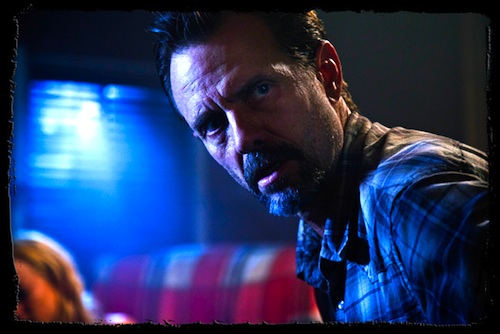
Michael Biehn in "The Victim."

By Joe Bendel. People say they love nature, but do you know who actually lives out in the wilderness? Freaks, that’s who. Nonetheless, a woman running for her life in the middle of nowhere can hardly be choosey about where she finds refuge. Proudly self-identifying as a retro grindhouse movie, Michael Biehn’s The Victim (trailer here) opens this Friday in New York.

In Victim’s world, women like Annie and her friend Mary can only be one thing: strippers. They are not bad people. They just enjoy the fast life. Unfortunately, when they start “partying” with two crooked cops, Mary is killed in a Very Bad Things-style mishap. Of course, Cooger the narc, and the super-connected Henderson, now have to shut up Annie – permanently.

Tearing through the woods, she ends up at the cabin belonging to Kyle, a smart, but seriously twitchy middle-aged anti-social loner. As you might guess, this dude seems to be hiding something. Yet, against his better judgment, he becomes Annie’s protector. At least she is nice enough to throw herself at him during quiet moments.

The truth is The Victim’s big twist is so deliberately obvious, it almost forgets to reveal it. Perhaps even more surprisingly, the film is not nearly as violent as one might expect. Kids still have no business watching it, though. Not a slasher film nor torture porn, The Victim is basically a coke and moonshine fueled cat-and-mouse thriller with a rather sinister shoe constantly poised to drop. Yet, it sort of works on its own sleazy terms.

Jennifer Blanc and Danielle Harris in "The Victim."

Kyle the misanthrope is basically the kind of role writer-director Biehn now specializes in, and indeed he does his thing with plenty of grizzled attitude. He certainly looks like a cat to avoid, whereas Jennifer Blanc and Danielle Harris certainly look like strippers, for what that’s worth. However, their frequent flashback scenes ring with the thudding sound of unintentional comedy. Yet that is nothing compared to some of the cheesy, over-produced pop songs inappropriately strewn throughout the soundtrack.

The Victim openly invites bad karma by liberally quoting from Clint Eastwood’s The Unforgiven—not a comparison they should invite. To be fair, though, there are a few cleverly written bits of dialogue. Basically, this film is for everyone who wants to see Michael Biehn and two other scumbags go at it like old school hill people. Entertaining in a way, but impossible to recommend to anyone accept hardcore fans of hermitsploitation, The Victim opens today (8/24) in New York at the Quad Cinema.

LFM GRADE: C

Posted on August 24th, 2012 at 10:36am.