LFM Reviews The Revenant

From "The Revenant."

By Joe Bendel. If a stoner rises from the dead as a zombie, would anyone notice the difference? Two slackers try to carry on as usual when one suddenly finds himself undead and rather parched, but the constant proximity with death has serious repercussions in D. Kerry Prior’s meathead buddy horror mash-up, The Revenant (trailer here), which opens today in New York.

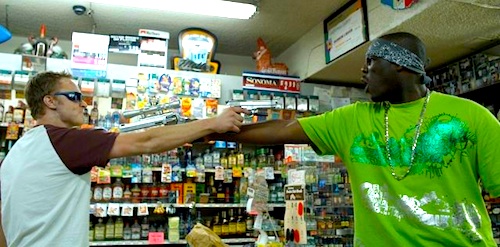
Bart Gregory would like to think he shipped off to Iraq for idealistic reasons, but the truth is he was trying to avoid making a commitment to his longtime girlfriend Janet. Thanks to a rather murky ambush, he won’t have to. It would seem Gregory is dead as a doornail, but he is actually undead. Staggering out of his grave and into his loser best friend Joey Leubner’s crash pad, Gregory struggles to come to terms with his new existence as a “revenant.” He can no longer keep down solid food, but it seems vast quantities of pot and booze are A-OK. For sustenance, though, he will need human blood.

No problem—this is Los Angeles. There is an unlimited supply of violent low-lifes in need of killing. Suddenly, the boys are vigilante media sensations. Unfortunately, Gregory and Leubner are really sloppy about their hunting practices, leading to all kinds of bad karma—and of course, gore.

Though it opens in Iraq, Prior largely resists the urge to pontificate on current events. These are not allegorical zombies. That’s the good news. However, The Revenant really does not have any ideas to take the place of didactic soap-boxing. Prior offers several scenes of truly inspired gross-out humor, but the in-between periods are rather slack and dreary.
From "The Revenant."

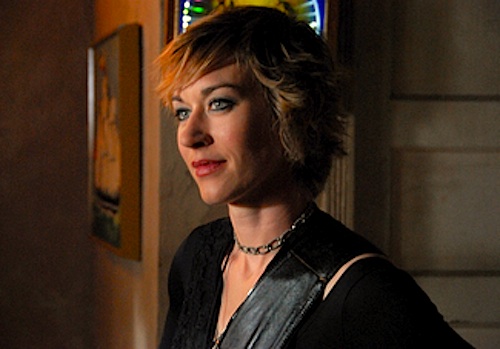
Still, David Anders plugs away admirably as the nice guy walking dead, keeping viewers somewhat invested in the grisly story. On the other hand, before it is over, the audience will be ready to rise up collectively, like pitchfork wielding peasants, to put a stake through the heart of Chris Wylde’s annoying as all get-out Leubner.

The Revenant built up quite a rep with cult movie fans through a series of well received midnight festival screenings. Frankly, that is the best venue for the film, catering to lubricated crowds primed to laugh and holler. It simply will not hold up as well for comparatively staid regular theatrical audiences. The Revenant has its moments, but not nearly enough for a ringing endorsement when it opens today (8/24) in New York at the Cinema Village.

LFM GRADE: C-

Posted on August 24th, 2012 at 10:35am.

Chinese Adoptees Coming to Terms with Their Identity: LFM Reviews Somewhere Between

By Joe Bendel. In recent years, China’s greatest export has been the best and brightest of the next generation. They call them girls. China’s One Child Policy, cultural preferences, and dire rural poverty created a perfect storm of little orphaned girls. Over 100,000 have been adopted worldwide, out of which over 80,000 are now Americans. Four such teenaged adoptees are profiled in Linda Goldstein Knowlton’s Somewhere Between, which opens this Friday in New York.

Few adoptees really expect to find their birth parents. It is a matter of simple math: over a billion people and scant documentation. Nonetheless, many will try to trace their roots, not necessarily to reconnect with the parents that let them go, but to help come to terms with who they really are. Jenna, Haley, Ann, and Fang (or “Jenni”), the primary POV figures in Somewhere, are indeed high achievers. Some admit part of their drive stems from the lingering feeling of abandonment—that is a loaded word in the film, but it is hard to get around it. However, it may come to pass China will regret losing out on their talents and those of scores of young women just like them. While the flow of adoption has slowed, the impact on upcoming Chinese generations will be felt in years to come.

From "Somewhere Between."

Perhaps the greatest revelation in Somewhere is the continuing engagement of not just the girls but their entire families on the issue of Chinese orphans. One Evangelical family has formed a nonprofit to deliver much needed supplies to the ill-equipped provincial orphanages. Yet, the film’s most moving subplot by far involves Fang and her family’s efforts first to fund physical therapy for a little disabled girl, and then to help facilitate her placement with an American family ready and willing to provide the care she needs.

Unlike in most documentaries, the Evangelical community is presented on balance quite positively in Somewhere. They are the adopting demographic, after all. The kids at school can still be insensitive jerks, though. Hopefully, Knowlton’s film will lead to greater understanding. Indeed, viewers should realize girls like the Somewhere quartet will be their children’s future classmates or maybe even their own daughters.

Smart and uncommonly together, each of the featured young women is worth meeting on-screen. Clearly they were comfortable opening up to Knowlton, who set out to make the film to provide her own adopted Chinese daughter some points of reference for when she is old enough to start grappling with these issues. Well intentioned, emotionally engaging, and never polemical, Somewhere Between is recommended rather strongly when it opens this Friday (8/24) in New York at the IFC Center, with Knowlton and several participants appearing at select screenings throughout the weekend.

LFM GRADE: A-

Posted on August 21st, 2012 at 10:55am.

Preserving Tibetan Culture Post-Communist Invasion: LFM Reviews Digital Dharma @ DocuWeeks 2012

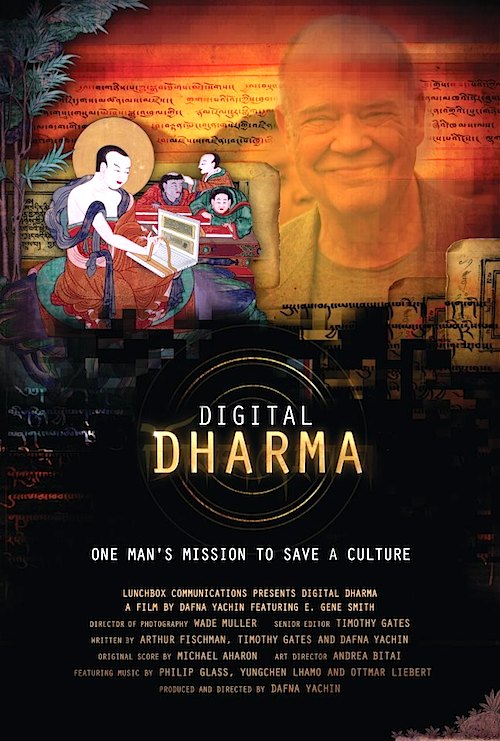
By Joe Bendel. The holy texts of Tibetan Buddhism are not very portable. That is not necessarily a problem if you are studying peacefully in a monastery, but it is a serious drawback if your country is invaded by an imperial power. Such was indeed the fate of Tibet. Following the 1950 Communist invasion, centuries of Tibetan culture were at of risk of being lost forever. However, one American scholar successfully spearheaded a drive to digitize, translate, and disseminate thousands of sacred and secular Tibetan texts. His campaign is documented in Dafna Yachin’s Digital Dharma (trailer here), which is currently screening during DocuWeeks New York 2012.

The late E. Gene Smith was a perennial student who specialized in East Asian languages with little commercial application. Tibetan was perfect for his purposes. Yet, as he immersed himself in the culture, he became increasingly alarmed about its chances for survival. After the initial invasion and again during the Cultural Revolution, monasteries were ruthlessly razed and books were systematically burned. As a result, many critical texts were completely unavailable to the Tibetan Buddhist Diaspora.

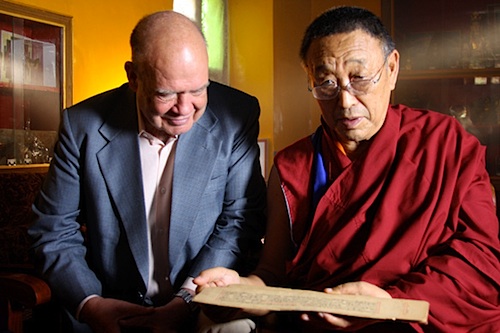
Fortunately, most of the books still survived, hidden away to avoid the Communist rampages. In the 1960’s, as a Library of Congress field worker in non-aligned India, Smith catalogued and facilitated the publication of hundreds of volumes smuggled out of Tibet. Retiring from the Federal government, Smith eventually co-founded the Tibetan Buddhist Resource Center, which would pursue the mission of digitization and translation, insuring that the wisdom of Tibet will survive and spread across the world.

E. Gene Smith (left), preserving Tibetan cultural history.

Clearly, Yachin nearly venerates the Tibetologist as if he had been a lama himself. While Smith surely did invaluable work preserving the endangered Tibet culture, he was not infallible. In fact, the 1960’s era pacifist seems to have carried some residual ideological baggage, leading to the somewhat debatable decision to leave his collection to the Southwest University for Nationalities in Chengdu, Sichuan. Smith was determined to return the ancient documents to the Tibetans, laudably considering himself only a temporary caretaker. Yet, just how trustworthy a caretaker a Chinese chartered institution will be surely remains to be seen, particularly considering earlier efforts to transfer his collection were forestalled by the 2008 riots that swept across Tibet. At least the contents of his collection are now preserved for posterity.

Often fascinating, Digital offers viewers some helpful context for understanding Tibetan Buddhism as well as the captive nation’s thorny history over the past seventy years or so. It is also one of the more polished productions seen during this year’s DocuWeeks, featuring some stylish but also informative graphics. Despite prompting some unanswered questions, Digital Dharma tells a great story. In fact, it is the rather rare film that presents both religion and technology in a positive light. Respectfully recommended for amateur Tibetologists and China watchers, Digital Dharma screens through Thursday (8/23) at the IFC Center in New York, as DocuWeeks 2012 comes to a close.

LFM GRADE: B

Posted on August 21st, 2012 at 10:54am.

Trading with a Hostile Power: LFM Reviews Death By China

Ford Motor Company moving to Chongqing, China in 2009.

By Joe Bendel. Is Bart Simpson an agent of oppression? He is to the legions of Chinese slave laborers, forced to churn out cheap licensed merchandise in work camps. Such involuntary servitude is one of China’s greatest competitive advantages in the global marketplace. Peter Navarro ominously warns America about the dangers of Chinese economic hegemony in the alarmist yet still highly alarming documentary, Death by China (trailer here), which opens this Friday in New York.

To Navarro’s credit, DBC repeatedly distinguishes between the decent, hardworking Chinese people and their oppressive Communistic government, often reminding viewers the former is the greatest victim of the latter. To this end, they enlist no less an authority than former dissident and Chinese Gulag inmate Harry Wu. Any film featuring Wu is worth our attention.

While DBC raises some salient human rights issues, its primary message is one of economic protectionism. Adapting his book of the same title for the screen, Navarro blames China’s predatory export subsidies for the drastic outsourcing of the American manufacturing base. We hear this echoed by several union leaders, whose rigid contracts and outright featherbedding have spurred the very outsourcing they bemoan.

An alienated worker in China.

Nonetheless, the film is on solid ground when it discusses the lack of environmental protection and consumer product safety regulation in China. Indeed, many innocent Chinese citizens are living with the toxic pollution released from the production of export-goods toxic to American end-consumers. It also makes a strong national security argument when it points out how much of our technologically advanced weaponry is assembled with parts made in China. In fact, given what we know or suspect about the Stuxnet virus, the film might actually underplay this line of inquiry.

You know DBC is well researched when it sites an article published in The Epoch Times. Shrewdly, it also maintains a legitimately bipartisan spirit, equally blaming Clinton and a Republican Congress for supporting China’s entry into the WTO (the original sin in Navarro’s judgment) and featuring interview segments with members of both parties, including longtime human rights champion Rep. Chris Smith (R-NJ).

Given his ideological baggage, though, the choice of Martin Sheen as narrator might drive away some that might otherwise be receptive to the film’s message. However, the greatest problem with the film is the wildly over-the-top interstitial animation. The bleeding American flags will just make it too easy for my snooty colleagues to dismiss the film wholesale.

In fact, DBC is not nearly as simplistic as those transitional graphics might suggest. Whether or not you accept the pseudo-protectionist premise, the sheer volume of American debt held by China is a problem the current administration has done its best to ignore. Recommended for its human rights content and for simply challenging our national policy of China-denial during an election year, the earnest but sometimes overheated Death By China opens this Friday (8/24) in New York at the Quad Cinema.

LFM GRADE: B-/C+

Posted on August 21st, 2012 at 10:52am.

Please Don’t Strip Search Your Employees: LFM Reviews Compliance

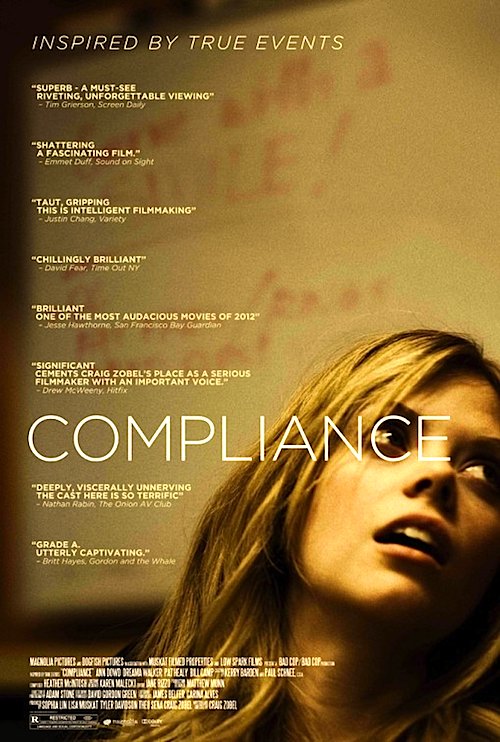
By Joe Bendel. Aren’t cop shows popular in the Midwest anymore? Anyone with a passing familiarity with the Law & Order franchises should understand the principle of lawyering up. Yet, one teen-aged fast food employee allows her manager to humiliate her on the instructions of a caller falsely identifying himself as a police officer in Craig Zobel’s ripped-from-the-headlines-with-the-names-changed-to-protect-the-innocent indie drama Compliance, which is now playing in New York.

Sandra, the restaurant manager, is under a lot of stress. She does not have enough bacon or pickles to make it through the weekend. Becky is an okay, but not a great employee. When “Officer Daniels” calls Sandra, sight unseen, claiming a customer accused the teenaged cashier of stealing money from her purse at the check-out counter, she is surprised but not incredulous. Just why the accuser never said anything at the time is an obvious question never asked. Dutifully, Sandra agrees to help Daniels’ investigation by sequestering Becky in the backroom, rifling through her belongings, and before long even strip-searching the confused young girl.

Of course, Sandra cannot find the “missing” money, which allows “Officer Daniels” to continue escalating the situation. Periodically, other restaurant employees are brought into this sensitive situation, who either reluctantly comply (so to speak) or wash their hands of the mess. To Zobel’s credit, he never plays any gender warfare cards. In fact, the voices of reason at this Chick-Wich are all male. However, the biggest offender also happens to be Van, Sandra’s inebriated fiancé, enlisted to “guard” Becky.

Yes, this is loosely based by a real case that even inspired an episode of Law & Order: SVU. While we cannot intellectually dismiss the events depicted in the film out of hand, it is important to remember they took place over the course of hours. This is a boiling frog phenomenon that simply is not credible in a mere ninety minutes. Granted, old Van was drunk as a skunk, but going from “hello Officer Daniels” to absolutely indefensible acts in about sixty seconds flat is dramatically problematic on-screen, regardless of the actual case files.

Pat Healy is effectively creepy and authoritative as “Daniels,” while Ann Dowd convincingly puts a harried every-person face on Sandra. Dreama Walker (known as a recurring on Gossip Girl) also has some very well turned scenes that help explain the victim’s mindset. Frankly, their performances are good enough to sell the initial set-up. It just spins out too quickly into some rather lurid places. Witnessing it all is supposed to challenge viewers to wonder what they would have done had they been in Sandra or Becky’s shoes. However, many will probably just quietly repeat to themselves the mantra: “right to an attorney.” After all, third graders can recite the Miranda warning by heart these days.

Perhaps the most troubling aspect of Compliance is its borderline vicarious sadism, essentially condemning its cake and eating it too. Ironically, though, the acts it portrays will make it easier for viewers to erect walls around the film and flatly deny they could ever be induced to act in such a manner. Hopefully they are correct. At times provocative, but also rather messy and ham-fisted, Compliance is a notable failure, probably worth viewing at a later stage for those who want to know what all the furor was about when it so sharply divided audiences at this year’s Sundance. For now, it is showing in New York at the Landmark Sunshine.

LFM GRADE: C+

Posted on August 18th, 2012 at 2:43pm.

LFM Reviews Wajda’s Korczak; Now on Blu-ray/DVD

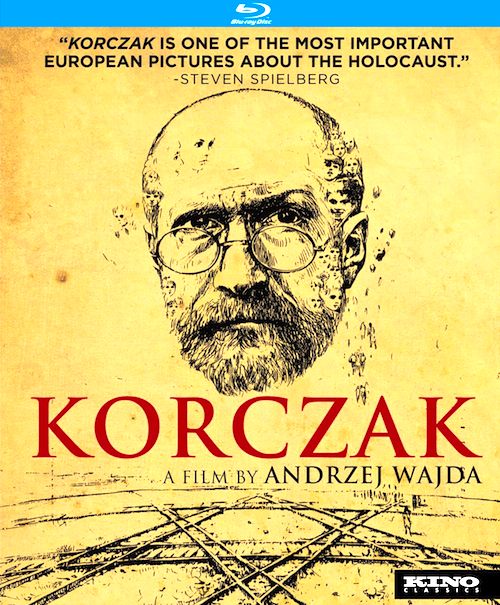
By Joe Bendel. Janusz Korczak was like the Polish Dr. Seuss, Dr. Spock, and Father Flanagan combined. He was born Henryk Goldszmit—a name that would prove fatal during the National Socialist occupation. Master Polish director Andrzej Wajda became one of his first filmmaking countrymen to forthrightly address the Holocaust, following the brave example of his protégé and frequent screenwriter Agnieszka Holland with 1990’s Korczak, which is now available on DVD and Blu-ray from Kino Classics.

Korczak/Goldszmit devoted his life to children. He was a popular children’s author and radio broadcaster, whose show was rather summarily canceled in the late thirties for sadly obvious reasons. Though removed from the public eye, Korczak continued to serve his beloved children as the benevolent headmaster of a progressive orphanage. A gentle gentleman by nature, Korczak loyally served as a doctor in the Polish Army, but nobody would have mistaken him for a military man. Yet, as the Germans marched through the streets, he refused to relinquish his uniform when so many others did. As viewers soon see, Korczak always did things the honorable way—the hard way.

Part of the agony of Korczak is watching the good doctor and his associates refusing to believe the situation is as bad as viewers know it is. Of course, the scale and systemization of the National Socialist death machine still remain hard to process. Yet, by 1942, enough escapees had sent word back to the ghetto that most of the involuntary residents would have a general idea what to expect from the concentration camps. Nonetheless, despite offers of counterfeit papers, Dr. Korczak refuses to leave his children. He had no use for one fake passport. He would need over two hundred.

Many have identified Korczak as a significant inspiration for Spielberg’s Schindler’s List. Shrewdly, the DVD cover prominently displays his unqualified endorsement. While both films profile heroic individuals, Korczak has absolutely no sentimental uplift to placate shallower viewers. It ends as it ended. Nonetheless, Wajda, again filming a Holland screenplay, ventures into more expressionistic territory in his final scene, perhaps representing idyllic afterlife not so strongly defined in the Judaic tradition Korczak never closely identified with (a stylistic decision Wajda took some heat for at the time of its initial release).

Wojciech Pszoniak gives one of the defining performances of the immediate post-Communist era. Yes, the Korczak viewers initially meet seems impossibly kind and virtuous. Yet, as the doctor endures pain and humiliation for the sake of his charges, Pszniak makes his anguish vividly clear.  Being a saint is trying burden.

Korczak also boasts a talented ensemble cast of pre-teen actors. Their complex relationships with each other feel very real and human. Conversely, those of Korczak’s colleagues are not as well established. Still, Ewa Dalkowska has some touching moments as Stefa Wilczynska, a former Korczak alumnus, who returned from the safety of “Palestine” to assist the doctor and his children during their hour of need.

Robby Müller’s black-and-white cinematography is absolutely arresting. Its influence on Schindler is unmistakable. Despite the deliberate lack of on-screen horrors, it is a draining film to watch. It is also exactly the sort of story that would have been impossible to depict under the recently deposed Communist regime, which had steadfastly relegated the Holocaust to the Orwellian memory hole. Along with his visceral Katyn, Korczak represents an important burst of creative truth telling from Wajda and Holland. Highly recommended, it is now on-sale at all major online retailers.

Posted on August 18th, 2012 at 2:40pm.