Honore’s New Movie Musical: LFM Reviews Beloved

By Joe Bendel. Prague and Paris have to be two of the most romantic cities in the world. Yet, a mother and daughter have relationship issues in both European capitals. It seems like codependent sexual dysfunction runs in their family in Christophe Honoré’s latest movie musical, Beloved, which opened Friday in New York.

Beloved opens in swinging sixties Paris, as Honoré revisits his acknowledged Jacques Demy influences. It is like a fairy tale, in which shopgirl Madeleine falls in love with Jaromir, one of the prostitution clients she sees on the side. It’s a French fairy tale. After Jaromir completes his specialized medical studies, she moves to Prague with him, becoming his wife. Soon, the hotshot doctor acts like he also has a license to philander, but his wife refuses to recognize it. Things come to head just as the Soviet tanks start rolling through the streets of Prague.

Madeleine divorces Jaromir but she never gets him out of her system. Even though separated by distance and ideology, he maintains a hold on her, despite her second marriage to an adoring gendarme. It will be a pattern that somewhat repeats for her daughter Vera. Her colleague Clément is devoted to her, but she only has eyes for Henderson, a rock drummer from New York, who happens to be (mostly) gay.

Ludivine Sagnier in "Beloved."

Anyone who has ever considered themselves losers for carrying a hopeless torch will feel much healthier once they watch Vera pine away her life. Initially it is rather uncomfortable, but it gets downright tragic. Beloved is far from your typically bubbly movie musical, but it works better than Honoré’s prior attempt, Love Song, largely because the characters are not as irritating and the situations are less stifling. Beloved can make viewers wince, but it also gives them air to breathe.

Honoré walks quite a tightrope, using perhaps the two greatest post-war tragedies, the 1968 Soviet Invasion of Czechoslovakia and September 11th, as backdrops for his mercilessly intimate drama. Honoré focuses exclusively on the micro level, where painful personal conflicts continue unabated, even when the wider world is turned upside down. Nonetheless, some of the “internal contradictions” of post-Prague Spring Czechoslovakia are duly noted and images of the 1968 invasion are suitably ominous. Given their visceral nature, the scenes of 2001 Montreal (where Vera’s flight was diverted) are somewhat iffier, flirting with exploitation by mere association.

Happily, Milos Forman never sings in Beloved, but he is perfectly cast as the old charmingly degenerate Jaromir of 2008. In contrast, Honoré alumnus Chiara Mastroianni handles her husky vocal features fairly well and keeps viewers vested in her angst far more compellingly than in his outright maddening Making Plans for Lena. Her real life mother Catherine Deneuve has some nice moments as Twenty-First Century Madeleine, but it is totally the sort of diva-centric character we are accustomed to see her assume. In contrast, Ludivine Sagnier is appropriately spritely as young Madeleine in the early Cherbourg-esque scenes. Louis Garrel (son of Philippe) is his usual sullen screen presence as Clément, but American Paul Schneider is surprisingly engaging as the commitment-phobic Henderson.

As a musical, Beloved works rather well, thanks to some frequently distinctive songs penned by Alex Beupain. They certainly fit the vibe and context of the film (as well as any movie musical tunes ever do) and often serve to advance the story. While it is a bit overstuffed with characters and hoped for significance, it is definitely one of Honoré’s better works. Recommended on balance for Francophiles and those who appreciate moody musicals, Beloved opens today (8/17) in New York at the IFC Center.

LFM GRADE: B-

Posted on August 18th, 2012 at 2:39pm.
NYPD Blue, Circa 1864: LFM Reviews Copper

By Joe Bendel. Travel back to pre-Miranda New York. The Civil War has turned for the Union, but social strife remains a constant fact of life. For the accused, there is no right to remain silent. “Start talking or start praying” Det. Kevin Corcoran tells one uncooperative witness, cocking his pistol. There is a certain elegant simplicity to this direct approach. In fact, interrogations are probably the only straight forward part of police work in Copper, BBC America’s first original (non-imported) dramatic series, which premieres this Sunday night.

Corcoran bravely served the Union Army, only to find his young daughter murdered and his wife missing upon his return home. In 1864, the primary responsibility for a cop like Corcoran is collecting the Captain’s payoffs. While his personal investigation is his primary interest, the brooding officer tries to do some legitimate police work here and there, since he has the gun and badge. During the course of the first two episodes, Corcoran becomes understandably emotionally invested in the case of a young girl murdered by a sexual predator. Corcoran will risk his life and career to protect the victim’s twin sister from the uber-connected suspect. Fortunately, he will have some help from Five Points’ finest prostitutes.

Much of Copper is indeed set in that neighborhood so squalid, it no longer exists. The morally ambiguous Morehouse family, with whom Corcoran has some complicated history, expects to be the ones to profit from this anticipated urban renewal project. Meanwhile, Manhattan’s African American community is moving north. This includes Dr. Matthew Freeman, the only competent doctor in New York willing to act as Corcoran’s secret pathologist. As one might expect, the thorny racial relations of competing Irish immigrant and free African American communities take center stage in the third outing.

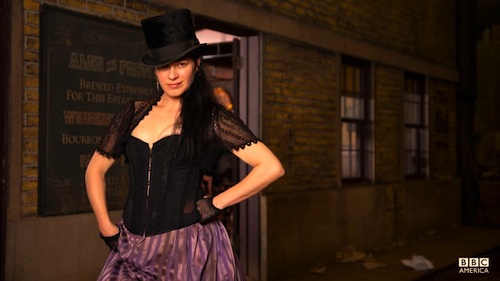
Franka Potente in "Copper."

Granted 1864 was a tough year in our nation’s history, but Copper seems to take perverse glee in reveling in New York’s degradation. Nor does it even attempt to disguise its overt class warfare. At least in episodes one and two, the wealthy are not just venal robber barons – they are also largely pedophiles.

Despite the heavy handed social commentary, Copper works well on the procedural level. MI-5’s Tom Weston-Jones is refreshingly hardnosed as the relatively honest anti-hero. It appears Copper will not be about solving mysteries per se, but figuring out how to dispense justice within a corrupt system. That is actually a potentially rewarding twist on the police drama that worked so well for the cool but canceled Zen.

Weston-Jones and co-writer-creators Tom “Oz” Fontana and Will Rokos compellingly establish Copper’s lead protagonist in the first three installments, but the supporting characters still need a bit of fleshing out. Of course, that is not uncommon at this stage. They have ten episodes to work with, after all. Still, Tanya Fischer’s Molly Stuart, the you-know-what with a heart of at least semi-precious metal, seems to warrant keeping an eye on.

There is some real potential in Copper. It is an impressive period production and when justice is served, it is served satisfyingly cold. Yet, it risks overdoing the Jacob Riis progressive tut-tutting in the early stages, already showing a tendency to fall back on clichéd stock villains. Engaging but uneven, Copper is an easy choice while Masterpiece Mystery is rerunning Inspector Lewises, but it may have a hard time holding its audience when Wallander returns. Whether it continues to develop and make good on what appears promising remains to be seen. Regardless, Copper begins this Sunday (8/19) on BBC America.

Posted on August 18th, 2012 at 2:38pm.

LFM Reviews Garden in the Sea @ DocuWeeks 2012

From "Garden in the Sea."

By Joe Bendel. The island of Espíritu Santo is wild land, off limits to humanity. It sounds like a miserable, forbidding place, but Mexican environmentalists consider it one of their greatest triumphs. To commemorate this legit feat of preservation, Spanish artist Cristina Iglesias created a special installation, not on the new no man’s zone, but off the coast, on the floor of the Sea of Cortez, bringing new meaning to the term “site specific.” Thomas Reidelsheimer documents the creation and dedication of the Espiritu Santo architectural sculpture in Garden in the Sea (trailer here), which screens during this year’s DocuWeeks.

There is a tiny irony that a film taking us to task for all we collectively dump into the ocean would also celebrate plunging a series of concrete gates into said waters. Yes, it’s hardly the same thing, but it is still rather odd. Still, there is a good chance the fish will like having it down there, like a giant aquarium ornament. Potentially, Garden could have been one of those documentaries that take viewers someplace they will most likely never have the opportunity to visit, like Into Eternity, Michael Madsen’s tour of Finland’s subterranean nuclear waste depository Onkalo or Cave of Forgotten Dreams, Werner Herzog’s 3D journey into the Chauvet cavern.

Unfortunately, despite the striking vistas of Espíritu Santo and the liberal helpings of underwater photography, Garden simply is not very cinematic. Frankly, it feels more like a cable special than a theatrical documentary feature, particularly given the relatively brief sixty-nine minute running time. However, it includes some soothing but distinctive Stephan Micus music licensed from the ECM label, perfectly suited to the aquatic theme.

From "Garden in the Sea."

Perhaps you have to be there. Swimming through Iglesias’s Atlantis gates is probably a pretty cool experience for scuba divers, but at about ten feet tall, they are not imposing enough to command the big screen. There are also only three of them too, so the project cannot really be thought of as Christo and Jeanne-Claude’s The Gates underwater.

Granted, Espíritu Santo is a nice story about engaged citizens taking direct action. However, most viewers will have nagging doubts whether turning the preserve over to the Mexican government is the wisest course of action. One has the uneasy feeling that if the environmental consortium is not constantly monitoring it, the beautiful island might be turned to more nefarious purposes. Of course, Garden is not about to address any concerns regarding systemic government corruption in Mexico. (Instead, look out for Bernardo Ruiz’s Reportero on the festival circuit for that kind of reality check.)

Aside from the occasional stern environmental talking-to, Garden is a slight but moderately pleasant travelogue. Marine enthusiasts might enjoy it, but its brevity makes it difficult to justify New York City ticket prices. Be that as it may, Garden in the Sea screens through Thursday (8/23) at the IFC Center, as part of the final week of DocuWeeks New York.

LFM GRADE: C-

Posted on August 18th, 2012 at 2:34pm.

Aging in the Age of AI: LFM Reviews Robot & Frank

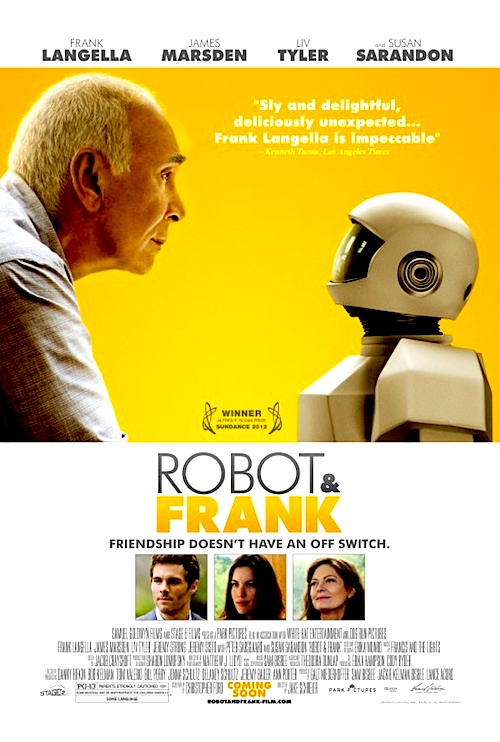
By Joe Bendel. Humans anthropomorphize. It is a very human thing to do, especially for objects that move on their own accord. One retired burglar will find himself doing just that with his assisted living droid in Jake Schreier’s very near future Robot & Frank, which opens this Friday in New York.

Frank Weld did not exactly get away scot free, but he is still living out his golden years in complete liberty. Unfortunately, his memory lapses are getting progressively worse. His establishment son Hunter is worried, because concern is what he does best. In contrast, New Age daughter Madison sees no evil when she calls in from exotic backwaters like Turkmenistan. Hoping to reverse his father’s slide, Hunter brings him a robot to help with the household chores and keep the difficult senior on a regular schedule.

Of course, Old Man Weld initially thinks little of his robot helper, nor does his kneejerk Luddite daughter. However, when the former burglar realizes the robot has a knack for things like lock-picking, he has a dramatic change of heart. He also has a perfect target: the oily hipster overseeing the conversion of his beloved library into some sort holographic monstrosity.

Having a purpose seems to do wonders for his mental state. He even starts seriously putting the moves on Jennifer, the librarian he always tentatively flirted with. Needless to say, though, the caper turns out to be a bit more complicated than expected.

Essentially, R&F is an intimate character study with some decidedly gentle SF elements (despite winning the Alfred P. Sloan Award for addressing themes of science and technology in indie film at this year’s Sundance); in other words, neither Frank the character (who is quite well read) nor Schreier is interested in exploring the implications of the singularity, at least not in this film. Yet though Schreier’s style is never all that showy, his restraint serves the material rather well. In fact, a late revelation packs considerable punch precisely because of its understated treatment.

Likewise, Frank Langella never overplays his hand, conveying his namesake’s vulnerabilities and self-doubt in quiet but effective moments. James Marsden does his best work perhaps ever (which is not saying much, with Lurie’s Straw Dogs remake relatively fresh in mind) as the understandably exasperated son. As Jennifer the librarian, Susan Sarandon makes the most of what initially appears to be little more than an extended cameo, but unfolds into something much more significant. Even Liv Tyler is not totally awful as daughter Madison (though “good” would still be pushing it).

Smartly written by Christopher D. Ford, R&F leaves viewers without complete closure, in a way that will ring true for families that have gone through similar experiences as the Welds. A sensitive, only slightly speculative film, Robot & Frank is easily recommended for general audiences (particularly librarians, robotics engineers, and thieves) when it opens this Friday (8/17) in New York at the Angelika Film Center downtown and the Paris Theatre uptown.

LFM GRADE: B+

Posted on August 14th, 2012 at 10:00am.

The Interwar Ghost-Hunter: LFM Reviews The Awakening

By Joe Bendel. It was always an old English tradition to have a ghost in your country house. After World War I, there were also plenty of dearly departed to be visited by. Of course, this led to a grand opportunity for a host of charlatans armed with a few garden variety parlor tricks. Florence Cathcart has made it her calling to debunk those flim-flam artists while she struggles with her own emotional issues in Nick Murphy’s The Awakening (trailer here), which opens this Friday in New York.

Cathcart is a bestseller, celebrated and sometimes reviled for her work exposing phony spiritualists. That is actually no small accomplishment for a British woman in 1919. While she is on friendly terms with Scotland Yard, she feels hollow inside. Robert Mallory is also skeptical, at least of her brilliance. However, with the boys of his private school spooked by sightings of a spectral student from years past, he reluctantly seeks her help, which she reluctantly gives. Much to her surprise, though, Rookwood’s haunting is not so easy to dismiss.

Rebecca Hall in "The Awakening."

Determined to crack the case, Cathcart stays on at Rookwood over the holiday break, with only Mallory, Maud Hill the kitchen matron, and young Tom, a student unable to return home during the academic hiatus, for company. There might be a few more malevolent entities as well, such as the brutish groundskeeper and perhaps the odd supernatural element.

Awakening starts out strong, establishing a vivid sense of time and place. Much like Rodrigo Cortés’ nose-diving Red Lights, the early séance-busting scenes are fun and atmospheric. The locations are certainly evocative too. Lyme Park in Cheshire, where most of the exteriors were shot (having previously stood in for Pemberley in the 1995 BBC adaptation of Pride and Prejudice) has to be one of the most severe looking estates the aristocracy ever summered in. Cinematographer Eduard Grau certainly makes it appear ominous and full of foreboding. Unfortunately, it all builds towards an over the top conclusion, loaded with contrived twists that would only leave M. Night Shyamalan satisfied.

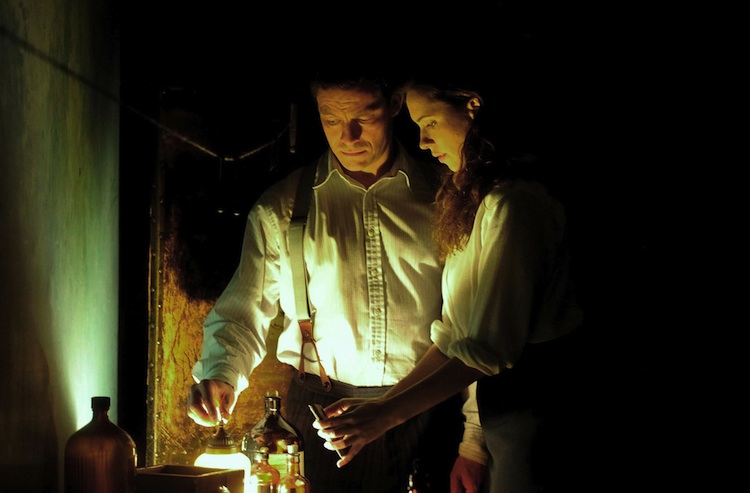
Rebecca Hall is okay as the doubter in crisis. She has the necessary intelligent presence and shivers with admirable conviction. However, the real standout work comes from Dominic West (terrific in BBC America’s The Hour) as the WWI veteran Mallory, with the heart of a romantic and a persistent case of survivor’s guilt. It is a sensitive, deeply humane turn.

Like many supernatural films, The Awakening completely dispenses with its better judgment in the third act. Still, its first two thirds are effectively eerie and entertaining. Frankly, that is above average for the genre standard. Recommended for those who enjoy the conventions of old dark British haunted houses, The Awakening opens this Friday (8/17) in New York at the Angelika Film Center and the AMC Empire.

LFM GRADE: B-

Posted on August 14th, 2012 at 10:00am.

Cantor Fitzgerald & 9/11: LFM Reviews Out of the Clear Blue Sky @ DocuWeeks 2012

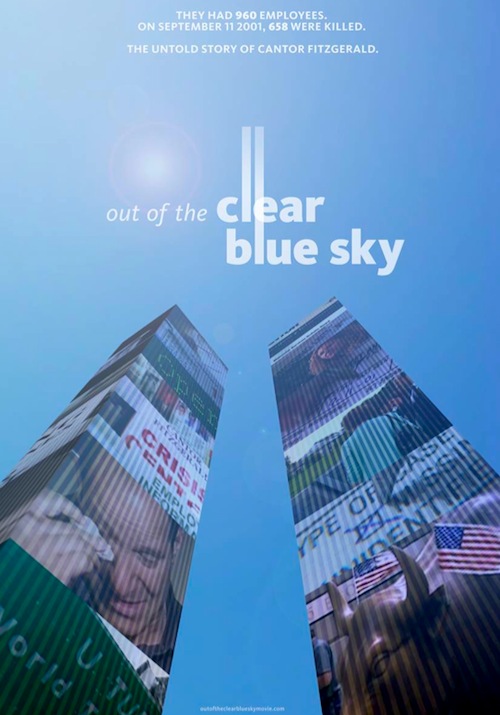
By Joe Bendel. A prestigious Wall Street firm specializing in Treasury securities, Cantor Fitzgerald suffered more losses on September 11th than any other organization, including the New York Police and Fire Departments. The numbers are staggering: 658 of their 960 New York employees died that morning. However, Cantor’s story did not end there. Filmmaker Danielle Gardner, whose brother Doug was one of the 658, documents CEO Howard Lutnick’s efforts to support the anguished Cantor families while desperately working to keep the firm afloat during its darkest hours in Out of the Clear Blue Sky (see clip above), which is currently screening as part of the 2012 DocuWeeks New York.

Had it not been the morning of his young son’s first day of school, Lutnick surely would have been at Cantor at the time of the attack. With offices several floors above the initial impact zone, Cantor employees never had a chance. Rushing to the scene only to witness the Towers’ collapse, Lutnick and a handful of senior staff began scrambling to determine who survived. With the enormity of their loss weighing on him, a distraught Lutnick became the public face of the tragedy. Yet, as some family members lashed out Lutnick in frustration, the media turned on Cantor, hard.

Blue’s stories of grief and remembrance are truly heartrending. Surprisingly, though, it is also a compelling business documentary, providing an inside account of Cantor’s fight to survive during the precarious days following the fateful Tuesday. Their resourcefulness is quite extraordinary, conducting Twenty-First Century financial transactions with scrounged office supplies. Of course, the stakes were high. Had the firm folded, Lutnick’s ability to help Cantor families would have been severely limited. Indeed, that behind-the-scenes look at Cantor’s tenacious rebound is what sets Blue apart and above other well meaning 9-11 documentaries.

As a member of their ranks, Gardner clearly earned the trust of Cantor families, eliciting some unusually eloquent testimony from her interview subjects. While there are many emotionally charged scenes, the film never feels intrusive or exploitative. (The only exception might be Lutnick’s tearful television interviews recorded within days of the attack, which have already been replayed innumerable times in the media.) Indeed, Gardner deftly walks the tightrope, directly conveying the rawness of survivors’ pain, without reveling in it.

While the media does not cover itself in glory for uncritically recycling complaints against Lutnick, the overall film is scrupulously nonpartisan. Too many misguided people would prefer to forget or deny the horrific events of September 11th. Worse still, some might even be inclined to dismiss Cantor as an instrument of the “1%” amid the current polarized climate. Blue acts as a valuable corrective to such impulses, reminding viewers the Cantor employees lost at the World Trade Center were all individuals from diverse backgrounds, who left behind friends and loved ones. Poignantly engaging but also quite an enlightening portrait of corporate resiliency, Out of the Clear Blue Sky screens through Thursday (8/16) at the IFC Center in New York, with a week’s run at the Laemmle Noho to follow (8/17-8/23) in Los Angeles, as part of this year’s DocuWeeks.

LFM GRADE: A-

Posted on August 13th, 2012 at 1:39pm.