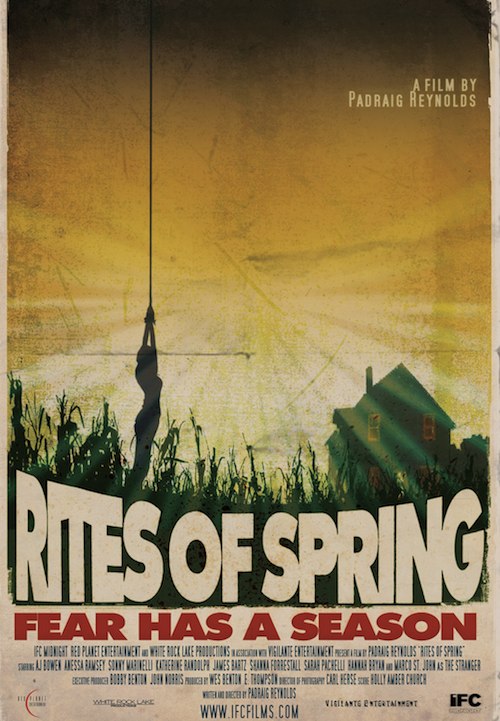
IFC Midnight: LFM Reviews Rites of Spring

By Joe Bendel. It’s time to spring forward into Spring—although not the way you might prefer. There is a reason a small rural Mississippi county always has perfect weather for their crops. Initially, a ruthless band of kidnappers couldn’t care less about agriculture when they abduct a young girl for ransom, but they soon will in Padraig Reynolds’ Rites of Spring (trailer here), which began a run of midnight screenings Friday night in New York at the IFC Center and will also be available nationally on VOD.

Rachel Adams is drowning her guilt at a local tavern. Thanks to a mistake she made, the office doormat got canned. Unfortunately, it is also the first day of spring. That means an old farmer has to find five sacrifices to the “it” living under the trap door in his barn to maintain the supernaturally good local weather. Adams and her friend Alyssa Miller are about to see the inside of his psycho-stalker van.

Ben Geringer is the dumb jerk from Adams’ office. Somewhat disappointed by recent events, Geringer agrees to a dodgy plot to kidnap the daughter of his now former boss. However, Paul Nolan, the ostensive mastermind, seems to nurse an even deeper grudge against their well-heeled target. Naturally, Geringer and company hole-up in a shuttered high school not far from the old coot’s farm, so when Adams manages to escape, she blunders into their abduction drama. Of course, the ravenous beast also follows.

This will probably disappoint many potential viewers, but they should know there is no Stravinsky on Spring’s soundtrack. And as a genre hybrid, the film is somewhat uneven. However, it is surprisingly effective as a rather dark and nasty crime drama, at least for a while. Sonny Marinelli makes a particularly entertaining villain as the all kinds of bad news Nolan. As Geringer and his Lady Macbethish girlfriend, indie genre vets A.J. Bowen and Katherine Randolph also fare quite respectably in the straight crime scenes.

Anessa Ramsey in "Rites of Spring."

Conversely, the supernatural-slasher side of the coin is often pretty silly. It is hard to believe the old farmer still has enough gas in his tank to lug about full grown adults, while the what-ever-it-is monster just looks like a dude with gauze tied around his head.

Reynolds team scouted some good locations, most notably the big spooky industrial-looking school building. He also builds some nice claustrophobic tension, only to let it deflate as soon as the action shifts to the evil farmhouse. The rather abrupt ending does not help much nor does the brief but befuddling stinger. Frankly, the film has its moments, but it just doesn’t pan out. That’s life. A serviceable midnight movie candidate, but highly flawed when judged on its merits, Rites of Spring screens round midnight at the IFC Center.

Posted on July 30th, 2012 at 12:40pm.

LFM Reviews Shanghai Calling @ The 2012 Asian American International Film Festival

By Joe Bendel. Go-getting corporate attorney Sam Chao is used to doing things his way. So is China. China’s bigger. Temporarily posted to the go-go city on the East China Sea, Chao is in for a steady diet of culture clashes in director-screenwriter Daniel Hsia’s Shanghai Calling, the 2012 Asian American International Film Festival’s opening night film, produced by this year’s Asian American Media Award recipient, Janet Yang.

Chao is not thrilled with his new assignment, but it is clear the partnership he covets depends on his performance opening the Shanghai office. His firm has come to China because that is where their most important client, eccentric industrialist Marcus Groff, has relocated. Never really in touch with his Chinese heritage, Chao does his level best to offend all his new colleagues as quickly as possible, particularly his assistant Fang Fang and his expat relocation specialist, Amanda Wilson. Unfortunately, Chao is going to need their help when makes a hash of Groff’s latest deal.

For reasons that remain elusive, Fang Fang has eyes for the boss, whereas Chao finds himself attracted to Wilson. That would also seem to be an odd choice on his part, but it fits with Chao’s cultural identity. He is the whitest guy in the room, especially compared to Wilson and expat business community leader Donald Cafferty, the “Mayor of Americatown.”

Hsia’s screenplay is quite astute observing the dynamics of the American business community in Shanghai, contrasting the old school old guard, represented by Cafferty, with the yuppie upstarts. It definitely feels like Calling reflects an insider’s perspective. However, the vibe of the romantic subplots are a bit too Gary Marshall (even the poster looks a bit reminiscent of New Year’s Eve). At least Hsia keeps the cast of characters manageable.

Daniel Henney (geek-famous as Agent Zero in X-Men Origins: Wolverine) maintains an easy likability, even when he is cruising for his ego bruising. Likewise, Eliza Coupe is like a cross between vintage Meg Ryan and Bonnie Hunt as Wilson, the harried single mother. However, some of the brightest lights are found in the supporting cast. In what could have easily been a shticky caricature, Bill Paxton brings out the wit and humanity of “Mayor” Cafferty. Not just window dressing, Zhu Zhu (of the Chinese remake of What Women Want) plays Fang Fang with real spirit and sensitivity, while Geng Le has a nice understated nerd charisma as Awesome Wang, a journalist-fixer often hired by the expats.

Clearly, Calling is not interested in muckraking. When Chao crashes the factory bootlegging Groff’s revolutionary cell-phone, it looks nothing like the Foxconn NPR describes. Nor does the film have anything to say about China’s internet freedoms, or lack thereof. That might limit its documentary value, but it is rather pleasant as an East-meets-West courtship (of both the personal and professional varieties). Though becoming more common, such American-Chinese co-productions still must present challenges (indeed, such is the basic premise of the film), so 2012 honoree Yang’s contributions as producer are surely considerable. Recommended for those who enjoy light cross-cultural rom-coms, Shanghai Calling screened last night as part of the 2012 AAIFF’s opening gala and also on Saturday (7/28), but both showings are sold out, so good luck queuing stand-by.

Posted on July 26th, 2012 at 9:49am.

Danes Behaving Badly: LFM Reviews Klown

From "Klown."

By Joe Bendel. At last, the Dogme Hangover is here, via Denmark, where they prefer their humor raw and black. Even if you wanted to, you are not likely to see a raunchier film in an art-house theater this year than Mikkel Nørgaard’s good-taste defying Klown, which opens this Friday in New York.

The feature film follow-up to the successful Danish television show (just like Sex and the City, in this one limited respect), Klown picks up with comedians Frank Hvam and Casper Christensen playing crude, self-absorbed versions of themselves. The lads are about to embark on a canoe trip that Christensen envisions as a smorgasbord of cheap illicit sex, but Hvam has other issues on his mind.

After doing something unspeakably heinous (think the “styling mousse” scene in Something About Mary raised to the power of ten), Hvam’s pregnant girlfriend starts questioning his potential as a father.  Naturally, he responds by kidnapping her socially awkward twelve year-old nephew Bo to burnish his paternal cred on their tour of debauchery. (Actually, Christensen uses a more colorful word than “debauchery,” which you can probably guess.)

Looking like a taller, slightly less pear-shaped Drew Carey, Hvam is basically a decidedly blue Costello, while the wiry Christensen is a real horndog of an Abbott. While they have a good bantering rhythm, the fundamental essence of their humor is their willingness to go “there,” as in you can’t believe they just went there. Based on the movie version of Klown, it seems like no joke is too naughty for them, but consistency can be an issue.

From "Klown."

By the way, Klown is absolutely not for children. The fact that a minor like Marcuz Jess Petersen appears as Bo might be grounds for prosecution in a few jurisdictions, especially given the questionable taste of some of his scenes. Good luck to him at school now that this is out there. Yet, it is Christensen and particularly Hvam who always suffer the worst humiliations.

In a bizarre, tripped-out way, Klown could be interpreted as a pro-life movie, because Hvam goes to ridiculous lengths to convince his girlfriend not to abort their unborn baby. Nonetheless, it is impossible to imagine the Church endorsing it any time soon, or GLAAD for that matter. While it is a bit slow out of the blocks and Nørgaard’s approach lacks breakneck energy, there are some genuinely huge laughs to be found down the stretch. Bracing in its tasteless outrageousness, Klown is recommended for those who rather enjoy being shocked and are weary of the phony uplift of Will Farrell-Judd Apatow Hollywood vehicles. Have no fear of that when Klown opens this Friday (7/27) in New York at the Village East.

LFM GRADE: B

Posted on July 26th, 2012 at 9:51am.

LFM Reviews Deranged

By Joe Bendel. For a slacker-copper, the good news is his latest dodgy stock recommendation appears to be panning out. The bad news is pretty much everything else. A pandemic is sweeping Korea and the pharmaceutical company he was tipped to may be somehow involved in Park Jung-woo’s Deranged (trailer here), which opens this Friday in select cities.

Thanks to Jae-pil’s dubious stock picks, his beleaguered brother Jae-hyeok found himself deep in debt, with a wife and two children to support. Once a promising medical researcher, he now kowtows to doctors on behalf of Joa Pharm, an industry bottom-feeder. Things are bad for the brothers and they will quickly get worse when Jae-pil investigates one of the first victims of a mutated parasite. At first, it stimulates the appetite, but hosts never gain weight. They become increasingly thirsty, eventually feeling compelled to submerse themselves in water, at which point the parasites burst out Alien-style, leaving a desiccated husk behind. It is not a pleasant way to go, but pandemics never are.

As the scope of the epidemic becomes apparent, Jae-hyoek’s family starts showing symptoms of contamination. Again, there is some good news. A consumer drug evidently fights off the parasitic agents. It is even one of his company’s products, but they recently discontinued production due to low demand.

From "Deranged."

As Jae-hyeok desperately scours the black market for the suspiciously scarce pills, Jae-pil peels away layers of the nasty corporate conspiracy. Indeed, Deranged suffers from a rather pronounced case of Big Pharma-derangement syndrome. Yet, in a way, it serves as a reminder that the pharmaceutical industry produces products that save lives, whereas politicians do not produce anything at all of lasting value.

Nevertheless, Deranged is an awfully darn scary depiction of the mob mentality in full force. It is not pretty to witness. In fact, it takes on classically tragic proportions when each time Jae-hyeok tries to act decent and compassionately, the irrational rabble only further stymies his efforts to save his wife and children.

As the frantic Jae-hyeok, Kim Myung-min is convincingly guilt-ridden and distraught. Yet, it is former pop idol Kim Dong-wan who really commands the screen as the slightly roguish Jae-pil. Unfortunately, former Miss Korea and current vegan cooking show host Honey Lee (a.k.a. Lee Ha-nui) does not get to do much more than look concerned as Yun-joo, Jae-hyeok’s former colleague and Jae-pil’s beleaguered lover. However, Lee Hyeong-cheol totally perfects evil smugness as Joa CEO Jason Lee.

Slickly shot by cinematographer Ki Se-hoon, Deranged shrewdly avoids the gruesome in favor of the more horrifically human. Despite the not so occasional soap-boxing, it is a rather tight, character-driven outbreak thriller. Recommended for those who can easily overlook its anti-corporate bias, Deranged opens this Friday (7/27) at the CGV Cinemas in Los Angeles, the AMC Cupertino in the Bay Area, and the AMC in Ridgefield Park, NJ, sort of near New York.

LFM GRADE: B

Posted on July 26th, 2012 at 9:48am.

The First London Games in 1948: LFM Reviews The BBC’s Going for Gold

By Joe Bendel. Seventy-three year-old British artist John Copley became the oldest Olympic medalist at the 1948 London Games, taking silver for his etchings. It would be the penultimate artistic competition of the modern-era games, all of which have since been segregated from the official medal counts. He might have made history (for a while, at least), but fortunately this will not be his story. Instead, BBC America takes viewers to the Thames, where a hastily assembled British sculling duo carries the hopes of their nation in Going for Gold: The ’48 Games, a one-shot airing this Wednesday as part of the current season of Dramaville.

Bert Bushnell and Dickie Burnell both competed for a spot on the 1948 Olympic team, but fell short. Pairing-up was not their fallback plan, but the brainchild of five-time British medalist and Olympic committeeman Jack Beresford. The double sculls is an event close to his heart, since he and his partner upset the favored Germans in front of Hitler at the 1936 Berlin Games.

The stakes are not quite so high for Bushnell and Burnell, but the malaise-ridden United Kingdom could use a lift. London could also use the tourist dollars generated by a successful Olympiad. However, with mere weeks to go, they’re still woefully behind on construction. Evidently its déjà vu all over again.

From "Going for Gold."

Likewise, Bushnell and Burnell have just started training together – and it shows. Socially and temperamentally quite different, the pair clash rather badly. In fact, the respectably middle class Bushnell’s class resentment of Burnell’s privileged background becomes tiresomely repetitive, perhaps saying more about screenwriter William Ivory (whose credits include the labor drama Made In Dagenham) than two athletes who fundamentally share so much in common. They both have a passion for their sport, similar last names, and persistent issues with their fathers.

For many viewers (as well as for BBC America) the most important thing to know about Gold is the presence of Doctor Who’s Matt Smith as Bushnell. He is credible enough as the tightly wound rower, but Sam Hoare certainly looks more athletic as Burnell. He also has some of the better turned straight dramatic scenes. However, for longtime TV anglophiles, it will be Geoffrey “As Time Goes By” Palmer who stands out as Burnell’s severely reserved father.

If rowing races is your thing, Going for the Gold (a.k.a. Bert & Dickie) is your tele-drama. Smoothly helmed by TV veteran David Blair, it still is hardly Chariots of Fire-on-the-Thames (notwithstanding one eyebrow raising quote), but it is about on par with most subsequent Summer Olympic movies. An appealing period production with a decent payoff, Going for the Gold is a pleasant enough warm-up for the London Games, recommended for sculling and Olympic enthusiasts when it airs this Wednesday night (7/25) on BBC America’s Dramaville showcase.

Posted on July 23rd, 2012 at 8:41pm.

LFM Reviews Mr. Cao Goes to Washington @ The 2012 Asian American International Film Festival

By Joe Bendel. Anh “Joseph” Cao was elected to Congress in 2008, a generally bad year for Republicans. He was defeated in his re-election bid two years later—a decidedly good year for Republican candidates. In a mere two years, the idealistic former Jesuit seminarian received an eye-opening education in all manner of group-think politics. Cao’s short tenure in office is documented in S. Leo Chiang’s Mr. Cao Goes to Washington, which screens during the upcoming Asian American International Film Festival in New York.

Immigrating to America while his father was still a captive of a Communist Vietnamese re-education camp, young Cao led an eventful life before he even considered a political career. Choosing law school over a life of the cloth, Cao became an activist leader in Versailles, New Orleans’ small but enterprising Vietnamese community (profiled in Chiang’s previous documentary, A Village Called Versailles). Louisiana’s second congressional district was deliberately drawn to elect an African American Democrat, everything that Cao is not. However, the ethical issues dogging William “Cold Cash” Jefferson gave Cao a once in a lifetime opportunity to flip the seat—and he was precisely the transcendent candidate to do it.

The question throughout MCGTW is whether or not Cao can hold his seat against a relatively untarnished Democrat (if one can be found in the Crescent City). Unfortunately, most viewers already know the answer, undercutting the suspense, but also preparing them for the inevitable crushing disappointment.

Chiang and film editor Matthew Martin arduously walk a political tight-rope, trying to frame Cao to be as appetizing as possible to left-of-center film critics. Much is made of Cao’s relative liberalism within the Republican caucus, including many laments that he might be better suited to the other party. Yet Cao remains staunchly pro-life throughout his term of office, so so much for that idea. Frankly, Cao had no complaints with his Republican colleagues, getting more than his share of their earmarks for his ungrateful district. Conversely, the figure who emerges in Chiang’s doc as the poster boy for political hypocrisy and opportunism is none other than the current (but perhaps not long term) occupant of the Oval Office.

From "Mr. Cao Goes to Washington."

Initially wooed by Obama, Cao genuinely believed the President’s pretenses of friendship. Indeed, Cao took a lot of heat voting for the House’s first Obamacare bill. However, when Obama inevitably cuts a commercial for his Democrat opponent (a less than inspiring figure with a history of disbarments and barroom brawling), it is profoundly disillusioning for Cao. Indeed, for all the film’s attempts to distinguish Cao from the national GOP, time and again it is the Democrats (both nationally and in New Orleans) who refuse to look past party labels and racial identity. To their credit, Chiang and his team show this quite clearly.

Nonetheless, MCGTW is so intent on presenting Cao in non-partisan terms, it declines to correct a few inaccuracies. While Cao was the only Asian American Republican in Congress at the time of his election, he was eventually joined by Charles Djou, the first Thai American congressman, who won a special election in Hawaii (but was subsequently defeated in 2010, like Cao). Perhaps more problematically, MCGTW lets a local provocateur’s incendiary racial attacks on the GOP stand unchallenged. Still, it illustrates the sort of rhetoric Cao faced from some extremists.

Perhaps most importantly, MCGTW always treats Cao fairly, recognizing his earnestness and integrity. He is clearly the real Horatio Alger deal, with the attractive wife and cute kids perfectly suited for campaign brochures. Watching his re-election campaign unfold will be a frustrating experience for viewers of most political stripes. If anything, it suggests the greatest problem with the current political system is not money or PACs, but the voters themselves.

That is a real downer of a Pogo-like message, isn’t it? Still, Cao’s frank, vigorous spirit is quite refreshing. After viewing MCGTW, one hopes for a sequel with a more satisfying ending.  Clearly, Cao is talented man and Chiang has a keen understanding of the community he represents. Considering the mildness of its biases, the mostly fair and responsible Mr. Cao Goes to Washington is recommended for political junkies on both sides of the aisle, particularly those who following events in New Orleans from a distance, when it screens this Thursday (7/26) at the Chelsea Clearview as an official selection of the 2012 AAIFF.

LFM GRADE: B-

Posted on July 23rd, 2012 at 8:39pm.