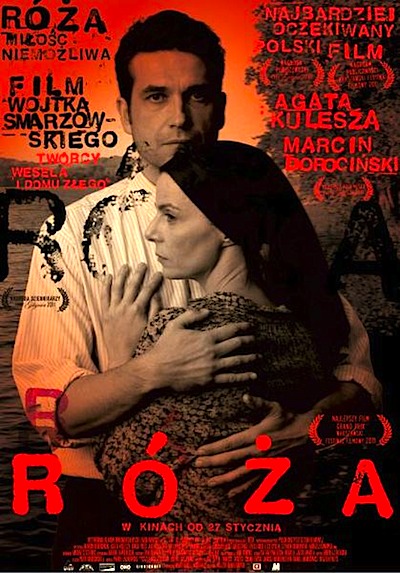
Terrorism in Turkey: LFM Reviews Labyrinth @ The 2012 Brooklyn Film Festival

By Joe Bendel. Turkey is still the modern, secular republic founded by Ataturk, but there are those who would like to turn back the clock. Nobody understands that better than the agents of Turkey’s counter-terrorist agency. They will risk their lives to thwart a violent group of Islamist fanatics in Tolga Örnek’s Labyrinth, which screens during the 2012 Brooklyn Film Festival.

A horrific homicidal suicide bombing has murdered 95 innocent souls, including thirty Americans and five Brits. Unfortunately, the shadowy mastermind (who never delivers the bombs himself, mind you) is working on a more ambitious attack. For Fikret, the moody Turkish Jack Bauer, it is not just an assignment, it is personal. He is out to avenge the partner kidnapped and presumably murdered by the newly resurfaced terrorist ringleader.
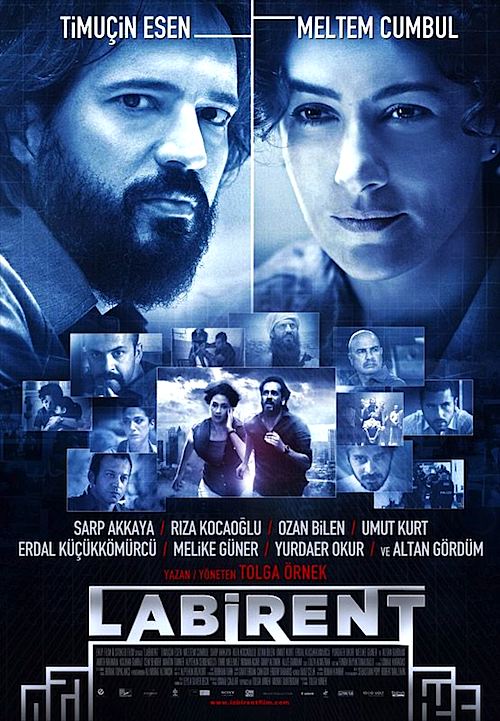
Fikret has one ace card in his hand. He has been running a confidential informative more-or-less off the books, whose brother has fallen in with the elusive terror cell. He only trusts Rasim’s identity with his loyal colleague (and prospective romantic interest), Reyhan. A valuable source, Rasim is coveted by British intelligence, who offer information on Fikret’s missing partner in return for the mystery source. The proposition is not appreciated.

Frankly, the tension between the Turkish and British security services never escalates beyond trash talking. In point of fact, Labyrinth is a refreshing corrective to the notoriously anti-American and anti-Semitic Valley of the Wolves: Iraq, the Turkish Islamist agit-prop film co-starring Gary Busey and Billy Zane. Here, it is the Islamists who are explicitly identified as the terrorists, freely murdering their own more moderate co-religionists for the sake of their extreme agenda. Of course, their preferred target is Turkey’s Jewish community. They even use inconvenient terms such as “the caliphate” in the pre-bombing videotapes. The American military only appears in passing, productively collaborating with their Turkish counterparts on a mission in Northern Iraq.

While there are some moments of inspired movie violence, Labyrinth is more cerebral than action-oriented. As Fikret, Timuçin Esen power broods like nobody’s business, while also developing some nice chemistry with Meltem Cumbul’s smart and mature Reyhan. They make it clear they care about each other in ambiguous ways, without ripping their clothes off. As for their quarry, the effective supporting ensemble is flat-out chilling when portraying the face of Islamist terror.

We could be proud of Hollywood if it finally tackled terrorism with a film like Labyrinth. That it was produced in Turkey is downright shocking, in a good way. Engrossing and tragically realistic, Labyrinth is a standout selection of this year’s BFF. Highly recommended, it screens again this Sunday (6/10) at IndieScreen in Williamsburg.

LFM GRADE: A

Posted on June 7th, 2012 at 6:19pm.
LFM Reviews Japanese Shorts, Made in America, at the Asia Society

By Joe Bendel. Japan has long been a source of inspiration for American artists, and vice versa. In that spirit, the Asia Society hosts a screening of seven short films of varying degrees of Japanese-ness from filmmakers working in America. Diverse and intriguing, the New York Japan CineFest: Short Film Program will be a treat for short film connoisseurs this Friday night at the venerable Park Avenue institution.

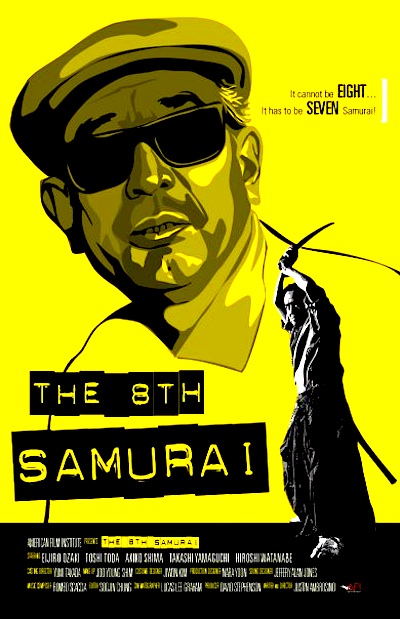
For diehard fans of Japanese cinema, the highlight of the evening will doubtless be Justin Ambrosino’s The 8th Samurai. Absolutely not purporting to tell the behind-the-scenes story of Kurosawa’s Seven Samurai, it speculates what might have happened if a cap and sunglasses donning director had a dream telling him to cut one of the eight samurai from his upcoming epic, just prior to the start of shooting. While Kurosawa’s film is an obvious inspiration, one luckless actor’s wickedly supernatural mother-issues suggest the influence of Kaneto Shindo, the director of ambiguous horror classics like Kuroneko and Onibaba, who recently passed away after reaching the century milestone.

Filmed in glorious black-and-white by cinematographer Lucas Lee Graham, the subtitled Samurai is a moody but loving valentine to Japanese cinema. Though Ambrosino is not anymore Japanese than he sounds, Samurai features almost the entire Japanese supporting cast of Eastwood’s Letters to Iwo Jima. The second longest selection of the program at twenty-eight minutes, it is a fully realized, enormously satisfying film, by any standard.

Yet, perhaps the best film of the evening is the hardest to describe, combining elements of narrative, essay, and experimental filmmaking. Observing the terms of his mother’s will, the introverted narrator of Ken Ociai’s Frog in the Well (trailer here) travels throughout Japan spreading her ashes, as directed. Sometimes employing quick-cut film stills to create a live-action flip book effect, Frog has a decidedly unusual visual style yet it never overshadows the emotional significance of the grown son’s travels. Indeed, it is surprisingly touching, while also enticing viewers to visit Japan. Frankly, considering how gorgeous it makes the country look, starting in the snowy north and traveling down to Okinawa, the Japanese tourism board ought to buy television air time for it around the industrialized world.

Though much simpler and more straight-forward, Chisa Hidaka’s three minute Together: Dancing with Spinner Dolphins is also lovely to look at, following a swimmer as she frolics underwater with the beloved marine mammals. It sounds great too, thanks to a shrewdly chosen excerpt from Ketil Bjørnstad’s The Sea, featuring ECM label mates Terje Rypdal, David Darling, and Jon Christensen.

Though something of a brief irony-driven short, Yoriko Murakami’s richly rendered stop-motion animated Corazon en Fuego / Heart on Fire puts a twist on the O. Henry twist, ultimately guiding its bereaved protagonist somewhere quite life-affirming. Yasu Suzuki’s New York set Radius Squared Times Heart is even more upbeat, depicting a shy Japanese scientist courting a fellow tango dancer through his skills in the kitchen. With its accessible, Friends-style humor, it could easily be the crowd favorite of the evening.

Far heavier, Haruhito Naka’s Into the New World rather awkwardly addresses big picture topics like God and 9-11 through half-baked magical realism. Fortunately, Kosuke Furukawa’s only slightly metaphysical Uguisu is much subtler. It also features an excellent supporting turn from Seiji Kakizaki, who has such presence as a diner customer getting under the skin of a hipster artist simply through his soft-spoken honesty, he sort of fools viewers into investing undue significance in his character. Furukawa’s sparing use of color is also quite distinctive, as are the sly hints at the fantastical.

Overall, the New York Japan CineFest night of shorts is very strong, including two excellent films, 8th Samurai and Frog in the Well, plus several other quality selections. Since most films are American productions, at least to an extent, it also represents an interesting change of pace for the Society, while still staying true to their mission and focus. It is another example why New York cineastes need to follow their programming closely. Definitely recommended, the short film program screens this Friday night (6/8) at the Asia Society.

Posted on June 7th, 2012 at 6:18pm.

The Best Temp Gig Ever: LFM Reviews Safety Not Guaranteed

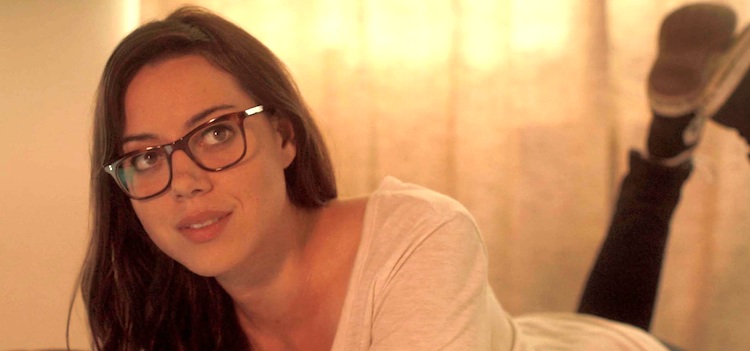
Aubrey Plaza in "Safety Not Guaranteed."

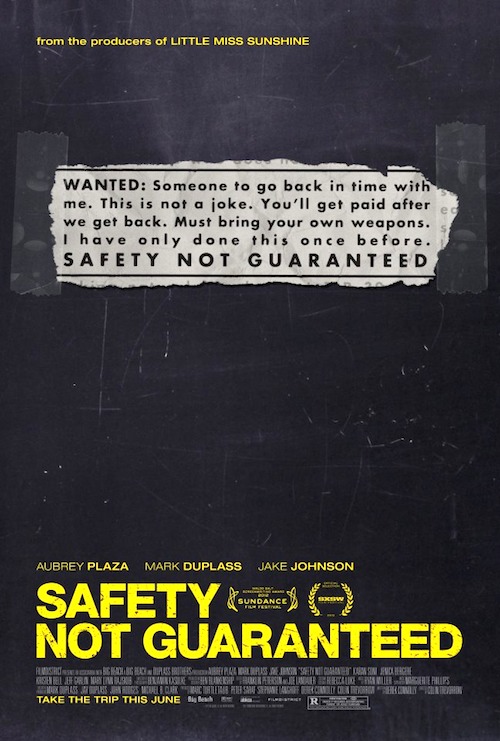
By Joe Bendel. The cynicism of journalism is about rub up against the idealism of science. However, the science practiced by Kenneth Calloway is a decidedly scruffy, DIY affair. His unusual classified ad attracts the attention of a Seattle magazine writer, who brings along two lowly interns to help investigate Calloway’s time travel claims in Colin Trevorrow’s Safety Not Guaranteed, which opens this Friday in New York and the Pacific Northwest.

Based on a real classified that became a minor internet sensation, Calloway’s ad seeks: “Someone to go back in time with . . . You’ll get paid after we get back. Must bring your own weapons. Safety not guaranteed. I have only done this once before.” To Jeff Schwensen this sounds like the perfect set-up for a mock-the-rube piece (and also represents a good opportunity to hook up with an old summer fling). At first, Darius Britt, an intern who makes Janeane Garofalo look upbeat, sees it pretty much the same way. However, when Schwensen’s direct approach spooks the self-styled time traveler, he sends Britt in undercover to win their subject’s trust.

Much to her surprise, she starts to like the guy—kind of a lot. After all, Calloway is a socially stunted paranoid delusional—what’s not to like? Of course, Derek Connolly’s consistently clever script leaves the door open just wide enough for viewers to consider the possibility Calloway is not so crazy after all. Like they say, just because you’re paranoid . . .

Mark Duplass’s beefy Calloway (somewhat resembling Lon Chaney, Jr. before his transformations) and Aubrey Plaza’s much younger and very petite Britt look like a wildly mismatched couple, but the way they click as kindred outsider spirits makes perfect sense in the film’s’ dramatic context. Frankly, their romance-in-denial chemistry is shockingly endearing. Meanwhile, Jake Johnson delivers generous helpings of outrageous humor, of both the politically incorrect and ribald varieties. You know that obnoxious guy you put up with because he is so unfiltered you want to hear whatever crazy thing he says next? Johnson nails that vibe as Schwensen (sort of like a Tom Hanks circa Bachelor Party). Poor Karan Soni is also good sport playing the Arnau, the nebbish straight-man intern, looking appropriately lost amid all the bedlam.

Helmed with sensitivity rarely seen in a genre send-up, Trevorrow nicely balances the comedic bravado with a humanistic sensibility. Indeed, Safety never moderates Calloway’s twitchiness, nor does it judge him. Yet the film offers an unmistakable rebuke to the urban hipster condescension for small town America. Don’t let the “from the producers of Little Miss Sunshine” copy line set off your quirky indie alarm bells. It is a film with a sharp edge and a big heart, but it always stays true to its geek roots. Thoroughly satisfying, Safety Not Guaranteed is enthusiastically recommended for general movie-going audiences when it opens this Friday (6/8) in New York, Los Angeles, Portland, and Seattle.

LFM GRADE: A

Posted on June 6th, 2012 at 10:10pm.

LFM’s Joe Bendel Reviews Snow White and the Huntsman

By Joe Bendel. These dwarves do not whistle while they work. They are not so hot when it comes to comic relief in general, but they are still devoted to a certain princess, as is most of their fairy tale realm. That is why she is such a threat to the despotic Queen Ravenna, her wicked stepmother. Straying from familiar Disney territory, the latest live action adaptation of the Brothers Grimm fairy tale takes on overtones of Joan of Arc as the protagonist rallies the troops in Rupert Sanders’ Snow White and the Huntsman, which opened Friday nationwide.

King Magnus, Snow White’s widower father chose the wrong second wife; he doesn’t even make it to the honeymoon. The narcissistic Ravenna’s reign is harsh, even depressing the natural environment around her imposingly cinematic castle. However, she gets a rather unwelcomed surprise from her magic mirror when Snow White comes of age: Ravenna is no longer the fairest of them all, and the prisoner of the North Tower is. Thanks to the help of sundry beasts and birds, Snow White escapes her captivity, only to find herself in the supernaturally ominous Dark Forest.

Wanting Snow White’s purity for uncanny purposes, the Queen sends in Eric, a drunkard huntsman who happens to be one of the few mortals to have ventured through the forest and lived to tell the tale. Fortunately, the Huntsman does not take direction well. As a result, he will have to contend with her loyal, Game of Thrones-ish brother, his armored forces, and a fair number of monsters. A small band of short eccentrics might be able to help them. There is also some business with an apple.

Kristen Stewart as Snow White.

This is Snow White, done kind of-sort of faithfully. However, it spends far too much time aimlessly trudging about the Dark Forest. Frankly, the film really starts to take off when it diverges from Grimm, becoming an old fashioned fight-for-freedom epic. Indeed, it is refreshing to see a less passive Snow White, leading the resistance into battle like it’s St. Crispin’s Day.

In fact, Kristen Stewart rather exceeds expectations, balancing vulnerability and a suitably regal presence as Snow White. Chris “Thor” Hemsworth might not be venturing too far out of his comfort zone here, but he swings the battle axe as well as the war hammer. Though played by great (full sized) actors like Ian McShane, Ray Winstone, Bob Hoskins, and Eddie Marsan, the dwarves just look weird. They are not funny, but they are still rather shticky. However, it is Charlize Theron who really puts a stamp on the picture, vamping it up and chewing the scenery with sheer evil delight as Ravenna, while her apparent age yo-yo’s up and down (getting a crucial assist from a crack team of make-up artists).

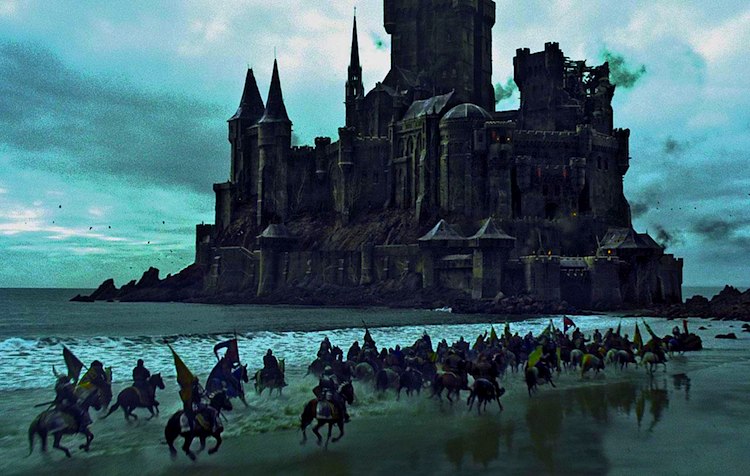
Graduating from commercials to big special effect-laden features, Sanders creates a richly detailed fantasy world, particularly the striking castle, in both interior and exterior shots. However, one has to wonder just who is the intended audience for a dark brooding version of Snow White, served with a reasonable helping of hack and slash action.  Those looking for happily-ever-after romance might find the film leaves them cold, while the laughably clunky dialogue is not likely to do much for anyone else.

Snow White and the Huntsman is an odd assortment of mismatched parts, but some of those pieces are admittedly entertaining. Ironically, it would not be a good date movie – because guys who are reluctantly dragged into it might find it more enjoyable than expected, whereas their dates will likely be disappointed by it. A mixed bag best saved for post-theatrical viewing options, it is now playing nationwide, including the AMC 34th Street and AMC Kips Bay in New York.

Joe’s LFM GRADE: C+

Posted on June 5th, 2012 at 4:31pm.

Russia’s Bernie Madoff: LFM Reviews Pyrammmid @ The 2012 Brooklyn Film Festival

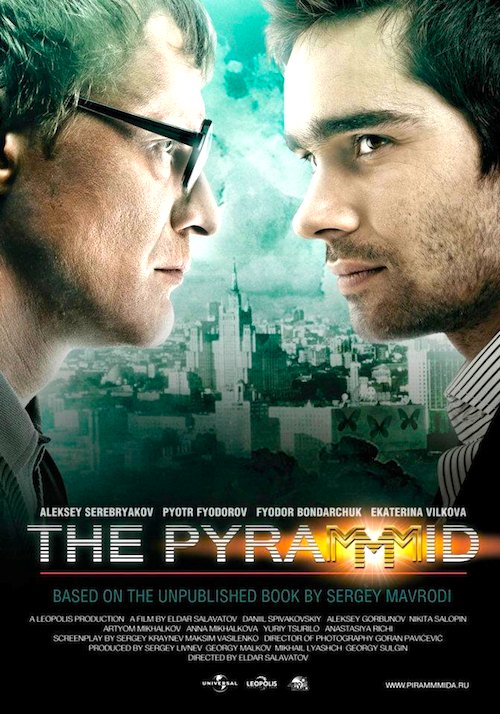
By Joe Bendel. Only Russia could celebrate a Ponzi scheme con artist as a national hero. It’s a complicated place. Transparently based on Sergei Mavrodi, the Russian Madoff, a bizarre episode of post-Soviet economic history is only slightly exaggerated in Eldar Salavatov’s Pyrammmid, which screens during the 2012 Brooklyn Film Festival.

Mavrodi’s dodgy financial empire was also known as MMM and its commercials promising forty percent returns on investment were a constant presence on Russian television during its heyday. Many Russians blamed its inevitable collapse on the government thanks to conspiracy theories no doubt nurtured by Mavrodi. However, the fictional Sergey Mamontov’s MMM really is the target of the corrupt national government and their oligarchic allies. Understand: Mamontov is no mere charlatan. He is scamming all that money in order to preserve Russian ownership of the old state-owned enterprises being sold to the well-connected at fire-sale prices, through a dubious privatization process. Well, that’s Pyrammmid’s story and its sticking to it.

It gets quite complicated, though. Raking in cash, Mamontov plans a fatal run on his major banking rival, while getting involved in weird sidelines, like buying the major Russian beauty pageant. Most of those distractions are the brainchild of maverick mathematician Anton who loses sight of the big picture. Frankly, the film is a bit overstuffed with plot, sacrificing the dead weight of transitions to fit it all in. As a result, audiences watching it in subtitles really have to keep on their toes.

Reportedly, Pyrammmid is based on an unpublished manuscript by Mavrodi, which must be considered either a novel or a memoir, depending on whether or not you happen to be Sergei Mavrodi. Ideologically, it is a bit of a head-scratcher, unambiguously lionizing exactly the sort of financial plunderer the current regime made its name inveighing against. Still, the symbolic significance of Mamontov’s choice of car is hard to miss: a vintage Soviet Chaika sedan. In fact, the film has nothing to say regarding the lack of consequences faced by the oppressive former Communist hardliners. Indeed, that refusal to account for the past has led the country precisely where it is now. The presence of Putin favorite Nikita Mikhalkov’s son Artyom and daughter Anna Mikhalkova in the ensemble cast further muddies the waters.

Having played more traditionally action-oriented protagonists in previous films (such as the Da Vinci Code-ish Golden Mean), Alexey Serebryakov is surprisingly convincing as the owlish Mamontov (those specs are another Mavrodi trademark). Unfortunately, he is largely surrounded by stock characters existing simply to serve the plot, like Gutov the shifty lawyer and Vera the ambitious muckraking photojournalist.

Frankly, the fact that this movie exists is downright mind-blowing. Imagine a slick, big budget American film positioning Bernie Madoff as a misunderstood hero, whom we should give good money to, for the sake of the country. That is about how Pyrammmid shakes out. It is a fast-moving big-canvas conspiracy thriller that does not always make a whole lot of sense. Yet, it is more stylistically grounded than the thematically related Generation P. Flawed but fascinating for Russia watchers, it screens again this Wednesday (5/6) at IndieScreen as part of this year’s Brooklyn Film Festival.

Posted on June 4th, 2012 at 9:31pm.

LFM Reviews Rose @ The 2012 Brooklyn Film Festival

By Joe Bendel. The war is over, but for many Polish women it’s hard to call the aftermath “peace.” This is especially true for ethnic German Masurians, formerly of eastern Prussia, like Rose Kwiatkowska. Though Poland has been “liberated,” they are constantly reminded that “their side” lost, and are treated as treasonous pariahs, accordingly. Yet, Kwiatkowska’s situation is especially dire, as a mysterious Polish veteran slowly discovers in Wojtek Smarzowski’s uncompromising Rose, which opened the 2012 Brooklyn Film Festival Friday at the Brooklyn Heights Cinema.

Tadeusz Mazur is a world-weary Home Army veteran, who witnessed things during the Warsaw Uprising no man could forget. He watched as his wife was raped and murdered by the rampaging National Socialists, and was also present during the death of Kwiatkowska’s husband. She is not exactly welcoming when he turns up to deliver some of her husband’s effects, yet a bond slowly forms between them. Kwiatkowska needs protection from the Soviet-aligned bandits, who literally rape and pillage their way through the Masurian countryside. She could also use his help clearing the landmines from her fields, so they can harvest the potatoes. As for Mazur, he has his reasons to lay low, hoping not to attract the attention of the NKVD. However, Masuria is not the best place to be to avoid trouble.

Michał Szczerbic’s screenplay is brutally direct and honest about the treatment of women during wartime by the Germans, the Soviets, and their minions (indeed, they all seem to blend together throughout the film). The sheer volume of sexual assaults in Smarzowski’s historical drama is overwhelming, but they are never treated in a lurid or sensationalized fashion. Rather, it is a harrowing depiction of an ugly period of institutionalized score-settling.

Yet incredibly, Rose is a fundamentally a love story, sensitively bringing to life the brief but intense relationship that develops between Kwiatkowska and Mazur. There are no cute courtship rituals or romantic contrivances. They simply fall in love (or something near enough to it), while banding together to survive. It is definitely not pretty, but in a way, it is kind of beautiful.

Marcin Dorociński is riveting as Mazur, portraying him as both a flinty man of action and a tragic romantic hero. It is a bit surprising how thoroughly he dominates the film (since it is called Rose), but he does. Agata Kulesza is also quite haunting as Kiatkowska, creating a profile of herculean endurance. Their scenes together are quite special.

Despite somewhat rushing the third act (which features a few “wait, he did what?” moments), Smarzowski (previously represented at BFF with the gritty Martial Law-era noir The Dark House) deftly helms Rose, capturing the sweep of terrible historical forces, but maintaining an intimate focus. He forces viewers to confront the nature of the crimes committed against Kiatkowska and other Masurian women, up close and personal. Polish free jazz bass clarinetist Mikołaj Trzaska’s eerie minimalist score also heightens the unsettling mood.

Rose can be tough to watch, but it is an excellent film. Highly recommended, it screens again this coming Thursday (6/7) at IndieScreen, as part of this year’s Brooklyn Film Festival.

LFM GRADE: A

Posted on June 4th, 2012 at 9:30pm.