LFM Review: White Button (Bijelo Dugme) @ The 2011 Bosnian-Herzegovinian Film Festival

By Joe Bendel. They were much like Yugoslavia’s version of Czechoslovakia’s Plastic People of the Universe, except they had a much easier time of it with the Tito regime. They only faced a few drug busts, which they do not claim to be altogether unwarranted. Indeed, the hard rock band was a unifying force for the youth culture, but attempts by various nationalities to claim them as their own contributed to the band’s eventual break-up. The rise, fall, and multiple reinventions of the Yugoslav hard-rock band Bijelo Dugme is chronicled in Igor Stoimenov’s documentary, White Button, the closing film of the 2011 Bosnian-Herzegovinian Film Festival.
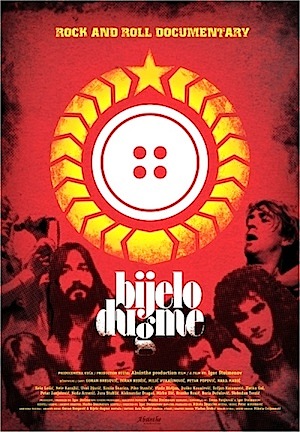
Yugoslav rock heroes.

Musically, White Button (who adopted the “Bijelo Dugme” moniker essentially to prove names don’t matter in rock) is probably best compared to Led Zeppelin. Both bands represented the early cusp of Heavy Metal, but were still very much in touch with the blues and R&B roots of the music. In terms of popularity, they were the Beatles, the Stones, the Bieber kid, and the Grateful Dead, all in one. Their ethnic heritage was mixed, but they all originally came together in Sarajevo.

Evidently, it was good to be a rock-star, even under Tito. Though Stoimenov largely glosses over their relationship with the state, it seems they must have been tolerated as an instrument to keep the Balkan country from Balkanizing. (Also, it would have been the height of hypocrisy for the government to act against Bijelo Dugme at a time when Tito was criticizing the Husek puppet government for cracking down in Czechoslovakia.)

What Bijelo does best is old time rock & roll. The band turned the Yugoslav music scene on its ear in more ways than one. For instance, their graphic designer recalls how they pushed the envelope using sexual imagery to sell records (see exhibit A below).

It is not always a triumphant story, though. Like any legitimate rock band, they lost a drummer to drugs and personal demons along the way. They also took an ill-conceived detour into the New Wave that the film never shies away from examining in humiliating detail. They would have better luck when Goran Bregocić, the Brian Wilson of the group, looked toward traditional Roma and Macedonian music for inspiration.
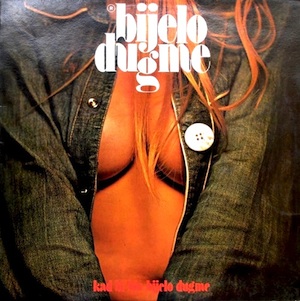
Bijelo Dugme album cover.

Oddly, the film ends exactly when Bijelo Dugme disbands, declining to cover the band members’ experiences during the war. However, the accompanying short, Damir Pirić’s Rock ‘n’ War, fills that gap, but from the perspective of the working rock bands of Tuzla rather than the White Buttoners.

Rock concerts “for peace” are a tiresome cliché here, but when the Tuzla rockers organized them in hopes that cooler heads would prevail in the weeks leading up to war, one has to give them credit for trying. Indeed, there is a lot of dramatic footage in the short (sixteen minute) doc. Hearing one band shred through and utterly re-contextualize Neil Young’s “Keep Rockin’ in the Free World,” is frankly kind of awe-inspiring.

Bijelo is a droll, cleverly assembled Behind the Music film, while R ‘n’ W is raw and poignant.  They both rock hard, though, closing this year’s festival on a high note. A sold-out screening, the BHFF appears to be growing nicely, bringing films by and of interest to Bosnians to a wider audience beyond the local expat community. Here’s hoping for a third day next year.

Posted on May 17th, 2011 at 2:37pm.
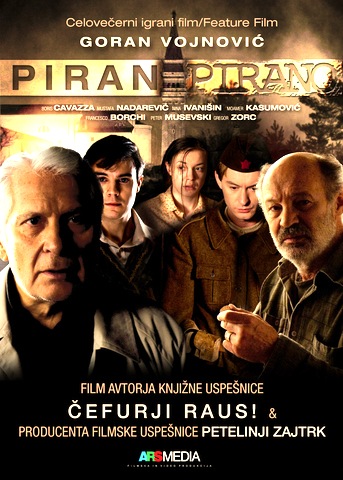
LFM Review: Piran-Pirano @ The 2011 Bosnian-Herzegovinian Film Festival

By Joe Bendel. How better to start the 2011 Bosnian-Herzegovinian Film Festival than with a film about the arbitrary nature of geography? Antonio is Italian. Veljko is Bosnian. Yet both have only felt truly at home in a particular apartment in the picturesque Slovenian city of Piran. That is where their paths fatefully crossed during WWII in Slovenian filmmaker Goran Vojnović’s Piran-Pirano (trailer here), the opening film of the 2011 BHFF in New York.

Antonio was not a Fascist, but his father certainly was. A school teacher whose lesson plans were little more than hateful propaganda, he decides discretion is the better part of valor when Tito’s forces arrive. Only concerned with his own neck, he leaves his college-aged son behind in their flat. Through sheer fortune, Antonio eludes the Partisans’ initial sweep of the apartment, but he is caught flat-footed by Anica, a young Slovenian woman traveling with the partisans.

Mourning her entire family, the vengeful Anica is in no mood to show mercy to an Italian, yet they reach an uneasy truce of sorts for the night. It is there in the apartment that Veljko discovers them. Like Anica, he has also lost his family, but he is not inclined towards retribution. In fact, he is not much of a soldier at all.

Told in flashbacks when the two men meet again decades later, Piran’s themes of cruelty and compassion in times of war have obvious resonance for Bosnian audiences. It hardly glorifies Tito’s army either, clearly depicting the summary executions ruthlessly carried out by the Communist forces. The commander matter-of-factly accepts the brutal tactics, as well as the potential death of innocents, as the cost of waging war. However, some of his subordinates are more enthusiastic about the dirty business of war. Continue reading LFM Review: Piran-Pirano @ The 2011 Bosnian-Herzegovinian Film Festival

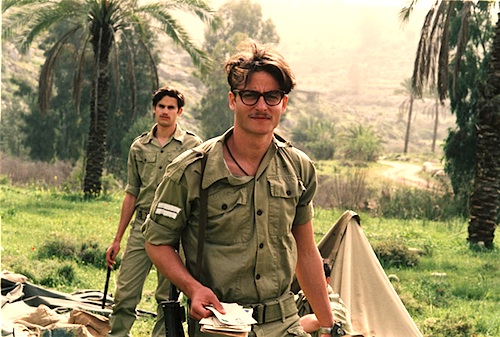
LFM Review: The Matchmaker @ The Israel Film Festival in New York

By Joe Bendel. Would you buy a second-hand heart from this man? Yankele Bride genuinely wants to make love connections, even for those who cannot afford to pay. Of course, the dodgy contraband in the storeroom is another question altogether. 1968 proves to be a tumultuous year for Bride and his adolescent assistant in Avi Nesher’s The Matchmaker, one of the highlights of the 2011 Israel Film Festival in New York.

Bride was literally scarred by his time in the concentration camps, yet he still believes in love. He is a realist though, telling his clients he “gets them what they need, not what they want.” Despite his many dubious enterprises, he scours the neighborhoods looking for the marginalized in need of his match-making help. That is how Arik Burstein initially encounters him. Fatefully, Burstein’s attempt at a practical joke at Bride’s expense backfires when it turns out he is a long lost classmate of his Romanian émigré father, Yossi. Before he knows it, young Burstein is working as Bride’s assistant, which largely involves trailing prospective clients to make sure they are on the up-and-up.

Although romance is Bride’s business of choice, he must settle for a close but chaste friendship with Clara, the love of his life, who remains profoundly haunted by her Holocaust experiences. In contrast, Burstein struggles against his attraction to Tamara, his best friend Benny Abadi’s sultry hippy cousin, who finds herself spending her summer with the Jewish Iraqi family.

Continue reading LFM Review: The Matchmaker @ The Israel Film Festival in New York

LFM Review: Infiltration @ The Israel Film Festival in New York

From "Infiltration."

By Joe Bendel. The platoon of rejects undergoing bootcamp at IDF Training Base 4 cannot be called a Dirty Dozen. Frankly, they are not even dirty. Each should have been disqualified on the basis of physical or mental grounds. Instead, they are botching basic training together as a misfit unit in Dover Kosashvili’s Infiltration (trailer here), which screens during the 2011 Israel Film Festival in New York.

Miller is an epileptic. Peretz has anger management issues. Poor Rachamim Ben Hamo is a wreck, both physically and mentally. It is not exactly clear why self-styled ladies’ man Gabay is there, but it is quickly obvious he is the sort of person who makes every situation more difficult than necessary. Nearly everyone in the platoon expects a menial assignment when their course is completed, except Alon Harel. As a strapping young kibbutznik, he refuses to consider anything less than the paratroopers, not that he has any say in the matter. Unfortunately his resentment will not dissipate, despite the (mostly) helpful suggestions of Commander Benny, their NCO drill instructor.

Based the 1986 novel by Yehoshua Kenaz, Infiltration (so titled for a war game exercise) obviously inspires comparisons to Full Metal Jacket. However, Commander Benny is no R. Lee Ermey. Granted, he can be cruel, but it is rather hard to blame him. After five minutes, you will want to haze the holy terror out of his recruits too. Continue reading LFM Review: Infiltration @ The Israel Film Festival in New York

LFM Review: Land of Genesis @ The 2011 Israel Film Festival in New York

By Joe Bendel. When watching a mongoose take out his hissing foe in Israel’s first nature documentary, the allegory is almost too easy to draw. Fortunately, Israel has been the scrappy mongoose, not only defending the only civilized corner of the Middle East but also preserving considerable areas of pristine nature. Moshe Alpert documents three species of mammals raising their young in the wild habitats of Israel most people never knew existed in Land of Genesis, which screens during the upcoming 2011 Israel Film Festival in New York.

Genesis will radically change how many people think of Israel, particularly the Golan Heights, where two wolves are starting their own pack. Likewise, the Sea of Galilee probably has much different associations for viewers than as the habitat for swamp cats. At least the desert might seem like a fitting environment for exotic species, like the ibexes Alpert follows. Continue reading LFM Review: Land of Genesis @ The 2011 Israel Film Festival in New York

LFM Review: Klitschko @ Tribeca 2011

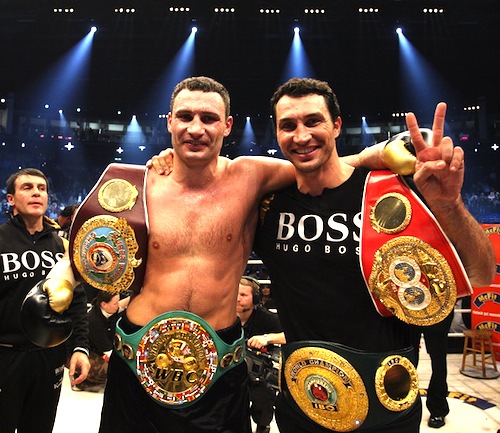
By Joe Bendel. Mother Klitschko is no fun. She expressly prohibited her boxer sons Vitali and Wladimir from fighting each other. Of course, that is exactly what the boxing world wants to see. Sebastian Dehnhardt profiles the two well-educated Ukrainian brothers who rose to the top of the boxing ranks, got knocked down, and clawed their way back in the simply but aptly titled documentary Klitschko, which screens at the 2011 Tribeca Film Festival.

The Klitschko brothers.

Growing up military brats, the Klitschko brothers’ father was an ardent Communist. However, he would pay for his blind faith, when his unit responded to the Chernobyl crisis without adequate protective gear. Fortunately when his cancer inevitably surfaced, the Klitschkos already had sufficient means to provide their father with the best of western medicine. Coincidentally, the now cancer-free Col. Klitschko has had a complete ideological change of heart, at least according to his sons.

Though not technically twins, the Klitschko boys were always big and nearly impossible to tell apart. The older Vitali actually started out as a kick-boxer while so-called “Western martial arts” were prohibited in the Orwellian Soviet Union. Eventually the Klitschkos switched to boxing, where fighters could make serious money. Due to inopportune injuries, they lost several high profile bouts they should have won. The elder Klitschko was especially dogged by the quitter epithet. Yet, both brothers would have their Rocky moments in the ring.

Klitschko the film is definitely produced with boxing fans in mind. However, those who follow post-Soviet politics will also find Dehnhardt’s documentary engaging. A reformer, the elder Klitschko was even elected to the Kiev City Council for two stormy terms. The film is also unexpectedly (and unfortunately) topical, given the increased interest in the Chernobyl disaster following the near-repeat in Fukushima. Continue reading LFM Review: Klitschko @ Tribeca 2011