LFM Reviews Mary Lou Williams: The Lady Who Swings the Band on PBS

By Joe Bendel. You can pretty much count on one finger the jazz musicians who have received Papal commissions. Mary Lou Williams will always be remembered for excelling as a musician-arranger-composer at a time when the music industry was ridiculously male-dominated. Yet, by reconciling and combining jazz with her Catholic faith, Williams shattered just as many musical preconceptions. Williams’ life and music are surveyed in Carol Bash’s Mary Lou Williams: The Lady Who Swings the Band, which premieres on many PBS stations this week.

Williams was a child prodigy born to play the piano, but she first started to make a name for herself in Kansas City, at the height of the town’s hipness. Most musicians were loath to play with women, but her husband, alto and baritone player John O. Williams, knew she could swing. When his boss, territory bandleader Andy Kirk, found himself caught without a piano player, he reluctantly called her in to sub. Needless to say, she basically made Andy Kirk and the Clouds of Joy. Naturally, he resented her for it, but the producers were adamant—no Williams, no contract.

From "Mary Lou Williams: The Lady Who Swings the Band."

Eventually, Williams would separate from both Kirk and her husband, striking out on her own. Despite her talent and reputation, she would experience all the ups and downs of the jazz musician’s life, except it was always even more challenging for Williams—until she heard what can be rightly described as her calling. Finding spiritual renewal in the Catholic Church, Williams was encouraged to use her musical gifts, but in a way that expressed her deepening faith.

It is great to see Bash fully explore the significance and influence of Williams’ sacred music. She also gives the jazz legend her due as an entrepreneur – self-producing her releases on her own Mary label, long before that became the industry norm. However, the film leaves some unanswered questions regarding her relationship with John O. According to his obit, he also played with the Cootie Williams band and co-wrote “Froggy Bottom,” which suggests he might be one of those unfairly overlooked kind of guys.

Of course, the music is the most important thing in Lady Who Swings. Bash incorporates some all-star performances, appropriately including Geri Allen, who played the Mary Lou Williams figure in Robert Altman’s unfairly panned Kansas City. Wycliffe Gordon also leads a big band and Carmen Lundy lends her vocal chops and elegant presence, but Bash cuts off them off before they really get started. That is a shame, because just about all of us interested in Williams will want to hear their take on her music. Maybe the concert interludes are allowed to go on longer in a more extensive festival cut.

Indeed, fifty-four minutes on Mary Lou Williams is certainly economical, but it only scratches the surface and whets the appetite. Nevertheless, Bash makes sure viewers leave with the right take-aways. If you still don’t understand Williams was Catholic who could still swing hard after watching her film, you have serious retention issues. Brisk, informative, and respectful of Williams’ Catholicism, Mary Lou Williams: the Lady Who Swings the Band will leave audiences wanting more, but what we have is still definitely worth seeing. Highly recommended, it airs Monday night (4/13) in LA and Wednesday night (4/15) in San Francisco, with more airdates to come across the country, so check those local listings.

LFM GRADE: B+

Posted on April 13th, 2015 at 3:56pm.
LFM Reviews Éric Rohmer’s Newly Remastered Full Moon in Paris

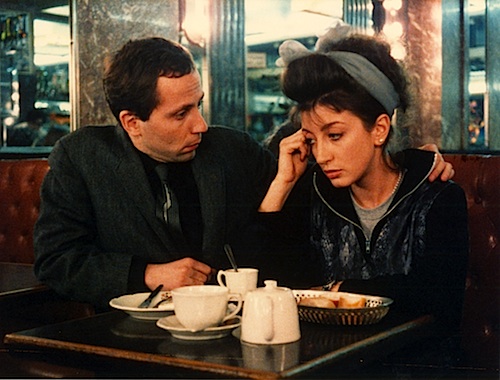
By Joe Bendel. It is the early 1980s in Paris. The hair is feathered and the phones are all rotary. It looks glaringly dated, but the relationship issues of the characters inhabiting this world are as fresh today as they were when the film wrapped. Such is often the case with the work of Éric Rohmer. Technically, it is the fourth of his narratively discrete Comedies and Proverbs pseudo-series, but Full Moon in Paris is completely its own Rohmeresque animal, which launches Film Movement’s Classic line when it re-releases this Friday in New York.

Louise loves Remi, more or less, but she is not nearly as enamored with him as he is with her. By now, the lovely social butterfly is accustomed to being in that position. Still, she is committed enough to move into his modern suburban condo in Marne. The daily commute from her Paris interior design internship is a bit of a drag, especially when she wants to go out with friends. Everything would be much simpler if Remi would agree to let her keep a pied-a-terre. Of course, that means they will have to mutually trust each other.

Despite her aggressively flirtatious nature, Louise is, by-and-large, faithful to Remi. Ironically, it is Octave, the married platonic friend whose advances she frequently refuses, who plants the seeds of suspicions in her. He is absolutely convinced he saw Remi with one of Louise’s fashionista friends, under rather intimate circumstances.

Like most of Rohmer’s films, Moon completely stands alone. Yet, the more Rohmer films viewers watch, the more they get out of them as a collective body. Again, Rohmer displays a characteristic fascination with schedules and time tables, while duly marking the passage of successive months. He also gives us a time capsule snap shot of the suburban Paris circa 1984.

However, Moon is arguably one of the easiest Rohmer films for viewers to identify with. Let’s be honest, just about everyone has been in an unequal relationship, liking the other person more than they reciprocated, or liking them in a completely different way. Louise is in several such relationships, but karma will ultimately catch up with her.

Perhaps the saddest aspect of Moon is the tragic fate of Pascale Ogier, who would become only the second actress to be posthumously nominated for César Award for her performance as Louise. She might very well have become a Rohmer mainstay, but it was not to be.  Even though the character causes all her angst and heartache, Ogier still makes Louise a figure of great sympathy. Yes, she is self-serving and insensitive, but in a strangely naïve way. Indeed, she is the picture of waif-like vulnerability.

From "Full Moon in Paris."

It is also rather mind-blowing to see the future Luc Besson tough guy Tchéky Karyo playing the socially awkward Remi. He is in fact, quite good, especially in the big pay-off scene. In contrast, Octave is not so very different from the supercilious characters Fabrice Luchini has made a career out of playing, but he gives Louise’s married suitor a notable edge. Whereas, in the Rohmer tradition of small parts with large impact, László Szabó nearly steals the entire picture outright in his eleventh hour appearance as an illustrator working in the wee hours at a local café, slyly putting an exclamation point on Rohmer’s chosen proverb: “he who has two women loses his soul, he who has two houses loses his mind.”

Moon returns just in time to act as a corrective to Victor Levin’s middling 5 to 7, which seems to think it has a lot to say about relationships, but is completely undercut by Louise’s eye-opening experiences. Rohmer’s film has a forgiving nature, but there is still a lot of sting to it. It is also rather encouraging to see the quiet Rohmer renaissance continue, following the long deferred proper New York opening of A Summer’s Tale and the subsequent revival of A Tale of Winter. Both are fine works, but Full Moon in Paris is an even better film. Highly recommended for those who appreciate honest and sophisticated filmmaking, Full Moon in Paris opens this Friday (4/17) at the Elinor Bunin Munroe Film Center, in conjunction with a full retrospective of Rohmer’s Comedies and Proverbs.

LFM GRADE: A

Posted on April 13th, 2015 at 3:56pm.

LFM Reviews The Dead Lands

By Joe Bendel. You may not be familiar with the Maori martial arts discipline of Mau Rakau, but there is a reason it translates as “to bear a weapon.” Viewers will see just how lethal paddle-shaped Patus and assorted traditional spears can be when a teenage Maori follows his father’s killer through a shunned stretch forest in Toa Fraser’s The Dead Lands, which opens this Friday in New York.

This is New Zealand before contact with Europeans, but it is not necessarily unspoiled. Something so horrific happened in the so-called Dead Lands, the various Maori tribes avoid it at all costs. The exact details remain hazy, but everyone believes the old, ferocious figure known simply as “the Warrior” was intimately involved in the atrocity. Just about everyone will travel days out of their way to avoid his territory – but not Wirepa, who just barges through.

The arrogant young son of the tribal chief has just manufactured a grievance against their rival tribe. His subsequent sneak attack nearly wiped out all of Hongi’s people and killed his father, the peace-loving chief. Nobody ever thought the clumsy Hongi would ever amount to much of a warrior, but he will have to develop his skills quickly to avenge his people. With the encouragement of his grandmother’s aggrieved spirit, Hongi forges an alliance with the fearsome Warrior (with a capital “W”), who does not appreciate the entitled Wirepa traipsing through his territory. Despite his profoundly antisocial nature, The Warrior will take Hongi under his wing, teaching him the deadly art of Mau Rakau.

Dead Lands is bound to offend some viewers because its vision of pre-contact Maori is all about fighting. Yet that is not such a bad strategy, since it allows the film to sidestep the awkward melodrama of a Rapa Nui. It certainly makes viewers reluctant to hassle anyone carrying a patu with authority, which is something the film can hang its hat on.

Indeed, the Mau Rakau fight scenes choreographed by cast trainer and co-star Jamus Webster are spectacularly cinematic. The imposing Lawrence Makoare (a veteran of The Lord of the Rings franchise and Marco Polo) is an especially effective action figure, who seems ripe for a cult following after all the glowering and hacking-and-slashing he does as “The Warrior.” James Rolleston and Te Kohe Tuhaka also go at it with admirable vigor as Hongi and Wirepa, respectively. Frustratingly, Raukura Turei displays impressive Mau Rakau chops and real screen presence as Mehe, a lady warrior and potential love interest, but she is forced to make a rough entrance all too quickly after the film introduces her.

There is probably plenty of ethnographic hand-wringing to do over Dead Lands, but the action scenes are cool and it provided a lot of work for Maori actors and craftsmen. In its way, it should inspire widespread fanboy appreciation for the time honored practice of Mau Rakau. Fraser gives it all a strong sense of place and nicely instills a mood of mystery and foreboding. Recommended for fans of Seediq Bale, The Dead Lands opens this Friday (4/17) in New York, at the Village East.

LFM GRADE: B

Posted on April 13th, 2015 at 3:56pm.

LFM Reviews Li Wen at East Lake @ Art of the Real 2015

By Joe Bendel. A cop who collects Cultural Revolution-era pre-execution photos must sound like one scary cat, but Li Wen does it with a sense of irony. To keep the peace, he will hunt a supposedly mentally disturbed troublemaker, who might just be an eccentric gadfly the powers-that-be find inconvenient. Everything about the copper and his latest case are both fake and real, making Luo Li’s meta-meta-hybrid documentary Li Wen at East Lake a perfect selection for the Film Society of Lincoln Center’s annual Art of the Real series of aesthetically challenging docs.

Following in the recent tradition of independent Chinese cinema, Li Luo does not exactly rush into his narrative. Instead, he establishes a sense of East Lake, one of the few remaining inland lakes in the hyper-developed Wuhan metropolitan district. Legend has it, a dragon once rose from the lake to wreak fiery, purifying vengeance. A sort of Holy Fool seems to be peddling that story again, which is bad for state socialist-crony capitalist business, so Li Wen and his deputy must track down the rabble-rouser. Yet, either their quarry is surprisingly elusive or Li Wen is not feeling especially motivated, because it will take quite some time.

If ever there was a film whose sum of its parts is greater than its whole, it would be LW@EL. There are a number of boldly pointed scenes, some of which even get quite intense. Unfortunately, there is an awful lot of sketchy and sluggish connective material, ostensibly holding it together, but really just watering down the overall cinematic experience.

From "Li Wen at East Lake."

Nevertheless, when it is on, it scores impressive points. This is especially true when Li Wen argues with a gender and sexuality identity-studies grad student—a sequence that is as funny as anything you will see in a major studio release this year. Yet, there is also a very serious subtext critiquing the Communist government and state media’s hostility towards LGBT citizens. Likewise, Li Wen’s rather frank discussions regarding the Party and the Cultural Revolution (which officially never happened) are far from flattering. In fact, we eventually learn he was once a modernist artist, but now Li Wen paints motel-worthy landscapes as brown-nosing offerings for his uncultured superiors.

Piling on the meta-ness, Li Wen the copper-painter is played by Li Wen the real life painter and occasional actor, previously seen as the title character in Luo Li’s Emperor Visits the Hell. As his namesake, he shows considerable range, in the unlikeliest of ways. He shows off some razor sharp comedic timing, while also conveying profoundly sad awareness of current injustices and the weight of historical tragedies.

There are flashes of brilliance from Li Luo and his mostly unprofessional (or perhaps semi-professional) cast throughout LW@EL, but he forces viewers to really work for them. Committed China watchers will find it worth the effort, but the less cerebral and adventurous the viewer, the slimmer the returns. Recommended for a narrow, confidently self-selected audience, Li Wen at East Lake screens this Wednesday (4/15) at the Francesca Beale Theater, as part of this year’s Art of the Real.

LFM GRADE: B-

Posted on April 13th, 2015 at 3:55pm.

LFM Reviews Flowers of Taipei

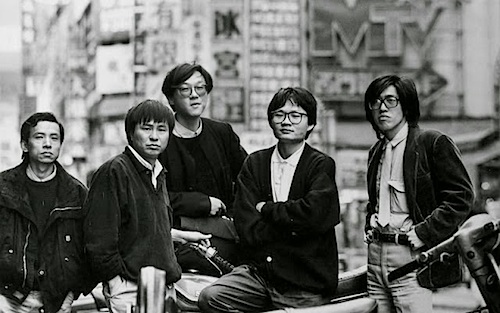
By Joe Bendel. Even according to its most ardent admirers, it was a movement that only lasted a few years in the 1980s. Yet, it has had a lasting influence on art cinema throughout Asia and beyond. If there is one filmmaker who best embodies the New Taiwanese Cinema (or New Wave) it would be Hou Hsiao-hsien. Fittingly, Hou factors prominently in Hsieh Chin-lin’s documentary, Flowers of Taipei: Taiwan New Cinema, which screens as part of the Hou retrospective Also Like Life, now underway at UCLA’s Billy Wilder Theater.

They were the product of a very specific place, at a very specific time. Taiwan was beginning its transition to a legitimate democracy, while its economy was emerging as one of Asia’s vaunted “Tigers.” Hou and Edward Yang were addressing the Taiwanese character in intimate terms, while also exploring the messier aspects of the nation’s history, including the Japanese occupation and the purges of the 1950s. Perhaps most importantly, they received unprecedented recognition on the international festival circuit.

It is particularly telling to hear Chinese filmmakers like Jia Zhangke and dissident artist Ai Weiwei express their esteem for New Taiwanese Cinema and considerable regret an equivalent movement was not possible in Mainland cinema. Hsieh does not belabor the point, but one gets a real sense that Hou, Yang, and their colleagues helped exorcise many of Taiwan’s ghosts and thereby helped the nation progress into a modern democracy.

We hear from many other appreciative filmmakers, including Apichatpong Weerasethakul, who credits the New Taiwanese Cinema for shaping his style. It is not hard to see the seeds of his inspiration, but it does not seem fair to lump the 1980s Taiwanese auteurs into the slow cinema rubric. Yang’s A Brighter Summer Day is a particular touchstone for Weerasethakul, but that film has no shortage of plot in its two hundred thirty-seven minutes.

From "Flowers of Taipei."

Unlike typical talking head documentaries, Hsieh is unusually sensitive to the power of place. It just adds something unquantifiable when Japanese actor Asano Tadanobu discusses making Hou’s Café Lumière in the Japanese bookstore where many of their scenes were shot. It is also a nice touch interviewing Hirokazu Kore-eda in the hotel room where Ozu and his co-writer Kogo Noda worked out so many of their great collaborations. Of course, Hsieh liberally illustrates Flowers with clips from the films under discussion. Many might be obvious choices, like the stunning opening shot of Shu Qi in Millennium Mambo (which some might consider a post-New film), but they still look great.

There is a fair degree of debate amongst Flowers’ expert commentators, but there is general agreement on the merits of Taiwanese New Cinema films, regardless of categorizations. It is rather fascinating to see how these acutely personal films fit within a larger social and cultural context. This is also an appropriate time to take stock of Taiwanese cinema, with the Hou retrospective now playing in Los Angeles and the Tsai Ming-liang career survey launching at MoMI this weekend, both of whom appear in Flowers. One of the best documentaries on non-genre-related cinema in recent years, Flowers of Taipei is very highly recommended when it screens this Sunday (4/12) in Los Angeles, as part of Also Like Life: the Films of Hou Hsiao-Hsien.

LFM GRADE: A-

Posted on April 10th, 2015 at 2:59pm.

LFM Reviews Who Am I—No System in Safe @ Kino! 2015

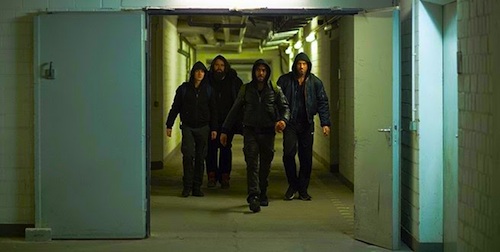
By Joe Bendel. Considering the shadowy cyber-activist outfit known as FR13NDS decks out their avatars with masks clearly inspired by the terrorist protagonist of V for Vendetta, it is probably safe to assume the sanctity of life is not a big priority for them. However, a hero-worshipping hacker will be rather disappointed to learn they are in league with the Russian mob. Unfortunately, this revelation comes after he ever so ill-advisedly passes along some highly secretive intel. Cyber monkey-wrenching inevitably turns into cyber-terror in Baran bo Odar’s Who Am I—No System is Safe, which screens as part of Kino! 2015, the festival of German Films in New York City.

Life has not worked out so well for Benjamin, at least so far. Yet, it always makes more sense when he is in front of a computer screen. Since he bought into the propaganda disseminated by FR13NDS, Benjamin has become one of the sycophants hanging on the pronouncements of the group’s shadowy leader, Mr. X, in super-secret online forums. He is not the only one. A chance meeting during court mandated community service with the mercurial Max will bring the two kindred spirits together. Together with Max’s old co-conspirators, they form CLAY (“Clowns Laughing At You”) in hopes of impressing Mr. X with their socially conscious prankersterism.

Much to the temperamental Max’s frustration, Mr. X remains dismissive of CLAY. Yearning for online approval, they swing for the fences, launching a major online and physical breach of the Federal intelligence service. Regrettably, when Benjamin gives Mr. X a batch of unvetted classified files as proof-of-hack, it leads to the gangland-style execution of government informants. Wanted for murder, CLAY will have to take down Mr. X to clear their names.

It might be awkwardly titled (“No system is safe” being one of Mr. X’s maxims), but WAI—NSIS is a massively slick thriller that offers a pointed critique of Vendetta and Hacktivist culture in general, while also slyly riffing on Fight Club. Odar’s inventive representations of cyberspace (in a dodgy looking subway car) are quite stylish and cinematic. He also stages some impressive breaking-and-entering scenes and seamlessly executes the third act mind-twister. Based on WAI—NSIS and his previous film, The Silence, it should not be long before Odar is recruited for a major American studio thriller gig.

From "Who Am I—No System in Safe."

The cast might have to wait longer for a call from Hollywood, but they are all reasonably solid. Tom Schilling (Generation War and A Coffee in Berlin) is suitably earnest and nebbish as Benjamin. Elyas M’Barek also vents some convincing spleen as the petulant Max, while Wotan Wilke Möhring and Antoine Monot Jr. add seasoning as their unlikely looking accomplices. On the other hand, it is difficult to fathom Hannah Herzsprung’s appeal as Marie, the charmless object of Benjamin’s affections.

Frankly, it is almost a miracle the production company behind WAI—NSIS has not been hacked back to the Stone Age by hacker-activists taking umbrage with the film’s relatively favorable depiction of law enforcement and decidedly critical portrayal of their online skulduggery. Arguably, it is one of the bravest films you will see all year. Highly recommended, Who Am I—No System is Safe screens this coming Monday (4/13) and Wednesday (4/15) at the Cinema Village, as part of this year’s Kino! in New York.

LFM GRADE: A-

Posted on April 10th, 2015 at 2:59pm.