Salma Hayek vs. the Yakuza: LFM Reviews Everly

By Joe Bendel. Even if you believe “violence is never the answer and what the world really needs is more love and understanding,” just keep it to yourself. Everly does not have time for warm and fuzzy liberal new age platitudes and we do not want to hear them. She is simply too busy worrying about escape and payback. For several years, she was enslaved as a prostitute by the Yakuza, but now she will try to shoot her way out of their fortified brothel. It is not a well thought out  plan, but at least she will be able to take a lot of bad guys with her in Joe Lynch’s Everly, which opens this Friday in targeted markets.

Everly used to be the favorite of the kingpin, Taiko, but not anymore. An honest cop also lost his head over her. Taiko had it boxed up and presented to her. She had agreed to testify for the late detective, but obviously that will not be happening. Taiko’s men were supposed to do their worst to her, but she was able to stash a gun in the toilet bowl. Bullets will fly—and they will keep flying, but Everly is not immune to them. In fact, she starts the film pretty dinged up, but she is able to patch herself up and keep going.
Unfortunately for him, one of Taiko’s bean-counters gets gut-shot in the first volley. There is clearly no way he will make it. Much to her surprise, the dying paper-pushing gangster offers her some helpful strategic consultation as he slowly expires. Acting on his advice, she makes a risky play, arranging a pretext for her mother and the daughter she never knew to pick up a bag of traveling money from Taiko’s high-rise of hedonism-turned war zone.

To their credit, Lynch and screenwriter Yale Hannon understand the point of a film like this and therefore never cheapen it with a disingenuous take-away about the supposed dangers of firearm possession or the folly of vengeance taking. Taiko and his associates need to die—period. Frankly, some bits are rather disturbingly explicit, particularly those involving the “Sadist” played by the classy Togo Igawa (the first Japanese member of the Royal Shakespeare Company), but that makes it extra satisfying when they get theirs.

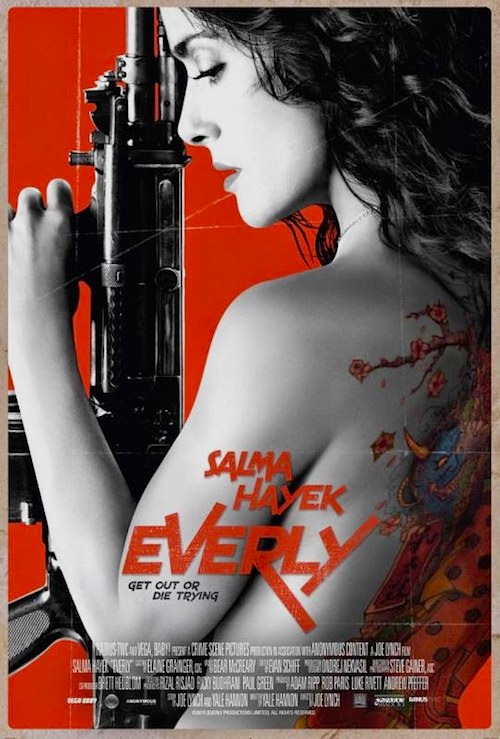
It should also be noted that the forty-eight year old Salma Hayek looks all kinds of dangerous as Everly. She is in tremendous shape and shows real action chops, but in a grittier, less cartoony way. She conveys the well-armed rage of a desperate mother, which makes each showdown deeply primal. There are real stakes in Everly—and plenty of blood, but her relatively quiet scenes with Akie Kotabe as the dying suit are some of the film’s best.

We have often lamented the dearth of legitimate female action stars in Hollywood and mainstream indie movies. It is so bad, Meryl Streep has laughably been suggested for the female Expendables film in development. With Everly, Hayek blasts herself into contention to lead the whole darned shooting match. Despite its obvious debt of inspiration to Gareth Huw Evans’ The Raid, it is an old school, deliciously sleazy revenge thriller that always delivers the goods right to your doorstep and never expects a tip. Highly recommended for fans of exploitation action, Everly is now available on VOD via iTunes and opens this Friday (2/27) in selected cities.

LFM GRADE: A-

Posted on February 25th, 2015 at 9:59pm.
LFM Reviews My Life Directed by Nicolas Winding Refn

By Joe Bendel. It was not a total loss when Only God Forgives, Nicolas Winding Refn’s much anticipated follow-up to Drive, bombed with the Cannes press corps. At least it should have shown Ryan Gosling how to deal with the Lido drubbing dealt to his directorial debut, Lost River. Maybe Winding Refn’s film is not looking as bad to them, by comparison. Maybe. Nevertheless, his family did not return from six months in Thailand without bringing home one highly watchable film. Alas for Refn, that would be his wife Liv Corfixen’s up-close-and-personal behind-the-scenes documentary, My Life Directed by Nicolas Winding Refn, which opens this Friday in New York.

When watching Corfixen’s film, you immediately realize there was no way OGF was going to work. Winding Refn essentially admits his script makes no sense, which is never a good sign. Yet, his own contradictory impulses imply an even deeper identity crisis for the film. On one hand, he is clearly preoccupied with the pressure to repeat the success of Drive, yet he is perversely determined to produce a something utterly dissimilar. Mission accomplished on that score.

Much to her frustration, Winding Refn strictly limited Corfixen’s access to the set. It is evident from their often testy exchanges that she missed a lot of “making of” drama as a result. Still, it is blindingly obvious from the get-go this is a “troubled” production. In some shockingly revealing scenes, she captures all of her husband’s unvarnished self-doubt and self-pity, as OGF irreparably runs off the rails. Winding Refn’s references to compatriot Danish filmmaker Lars von Trier sounds especially telling. They seem like they should be two neurotic peas in a pod, but Winding Refn clearly nurses an inferiority complex.

Life should really not be dismissed as a DVD-extra, because it is hard to see anyone packaging it with OGF. After all, the shorter film basically explains why the longer feature attraction is such a chaotic mess. Short is also the right term. The actual movie substance of Life clocks in just under sixty minutes. However, Life has one thing few films can boast: their legendary family friend, director Alejandro Jodorowsky reading tarot and providing marriage counseling.

From "My Life Directed by Nicolas Winding Refn."

In all honesty, OGF has its moments, but they all come courtesy of the wonderfully fierce Kristin Scott Thomas and stone cold Thai movie star Vithaya Pansringarm, both of whom are seen in Life, planning their climatic scene together. In contrast, Gosling is utterly underwhelming, but to be fair, he comes across like a good sport in Corfixen’s doc, often seen playing with the couple’s young daughters. Perhaps he and Refn should just leave the making of David Lynchian films to David Lynch.

Regardless, Life is a brutally honest look at the personal and emotional repercussions of a film that never worked, in any step of its production. It is also frequently very funny, in decidedly uncomfortable ways. Frankly, it is a shame we do not have similarly intimate records of the notorious production processes for films like Heaven’s Gate, but Life will be there as a cautionary example for all future filmmakers battling their expectations and egos. Highly recommended for fans of cult cinema, My Life Directed by Nicolas Winding Refn opens this Friday (2/27) in New York, at the Elinor Bunin Monroe Film Center.

LFM GRADE: B+

Posted on February 25th, 2015 at 9:58pm.

LFM Reviews Serangoon Road, Now Available on DVD

By Joe Bendel. If the boy from Empire of the Sun, grew up to be a hardboiled private detective, he would be a lot like Sam Callaghan. The Aussie expat is still haunted by his childhood experiences in a Japanese internment camp, but he toughened up considerably through his Malaya military service. He used to lend a hand to the late Winston Cheng on a freelance basis, but he reluctantly agrees to a more regular arrangement when his widow Patricia decides to keep the agency open. Thanks to the Secret Societies, terrorist bombings, and all sorts of garden variety smuggling, they will find no shortage of business in Serangoon Road, HBO Asia’s first original series production, which releases today on DVD from Acorn.

Callaghan sort of blames himself for Cheng’s death, but the elegant Mrs. Cheng plays the guilt card with restraint. Although she is from a “mainline” establishment Peranakan Chinese family, the childless widow still needs the agency as a means of support. With the help of Sam and her progressive niece Su Ling, she also hopes to catch her husband’s murderer.

Their first case seems to be a one-off with little long term implications, but it will introduce the large cast of characters. Fresh-faced CIA recruit Conrad Harrison and his shadowy boss “Wild Bill” need the Cheng Agency to track down an African American sailor accused of murdering his best mate. It is probably the series’ least flattering depiction of American spooks and servicemen, but at least Harrison, one of those “best and brightest,” seems to care about right and wrong. He is also very interested in Su Ling, but she initially wants nothing to do with a Yankee government employee.

The past will directly haunt the present in subsequent episodes, as when the Cheng Agency takes on an illegal refugee’s case in the second episode. Forced to take flight during the Japanese invasion, Ms. Feng has returned (undocumented) in search of the husband she left behind. The case looks pretty cold until Ms. Feng is mysteriously poisoned. As she clings to life, Callaghan scrambles to trace her beloved husband, empathizing with her deep sense of loss. He will become even more personally involved with a case later in the season, when the Aboriginal soldier who watched over him during the darkest hour of the war is accused of murdering an aspiring journalist.

Many of the Cheng Agency cases lead back to Kay Song, the heir apparent of Singapore’s most feared secret society (a gang primarily involved in crimes of sin). For some reason, the sinister gangster has it in for Kang, Callaghan’s compulsive gambling partner in a barely legal shipping operation. It is hard to see why he bothers, given Kang’s multitude of self-destructive flaws. Frankly, Kang subplots will become a tiresome distraction as the series progresses.

As befits a good period noir, everyone in Serangoon is compromised to some extent, particularly Callaghan, who is rather openly carrying on an affair with Claire Simpson, the wife of a junior executive assigned to a powerful western trading company’s Singapore office. Conveniently, Frank Simpson is often required to travel throughout Southeast Asia. Rather awkwardly, Callaghan is even hired to investigate his rival when Simpson is anonymously sullied with rumors of corruption.

During the course of the first season, the Cheng Agency will also deal with a mysterious foundling, a suspicious business leader with political aspirations, his nearly as suspicious trade unionist brother, two kidnapped Australian tourists, and a massive race riot that the bad guys will opportunistically exploit to the fullest. Structurally, each episode is reasonably self-contained, but they fit together to form a wider overall narrative arc.

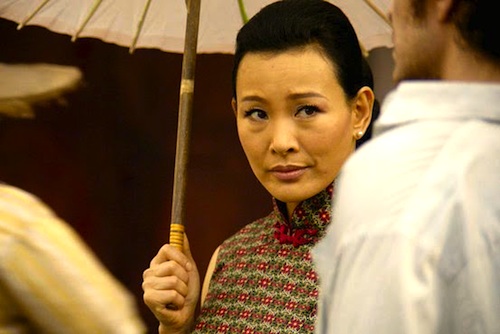
Although many of the mid-sixties Singaporean details are quite intriguing, it is the strong ensemble cast that really distinguishes Serangoon. Even though he sometimes overdoes the heartsick brooding, Don Hany’s Callaghan still has an appropriately manly yet world weary screen presence. Of course Joan Chen adds plenty of class and sophistication as Patricia Cheng. It is easy to see why western bureaucrats would have confidence hiring her.

From "Serangoon Road."

Frankly, the real discovery is Pamelyn Chee (who maybe a handful of people saw in Wayne Wang’s Princess of Nebraska), stealing scene after scene with Su Ling’s wry sarcasm and slightly deceptive elegance. Chin Han chews the scenery like he enjoys the taste as the villainous Kay Song (just as he did in Marco Polo). Somewhat frustratingly, Indonesian superstar Ario Bayu does not get a lot of fun things to do this time around, but there is room for his character, Inspector Amran, to grow. However, Maeve Dermody’s hopelessly vanilla Simpson falls somewhat short in the scandalous femme fatale department. It is hard to get why Callaghan is so hung up on her. Maybe you just have to be there—in Singapore—circa 1964.

Regardless, there is more than enough mystery, betrayal, and colorful supporting characters to keep viewers engaged and increasingly invested. Frankly, it seems strange the American HBO did not pick it up to fill a slow spot in their calendar. In terms of production quality, it holds its own with most limited-event cable series and should equally satisfy Joan Chen fans who know her either from Twin Peaks or Xiao Hua (The Little Flower). Recommended for anyone who enjoys humid noir in serial form, Serangoon Road is now available on DVD from Acorn.

LFM GRADE: B+

Posted on February 25th, 2015 at 9:58pm.

Meeting the Parents: LFM Reviews Anita Ho

By Joe Bendel. What kid wouldn’t want to date a Power Ranger? What guy wouldn’t be interested in a woman like Anita Lee? Maybe one who has met her parents. Harry Ho is about to have the dubious pleasure, but since he is Korean rather than Chinese, it will be a difficult getting-to-know-you process in Steve Myung’s Anita Ho, which opens this Friday in Los Angeles.

Harry is really a Korean Oh, but when his family came through immigration, it was changed to a Chinese-sounding (and more easily mocked) Ho. After a while, they got tired of fighting it. Unfortunately, this leads to some initial awkwardness when he first meets his girlfriend Anita’s parents, the Lees—and it only goes downhill from there. Needless to say, they want their daughter to marry a good Chinese boy. That means a doctor or a lawyer. An unemployed writer just does not cut it.

Technically, Ho is a freelancer, who quit his gig on Lee’s “Power Raiders” kiddie action show to write his screenplay. That has not been working out so well. At least, his relationship with Lee has been fulfilling. In fact, he intends to pop the question while they are visiting for her special thirtieth birthday banquet, but her parents will do everything they can to belittle and undermine him.

Just about anyone who was ever raked over the coals by their date’s dad on prom night should be able to relate to Anita Ho on some level. Of course, they never had to face George Cheung (the notorious Lt. Tay in Rambo: First Blood II and senior member of the Awesome Asian Bad Guys). Unimpressed with the mild-mannered Ho, Mr. Lee will actually try to fix his daughter up with a former classmate. Yes, he happens to be a doctor.

From "Anita Ho."

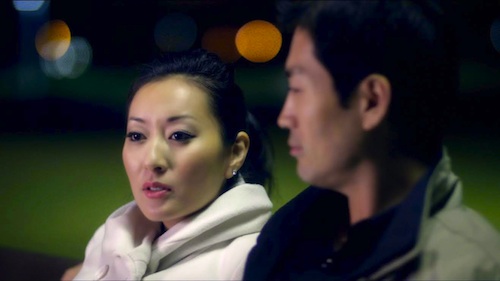
So maybe we have all been there, but director-co-writer Myung just cranks up the cringe factor when appearing as Ho. By the time the film is over that poor cat’s back is covered in “kick me” signs. He has some pleasant romantic chemistry with co-writer Lina So Myung, but it eventually becomes difficult to buy into them as a couple, while he wallows in humiliation and she essentially lets it happen. The Myungs also apparently dig romantic montages, because they are not stingy with them (though they really probably should have been).

Lina So Myung truly lights up the screen as Lee, while Cheung and Elizabeth Sung have their moments as the demanding parents. However, it is Kenny Waymack, Jr. who gives us something to latch onto as Lee’s Filipino brother-in-law and tough talking audience surrogate, Tyson Bautista. It is nice to see a film advocate inclusiveness, but some of the broad humor falls a bit flat. Frankly, the film would have been better served by a little more romantic courtship and a little less shtick. It is also cool to see the telegenic Myungs making their own opportunities. Nevertheless, Anita Ho is strictly a date-night kind of movie when it opens this Friday (2/27) at the Laemmle Playhouse 7 in Pasadena.

Posted on February 25th, 2015 at 9:57pm.

LFM Reviews Triumph in the Skies

By Joe Bendel. Where American networks failed with shows like Pan Am and LAX, Hong Kong found tremendous success with a prime time airliner drama. While it had the benefit of some star power from Francis Ng and Michelle Ye, it was really the multi-character romances that were powering the show. How big was it? Big enough to snag a New Year’s theatrical release for the big screen edition. Hearts will be broken on multiple continents in Wilson Yip & Matt Chow’s Triumph in the Skies, which is now playing in New York and select markets.

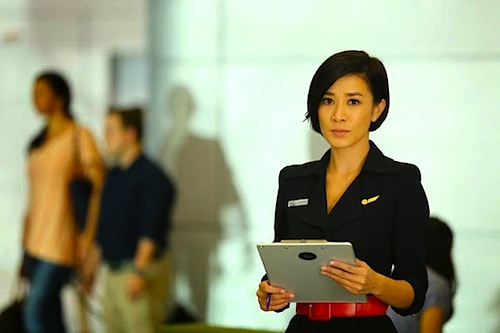
By-the-book Captain “Sam” Tong and his not-so-by-the-book co-pilot Jayden Koo used to be a regular flight crew, but they have split up. Tong is still the senior officer with Skylette, but the new boss’s son and heir apparent, Branson Cheung, has assigned him to serve as the technical advisor for their new commercial starring rock-star diva TM Tam. Nobody on-set wants to hear his quibbles, except maybe Tam. There are such polar opposites, they naturally start to attract.

Cheung, who also serves as a Skylette flight captain, is rather surprised to find his old flame Cassie Poon Ka-sze is part of the crew on his newly assigned plane. She is still disappointed he put their relationship on hold to please his father, but the sparks are still there. Meanwhile, Koo or “Captain Cool,” has landed a cushy job as the private pilot of a party plane, where he meets the seemingly ambitionless Kika Sit. However, he realizes almost too late there is far more to her story.

If you have seen a few Chinese romantic comedies you will basically know what to expect here, but Yip & Chow’s execution is wildly slick and lethally effective. You are not likely to see a sparklier movie anytime soon. Triumph has so much jet-setting, it makes Sex in the City look like EastEnders.

Sure, it is tons of manipulative, yet each of the three primary story arcs works surprising well, with the best being Tong’s halting flirtation with Tam. It is also the best written braided-storyline, featuring some wry, understated dialogue and terrific chemistry between series veteran Francis Ng and Sammi Cheng. You can almost think of it as an HK version of a James L. Brooks late middle-age relationship film. She also performs a catchy punk version of “Over the Rainbow” that will make you think that was what Harold Arlen & Yip Harburg really had in mind the whole time.

In contrast, Triumph totally goes for the tears with Captain Cool’s possibly tragic romance, but Amber Kuo just lights up the screen as Kika Sit. Of course, Julian Cheung is not exactly is not exactly a jowly sourpuss either—and they both know how to crank up the cute in their big feature spots.

From "Triumph in the Skies."

The third romance starring Louis Koo is a lot like an HK rom-com starring Louis Koo, but it is still one of the better ones. Again, he and Charmaine Sheh have surprisingly strong chemistry. However, the notion of an attractive working woman sitting around waiting for the man who walked out of her life to saunter back might not sit too well with American audiences.

Despite the vaguely Leni Riefenstahl-ish title, Triumph in the Skies is a pleasingly upbeat and colorful film. These days, it is just no fun whatsoever to fly on a commercial airliner or schlep through an airport, but it would be worth taking off your belt and shoes to fly with the ridiculously good looking crews of Skylette. Maybe it is a guilty pleasure, but it is fun. Recommended for those looking for an entertaining movie romance that pretty much covers all the bases, Triumph is now playing in New York at the AMC Empire.

LFM GRADE: B+

Posted on February 25th, 2015 at 9:57pm.

LFM Reviews Also Like Life

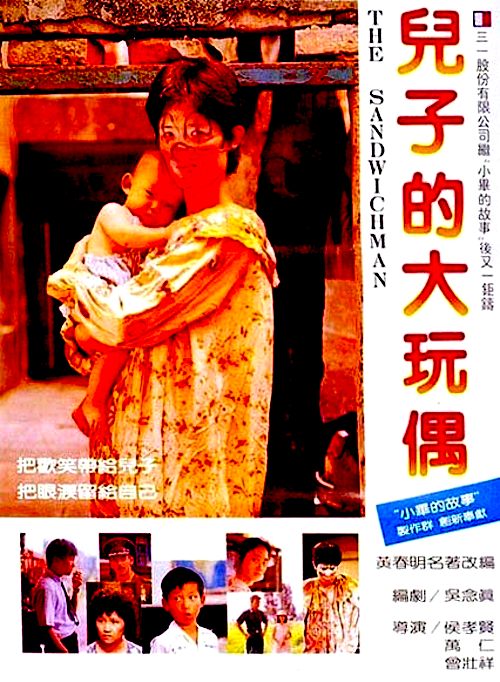
By Joe Bendel. Look in your pocket and you might find a smart phone made in Taiwan. They were the only one of the four Asian Tiger economies that largely dodged the regional financial crisis of the late 1990s. However, the Republic of China remains very aware of the extreme poverty it rose out of. The memories of its hardscrabble past were even fresher in the early 1980s, when Edward Yang and Hou Hsiao-hsien introduced the world to Taiwanese auteurist cinema. One of those watershed films was an anthology production Hou contributed to. Fittingly, Hou, Zeng Zhuangxiang, and Wan Jen’s The Sandwich Man screens this week as part of the traveling Hou retrospective Also Like Life, now playing in Vancouver.

Jin Shu is definitely a crying-on-the-inside kind of clown, but he doesn’t look very cheerful on the outside either. He tramps through his provincial small town wearing his shabby home-made clown costume and sandwich boards advertising the local theater. He has not even been paid yet for his humiliations. This gig was his idea and he is still working on-spec during the trial period. He badly needs work to support his infant son and increasingly impatient wife, but he does not have the right sort of personality for anything involving promotions to the public. Adding further anxiety to his wounded ego, Jin Shu’s little boy no longer recognizes him when he is out of make-up.

In some ways, His Son’s Big Doll (as the story’s title directly translates) also critiqued restrictive Taiwanese laws against contraception that were abolished a few years after the film’s release. It is a relentlessly naturalistic tale about economic desperation, but the surprisingly upbeat conclusion makes it feel like a sort of before-the-fact allegory of Taiwan’s rapid development—just hang on and everything will get better.

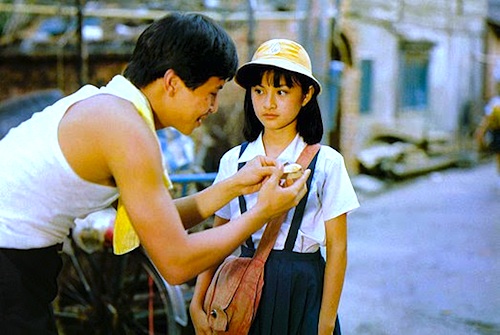
Since it is Hou Hisao-hsien and the titular story, The Sandwich Man would seem to be the main event, but the subsequent constituent films are just as good or better. In Zeng’s Vicky’s Hat, two new recruits try to sell Japanese pressure cookers throughout their provincial territory, but they soon start to suspect their product is categorically unsafe. It is a story that has a bit of Glengarry Glen Ross to it, but it is even more concerned with the younger salesman’s halting friendship with Vicky, a mysterious school girl in their neighborhood. There are some fine lines Zeng and his cast must walk—such as establishing his willingness to chastely wait for her to grow old enough for a relationship, but they turn the multiple tragic twists to devastating effect.

Wan’s concluding Taste of Apples is a bit O. Henry-ish—in fact, its irony now seems ironic. A migrant worker is hit by the American military attaché’s car, but this might not be the worst thing that could happen to his struggling family. He will have the best of medical care at the American military hospital, his wife and family will be financially taken care of, and his children will have educational opportunities that never would have otherwise been available to them. Plus, the American Colonel seems genuinely sorry about it all.

From "The Sandwich Man."

Reportedly, the Taiwanese government sought to suppress Sandwich Man because of its portrayal of American government personnel, but considering the anti-American propaganda out there, we should settle for Sandwich Man every chance we get. Sure, we try to fix problems by throwing a bunch of cash around, but that just might work for the family of Apples.

It is also rather fascinating to see how each narrative arc (all adapted from short stories by Huang Chunming, by screenwriter Wu Nien-jen, and shot by cinematographer Chen Kun-hou) speak in dialogue with each other. Those who survived the painful past and make it through the difficult present just might see a better tomorrow, but it will not be easy. A modern classic of Taiwanese cinema, The Sandwich Man could be even more significant when seen in the light of the subsequent thirty-some years of growth and liberalization. Highly recommended, it screens this Thursday (2/26) at The Cinematheque in Vancouver, as part of Also Like Life.

LFM GRADE: A-

Posted on February 25th, 2015 at 9:56pm.