Don’t Call It Found Footage: LFM Reviews Digging Up the Marrow

By Joe Bendel. Thanks to the found footage sub-genre, the horror movie community hardly knows what to do when the real thing comes along. At least that is sort of the premise of the new meta-meta mock-and-shock doc from the team behind the Holliston television series. Director Adam Green, playing himself and riffing off his Holliston persona, starts to suspect monsters are real, so naturally he sets out to film them in Digging Up the Marrow, which launches on VOD and opens in select theaters this Friday.

Green really does get a great deal of intricately constructed fan fiction sent to him, in some cases much like the incredibly detailed but presumably barking mad missive that starts his on-camera excursion down the rabbit hole. A retired Boston cop named William Decker claims a secret band of the freakishly deformed live in a subterranean world he calls the Marrow. The entrances are closely guarded, but he has discovered one, logically located in an out of the way cemetery. Thus begins a series of futile stakeouts, with his reluctant cinematographer Will Barratt (played by cinematographer Will Barratt) in tow.

Of course, just when Green decides Decker is a complete nut leading them on a wild goose chase, they finally see something that changes everything. However, they still have to convince their colleagues to take their footage seriously. Green’s real life editor Josh Ethier (who also played the killer lumberjack-alien in Joe Begos’ Almost Human) is particularly skeptical, but he is perfectly willing to cut Green’s stolen shots. “It’s not found footage, it’s . . . footage” he insists.

Frankly, this is one of the best postmodern self-referential genre films since Wes Craven turned his signature franchise on its head with New Nightmare. It is light-years better than the Vicious Brothers’ knowing but disappointingly flat Grave Encounters 2. While there are plenty of creepy moments, the film is more about exploring how the horror industry and sub-culture would respond when confronted with possible evidence that maybe some of this stuff might just be real.

In a pleasant turn of events, Ethier and Hatchet star Kane Hodder (best known for his stint as Jason in the old school Friday the 13th films) are totally hilarious playing off each other and Green. They give the film a major energy boost during their scenes. Green himself is a good sport as the straight man for their quips and all of Decker’s macabre madness, whereas Ray Wise, the only cast member assuming a fictional persona, is reliably looney as the unreliable Decker.
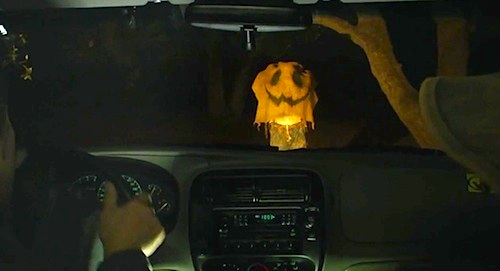
From "Digging Up the Marrow."

Inspired by the Alex Pardee’s monster art, Marrow is a strong creature feature that might even be more interesting when it operates in the ostensibly real world. Sadly, the film also marks the last screen appearance of Green’s late series co-star Dave Brockie. Green also was disciplined enough as a director to keep the scenes of actress Rileah Vanderbilt playing his actress-wife Rileah, even though she would now have to play his ex-wife should there ever be a sequel.

Given all that seems to transpire, fans will not be expecting a third season of Holliston anytime soon after watching it, but they should enjoy appearances from leading genre filmmakers like Don Coscarelli, Mick Garris, and Tom Holland. Highly recommended as a clever, fully developed, ironically meta genre film, Digging Up the Marrow hits iTunes this Friday (2/20).

LFM GRADE: B+

Posted on February 16th, 2015 at 10:04pm.
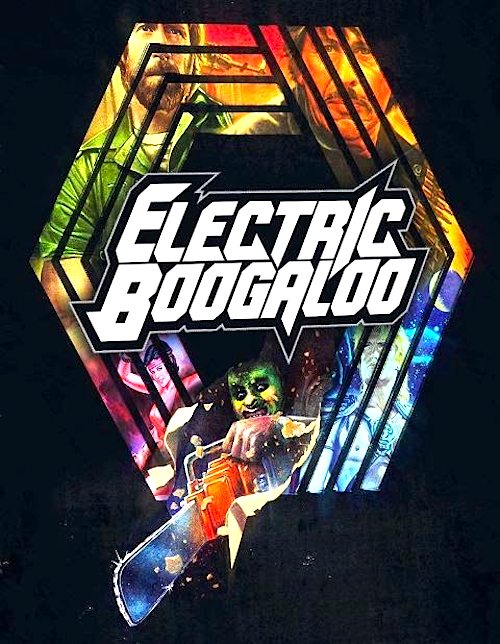
LFM Reviews Electric Boogaloo: the Wild, Untold Story of Cannon Films

By Joe Bendel. They were decades ahead of the curve, making profitable films about terrorism long before it became an overriding concern for Americans. Of course, Menahem Golan and Yoram Globus happened to be Israeli, so they understood how dangerous the world could be. Unfortunately, they were not as canny judging the American marketplace with the releases that followed Invasion U.S.A. and The Delta Force. Mark Astley compiles a breezy oral history of their rise and fall in Electric Boogaloo: the Wild, Untold Story of Cannon Films, which opens this year’s 2015 Film Comment Selects.

Yes, Hilla Medalia’s Cannon doc The Go-Go Boys just played the New York Jewish Film Festival, but there is always room for more Cannon. Reportedly, Go-Go is considered the B-movie moguls pre-emptive attempt to tell their side of the story. Hartley’s film even acknowledges the competition, comparing it to the dueling lambada films the former partners rushed to the marketplace after their contentious split. While Medalia spends more time on their early days in Israel, Hartley delves further into the early history of Cannon before Golan and Globus acquired it to serve as their Hollywood beachhead.

Plenty of the executives, writers, and directors associated with Cannon fondly remember the duo’s eccentricities, but there is not a lot of nostalgia coming from Frank Yablans, the former MGM studio head, who was contractually obligated to distribute their mid-1980s output. Hartley, who previously documented the Australian exploitation cinema of the 1970s and 1980s in Not Quite Hollywood and surveyed the low budget foreign and domestic action movies filmed in the Philippines with Machete Maidens Unleashed, not surprisingly shows an affinity for the nuttier movies in their filmography, like the notoriously spaced out futuristic rock opera The Apple and Tobe Hooper’s sci-fi grand guignol, Lifeforce.

Of course, it was their ill-conceived bids for Hollywood blockbuster respectability with the peacenik Superman IV and the Sylvester Stallone arm-wrestling epic Over the Top that would be their undoing. Frankly, it seems they never really understood their true comparative advantage: action cinema. Cannon really did take Chuck Norris to the next level and they substantially prolonged Charles Bronson’s career. They also discovered a Belgian waiter named Jean-Claude Van Damme. Unfortunately, they never really figured out what to do with their potential breakout star Michael Dudikoff, beyond the completely awesome American Ninja franchise and never recognized the untapped star-power of frequent supporting player Steve James (who frustratingly goes unmentioned again, after being overlooked by The Go-Go Boys).

Hartley marries up generous helpings of off-the-wall clips with some hilarious commentary (it is especially nice to see Catherine Mary Stewart remembering The Apple with self-deprecating humor). However, some of his talky head witnesses suggest some of the Hollywood resentment of Golan and Globus was a dark product of anti-Israeli, anti-immigrant sentiments, which is a place Medalia’s film never treads. Boogaloo (taking its title from their ill-advised break-dancing sequel) also gives the almost-moguls credit for successfully backing a number legit art films, but it is less interested in this side of their business than Go-Go Boys.

Go watch The Delta Force (with Chuck Norris, Lee Marvin, and the late Steve James) and try to pretend it doesn’t hold up today. The best of Cannon really defined the 1980s. Even after two documentaries, the full importance of those action movies still has not been fully explored. For instance, James may well be the first African American cult actor whose fan-base at the height of his productivity was nearly entirely white (and probably right-of-center). That seems culturally significant, but nobody wants to pick up on it. Regardless, Electric Boogaloo delivers plenty of entertaining nostalgia and attitude. Recommended for genre fans, it kicks off the 2015 edition of Film Comment Selects this Friday (2/20), at the Walter Reade Theater.

LFM GRADE: B+

Posted on February 16th, 2015 at 11:02am.

LFM Reviews Father and Sons @ MoMA’s 2015 Documentary Fortnight

From "Father and Sons."

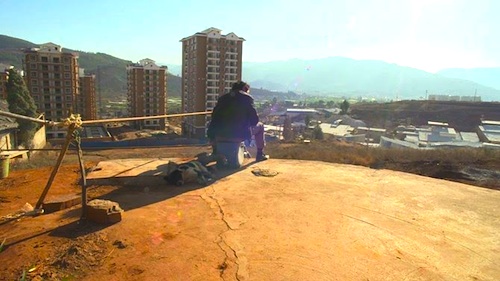
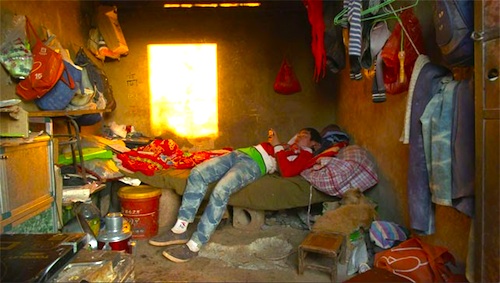
By Joe Bendel. It is yet another example of the appalling lack of free speech and press protections in contemporary Mainland China. Documentarian Wang Bing had intended to follow the lives of subsistence laborer Cai Shunhua and his two tweener sons Yongjin and Yonggao in his typically in-depth, observational fashion, but threats from the father’s landlord-factory owner forced the filmmaker to halt the project after a few days of shooting. It is therefore hard to really judge the resulting film, but at least Wang gives the world a good hard look at the mean living conditions the exploitative boss presumably wanted to keep under wraps in Father and Sons, which screens during MoMA’s 2015 Documentary Fortnight.

We have no idea where their mother is or whether there might be anymore extended family back in the countryside. Since 2010, Yongjin and Yonggao have lived with their migrant worker father in a four meter square single room occupancy. There is a stove and you had better believe they have a TV, but that is about all the amenities life affords them. Watching them carefully allot squares of toilet paper before leaving for whatever outside facilities are available to them should give you an idea of the scarcity of their resources.

Wang Bing has certainly never been intimidated by long takes in his previous documentaries, but they usually framed considerable real life drama. Fengming: a Chinese Memoir simply focuses on an elderly survivor of the Cultural Revolution telling her story on-camera, but her oral history is absolutely riveting and heavy with historical significance. Three Sisters is an absolutely heartbreaking record of the difficulties faced by the titular rural siblings, particularly the eldest. ‘Til Madness Do Us Part might not have been as emotionally engaging, but its unvarnished look inside a provincial Chinese mental asylum is often quite shocking.

From "Father and Sons."

In contrast, the majority of the shots in F&S capture Yongjin and Yonggao watching television—ironically, they are usually watching something more interesting than we are. Wang seems to be trying to convey a sense of the indolence that comes out of a sense of hopelessness, but a little of this goes a long way, especially in a ninety minute film. Still, it is not fair to criticize Wang for the static repetitiveness of the film.

Frankly, it is admirable he was able to keep faith with the Cai family and cobble together a film representative of their hardscrabble lives from the limited footage he was able to shoot. We can look at Three Sisters and imagine what could have been had Wang been allowed to observe his subjects as their lives developed over time. Father and Sons is probably best seen and programmed in conjunction with other Wang films, so it can serve as another small piece in his overall documentary mosaic of contemporary Chinese life. On its own, it is not an especially rewarding viewing experience, but it is still cool that MoMA selected it for this year’s Documentary Fortnight, because of the wider circumstances surrounding it. For those who understand what to expect, Father and Sons screens this Tuesday (2/17) and Wednesday (2/18) as part of this year’s Documentary Fortnight.

Posted on February 16th, 2015 at 11:01am.

LFM Reviews The 414s: the Original Teenage Hackers @ The 2015 Sundance Film Festival

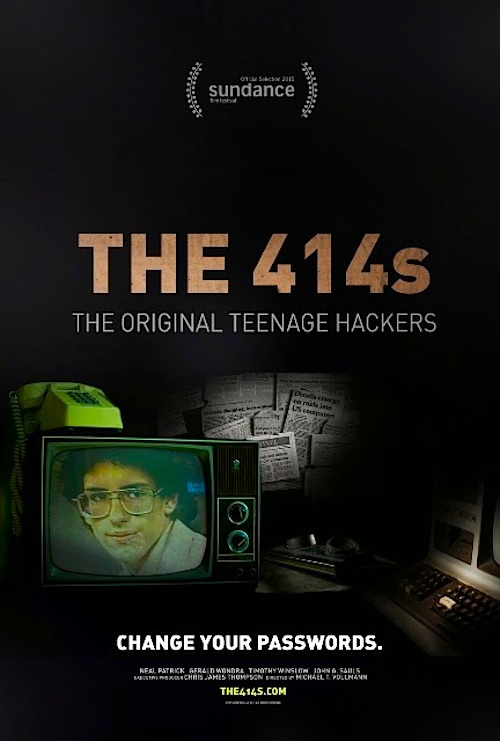
By Joe Bendel. They did in the CBS show Whiz Kids before it even started. Developed before WarGames was released, the young computer prodigies of the sixty minute drama only used their skills to aid law enforcement. Nevertheless, the media was predisposed to be critical following the feeding frenzy ignited by a group of teen hackers who cracked the systems of Los Alamos and the Sloan Kettering Cancer Center. Now all grown-up and reformed, the first generation hackers look back at their brief notoriety in Michael T. Vollman’s short documentary, The 414s: the Original Teenage Hackers, which screened at the 2015 Sundance Film Festival.

Milwaukee’s real deal gangs took their names from the numbered streets that defined their territory, so the 414s adopted the local area code in a similar spirit. Frankly, nobody ever claimed they were malicious. They were just fooling around, trying blindly to gain access to any system that acknowledged their random calls. When their breach of the Los Alamos network was finally discovered, the FBI and the media basically freaked.

While some of the 414s who were old enough to be prosecuted had to shut up and do their best to look innocent, Neal Patrick was still under-age and more than willing to talk. In fact, he became a minor media sensation, before tiring of controversy and computers.

From "The 414s."

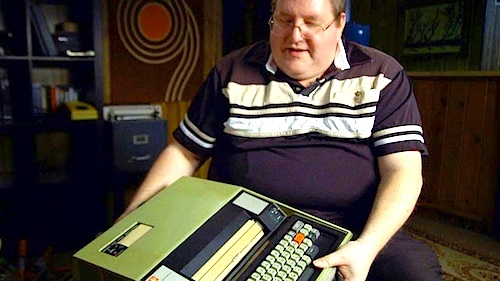
Even if you weren’t trying to cold call NORAD, there is a lot of nostalgia in The 414s. It will remind you there was a time a strange cat named Phil Donahue had a talk show that some people took half-seriously. The old hardware is also a blast from the past. Yet, it is also an uncomfortably timely film, arriving at Sundance in the wake of the Sony hack. You would think the Feds would have seriously stepped up their cybersecurity game since 1983, when it was literally nonexistent, but you have to wonder.

The 414s is the sort of short that seems to beg to be expanded into a feature. The participating 414s are all smart and compelling screen presences, who have interesting things to say. Clearly, their influence is still being felt, in ways that could easily be explored in greater detail. Regardless, the short that screened with the terrific Chuck Norris vs. Communism is quite informative and unexpectedly fun. It also got sold, which is something for a short film. It went to CNN Films for some kind of prospective digital platform, but it still counts. Highly recommended, The 414s should have some sort of digital life ahead of it, following its screenings at this year’s Sundance Film Festival.

Posted on February 16th, 2015 at 11:01am.

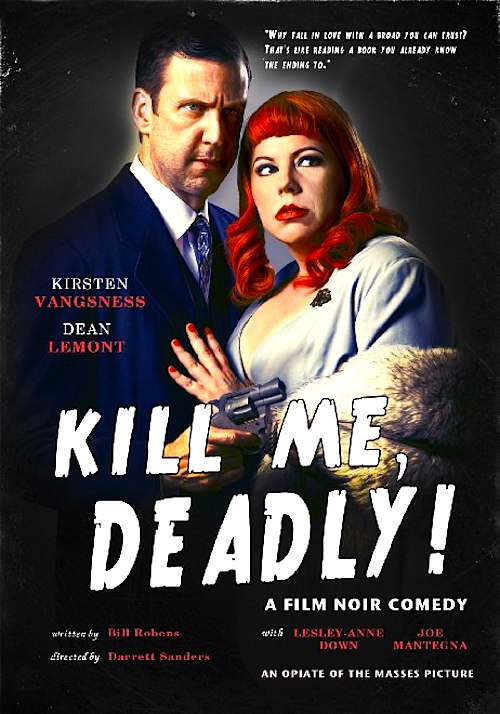
LFM Reviews Kill Me, Deadly! @ The 2015 Hollywood Reel Independent Film Festival

By Joe Bendel. It debuted at the scrappy forty-three seat Theater of NOTE in Los Angeles, but you would be surprised how many high schools and colleges have subsequently mounted productions. It was exactly the sort of hardboiled film noir send-up they were looking for. It turns out Bill Robens’ stage play is so durable, it can even be adapted as an independent film. Danger is Charlie Nickel’s business in Darrett Sanders’ Kill Me, Deadly!, which screens today during the 2015 Hollywood Reel Independent Film Festival.

Nickels thought there was something funny about his new client and his judgment is sort of vindicated when Lady Clairmont is mysteriously murdered. Naturally, there are no shortage of suspects, including the servants she did wrong, Clive, the man-child son she belittled, and Veronica, the daughter who makes Carmen Sternwood in The Big Sleep look demur and responsible. Lady Clairmont’s missing cursed diamond also suggests a potential motive.

Rather belatedly, Nickels takes on the Clairmont case in earnest. Fortunately, that means his considerably more resourceful secretary Ida is also on the job. He might not like what she turns up, particularly when he gets personally involved with torch-singer Mona Livingston, a potential “witness.”

Brought to the big screen by the teams behind the original stage production and the Euro-spy spoof Scream of the Bikini, KMD has a terrifically rich film noir look and it offers plenty of hat-tips to classics of the genre. It is also something of a Criminal Minds reunion featuring series stars Kirsten Vangsness as Livingston, Joe Mantegna in a small but significant role as Bugsy Siegel (even winning him HRIFF’s pre-announced best supporting actor award), and Shemar Moore making a cameo appearance as Livingston’s piano accompanist. Plus, the previously recurring Dean Lemont returns to the role of Nickels, which he originated on stage.

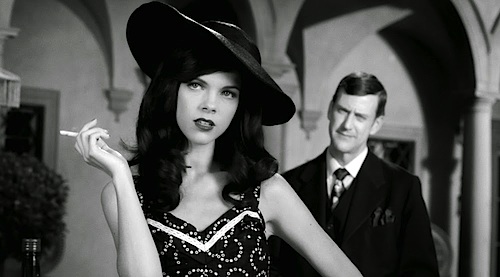
From "Kill Me, Deadly!"

Although KMD is technically a spoof film, the entire ensemble prefers to dig into the genre for all its worth, rather than mug for the camera and troll for cheap laughs. There is plenty of scenery chewing, as well there should be, but Lemont plays it scrupulously straight, in a Robert Stack kind of way. Both Vangsness and Raleigh Holmes (as Veronica Clairmont) embrace their femme fatale-ness to the hilt, but nobody can out noir-diva Lesley-Anne Down as the still seductive but not long for the world Lady Fairmont. Yet, one of the more subtly shaded turns comes from Sanders, the helmer himself (prominently featured in Bikini), who brings a nice world-weariness to in-demand freelance enforcer Louie Shorts.

It is clear everyone involved with KMD loves film noir and wanted to make one just as much as they set out to satirize them. Robens’ adaptation of his play hits all the bases. Mainly, he and the game cast score knowing chuckles from appreciative fans, but there are some big laughs down the stretch. Even though it was shot in a mere twenty-six days, spread out over five years, Sanders and cinematographer Nicholas Trikonis makes it look seamless and stylishly era-appropriate. Recommended for film noir lovers, Kill Me, Deadly screens tomorrow night (2/13) as part of this year’s Hollywood Reel Independent Film Festival.

LFM GRADE: B+

Posted on February 13th, 2015 at 7:53pm.

LFM Reviews Black Mountain Side @ The 2015 SF Indie Fest

By Joe Bendel. What was an ancient civilization doing in the northern most regions of the Yukon’s Taiga Cordillera? Not much, at least not anymore. However, their stag-headed demigod might be up to some bad supernatural business in writer-director Nick Szostakiwskyj’s Black Mountain Side, which screens during the 2015 SF Indie Fest.

Although there are indigenous peoples in the Taiga Ecozone, by the time you reach the research station commanded by Myles Jensen, civilization thins out to pretty much to nothing. That is why the discovery of a Mesoamerican monument (or rather the visible tip of it) is such a significant surprise. The more academically respectable Peter Olsen is flown out to inspect it, unfortunately for him. He agrees, it is the darnedest thing, but it is not Mesoamerican.

Soon thereafter, the camp cat is found murdered at the excavation site, like a sacrifice at an altar. The next day, the outpost’s indigenous workers have all taken to the wind. With the weather getting even worse, the men are cut off from the world, struggling with each other’s increasingly violent, delusional behavior, diagnosed by the camp doctor as the result of exposure to an ancient but still potent virus.

Frankly, Szostakiwskyj’s surprisingly subtle script allows for the possible the bedlam might just as easily be the product of an all-too human psychosis brought on by stress and isolation as it is the result of a killer virus or the work of a malevolent entity. We can probably safely assume all three are a factor in the ensuing chaos.

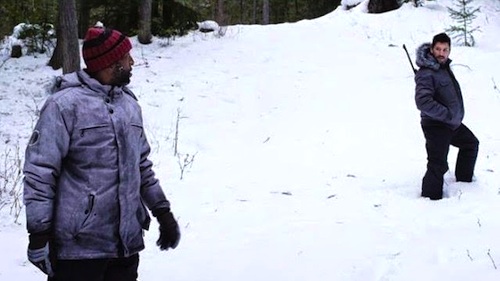
From "Black Mountain Side."

Despite the severed body parts, Mountain is remarkably restrained for a horror film. Much like the original Howard Hawks produced The Thing, it features some unusually smart dialogue, particularly the speculation regarding the vanished civilization that left behind the ominous artifact (someone should have thrown a bone up in the air in front of it to see if it would turn into a space station). This film was not exactly a bumper crop of opportunities for actresses, but Szostakiwskyj deals pretty forthrightly with both sides of masculinity—the cerebral reserve and the arm-chopping violence.

Arguably, Mountain is a little too quiet, soaking up atmosphere when it should be getting somewhere quicker. The primary characters are also a bit tricky to differentiate from one another. Mostly, they are smart, intense, and liberally appointed with facial hair. Still, Michael Dickson makes all of Olsen’s anthropological speculation sound cool.

While its horror movie mechanics are a tad off, the creepy vibe and distinct sense of place elevate Mountain above most indie genre outings. It the sort of film that makes viewers feel chilly in the moment and inspires gratitude as they live in major metropolitan centers after their screenings. Recommended for fans of naturalistic horror films, Black Mountain Side screens this Sunday (2/15), and the following Wednesday (2/18), as part of this year’s SF Indie Fest.

LFM GRADE: B

Posted on February 9th, 2015 at 8:59pm.