LFM Reviews Concrete Love @ The 2015 Slamdance Film Festival

By Joe Bendel. Pritzker Prize winner Gottfried Böhm and his three architect sons might be the world’s preeminent modernists, but the function of many of their buildings is to harken back to the past. With churches, mosques, World War II memorials, and an Egyptology museum to their collective credit, the Böhms have built, but they find themselves at a personal and professional crossroads in Maurizius Staerkle Drux’s documentary, Concrete Love: the Böhm Family, which screened during the 2015 Slamdance Film Festival in Park City.

As the only German Pritzker laureate, Gottfried Böhm is the unquestioned head of the clan and of their family practice. His overwhelmingly dominant stature leads to issues and tensions within the family unit, particularly with respect to his wife Elisabeth. She was once a promising junior architect as well, but she permanently deferred her career to raise their children. She has long suffered from dementia when Drux starts observing the family, but she soon succumbs to age and infirmity.

Despite her failing health, the Böhm sons miss their mother’s stabilizing influence. Resentments of the patriarch start to become more pronounced, especially as the sons face their own particular professional challenges. Stephan is determined to get a toehold in the exploding Chinese market, even though he is a bit put off to learn architects are largely considered on par with contractors and workmen in the People’s Republic (arguably, a rare expression of egalitarianism in the increasingly stratified nation). Meanwhile, Paul Böhm is growing exasperated with the budget cuts and aesthetically dubious demands imposed on him by the strange network of patrons behind his mega-mosque project. Believe it or not, we sort of get the sense he is being set up to be some kind of scapegoat.
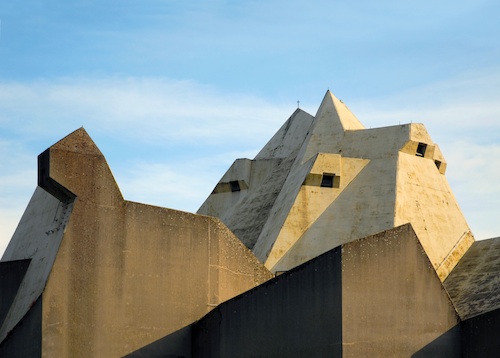
From "Concrete Love."

At least Peter Böhm sort of gets the last laugh at the opening of the Museum of Egyptian Art he designed. He had clashed with his father over its deceptively simple, boxy layout. Yet, once Drux takes his cameras inside, we get a sense of how its imposing massiveness evokes the great monumental structures of ancient Egypt and how the surprisingly airy open spaces serve the exhibitions. It really has a cool sense of place.

Of course, the elder Böhm has plenty of striking buildings to his credit as well. Indeed, seeing the family’s greatest hits is one of the best parts of Concrete. To his credit, Drux has a good eye for both architecture and familial drama. In a case of good news-bad news, his approach is probably too detached to feel voyeuristic or intrusive. As a result though, the pace can be a bit leisurely at times, but the film is clearly intended for a cultured audience with a sustainable attention span. Respectfully recommended for those interested in post-war architecture, Concrete Love will likely screen at many art-focused and German language festivals over the coming year, following its North American premiere at this year’s Slamdance Film Festival.

LFM GRADE: B

Posted on February 6th, 2015 at 12:33pm.
LFM Reviews Cop Car @ The 2015 Sundance Film Festival

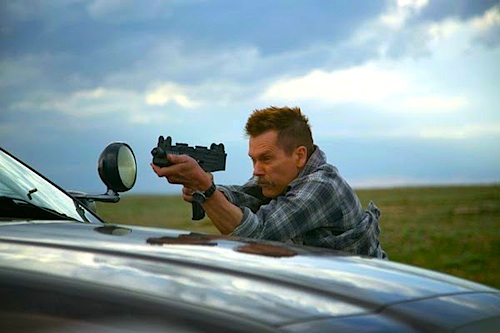
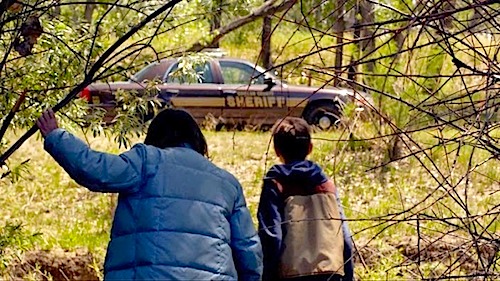
From "Cop Car."

By Joe Bendel. Seriously, does anyone still think keeping the car keys under the sun visor is a good idea? If anyone ought to know better, it should be a corrupt sheriff. Regardless, while burying a body, he leaves them in that conveniently obvious place for two mischievous ten year-olds. A dangerous joyride commences in Jon Watts’ Cop Car, which screened at the 2015 Sundance Film Festival.

When you see Kevin Bacon playing a sheriff, you have to think he ought to be out there arresting kids for dancing. Instead, Sheriff Kretzer is in bed with a number of dodgy underworld types. Travis and Harrison just happened to blunder along at the right time to take his cruiser for a spin. Obviously, this is trouble for Kretzer. He can hardly explain why he was in the middle of scrub grass nowhere in the first place, let alone how he could allow his wheels to be swiped out from under him.

However, by claiming a faulty radio, he can get dispatch calling in regularly on his cell, as he madly dashes home, while still pretending to be on patrol. Eventually, Kretzer starts tracking the kids in his own pick-up, but troublesome witnesses will inevitably cross their paths.

From "Cop Car."

As Travis and Harrison, James Freedson-Jackson and Hays Wellford really look and sound like real life kids (as they are), trying their darnedest to act tough through foul language and what they think is cool posturing. Watts taps into a sort of archetypal Stand By Me-Huck Finn youth-on-the-fateful-road vibe that gives the film more resonance than one might expect. Kevin Bacon is also entertainingly sleazy and cunning as Kretzer. Unfortunately, the film is more than a tad underwritten, with a fair amount of time-killing required in between its inspired scenes.

Camryn Manheim and Shea Whigham do what they can with their small, near cameo roles, but they do not provide much connective help in the Six Degrees of Kevin Bacon game. Cinematographers Matthew J. Lloyd and Larkin Seiple capture the big expansive emptiness of the Colorado plains and highways. Frankly, we can understand how the boys could do something so rash and potentially hazardous out of unsupervised boredom. Despite pacing issues, Cop Car is recommended for its atmosphere and Bacon’s salty turn, following its recent premiere at this year’s Sundance Film Festival.

LFM GRADE: B-

Posted on February 5th, 2015 at 11:25am.

LFM Reviews Station to Station @ The 2015 Sundance Film Festival

By Joe Bendel. Where can hipsterdom and traditional Americana come together in common purpose? Evidently, along our nation’s railways. Neither wants to be tied down, nor are either in any particularly hurry. Collaborating with musicians who would feel at home either at Lollapalooza or on Austin City Limits, Doug Aitken documents a twenty-four day coast-to-coast train trip in sixty-one one-minute shorts films (plus beginning and end credits), assembling it all into the restless, slightly avant-garde concert doc, Station to Station, which screened at the 2015 Sundance Film Festival.

Granted, Aitken’s preferred term of “happenings” is pretty cringey, but the ten stops his transcontinental train made for multi-disciplinary performances mostly look like a lot of fun. It seems the music never stopped, as performer after performer gets their one minute feature spot, sometimes at the happening, other times on the speeding train.

A pair of flamenco dancers, an old school western auctioneer, and the Kansas City Marching Cobras are particularly fun to watch, because they have tons of talent, but they are hardly recognizable celebrities. However, big name recording stars like Beck and Thurston Moore bring their A-game, perhaps even winning over new fans. Of course, nobody can out power soul legend Mavis Staples. Perhaps the biggest surprise is the appearance of Giorgio “Flashdance” Moroder, but it is pretty cool to see him do his thing on the synthesizer.

From "Station to Station."

Despite its linear direction and the imposed limits of the train, Station is a largely shapeless film. However, it has a lot of energy and it is visually quite stylish. Whether it be the lonely desert vistas, the warm glow of an electronica performance, or the evocative sight of Aitken’s movable light show of a train hurtling through the night, he and co-cinematographer Corey Walter always make the rapidly changing visuals look great. On the other hand, when he invites spoken word commentary from the likes of Gary Indiana, we mostly get annoyingly folksy dialectics.

Frankly, Station to Station probably isn’t experimental enough to sit comfortably in Sundance’s New Frontiers section, but it is hard to see where it would more easily fit. It certainly moves along at a good clip. Like Midwest weather, if you’re not digging it, just wait a minute and it will change. Rather pleasant overall, Station to Station is recommended for listeners of Sonic Youth and Patti Smith, as well as the sort of neo-roots artists profiled in No Depression. Having just notched a number of international sales, Station to Station should find its audience after world-premiering at this year’s Sundance Film Festival.

LFM GRADE: B-

Posted on February 4th, 2015 at 8:28pm.

LFM Reviews My Friend Ivan Lapshin

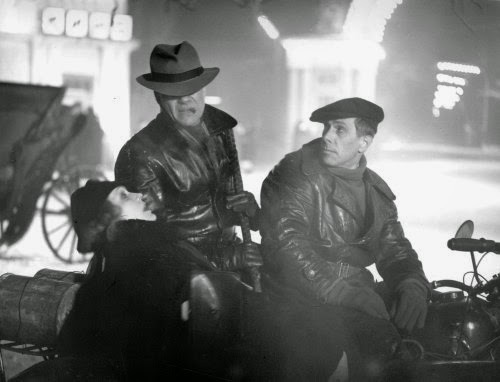
By Joe Bendel. How can you be nostalgic for the bad times? Because they are the old times. For instance, our narrator looks back rather fondly on the early days of Stalinism. He and his father were fortunate to share their flat with the local police constable. That meant there were only five (and later six) people crammed into the apartment. How spacious. Even without depicting the Stalinist terror, there is still plenty of scarcity and absurdity in Aleksei Guerman’s My Friend Ivan Lapshin, which screens as part of a mini-Guerman (sometimes translated as German) retrospective now running at Anthology Film Archives in conjunction with the premiere theatrical release of Guerman’s Hard to be a God.

There is not much sugar in this sleepy village of revolutionary fervor, but there always seems to be some in Lapshin’s flat. The town will also get a treat in the form of a traveling agitprop stage performance. The show is a bad as it sounds, but Lapshin still falls for Natasha Adasova, a demur featured actress. They will have some laughs together, but unfortunately, it will be Lapshin’s suicidal journalist friend Khanin who turns her head.

However, Lapshin has another obsession to fall back on: capturing the dreaded Solovyey gang. It is not clear just what crimes the Solovyey outfit has committed, but their (comparative) liberty rankles Lapshin. Frankly, they seem to be born out of the same cloth of economic desperation that gave rise to Bonnie and Clyde—and their ability to evade justice (probably due to their considerable local support) arguably undercuts the state’s authority.

One thing is certain, everyone spends a good deal of time in queues, struggling with shortages, except Lapshin, who goes out of his way to bust black market firewood peddlers. Yet, somehow he seems like a decent fellow, in a rigid, stentorian sort of way, perhaps because we might guess what sort of trials and travails lie ahead for him.

From "My Friend Ivan Lapshin."

Although Friend is far more accessible and narrative-driven than HTBAG, the vibes of the respective films are not so very different. In both cases, characters exist in a state of constant chaos, yet they live in an environment of near total stasis. Both films are distinguished by their striking black-and-white cinematography, but there is something about the dreamy vibe that keeps us at arm’s length.

Andrei Boltnev is commandingly tragic as the severe Lapshin, while Andrey Mironov makes a strangely charismatic sad sack as Khanin. Nina Ruslanova’s Adasova also brings sufficient heat to let us buy into their love triangle. Indeed, it is quite a fine example of ensemble acting, but it is still a rather odd film to watch, because Guerman is being so deliberately cagey with his allegorical implications, for obvious reasons.

Nevertheless, Friend was duly banned by the authorities for fourteen years, finally seeing the light of day in the late 1980s. Reportedly, it was deemed an insufficiently heroic portrayal of the early days of socialism building. It was also an awkward, sometimes even sarcastic reminder they had been building socialism for five decades, but things were as crummy as ever. Recommended as a fascinating historical document not without its own artistic merits, My Friend Ivan Lapshin screens again this coming Monday (2/9), as part of the Guerman series at Anthology Film Archives.

LFM GRADE: A-

Posted on February 4th, 2015 at 8:27pm.

LFM Reviews Knock Knock @ The 2015 Sundance Film Festival

By Joe Bendel. Eli Roth digs Chile and they dig him back. He’s like Hasselhoff over there, so its not surprising he shoehorned in some Chilean references, shot in Chile (Santiago doubling for the Hollywood Hills) and featured two Chilean actresses (one being his wife, Lorenza Izzo) in his latest film. However, the love affair might end once they get a load of his new psycho-sexual home invasion thriller, Knock Knock, which premiered at the 2015 Sundance Film Festival.

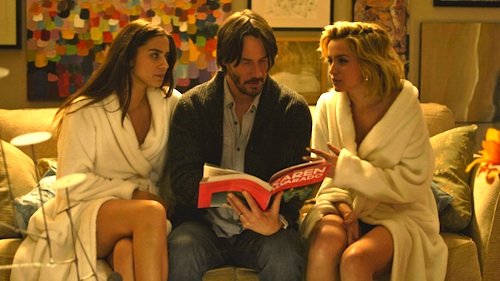
Evan Webber is an architect and a committed family man, but he still remembers his glory days as a DJ. He is home alone working on a commission while his artist wife and kids spend the weekend at the beach. Unfortunately, Webber’s dope smoking is soon interrupted by a fateful knock at the door. That will be Genesis and Bel Who, two party girl flight attendants who got lost in the rain looking for a friend’s bash. At least that is their initial story.

As Webber lets them in to dry off, they start flirting hard. Honestly, flirting is not a strong enough term. They practically wrestle him to the ground and have their way with him. Yet, the opening act is surprisingly effective pitting his awkward attempts at evasion against their sexed-up seduction techniques. There is a sly give-and-take or ebb-and-flow to this first half hour or so, but unfortunately it is completely jettisoned once Webber inevitably succumbs to temptation.

From here on out, Genesis and Bel become moralizing fatal attractions, who declare Webber must pay for his transgressions. Suddenly, Webber is fighting for his life and the well-being of his family, but he never stands a chance. The ladies just keeping beating him down at every turn. Perhaps this constitutes some sort of subversive feminist statement, but as dramatic arcs go, it is pretty darn flat.

From "Knock Knock."

One of the biggest disappointments of Knock Knock is the speed bump it drops in front of the Keanu Reeves comeback express. Everyone primed for more badassery after John Wick and Man of Tai Chi, will be let down by this Nic Cage-ish turn. Let’s face it, we don’t want to watch Reeves losing his cool. We want him to be silent, but violent. Still, Izzo and Ana de Armas are sufficiently ferocious and they look good soaking wet, so at least they keep their end up, in exploitation terms.

Knock Knock is largely based on/inspired by the 1977 cult exploiter Death Game, which featured producer Colleen Camp and executive producer Sondra Locke tormenting Seymour Cassel, so there is precedent for everything that feels like a misfire. It is a bit of a departure for Roth, but despite the lack of gore, it still really doesn’t work. It is all cat-toying-with-the-mouse with no promise of table-turning to keep things interesting. Regardless of its shortcomings, Knock Knock was picked up by Lionsgate, so expect to hear more from it following its midnight screenings at this year’s Sundance Film Festival.

LFM GRADE: D+

Posted on February 2nd, 2015 at 9:13pm.

LFM Reviews 20 Years of Madness @ The 2015 Slamdance Film Festival

20 Years of Madness – Trailer from 20 Years of Madness on Vimeo.

By Joe Bendel. In 1988, Mystery Science Theater 3000 debuted on Minnesota’s struggling independent KTMA with little fanfare, but it was just too funny not to go national. High school student Jerry White, Jr. assumed the same was true of his raucous suburban Detroit cable access show, 30 Minutes of Madness (30MOM). You could legitimately debate whether this was true or not, but the fact remains he never received the big league call-up he was hoping for. Twenty years later, White tries to get the gang together to take another shot at it. Jeremy Royce documents the unruly reunion in 20 Years of Madness, which won the Jury Honorable Mention for Documentary Feature at the 2015 Slamdance Film Festival.

Based on the generous samplings of weird and wacky clips, the original 30MOM looks like a cross between the slapstick stunts of Jackass and The Kids in the Hall at their most conceptual. Although it was an analogue VHS deal, through and through, White had a facility for pulling off strange visual effects. Perhaps they could have caught on, but like every cult band that didn’t make it big, they imploded from within before they ever got that big break.

Having recently graduated from film school (where he met Royce), White is now at loose ends. Since 30MOM is still his best known calling card, he tries to revive it with his old colleagues. White will more or less admit his runaway ego was most to blame for poisoning the chemistry the first time around. Everyone seems to be willing to make another go of it, but some seem more willing to patch up old resentments than others.

One of the strange things about 20YOM is the way the various players shrink and grow in stature over time. Sometimes White seems to be reverting to his old high-handed ways, but as we listen difficult cast-members whine and play the diva card, it is hard to blame him for telling them where to get off. Happily, he seems be able to permanently repair his friendship with Joe Hornacek, who was probably the second most important 30MOM contributor after White.

From "20 Years of Madness."

It is rather fascinating to see what the motley crew does with their possible second chance. After all, no 30MOM alumnus has exactly set the world on fire. One lost about a decade to heroin addiction, while another struggled with bi-polar disorder. At least White and Hornacek could reconnect for real, which is a rather hopeful development.

At times, White is rather contemptuous of YouTube, explaining that 30MOM had viewers who made a real time commitment to find and watch their show, rather than net surfers hitting the “like” button. Those who share his affection for the VHS tapes and cable broadcasting of the 1980s and 1990s will get his point. Even if you never saw 30MOM, 20YOM will make you nostalgic for the era that produced it. Who knows, now that Royce’s doc has at least one festival award under its belt, maybe the 30MOM show could see some kind of release on the increasingly obsolete format known as DVDs? Recommended for anyone who still feels more comfortable with old school media (and the grungier the better), 20 Years of Madness screened at this year’s Slamdance Film Festival.

LFM GRADE: B+

Posted on February 2nd, 2015 at 9:12pm.