LFM Reviews Hellions @ The 2015 Sundance Film Festival

By Joe Bendel. One of the nice things about Manhattan walk-ups is trick-or-treaters never knock on your door. Instead, it is the local businesses that have to deal with them. Sure, you might think you would miss the little dears until you see Bruce McDonald’s Hellions, which screened during the 2015 Sundance Film Festival.

Dora Vogel just got the super exciting news that she is pregnant—on Halloween. Seriously bummed out, she mopes around the house waiting for her boyfriend to pick her up, so she can spring the good news on him. However, he is running suspiciously late. With her mother and obnoxious younger brother out trick-or-treating, Vogel is stuck dealing with the persistent little buggers who keep coming to the door. They just aren’t satisfied with the dregs of her candy. When they show Vogel the head of her baby-daddy in their trick-or-treat bag, she realizes these little monster are as evil as they seem.

Of course, any horror fan knows the demonic trick-or-treaters really want the baby growing at a supernatural rate within Vogel. It turns out carrying a Halloween baby is a dangerous proposition in this paganistic neck of the woods. The creatures seem to be able to summon all kinds of elemental and inter-dimensional forces to help terrify Vogel. Somehow, the previously calm and rational Dr. Henry and Corman the local copper manage to reach Vogel, but they are essentially ineffectual dead meat. At least Corman brings guns, but they won’t be enough to stop the maniacal moppets. Only salt seems to do the trick.

McDonald certainly sets the creepy scene in Hellions, but compared to his cult classic Pontypool (arguably the best zombie film since the original Night of the Living Dead), it feels rather conventional. Granted, he opens it up rather well, turning the Vogel house into a surreal nightmarescape. Still, the film always fundamentally boils down to Vogel getting chased by kids wearing burlap sacks.

Robert Patrick (T2, The X-Files) is still pretty awesome, delivering instant genre credibility as Corman. Rossif Sutherland also helps flesh out the good doctor, beyond being mere meat for the grinder. Unfortunately, Chloe Rose is a bit of a dull scream queen.

McDonald and cinematographer Norayr Kasper give the film an eerie, otherworldly look. Arguably, the implications of the film also support gun-ownership rights, because you never know when your home will be overrun by hellions. It gets the job done, but Pontypool admirers will be disappointed it isn’t more ambitious. Recommended for mostly fans of Patrick and evil children horror movies, Hellions is sure to make the genre festival rounds after premiering as a Park City at Midnight selection of this year’s Sundance Film Festival.

LFM GRADE: C+

Posted on February 2nd, 2015 at 11:53am.
LFM Reviews American Songbook at NJPAC with John Pizarelli

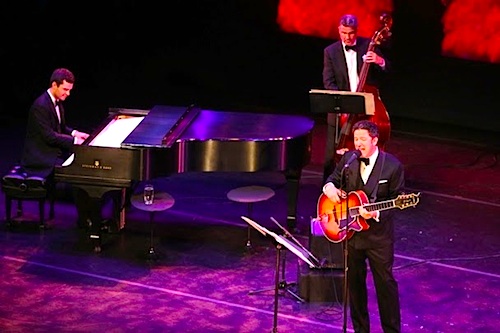
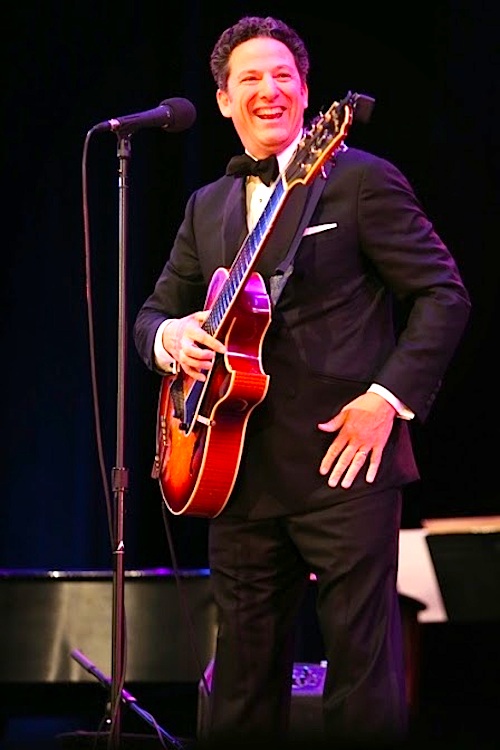
John Pizarelli.

By Joe Bendel. Maybe only Arthur Prysock ever experienced greater spillover success from a commercial gig than John Pizzarelli. For years, Pizzarelli got requests for the Foxwoods song, “The Wonder of it All,” but Prysock actually charted with “Here’s to Good Friends.” Of course, both also had a facility for interpreting the Great American Songbook, particularly Johnny Mercer in the case of Pizzarelli. The vocalist-guitarist takes the stage for an all Mercer concert for this week’s installment of American Songbook at NJPAC, premiering Wednesday night on NJTV.

Yes, it is all Mercer, but Pizzarelli also highlights the veritable hall of fame’s worth of collaborators he wrote with. It doesn’t get much more American Songbook than Jerome Kern, who composed the music for “Dearly Beloved.” Pizzarelli gives it a good healthy swing, featuring short but legit solos from Bud Burridge on trumpet and Kenny Berger on baritone. Acknowledging them by name, Pizzarelli gives the set an old school big band vibe, which is refreshing.

Shifting gears a bit, “Skylark,” written by Mercer and Hoagy Carmichael, gets a stripped down arrangement with only the barest of rhythmic support, but it’s the sort of melancholy song that lends itself to such treatment. However, the medley of Mercer’s four Academy Award winning songs really don’t really fit together so naturally, starting with “On the Atchison, Topeka, and the Santa Fe” (Harold Arlen) and ending on with Mercer’s Henry Mancini collaborations, “The Days of Wine and Roses” and “Moon River.”

Pizzarelli cranks up the swing for an up-tempo high-energy rendition of “Something’s Gotta Give.” A bit surprisingly, he embraces some of Mercer’s more novelty-ish tunes, like “Goody Goody” and “Accentuate the Positive,” doing his best to keep them honest. Of course, Pizzarelli also has the sort of musical theater chops for those sort of numbers. In fact, he reminds the audience he met his wife, vocalist Jessica Molaskey, when they were both performing in a Mercer show.

From "American Songbook at NJPAC."

Unlike the Osnes and Fontana season opener, Pizzarelli never sits down for an interview segment with host Ted Chapin, but he has a lot more band to showcase. John Mosca on trombone, Ken Hitchcock on flute, and Konrad Paszkudzki on piano all get some nice, tasty solo spots, while drummer Kevin Kanner and Pizzarelli’s brother Martin on bass lay down rock solid support. (FYI, it is only a limited family affair, with neither their father, guitarist Bucky Pizzarelli, nor Molaskey making a guest appearance).

It is just a pleasure to hear good standards get a muscular going over. “Dearly Beloved” has an especially catchy and appealing melody, but it is not exactly overplayed, so it is quite nice to hear Pizzarelli put it into the mix. Thanks to NJTV and NJPAC, it is a lot of fun to have the chance to tap your toe along with the Mercer songbook Again, this is great original programming that ought to be a model for regional PBS stations. Highly recommended, American Songbook at NJPAC: John Pizzarelli premieres this Wednesday (2/4) on NJTV, with a later WNET Thirteen airdate scheduled for March 28th.

Posted on February 2nd, 2015 at 11:51am.

LFM Reviews The Voices

From "The Voices."

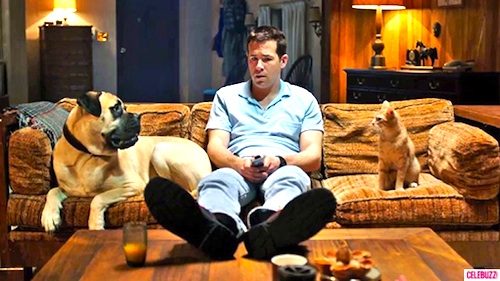
By Joe Bendel. Do you think talking cats are cute, like Garfield? Well, think again. Anthropomorphism can be a sinister business, but don’t worry, talking dogs are still cool. Regrettably, poor luckless Jerry Hickfang hears them both in Marjane Satrapi’s The Voices, which opens this Friday in New York.

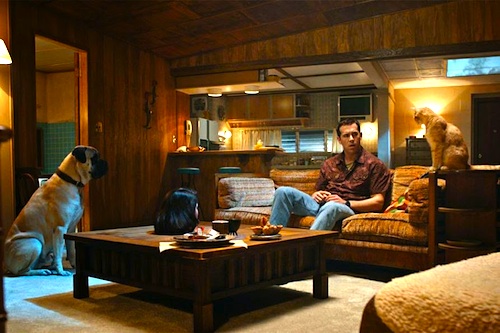
Forklift-driving Hickfang is clearly trying too hard to be liked by his co-workers at the Milton faucet and bath factory, but he seems harmless enough. Of course, they do not hear the conversations he has with his cat, Mr. Whiskers, and his loyal canine, Bosco. Mr. Whiskers does not suffer fools gladly. In fact, he is all in favor of killing them. In contrast, the dim-witted but affectionate Bosco always tries to find the best in people. Fortunately, good old Bosco can usually counterbalance Mr. Whiskers’ devilish influence, but it gets difficult when Hickfang is under emotional stress.

Despite what he tells his court-ordered psychiatrist, Hickfang has gone off his meds (hence the conversations with his pets). To make matters worse, getting the brush-off from Fiona, the British office sexpot, will hardly help his mental stability. Still, Lisa, her slightly more demur office-mate, continues to carry a torch for him. She might be his perfect match, but it is hard to envision Hickfang developing a healthy relationship, especially when we see his apartment without the happy haze of his dementia.

Along with Mississippi Grind at this year’s Sundance, The Voices ought to give Ryan Reynolds’ career a new lease on life. If nothing else, he ought to be able to find plentiful cartoon voice-over work, because his voices for Mr. Whiskers and Bosco are terrific. Who knew he could do such a pitch-perfect snippy Scottish accent for the former? He also does quite an impressive job conveying Hickfang’s naïve earnestness, along with his mounting mania. He is a tragic monster, in the Lon Chaney, Jr.-Wolfman tradition, who does not want to kill, but puts himself in that position through his own disastrous, but understandable, decision-making.

From "The Voices."

Frankly, it is hard to understand why it takes Hickfang so long to notice Anna Kendrick’s Lisa, but she definitely adds to the film’s energy and chemistry. Yet, the x-factor might be Jacki Weaver, who adds considerable humanity and authority to the film in her relatively brief turn as the over-worked Dr. Warren.

It is hard to imagine this is the same Satrapi who made Persepolis and Chicken with Plums, but she displays the same eye for visuals, employing color in bold and distinctive ways. When she contrasts Hickfang’s lunacy-tinged perspective with the film’s objective reality, it is quite effective. Cinematographer Maxime Alexandre gives it a warm, stylish sheen that somehow manages to feel slightly off, in the right way.

On paper, it all might sound rather sad and grubby, but it is actually a rather elegant little macabre tragedy. Recommended for genre audiences and fans of Reynolds and Kendrick, who want to see the thesps in a radically different context, The Voices opens this Friday (2/6) in New York, at the AMC Empire.

LFM GRADE: B+

Posted on February 2nd, 2015 at 11:51am.

LFM Reviews Listen to Me Marlon @ The 2015 Sundance Film Festival

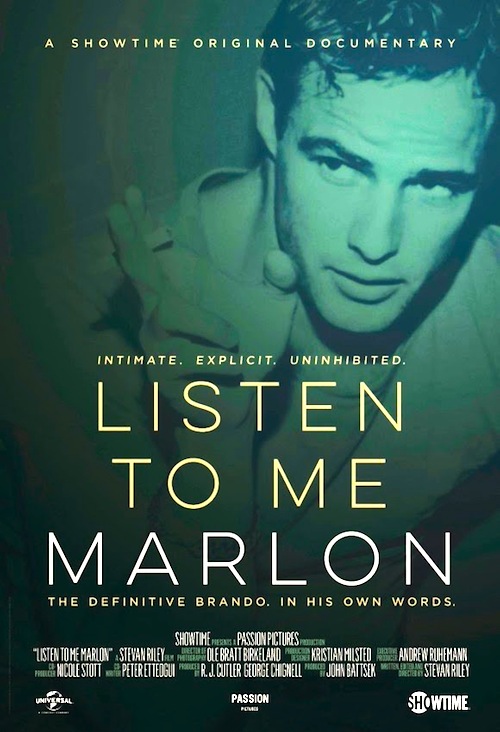
By Joe Bendel. Let’s be honest, the notion of Marlon Brando talking to himself probably isn’t that shocking. You might not have guessed it was through self-hypnosis tapes, but that probably still feels like it fits. They happened to be part of a large collection of private Brando recordings preserved by his estate. With its blessing, director-editor Stevan Riley has shaped this archive into a ghostly first-person confessional narrative, “written by” and “starring” the famous actor. The Brando that emerges is exactly what we expect, yet deeper and surprisingly revealing throughout Riley’s Listen to Me Marlon, which screened during the 2015 Sundance Film Festival, in advance of its future Showtime debut.

Through audio diaries and rarely seen interviews, Brando pretty much covers all his big career milestones (like Streetcar, Waterfront, Last Tango, and Godfather) as well as his more notorious misfires (Guys and Dolls, Mutiny on the Bounty, and Countess from Hong Kong). He also opens up regarding his troubled childhood and the profound influence of his acting teacher Stella Adler. Yet, as is often the case, some of the best sequences are relatively small moments, like his shameless flirting with a series of female interviewers during an early 1960s press junket.

Yes, Brando loved Tahiti, which he speaks of with deep affection. In fact, Brando is quite eloquent on his private tapes. Clearly, he is not speaking with an audience in mind, because he definitely lets his public mask slip. He is often painfully honest in his assessment of his own character and rather dismissive of much of his own work. His curt appraisal of his Oscar winning turn in On the Waterfront will be especially vexing to some fans, but it contains a real nugget of wisdom when recommending giving the audience the space to create a performance themselves. (Don’t you wish Meryl Streep had given us more of that kind of space in Osage County?).

Riley’s only real misstep is the overuse of a disembodied head, generated from a laser scanning session Brando consented to. It sort of breaks the intimate mood, evoking a Max Headroom vibe instead. However, the archival news reports of tragic Brando family scandals feel shockingly honest and raw. We get a sense the Brando on television and the private Brando were essentially one and the same.

For those of us who grew up when Letterman was still funny, it is strange to realize how spot-on Chris Elliott’s impersonations on the Late Show really were. All those Brandoisms are true, but we can understand better where they came from. Listen is the rare bio-doc that might make more fans for its subject, because it allows Brando to humanize himself. Recommended for fans of 1960s and 1970s Hollywood, Listen to Me Marlon was a hot ticket at this year’s Sundance Film Festival that should soon find a wide audience on Showtime.

LFM GRADE: B+

Posted on February 1st, 2015 at 10:50am.

LFM Reviews Meru @ The 2015 Sundance Film Festival

Meru Official Trailer from Chai Vasarhelyi on Vimeo.

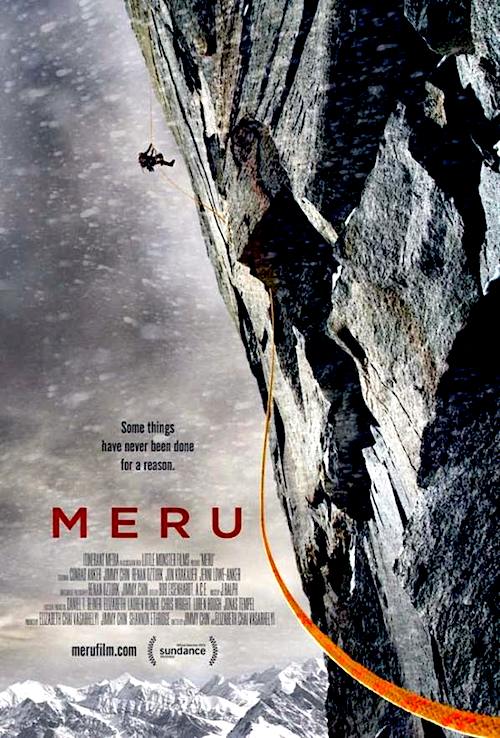
By Joe Bendel. You could call it the extremely scenic route. In the alpinist world, the forbidding Shark’s Fin route up Mount Meru was one of the last great conquests. Three climbers came maddeningly close in 2008, but fell short. Filmmaker-alpinist Jimmy Chin and his producer-co-director wife E. Chai Vasarhelyi document the 2008 expedition, their 2011 return, and the dramatic intervening events in Meru, which screens during the 2015 Sundance Film Festival.

Located in the Northern Indian Himalayas, Meru had been summited before, but never via the Shark’s Fin. It is an arduous field of ice obstacles, frozen sheer, offering precious few footholds or crevices. So why climb it? Presumably, because it is there. As one of the most respected alpinists climbing today, Conrad Anker was an obvious candidate to finally lick the Shark’s Fin. Chin also had extensive experience as a climber and photographer. Renan Ozturk was the junior man on the team, but the trio meshed well together. They just didn’t quite make it on their first attempt.

Frankly, Chin and Vasarhelyi do not spend must time establishing the significance of Mount Meru or the Shark’s Fin, pretty much launching into the climbing right away. Similarly, we do not get much sense of the three climbers’ personalities, until about halfway through. However, when two of the three are sidelined by misfortune, we start to get a better sense of who they are and what Meru means to them.

Anker had previously lost one regular team-member (ultimately marrying his widow), so he already knew tragedy first hand. Nevertheless, the time between Meru expeditions was comparatively less eventful for him. In contrast, after Ozturk barely survives a spectacular accident, it is unclear how much basic mobile function he will regain. Initially, the notion of mountain climbing in general seems awfully ambitious, let alone attacking the Shark’s Fin. Somehow, Chin also survived a freak avalanche. He is relatively unscathed physically, but clearly quite shaken, emotionally and spiritually.

By the time the three men launch their second campaign against the Shark’s Fin, the audience is thoroughly primed for a feast of redemption. Frankly, everything about the 2011 attempt just sort of boggles the mind, especially some of the jury-rigging we see them do with faulty equipment. Co-cinematographers Chin and Ozturk capture some absolutely awesome shots, particularly given the circumstances they were working under. Indeed, the film looks incredible and it eventually delivers the comeback satisfaction it promises.

The stakes have increased for subsequent mountaineering documentaries following the release of the very good to great The Summit, Beyond the Edge, and K2: Siren of the Himalayas, but Meru finds something new to say (and ends on a considerably different note than the first and third films). It seems like a particularly fitting Sundance film, incorporating elements of previous selections, like The Summit and The Crash Reel, but ending with considerably more uplift. Highly recommended for fans of outdoorsy cinema, Meru screens in Park City, as part of this year’s Sundance Film Festival.

LFM GRADE: B

Posted on February 1st, 2015 at 10:49am.

LFM Reviews Cartel Land @ The 2015 Sundance Film Festival

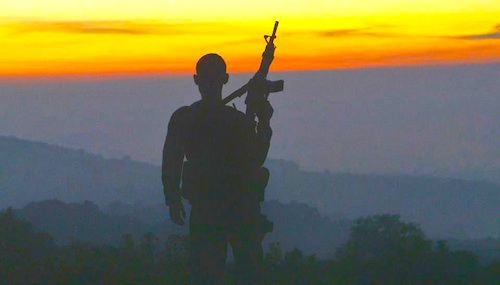
By Joe Bendel. Dr. Jose Mireles is like a kindly Mexican Marcus Welby, except he also happens to be the leader of a group of paramilitary vigilantes. Tim “Nailer” Foley more looks the part of a border militiaman, but he shares a common enemy with Mireles. It is not the illegal immigrant per se that concerns him, but the drug cartels running the human trafficking business. Matthew Heineman documents the full scale breakdown of law and order south of the border and some of the resulting implications for American border towns in Cartel Land (teaser here), which screens today as an award winner at the 2015 Sundance Film Festival.

Perhaps the most disturbing thing about “El Doctor” Mireles’ Autodefensas organization is that they operate in the central state of Michoacán, far away from the border. Although Mireles originally attended Autodefensas organizing meetings wearing a mask, he was so recognizable, he simply chose to embrace his role as the group’s public face and spiritual leading. Under his guidance, Autodefensas has been on a roll, liberating town after town from their cartel occupiers. If that sounds like a military campaign, it darn well should.

Meanwhile, Nailer and his Arizona Border Recon group patrol what is known as “Cocaine Alley,” scouring the hills for the cartels’ spotters and traffic directors. Yes, they are also heavily armed. You do not challenge the drug cartels with good intentions and optimism.

Although Cartel Land started out as a project solely about American border patrol groups, Mireles and Autodefensas completely took over the film once Heineman widened the scope. Frankly, it seems like the film is not sure what to make of the Arizona scenes in light of the chaotic drama it documents in Mexico. You can practically feel the film shrug, as if to admit they might have a point.

In contrast, the sequences in Mexico are absolutely harrowing and massively telling. Early on, there is a mind-blowing scene in which an exasperated village rises up against a military unit trying to disarm the Autodefensas. They make it clear, in no uncertain terms, they consider the government to be in league with the cartels. They therefore put their trust in Autodefensas rather than the military. It is stunning stuff, but it should be noted not every village shares this sentiment.

No matter how you feel about the film, you have to give Heineman credit for making it under genuine battle conditions. He was there filming during live firefights, when nobody really knew who was shooting at whom or from where. This is legit war-reporting, just like Sebastian Junger’s Restrepo films.

From "Cartel Land."

Cartel Land does not necessarily endorse taking the law into one’s own hands. In fact, many of the scenes in Mexico illustrate the ethical perils of doing so. However, it leaves viewers with no illusions about the complete absence of the rule of law in Mexico today. You can question their on-the-ground tactics, but why it is painfully obvious why Dr. Mireles and his comrades joined together in Autodefensas. Arguably, the film might have been tightened up by editing out more of the Arizona material, but who would want to tell them they ended up on the cutting room floor?

Regardless, Cartel Land is quite an eye-opener as it is. (Since the current president refuses to visit the border, perhaps a private screening can be arranged for him). Recommended for anyone concerned affairs in our hemisphere, Cartel Land screens again today (2/1) as part of this year’s Sundance Film Festival.

LFM GRADE: B+

Posted on February 1st, 2015 at 10:49am.