LFM Reviews A Werewolf Boy @ New York’s Korean Movie Night (6/25)

By Joe Bendel. Chul-soo is either Korea’s Kaspar Hauser or its Teen Wolf. He is old enough to be a war-era orphan, but even for a wild child he seems a little odd. Yet, a sickly teen-aged girl forms a deep connection with him in Jo Sung-hee’s A Werewolf Boy, which screens tomorrow night as part of the Korean Cultural Service’s ongoing free Korean Movie Nights in New York.

Soon-yi, her mother, and her younger sister Soon-ja have moved to the countryside in hopes the clean air will improve her health. Unfortunately, the big move was facilitated by Ji-tae, the entitled son of her late father’s business partner, who now feels at liberty to pop over whenever he feels like it. He assumes Soon-yi will eventually marry him for the sake of his wealth and social status. However, Soon-yi is not impressed.

She does not think much of the feral Chul-soo either when she and her mother first find him snarling in the garden. With the relevant social welfare agencies passing the buck, Soon-yi’s mother reluctantly takes him in. Slowly, he starts to grow on the family, once they clean him up and curtail his rougher instincts.  Soon-yi even starts teaching him to read with the help of a dog training manual. However, a rich jerk like Ji-tae cannot help making trouble, especially when his ego is bruised.

Chul-soo’s true nature is quite strange and uncanny, but Jo de-emphasizes the genre aspects of his story to focus on his young tragic love for Soon-yi. Told in media res as the decades-older woman returns to the fateful country house, Werewolf Boy has all the elements of a good weeper, so it is not surprising it was a monster hit at the Korean box office.

In truth, the film is at its strongest when portraying the innocent ardor of Chul-soo’s relationship with Soon-yi. In contrast, the ridiculously vile Ji-tae is little more than a clumsy class warfare tool that quickly grows tiresome. When the shoot-first military finally arrives on the scene, they at least have the virtue of being considerably less cartoony and more fully dimensional than the silver spoon villain.

Still, Song Joong-ki and Park Bo-young develop rather touching chemistry as Chul-soo and Soon-yi, respectively. The former shows both tremendous physicality and sensitivity as the young wolf-man, in an almost entirely nonverbal performance. Likewise, Park is radiantly expressive as Soon-yi. Jang Yeong-nam is also memorably charismatic yet down-to-earth as her mother. Unfortunately, as Ji-tae, Yoo Yeon-seok is stuck with a flimsy character and takes it embarrassingly over the top in every scene.

Werewolf Boy demonstrates how genre elements can be shrewdly repurposed to tell a highly relatable story rooted in human emotions. Frankly, Soon-yi and Chul-soo’s impossible love would resonate without Jo Sung-hee so conspicuously stacking the deck against them. Nonetheless, A Werewolf Boy is recommended for those who enjoy a shaggy-haired teen-aged romance, especially when it screens for free tomorrow (6/25) at the Tribeca Cinemas, courtesy of the Korean Cultural Service in New York.

LFM GRADE: B-

Posted on June 25th, 2013 at 12:06pm.

The War in Syria: LFM Reviews Not Anymore: A Story of Revolution @ 2013 AFI Docs, Presented by Audi

By Joe Bendel. Filmmaker Matthew VanDyke has unusual but highly pertinent qualifications to document the Syrian revolution. The self-described freedom fighter escaped from Gaddafi’s Abu Salim prison, where he was held in solitary during the Libyan civil war. Like a Twenty-First Century throwback to the partisan press corps that covered the Spanish Civil War, VanDyke both documents and advocates on behalf of the everyday Syrians rebelling against Assad’s dictatorship in his short documentary, Not Anymore: a Story of Revolution, which screens during the 2013 AFI Docs presented by Audi (as it is now officially, if awkwardly known).

VanDyke’s fixer is also his producer and subject. Nour Kelze sounds like she was once the sort of modern, educated woman so desperately needed in the Middle East. A former school teacher, she explains that she once wore fashionable clothes and high heels, but “not anymore.” With the onset of the Ba’ath regime’s crackdown, she became a war photographer, adopting the profession’s Kevlar helmet and vest.

Kelze guides viewers through the chaos that once was the thriving city of Aleppo. Although still populated, the neighborhoods strafed by Assad’s forces now look like a ghost town. Free Syrian Army commander “Mowya” wryly observes that Assad certainly made good on his promise to clear out the panhandlers from the desolate, bombed out streets.

From "Not Anymore: A Story of Revolution."

While Not Anymore clocks-in just under fifteen minutes, VanDyke captured more action in that time-frame than he probably would have liked. Unlike some documentary filmmakers, he is clearly willing to put himself on the front line, just like his producer. That gives the doc real immediacy and authenticity.

Throughout the film, VanDyke’s interview subjects pointedly ask why America has not forcefully interceded on their behalf. He is understandably diplomatic in his responses, but the hard truth is for the last four years or so, American foreign policy has been more interested in cultivating relations with regimes like Assad’s than changing them. Perhaps his film will open some eyes. Granted, it has a decided point of view, but it still is a powerful example of cinematic journalism. Recommended for all viewers concerned about conditions in Syria, Not Anymore screens tomorrow afternoon (6/20) and Sunday morning (6/23) as part of the Truth Be Told programming block at this year’s AFI Docs presented by Audi.

LFM GRADE: A-

Posted on June 19th, 2013 at 1:24pm.

A Hand-Crafted Indie: LFM Reviews Touch; Available Now on DVD

By Joe Bendel. If a craftsman works with their hands and an artist works with their hands and heart, than Tam is a manicure artist. Brendan is a mechanic and a regular customer. Their business relationship will evolve into the realm of the ambiguously personal in Minh Duc Nguyen’s Touch, which releases today on DVD from Cinema Libre.

Tam is quiet but she has considerable talent for her work. Despite her reserve, she is reasonably popular with her co-workers and clients at V.I.P. Nails. Brendan is a special case. One day the sheepish chap walks into the salon for a deep cleaning of his grease-stained hands. Evidently his increasingly distant white collar wife has used his grubby paws as an excuse to keep him at arm’s length. Tam gets the grime out, but that is just the start of it. Each time Brendan returns for his regular cleansing, she coaches him on ways to win back his wife’s affections.

Of course, the close contact between Tam and Brendan leads to more intense yearnings, confusing them both. On paper, they would seem a much better match. Both work with their hands and are relatively shy, but quietly harbor deep feelings. Unfortunately, Tam’s efforts to care for her difficult father monopolizes much of her personal time.

From "Touch."

Touch is too realistically messy to be called a romance, but it taps into some pretty intimate territory. Yet it should resonate with particular force for first and second generation Vietnamese immigrants, who understand the hardships endured by the older characters during their flight from the Communist oppression.

John Ruby’s work as Brendan is refreshingly mature and down-to-earth, but the film is truly defined by Porter Lynn’s star-making turn as Tam. She powerfully but sensitively portrays the young woman’s vulnerability and hidden pain, as well as her sensual side. There is no question this is her film, but Journey from the Fall star Long Nguyen’s brave performance as her father also has real impact.

Small in scope, it would not take much cutting to adapt Touch for the legit stage. Nonetheless, it expresses some very real emotions, with honesty rather than false sentiment. If only more slice-of-life indies were like this. An impressive, unassumingly humanistic film, Touch is recommended for those who appreciate adult drama. It is now available on DVD and digital/VOD platforms from Cinema Libre.

LFM GRADE: B

Posted on June 19th, 2013 at 1:22pm.

Bad Hair Day: LFM Reviews Maniac

By Joe Bendel. In its 1980’s heyday, Times Square was the place to find hipsters and lowlifes in close proximity. Today, if you need a similar ambiance for a remake of William Lustig’s grindhouse fan favorite Maniac, there is only one place to go: Los Angeles. You might well ask why someone would want to remake Lustig’s schlocker, but Franck Khalfoun has, so here it is, opening this Friday in New York at the IFC Center.

In Khalfoun’s reboot, Frank Zitto still has a thing for mannequins and mother issues that would give Norman Bates pause. No longer a schlubby apartment super, he is now the nebbish proprietor of his family’s mannequin supply company. Business is about as brisk as it is at the Bates Motel, allowing Zitto plenty of time to prey on women. For Zitto, it is all about the hair. When a coif strikes his fancy, he stalks the owner, killing and scalping her.  He brings his trophies home to adorn his personal stash of mannequins.

Despite all logic, Zitto develops an ambiguous friendship with a woman. Anna, a French expat and experimental photographer, shares his fascination with mannequins. Instead of killing her, he starts to have relationship notions. However, his homicidal urges continue unabated.

While Elijah Wood receives top billing, he is mostly heard rather than seen throughout Khalfoun’s Maniac. In a dubious attempt to be provocative, Khalfoun shows the grisly events unfold through Zitto’s eyes. Initially, this gimmick is only moderately annoying, but it becomes progressively more so as the film slogs along.

From "Maniac."

Casting Wood as the psycho killer is a bit problematic, because most of his victims could keep him at bay simply by palming his forehead. Regardless, the film’s misogynistic impulses are far more troubling. It is not content to dispatch Megan Duffy’s inked-up Lucie in typically gruesome fashion. It first forces her to voluntarily relinquish her dignity. Frankly, the cheap thrills in this Maniac are better described as cheap rather than thrilling. Yet, somehow Khalfoun’s Maniac has arthouse pretensions, even bringing the classy Nora Arnezeder aboard as Anna. Unfortunately, her winning screen presence is undermined by the character’s profoundly poor judgment.

One could raise a host of issues with the film, but the bottom line is that it just isn’t any fun. Still, in their way, both Maniacs 1.0 and 2.0 are a tribute to the Giuliani transformation of 42nd Street. The fact that such grubby exploitation is now at odds with the City is a good thing for those of us who live here. Not recommended, Khalfoun’s Maniac opens Friday (6/21) at the IFC Center for its built-in grindhouse fan base.

LFM GRADE: D-

Posted on June 19th, 2013 at 1:21pm.

The Human Cost of Piracy: LFM Reviews A Hijacking

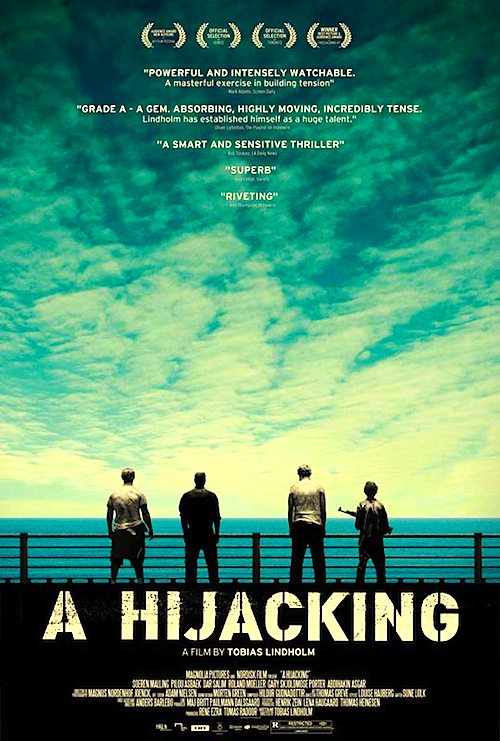
By Joe Bendel. They do not teach you how to negotiate with pirates in MBA courses, but perhaps they soon might. After all, this film is inspired by two real life incidences of Danish cargo ships taken hostage by Somali pirates. The negotiation process will be an ordeal both for the captive crew of the MV Rozen and their CEO in Tobias Lindholm’s edge-of-your-seat thriller, A Hijacking, which opens this Friday in New York at Film Forum.

Mikkel Hartmann is retiring from seafaring to spend more time with his family. Ordinarily, he serves as the ship’s cook, but when hijackers commandeer the vessel, they use him to communicate with the corporate office. He will be talking to Peter C. Ludvigsen, a media darling CEO with a knack for negotiating hard terms. However, bringing back his crew will be the greatest challenge of his career.

The company would willingly pay the ransom demanded, but according to their consultant (played by real life hostage negotiator Gary Skjoldmose Porter) it is not that simple. If they immediately pay-up, the pirates are likely to thank them for the “down  payment” and promise to get back to them regarding the full balance. Instead, Ludvigsen must convince them they are getting every last cent they can possible extract from the company. Counter-intuitively, protracted negotiations are in the best interests of the men and the firm. Of course, it will not be a pleasant experience for any of the Danes.

Scrupulously realistic, Hijacking acts as a bracing corrective to the cathartic satisfaction of action movies. It is simply not realistic to expect Roger Moore’s Ffolkes to launch a high seas rescue mission. The logistics are too complicated and life is too cheap for hostage takers. The film is also likely to run afoul of the professionally offended, because it portrays the Somali pirates as a callous, violently erratic lot. Nor does it whitewash their Muslim faith. Of course, that is precisely the reality sailors such as the Rozen crew must live with every day.

Cranking up the tension like a vice, Lindholm puts so much pressure on his characters they almost turn into diamonds. This is an exhausting nail-biter of a film, but somehow it seems far quicker than its ninety-nine minutes, despite the agonizing nature of the drawn out months-long negotiation. That is just great filmmaking.

There is also a truly award-worthy performance from Søren Malling as Ludvigsen. It is a brilliant depiction of the mighty humbled, precisely because of his genuine humanity. Never clichéd, Malling’s work is easily the most compelling big screen portrayal of a business leader in years (if not decades). In fact, Hijacking features strong ensemble work all around, most definitely including Abdihakin Asgar as Omar, the pirates’ devilishly manipulative negotiator. He is an unforgettable villain (though “villain” might not be a strong enough term).

The pirates might come from mean circumstances, but Lindholm never apologizes for their crimes. Instead, the victims of A Hijacking are Hartmann and his crewmates. Clear headed and relentlessly gripping, it is easily the pick of the week and might be the best theatrical release of the year, so far. Highly recommended, A Hijacking opens this Friday (6/21) in New York at Film Forum.

LFM GRADE: A

Posted on June 17th, 2013 at 12:53pm.

LFM Reviews Daphne Du Maurier’s The Scapegoat on PBS

By Joe Bendel. If her uncle had not been such an idiot, Elizabeth II never would have been Queen. Due to his dubious judgment, his brother’s daughter will soon ascend to the throne. The caddish Johnny Spence half-jokingly describes the days leading up to her coronation a period of monarch-less anarchy. It will indeed make a fitting backdrop for Charles Sturridge’s completely Anglicized adaptation of Daphne Du Maurier’s The Scapegoat, which airs in syndication on participating PBS stations, including Chicago’s WTTW this coming Saturday night.

John Standing has just been downsized out of a job as a boarding school teacher. With no family to support and lacking any significant ambitions or prospects, he sets out on a vaguely defined walking tour. Stopping at a seedy public house, he is startled to come face to face with his dead ringer, the wastrel Johnny Spence. After a night of imbibing with the charming but overbearing Spence, Standing is surprised to wake up and find the man has absconded with his anonymity, leaving him to take his position of wealth and privilege.

Unfortunately, Standing soon deduces that the Spence family fortunes are sagging. His doppelganger was hoping to save their glass foundry with a Hail Mary business deal, but he rather doubts the playboy pulled it off. However, he is quite charmed to meet the man’s spirited young daughter (Mary Lou, a.k.a. Piglet) and his nervous wife Frances. Conversely, he is quite uncomfortable around Nina, Spence’s sister-in-law with whom he seems to be having an affair with. Yet nobody seems to suspect his reluctant impersonation, not even his resentful brother Paul or their morphine addicted mother, Lady Spence. Frankly, the family might just be better off with the new and improved Johnny Spence, but the old one is still out there, up to no good.

From "The Scapegoat."

Produced by ITV, Scapegoat is a nifty little thriller that had a spot of film festival play before its American television run. Transferred from the south of France to post-war Britain, Sturridge’s adaptation is tightly paced and uses the impending coronation as a clever metaphor. As the director of most of the beloved Brideshead Revisited miniseries as well as the masterful A Handful of Dust, Sturridge has a keen feel for Twentieth Century British period pieces. He displays a nice touch with Scapegoat, combining a Downton-esque vibe with film noir-ish elements.

Logically, Sir Alec Guinness (the master of multiple parts) had first crack at the Standing/Spence role in Robert Hamer’s 1959 feature film. Yet, Matthew Rhys (now probably best known for FX’s The Americans) steps into his shoes admirably well. In fact, this might be his strongest small screen work, eclipsing his suitably brooding John Jasper in The Mystery of Edwin Drood. His Spence is charismatically wicked, but he also makes a convincingly confused and depressed everyman as Standing. Alice Orr-Ewing is a bit vanilla as poor Frances, but Andrew Scott (Jim Moriarty in Sherlock) adds some edgy energy into the mix as Paul Spence. Yet Sturridge’s wife and Brideshead co-star Phoebe Nicholls occasionally upstages everyone as the smart-than-her-employers housekeeper, Charlotte.

Altogether, The Scapegoat is quite cinematic by television standards. Handsome looking and intelligently written, it is definitely recommended for fans of Brit mysteries and literary dramas when it airs on select PBS stations later in the month.

LFM GRADE: B+

Posted on June 17th, 2013 at 12:52pm.