LFM Reviews Chiller, The Complete Yorkshire Horror Anthology on DVD

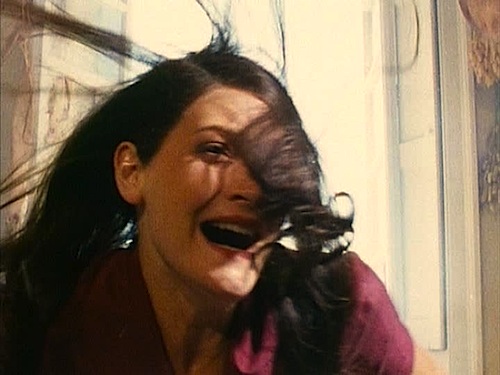
From "Chiller."

By Joe Bendel. Yorkshire is known for its green hills and savory pudding. However, the region is also rife with supernatural activity, if one can judge from a Yorkshire produced anthology series that aired in 1995. While totaling only five episodes, it built up a cult following, so this should be a happy Christmas for fans now that Chiller—the Complete Television Series has just been released on DVD by Synapse.

ITV may not have done Chiller any scheduling favors, but the show maintained a surprisingly gritty, mature vibe. Indeed, one of the striking consistencies throughout each installment is the rather grim, depressed look of the characters’ environment. In fact, a bit of urban renewal kicks off a whole mess of trouble in the initial episode, Prophecy.

Francesca Monsanto’s family diner is about to face the wrecking ball, but not before some of her drunken hipster friends convince her to hold a séance in the basement. It always creeped her out down there—with good reason. It was loads of laughs at the time, but one by one they suffer grisly accidents that were in some way foretold by the Ouija board. Stranger still, the son of her fabulously wealthy new boyfriend seems to be involved somehow. Featuring Chariots of Fire’s Nigel Havers as the well-heeled Oliver Halkin, Prophecy is one of the best of the series, cleverly blending all kinds of genre elements, including ancient evils and exorcisms. It will also be of particular interest to teen horndogs for Sophie Ward’s fleeting nude scene as Monsanto.

In contrast, Toby, the second episode, is the weakest of the short-lived series. Miscarrying after an auto accident, Louise Knight and her husband naturally move into a spooky old house with a macabre history, hoping to start over. Before long, she appears to be pregnant again, but the ultrasound says otherwise. Essentially, Toby recycles elements of Bradbury’s story “The Small Assassin” and scores of subsequent demonic baby films.
From "Chiller."

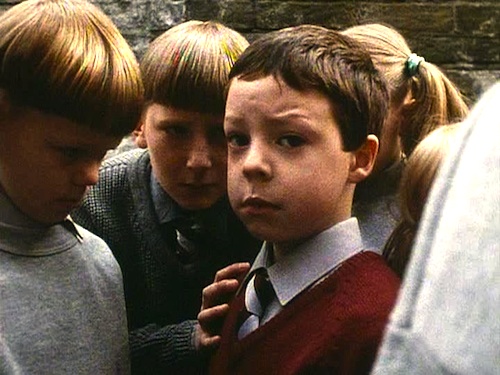
Here Comes the Mirror Man represents a return to atmospheric form for the series, capitalizing on the eeriness of the abandoned church where a young social services case is squatting with his homicidal imaginary friend, Michael. Phyllis Logan (widely recognizable from Downton Abbey and Lovejoy) stars as Anna Spalinsky, the lucky caseworker who inherits Gary Kingston’s file when her predecessor dies an untimely death.

Beginning like the standard “skeptic learns the hard way” tale, The Man Who Didn’t Believe in Ghosts develops some interesting twists and ambiguities. Richard Cramer is an Amazing Randy style writer whose books discredit paranormal humbug. Suffering a stroke after a television appearance, he naturally relocates with his family to the big, spooky Windwhistle Hall, where the former owner’s wife died in a tragic “sleep-walking” accident. Why doesn’t anyone ever want to recuperate in the city, with plenty of people around? Nevertheless, the Cramers cannot resist the low asking price, only to be terrified by a series of mysterious accidents as soon as they move in. Of course, Cramer is not going anywhere, lest he commit professional suicide.

Just as it began, Chiller ends with one of its strongest episodes. Every full moon, a serial killer preys on the children of the aptly named burg of Helsby in Number Six, perhaps inspired by the ancient druid rituals once (and maybe still) practiced in the region. Indeed, there may be both human and supernatural agencies involved. Quite engaging as a police procedural, Number Six also boasts some of the series’ most sinister moments.

Arguably, Chiller makes perfect sense for Christmas viewing.  There is a big turkey dinner at the Cramers (which becomes magically infested with maggots), a mass is held (as part of an exorcism), and kids chant nursery rhymes (derived from old Druidic rites). As a stocking stuffer for anyone who enjoys horror anthologies like Tales from the Crypt and Hammer House of Horror, Chiller is a solid bet. Recommended for fans of British genre television, the short but complete series is now available on DVD from Synapse Films.

Posted on December 21st, 2012 at 10:28am.

The Long Shadow of North Korea: LFM Reviews Our Homeland, Submitted By Japan for the Oscars

By Joe Bendel. In the 1960’s and 1970’s, many Korean-Japanese immigrated back to their homeland. Unfortunately, they chose the wrong one. With family at risk in the DPRK, active members of Japanese-North Korean friendship associations had no choice but to tow the party line. Yet, the implications of the basic foodstuff care packages they sent to loved ones spoke volumes. Granted a special three month visit for medical reasons, one such “repatriated” North Korean reconnects with his guilt-ridden family in Yang Yonghi’s devastating Our Homeland, which has been selected by Japan as their official foreign language Academy Award submission.

Yun Sung-ho most likely has a brain tumor. Given the woeful inadequacies of the North Korean medical system, he is allowed to briefly return to Japan—after a five year waiting period. He is fortunate his father is the president of the North Korean society, but he will still be monitored the entire time by his minder, Mr. Yang. Regardless, his family is grateful to see him again, especially his poor mother. Likewise, Rie is delighted to see her beloved brother again, but she cannot ignore certain ironies, like her brother developing malnutrition in the “Workers’ Paradise.” Yes, she is our kind of free-thinker and the unambiguous conscience of Our Homeland.

Based on writer-director Yang Yonghi’s own family experiences recorded in Dear Pyongyang and a subsequent documentary, Homeland is even more direct in addressing conditions in North Korea. Perhaps liberated by the fictional context, the film explicitly blames the DPRK for the misery of its citizens. There is no inclination towards moral equivalency. In fact, there is a clear affection for the Ozu-like quiet serenity of Japan.

While Yang’s script is unusually honest and challenging, her leads really make it hit home. Dynamic and vivacious but deep as a river, Sakura Andô is simply remarkable as Rie. It is an award caliber performance. Conversely, it takes a while for Iura Arata’s pitch-perfect portrayal to sink in, striking uncomfortable chords between bitterness and resignation. Boasting a top flight ensemble from top to bottom, Homeland is also distinguished and humanized by memorable supporting turns from Kotomi Kyôno as Yun’s ex Suni and Tarô Suwa as his loving blacksheep capitalist Uncle Tejo.

An assured narrative debut, Yang masterfully controls the mood and tone, despite the almost complete lack of soundtrack music. Her approach is intimate and not surprisingly documentary-like, but Homeland never feels overly talky or draggy. Indeed, the emotional drama never slacks.

Our Homeland is a deeply compassionate film, but it is also somewhat angry, plainly calling an older generation to account for sacrificing their children on ideological grounds. Its unmistakable critique of North Korean Communism might not sound like Academy fodder, but the foreign language division can be surprising – in a good way. After all, The Lives of Others won the Oscar and Andrzej Wajda’s Katyn was nominated before it even had American distribution. Regardless, Our Homeland would be a worthy nominee that deserves an international audience.

LFM GRADE: A

Posted on December 18th, 2012 at 11:59am.

Peter Jackson Cranks Up the Frame Rate: LFM Reviews The Hobbit: an Unexpected Journey

By Joe Bendel. Does this sound familiar? A little dude with big feet saves the world. A magic ring is involved. Welcome back to Middle Earth. After the complete triumph of the Lord of the Rings trilogy, a big screen treatment for The Hobbit was almost inevitable. Fortunately, after a complicated development process, Peter Jackson retook the reins of what is now a prequel trilogy. As most anyone remotely connected to the media culture knows, Jackson’s The Hobbit: an Unexpected Journey opens today, just about everywhere.

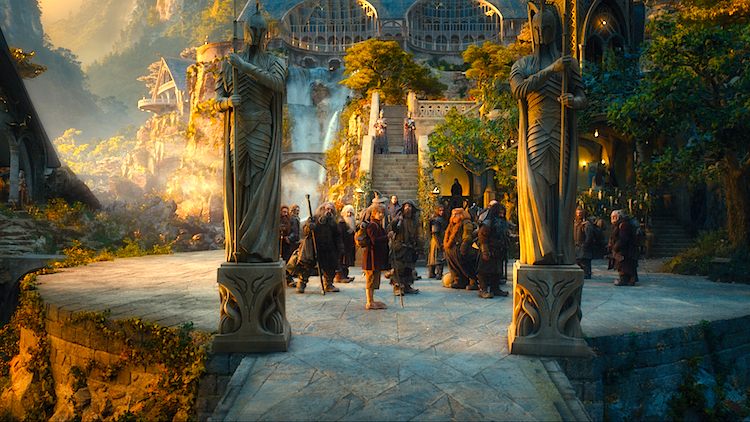
Blink and you might miss him, but Frodo appears in passing early on. Of course, The Hobbit is Bilbo Baggins’ story, which he is writing out for Frodo’s edification. In his younger years, Baggins was recruited by Gandalf the Grey to aid a company of dwarves in reclaiming their ancestral home from an ancient dragon. A bookish homebody, Baggins cannot fathom what he would bring to the expedition, but Gandalf just seems to think it will be helpful to have a hobbit along. Thorin Oakenshield, the fiery heir to the Dwarvish throne, is openly contemptuous of Baggins, but several of his compatriots eventually warm to their halfing compatriot.

Thorin also makes no secret of his resentment for the Elvish kingdom, whom he blames for turning their backs on the Dwarves in their hour of need. However, Gandalf insists they will need their assistance deciphering a certain magical map. They could also use a hand with the orc hordes pursuing them through the mountains. Frankly, there should not be so many trolls and goblins roaming about the foothills. There seems to be an evil agency at work, with most signs pointing to the former Dwarvish homeland.

Considering The Hobbit is just one average sized book and The Lord of the Rings is a fat trilogy, one would expect a lot of filler in Unexpected Journey. Yet, since about seventy-five percent of the film consists of the orcs chasing or battling the dwarves, its nearly three hours do not seem so excessively padded (as long as you enjoy fantastical action).

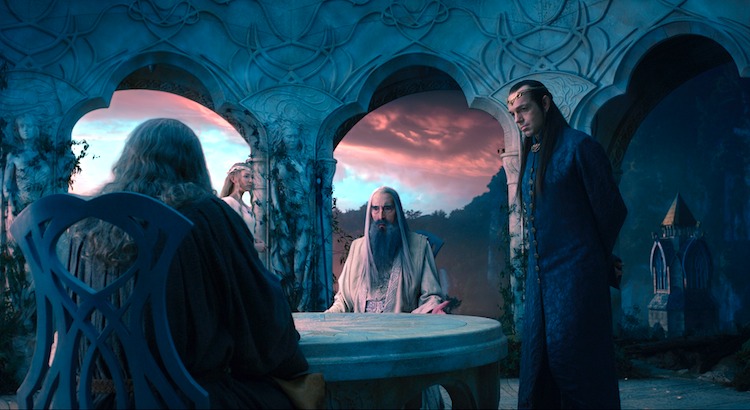
Ian McKellen, Cate Blanchett, Christopher Lee and Hugo Weaving in "The Hobbit: An Unexpected Journey."

All that melee looks great in 3D. No lame 2D fix-up (like Clash of the Titans), Journey was clearly conceived for the format. However, the High Frame Rate (HFR) gimmick is another story. Frankly, the super sharp clarity of the image often makes the effects look more fake, rather than the opposite. Also, the early scenes in Bag End lack the warm, cozy vibe one would expect.

Even if HFR is more of a distraction than an attraction, Jackson gets the bigger Tolkien picture. He understands and always remains true to the series’ themes of sacrifice, faith, courage, and humility. Fans trust him adapting this world, with good reason, so if the HFR experiment is the price to pay for Jackson’s return to Middle Earth, it is probably worth it.

Journey might not be as epic as its LOTR predecessors, but it does not disappoint. Martin Freeman (Sherlock’s Dr. Watson) has the right everyhobbit presence and looks quite credible as Sir Ian Holm’s younger analog. Most importantly, Sir Ian McKellen is back as Gandalf, a role he was probably born to play. Hammer fans will also be pleased to see Sir Christopher Lee return as Saruman the White. It is sort of more of the same, but Jackson makes it feel right even when it looks a little weird. Recommended for fantasy fans, The Hobbit is now playing on over 4,000 screens nationwide, including the AMC Loews Lincoln Square in New York.

LFM GRADE: B

Posted on December 14th, 2012 at 9:45am.

LFM Reviews Wrinkles @ Spanish Cinema Now

By Joe Bendel. Emilio is about to rediscover the joys of institutional food. The former banker has a hard time adjusting to life in an old folks home. Unfortunately, his fading faculties will eventually rob him of the relationships he forges in Ignacio Ferreas’s animated feature Wrinkles, which screens as part of the 2012 edition of Spanish Cinema Now.

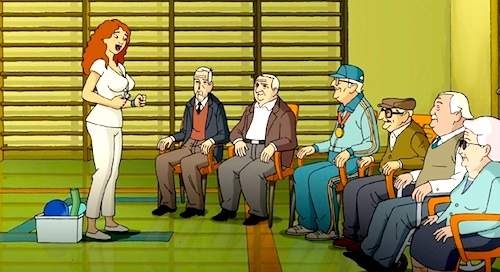
Emilio has Alzheimer’s, but nobody will tell him that directly. Increasingly difficult to handle, his grown son has packed him off to a nursing home. His new roommate Miguel, an Argentinian scammer, has been down this road before. Still sharp as a tack, Miguel specializes in conning the more addled residents out of their pocket money and flirting hopelessly with the nursing staff. Initially, Emilio is quite appalled by his shameless roommate, but they warm to each other over time—sort of. Miguel insists he is actually doing good deeds by keeping his suckers emotionally engaged on some level. While completely at odds with his middle class morality, Emilio starts to see his point.

Adapted from Paco Roca’s graphic novel, Wrinkles is entirely honest to its characters and their circumstances, making it a bit of a tough sell commercially. Nonetheless, its deeply humanistic spirit is quite refreshing. Avoiding cheap melodrama, it has more quietly telling moments than most slice-of-life live action indies, let alone the typical animated tent-pole.

From "Wrinkles."

Ferreras, who served as an animator on Sylvain Chomet’s wonderfully wistful The Illusionist, employs a similarly sensitive 2D animation that feels reassuringly nostalgic. Some of his richly detailed flashback sequences are even quite lovely. While the narrative occasionally resorts to the odd cliché, like the defiant, doomed-to-fail road-trip, most of the notes Wrinkles hits ring true.

While its themes are about as “mature” as they get, there is absolutely nothing objectionable in Wrinkles for young viewers. Still, the vibe of sad resignation is probably best appreciated by somewhat older audiences. Featuring two very real cartoon characters and an elegant visual style, Wrinkles is recommended surprisingly strongly for fans of both animation and Spanish film. It screens this coming Sunday afternoon (12/16) as part of the Film Society of Lincoln Center’s annual Spanish Cinema Now series.

LFM GRADE: A-

Posted on December 13th, 2012 at 10:33am.

Animating Depression: LFM Reviews Consuming Spirits

By Joe Bendel. It seems there are some things all newspapermen have in common: a taste for booze, and an abiding bitterness over the state of their lives. It is true at The Times and it is true at the Daily Suggester, a local broadsheet serving a profoundly depressed burg roughly situated where the Midwest meets Hill country. The scandalous history tying together three Suggester employees will come to light in Chris Sullivan’s years-in-the-making animated feature Consuming Spirits, which is now playing in New York at Film Forum.

As an evening talk radio host and columnist for the Suggester, former ladies man Earl Gray dispenses dark philosophical truths disguised as gardening tips. Victor Blue drudges along in a dreary back-office job at the paper with little hope of reclaiming control of his life from the social workers who have been mismanaging it since he was a child. He is semi-involved with Gentian Violet, the paper’s paste-up employee who lives with her senile mother. She has also just run over a nun, whom she has buried in a fit of panic, even though the sister was not yet dead. Yes, perhaps she was slightly under the influence, but who isn’t? This hit-and-run accident will reveal many secrets in a roundabout way.

Sullivan’s film is absolutely not animation for children. While there are spots of mature content here and there, it is the overwhelmingly fatalistic vibe that would most trouble younger viewers. Yet, that is also its greatest merit. Consuming is more closely akin to David Lynch’s vision of small town America (most notably Twin Peaks and Blue Velvet) than anything produced by the major animation studios. This is really not a genre picture in any sense and its revelations are easy to predict, but there is still something unsettling about it all that lingers with viewers well after the initial screening.

From "Consuming Spirits."

Consuming is also pretty notable for its cynical portrayal of social workers, more or less implying they often compound problems rather than solve them. On the other hand, those poor nuns really take it in the shins. Sullivan will spare them no anti-Catholic stereotype. Still, he nails the rust belt-Appalachian milieu (it smells a lot like Clark County, Ohio, but it could be any number of places).

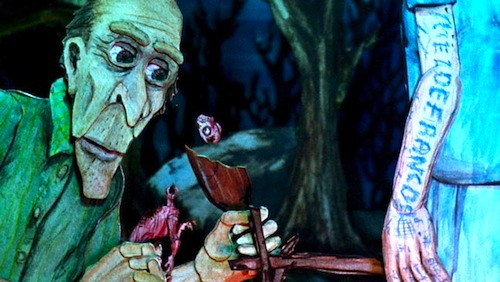
Visually, Consuming is also quite distinctive, incorporating claymation and deliberately sketchy line animation for flashbacks. However, the bulk of the present day action is rendered 2D cut-out animation that seems to perfectly convey the broken souls inside their flat, crumpled bodies.

There are some wickedly funny moments in Consuming, often coming from the haunted Gray. Indeed, Robert Levy’s richly evocative voice-over performance as the “Gardeners Corners” host is one of the best you will hear in animated films in a month of Sundays. Yet, while Sullivan’s script has its inspired moments, its overall trajectory is disappointingly conventional. Recommended for animation fans who appreciate style, tone, and characterization more than narrative, Consuming Spirits runs through Christmas Day at Film Forum.

LFM GRADE: B-/C+

Posted on December 13th, 2012 at 10:31am.


Anime Gets Medieval: LFM Reviews Berserk the Golden Age Arc I: The Egg of the King on Blu-ray

By Joe Bendel. They were not called dark ages for nothing. Battlefield carnage and an inflexible class system are the realities of the day. Yet, the charismatic leader of a band of mercenaries has unthinkably lofty aspirations in Toshiyuki Kubooka’s Berserk the Golden Age Arc I: The Egg of the King, the feature anime adaptation of Kentara Miura’s popular manga series, recently released on DVD and Blu-ray by Viz Media.

The relatively young looking Guts is a ferocious sword-for-hire if paid well enough, but he is not a joiner. Nonetheless, the mysterious Griffith is determined to recruit him for his “Band of the Hawk” mercenary troupe. While Guts easily overpowers Griffith’s best warriors, including the fiercely loyal Casca, he is no match for their angelically effeminate leader. Bested in a fair fight, Guts swears fealty to Griffith, quickly becoming his favorite.

Thanks to Guts’ reckless courage, the Band of the Hawk earns the gratitude of the Midland Kingdom. Much to the shock and disdain of the nobility, Griffith is rewarded with a title. However, he has even further ambitions, including catching the eye of the Princess. It will probably end badly if you believe the prophecy of Nosferatu Zodd, but you can’t always accept the word of giant demonic mercenaries.

While the Berserk series was produced in Japan (with the original Japanese soundtrack available as a DVD option for purists), it was clearly shaped by the Medieval Europe that served as the foundation of Tolkien’s Middle Earth and most subsequent epic fantasy series. Yet, the anti-heroism of Egg is rather distinctive. Indeed, the opening battle sequences are unusually stylishly by anime standards, yet surprisingly brutal.

Intended for mature audiences, Egg should be considered anime for Game of Thrones fans. Blood will definitely run. There is even some brief fan service provided by Casca. While most of the target audience is probably already familiar with the franchise characters, new arrivals pretty much have to roll with the punches. We can glean there were some difficult childhoods in the past, forging everyone into lethal warriors. Of course, how much characterization do you need in the middle of a full scale siege?

As dark and moody as Egg gets, it never lets the angst interfere with the action.  As a result, the awkwardly titled Berserk the Golden Age Arc I: the Egg of the King delivers all kinds of hack-and-slash, making it a fitting stocking stuffer for a reasonably “grown-up” fantasy fanatic awaiting the new season of Thrones and the final Wheel of Time novel. Recommended pretty enthusiastically for genre and anime fans that prefer blood and guts over magical devices, Berserk … King is now available for home viewing from Viz.

LFM GRADE: B+

Posted on December 12th, 2012 at 8:30am.