LFM Reviews Toussaint Louverture @ The African Diaspora International Film Festival

By Joe Bendel. Toussaint Louverture was a freed slave, an abolitionist, and a onetime slave-owning plantation master. He led an epic life dramatized in all its messy glory throughout Philippe Niang’s two part French miniseries, Toussaint Louverture (trailer here), which screens in its entirety as the centerpiece selection of the 2012 African Diaspora International Film Festival in New York.

Told in flashbacks, viewers know right from the start that Napoleon will eventually have his fill of Louverture, consigning him to prison, where his lackeys interrogate the Haitian general for the whereabouts of an apocryphal buried treasure. In a way, Louverture was lucky to be there. Having watched a cruel slaver murder his father, the young Louverture would have been next had Bayon, a more humane plantation holder, not interceded (evidently, this scene involves some dramatic license, but so be it). Recognizing the boy’s talents, Bayon somewhat reluctantly teaches Louverture to read and even grants him his freedom as a young man. The evolving, cliché-defying relationship between the two men is one of the strongest elements of this bio-drama.

Eventually, Louverture takes arms, but again this is complicated. Serving as an officer first for the Spanish and then the French, Louverture fought against every European power in Haiti at one time or another. Although he is an abolitionist, Louverture strives to maintain strategic ties to the colonial landlords. The Louverture Niang shows the audience is not a class warrior. He wants to keep their capital in Haiti—he just doesn’t want to be considered part of it. However, this inevitably brings conflict with hotter heads intent on score-settling.

Indeed, the tragedy of Niang’s Louverture is the way cynical white, black, and mulatto Haitians exploit racial resentment to further their power games. It is also fascinating to see how the chaos of the French Revolution shaped events a hemisphere away. However, given Louverture’s reputation as one of history’s great revolutionaries, many viewers will be surprised that there are no battle scenes in Niang’s production, just the anticipation and consequences of armed conflict.

Jimmy Jean-Louis as Toussant Louverture.

Something of a throwback to the epic historical minis of the 1980’s, Louverture is sweeping, melodramatic, and ennobling in a very satisfying way. As one might expect, Jimmy Jean-Louis’s dynamic lead performance is the key. He is suitably intense, without allowing Louverture to degenerate into a fire-breathing revolutionary stereotype. Likewise, Philippe Caroit genuinely humanizes the French old guard as the decidedly un-Legree-ish Bayon.

A French television veteran, Niang’s tele-movie Prohibited Love (which screened at the 2010 ADIFF) also dealt with racial themes pointedly, but without wallowing in didacticism. Louverture is even better. In fact, it should appeal to audiences across the ideological spectrum, aside from any odd remaining Bonapartists out there. Appealingly old fashioned, Toussaint Louverture is a well produced period drama, recommended for history buffs and Francophone audiences when it screens next Saturday and Sunday (12/1 and 12/2) as the centerpiece of this year’s ADIFF.

LFM GRADE: A-

Posted on November 23rd, 2012 at 12:12pm.

LFM Reviews Tango Macbeth @ The African Diaspora International Film Festival

By Joe Bendel. It is like the Bewitched version of the “Scottish Play.” Two identifiably different actors will play the murderous general, due to complicated circumstances. It is all part of the backstage drama brought to the fore in Nadine M. Patterson’s meta-postmodern-experimental-musical-docudrama Tango Macbeth (trailer here), which screens during the 2012 African Diaspora International Film Festival in New York.

Unconventional in many ways, this Macbeth will be choreographed. Yes, there will be tango, as well as some vaguely Fosse-esque steps, but that is the least of Patterson’s gamesmanship. While the play itself is shot in stylized music video-style black-and-white, the ostensive behind-the-scenes rehearsal will be filmed in Wiseman-like color. There will be nearly as much fireworks going on amidst the cast and crew as in the presumptive play within the film.

Hopefully, it is all a bit of meta-meta fun, or else Macbeth #1 will be in for some indigestion when he finally screens Tango. Yet, the Shakespeare is still in there and the cast is often quite good bringing out the flavor and dynamics of Shakespeare’s most perilous tragedy. In fact, Brian Anthony Wilson is absolutely fantastic as Macduff (and himself as Macduff), blowing the doors off the Thane of Fife’s big scenes. Based on his work in Tango, most viewers will probably be up for watching him tackle the title role in a more traditional production.

From "Tango Macbeth."

Alexandra Bailey also has some powerful scenes as Lady Macbeth, apparently developing some nice chemistry with both Macbeths. If Carlo Campbell, Macbeth #1, always appears in character[s], than it is a really fearless performance. Ironically though, Eric Suter’s best scene comes not as Macbeth #2, but when he was still a swing player, appearing as Lady Macbeth’s assassin.

It might seem hypocritical to criticize Anna Karenina for Joe Wright’s stylistic excesses, but praise Patterson’s explicitly avant-garde approach. Yet, they are coming from two very different places. While Wright is just tossing in a distracting bit of hipster pretension, Patterson is fundamentally deconstructing both Shakespeare and traditional notions of stage drama.

The talented ensemble makes quite a mark in Tango, yet it is likely to disappoint anyone hoping to see actors in classical costume, dancing about with roses in their teeth (perhaps bitterly so). However, for the aesthetically adventurous it is a fascinating production. Recommended for frequent patrons of the Anthology Film Archives, it screens Saturday (11/24) and Sunday (11/25) as part of this year’s ADIFF.

LFM GRADE: B

Posted on November 23rd, 2012 at 12:11pm.

LFM Reviews Hopeville @ The African Diaspora International Film Festival

By Joe Bendel. Hopeville is the sort of town that will drive you to drink. It is probably not the place for a recovering alcoholic granted provisional custody of his estranged son, but Amos Manyoni does not have a lot of options in John Trengove’s Hopeville (trailer here), an original feature film adaptation of the popular South African miniseries, which screens as part of the 2012 African Diaspora International Film Festival in New York.

Pools play in important role in the life of Manyoni’s son Themba. He was a champion swimmer, but his mother tragically died in an accident en route to one of his meets. Clean and sober for over a year, Manyoni regains his parental rights, as long as he adheres to three conditions: stay away from alcohol, hold down a steady job, and provide Themba access to a pool. Hopeville sounds perfect. He has a gig lined up there with the municipal government and there is a pool, except not really.

Drained and in a state of disrepair, the pool now serves as a garbage dump. The corrupt mayor and his council cronies are planning to develop it into a booze drive through, but they are reluctant to tell Manyoni their plans forthrightly. Instead, they do their best to secretly undermine his efforts to single-handedly fix up the pool. Much to their frustration, though, Manyoni’s work begins to inspire the depressed town.

Hopeville is the sort of film tailor-made for feel-good festival play. There is redemption, family values, spirited old folks, and triumph over adversity. Manyoni even develops a romance with Fikile, the mayor’s ice cream vendor mistress, but it is decidedly chaste—just an odd kiss and a bit of handholding.

From "Hopeville."

Of course, you cannot spell “Hopeville” without “evil.” That might be too strong a term, but Desmond Dube’s venal mayor is definitely a pointed portrayal of post-apartheid political opportunists. Yet, by and large, Hopeville is about inclusion and multi-racial community.

Themba Ndada is painfully earnest but still reasonably down to earth and credible as Manyoni. While there is a lot of manipulation going on, viewers will still find themselves caring about his trials and tribulations. While Dube plays the mayor like a caricature of graft, Hopeville boasts several appealingly colorful supporting turns, including Jonathan Pienaar as the Fred, the not-as-bad-as-he-looks barkeep.

On one hand, Hopeville is competently produced, likable, and well-intentioned. It is also predictable and sentimental. Sometimes, that is all rather comforting. Recommended for patrons in the mood for reassuringly inspirational cinema or interested in contemporary South African film, Hopeville screens this Saturday (11/24) and the following Thursday (12/6) as part of the ADIFF in New York.

LFM GRADE: C+

Posted on November 23rd, 2012 at 12:10pm.

The End is Near, Meditate Quickly: LFM Reviews The Mystical Laws

By Joe Bendel. An expansionist Eastern regime is dead set on war with Japan, at a time when America’s defense capacity and influence in the UN are both at all time lows. They say it’s the near future, but it feels only too near. Still, there may yet be hope in Isamu Imamake’s apocalyptic anime feature The Mystical Laws, created by executive producer Ryuho Okawa (founder of the controversial Japanese religious fusion movement, Happy Science) which opens this Friday in New York.

In an authoritarian country not identified as China, a shadowy military science officer named Tathagata Killer assumed power in a coup. Now known as the Godom Empire, his kingdom becomes the dominant super-power, thanks to the remarkable technology provided by the beautiful but mysterious industrialist Chan Leika.

The world slept while the demonic dictator consolidated power, except Hermes Wings. Partly a Doctors Without Borders-style NGO and partly a secret society dedicated to preserving free democratic values, Hermes Wings is considered the greatest threat to the Godom overlord, so he targets them accordingly. Through tragic circumstances, Sho Shishimaru rises to the top of Hermes Wings. There is a reason people have confidence in him: according to prophecies, he might be both the savior and the second coming of Buddha, which is an awful lot for any dude to live up to.

From "The Mystical Laws."

Mystical Laws could be described as a Buddhist Left Behind, with generous helpings of Christian symbolism thrown in for good measure. It is also anime. In truth, just about every conception of divinity is covered in Mystical, including the embodiment of the “Spirit of Japan,” who looks rather attractive. Some of the symbolism is impossible to miss, such as the swastikas the Godom army marches under, or the crosses on which they crucify enemies of the state. Still, if the slightly odd film represents an attempt to proselytize, it is dashed hard to tell what for.

Okay, so subtlety really isn’t Mystical’s thing. Nonetheless, the first two acts constitute a rather intriguing end-of-the-world/sci-fi conspiracy thriller. The relationship between Shishimaru and Leika is also nicely developed, and the Buddhist elements give it all a distinctive flavor. Unfortunately, the third act is largely given over to a Harry Potter-esque clash of fireballs and god-rays.

You have to take satisfaction from a Japanese film that bemoans the lack of American military bases. Indeed, it takes notions of faith, freedom, and sacrifice profoundly seriously. With art and characterization well within the anime industry standard, perhaps even slightly higher, it might be the most effective end-of-days religious thriller, well maybe ever (for what that’s worth). It certainly puts to shame impassioned but clunky evangelical films, like Jerusalem Countdown.

Mystical probably is not your Cheetos-eating fanboy’s anime. However, anyone interested in a film arguing that religion plays an essential role in a healthy society (and also implying a need for a strong military) might just get sucked in, in spite of themselves. Recommended for fans of challenging anime, aesthetically adventurous evangelicals, and nontraditional Buddhists (collectively a woefully underserved market), The Mystical Laws opens this Friday (11/23) in New York at the Cinema Village.

LFM GRADE: B

Posted on November 23rd, 12:07pm.

Escaping Russia: LFM Reviews Purge, Submitted by Finland for the Oscars

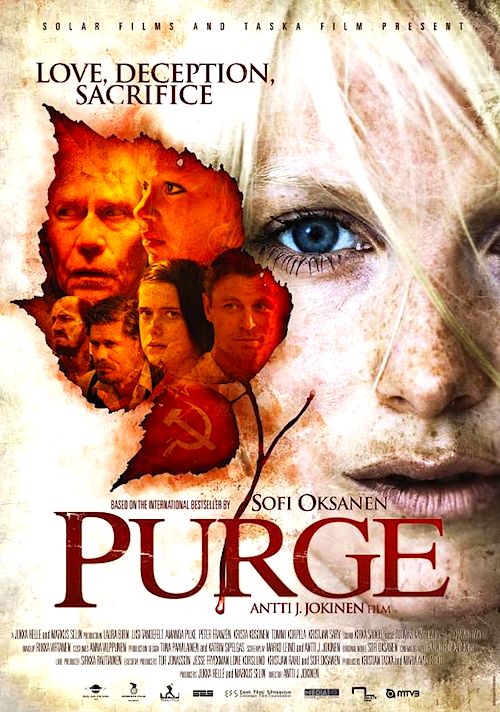
By Joe Bendel. Finland and the Soviet Union shared some complicated history over the last hundred years or so. They fought at least two wars against each other, give or take, and then brought the world the term “Findlandization.” In contrast, Estonia and the U.S.S.R.’s relations were more straight-forward. The latter forcibly dominated the former, and the Baltic Republic did not like it one little bit. Although it tells an Estonian story, Sofi Oksanen’s novel has had great resonance for Finnish readers. In fact, former East Carolina University basketball recruit Antti J. Jokinen’s adaptation of Oksanen’s international bestseller Purge has been selected by Finland as their official foreign language Academy Award submission.

One fateful night, Zara, a sex slave fleeing her Russian mobster captors, seeks refuge at Aliide’s remote farm house. The old woman is instantly suspicious, but she takes in the exploited woman nonetheless. As it happens, Zara did not make her way there by accident. Their tragic histories are intertwined, as the audience learns in a series of flashbacks.

Aliide was always a little strange. While she fell head over heels for the dashing Hans Pekk, it is her sister Ingel who turns his head. Yet Aliide is more than willing to help Ingel shelter her former freedom fighter brother-in-law from the Soviet authorities. Frankly, she kind of likes knowing exactly where he is at all times. Decades later, that secret hiding space under the floor boards will come in handy again.

In a case of ironic symmetry, both women will suffer tremendously at the hands of Russians. Even though Aliide eventually marries a true believer, she still cannot avoid seeing the inside of a Communist torture chamber. Despite all the humiliations Zara endures as an unwilling prostitute, Aliide’s torments are probably even worse. As a result, Purge is often a difficult film to watch, but it is never exploitative or morally ambiguous in the ways it presents such horrors. Whether motivated by ideology or sadism, the reality of rape and assault remain the same.

Laura Birn gives an incredible performance as the mid-twentieth century Aliide. A twitchy young woman in an apparent state of arrested development, she is not the sort of victim figure viewers can easily embrace. In truth, she has a bit of a Machiavellian streak, yet she still experiences more pain and degradation than anyone could possibly deserve.

Jokinen is not afraid to confront his audience with all manner of atrocities. Nonetheless, he also shows a deft touch with the quiet moments occasionally stolen by the Estonian lovers. He clearly differentiates each time period without resorting to distracting visual gimmicks, balancing each narrative relatively evenhandedly.

Purge might be a dark horse contender, but Jokinen has Hollywood ties, having directed Hillary Swank-Kadyrov and Jeffrey Dean Morgan in The Resident, so who knows? Purge is certainly a quality period production, which often counts for something with Academy voters. It might be a bit too honest for their tastes, though. Regardless, Purge would be an enormously worthy nominee, definitely recommended for patrons who have a chance to catch it on the festival circuit.

LFM GRADE: A-

Posted on November 19th, 2012 at 12:46pm.

From the Tel Aviv Opera: LFM Reviews Gottfried Helnwein and the Dreaming Child

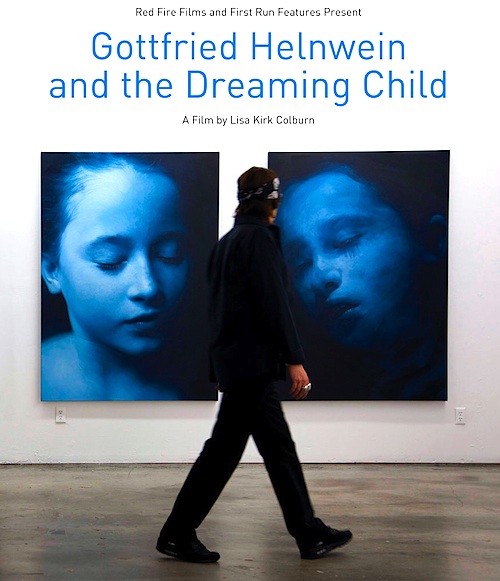
By Joe Bendel. Austrian born artist Gottfried Helnwein hosted the wedding ceremony of Marilyn Manson and Dita Von Teese, presided over by Alejandro Jodorowsky. That fact alone sets off plenty of alarm bells. Nonetheless, Helnwein has produced an impressive body of work, largely informed by the horrors of the Holocaust. It was the themes and sensitivities of his oeuvre that inspired the Israeli Opera to commission Helnwein’s designs for an ambitious new production. Lisa Kirk Colburn documents the visual artist’s sometimes dramatic collaborative process in Gottfried Helnwein and the Dreaming Child (trailer here), which opens this Friday in New York.

In a telling historical irony, Helnwein was accepted by the art academy that famously rejected Hitler. Coming of age at a time the Holocaust simply was not discussed in Austria, Helnwein discovered the truth on his own. The revelation profoundly influenced his work both as a student and a mature artist. Images of children in various states of vulnerability reappear over and over in his photo-realist paintings. Not surprisingly, Helnwein had a deep affinity for Hanoch Levin’s allegorical play, The Dreaming Child and its Helnweinesque title character.

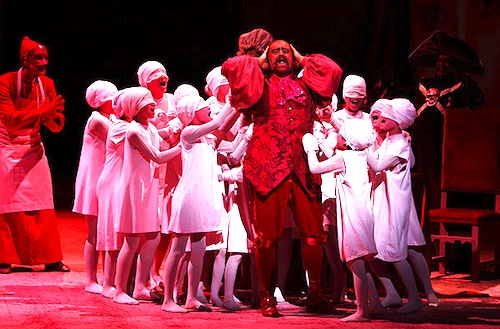
When Helnwein designs a stage production, he does not dash off a few set decorations and call it a day. Essentially he takes over the show, at least to judge by the evidence of Dreaming Child. Director and co-librettist Omri Nitzan comes across like an evenhanded mediator, but some of the Opera’s creative crew clash repeatedly with the celebrity artist. That’s just what you get when you bring in a design auteur.

From "Gottfried Helnwein and the Dreaming Child."

Leading up to the premiere of Dreaming Child, Helnwein also mounts a new showing of his large scale public installation piece, Selektion. Frankly, the story behind that piece (and its rather rocky debut in Cologne) might be even more documentary-worthy than the Dreaming Child production.

Fortunately, Colburn’s film shows us more than Helnwein puttering about his studio. In fact, he is an artist with something to say and he takes advantage of the opportunity to do so. To her credit, Colburn does not leave any obvious questions unaddressed, showing her subject’s high-handedness as well as his passion and empathy. Viewers should note: there is also a brief but humanizing post-credits stinger. It looks like a cool shot Colburn fell in love with, but could not figure out any other place to put it.

An engaging art documentary comparable to recent releases like Bel Borba Aqui and Gregory Crewdson: Brief Encounters, Dreaming Child also offers additional social-historical significance by forthrightly exploring the themes of Helnwein and Levin’s work. Recommended for Helnwein’s fans and patrons of Israeli culture, Gottfried Helnwein and the Dreaming Child opens this Friday (11/23) in New York at the Quad Cinema.

LFM GRADE: B

Posted on November 19th, 2012 at 12:45pm.