With No Apologies to Mellencamp: LFM Reviews Jack and Diane

Juno Temple in "Jack & Diane."

By Joe Bendel. You could possibly liken lycanthropy to puberty – because they both involve dramatic physical transformation. It is a dubious comparison, but evidently it was enough for writer-director Bradley Gray Rust to build a film around. As a result, love is rather messy in several ways for two young women in Jack & Diane (trailer here), which was supposed to open yesterday in New York.

Diane dresses like Goldie Hawn on Laugh-In. Tomboyish Jack dresses like Tim Allen on Home Improvement. However, when the two hipsters see each other, it is love at first gawk. Lost in Manhattan not far from Evacuation Zone A, the visiting Diane accepts Jack’s offer of hospitality. The British Diane seems to exist in a state of arrested development, but it evidently works for the tough-on-the-outside-needy-on-the-inside Jack. Yet, just as their whirlwind romance begins, miscommunication and Diane’s meddling aunt threaten to tear it asunder.
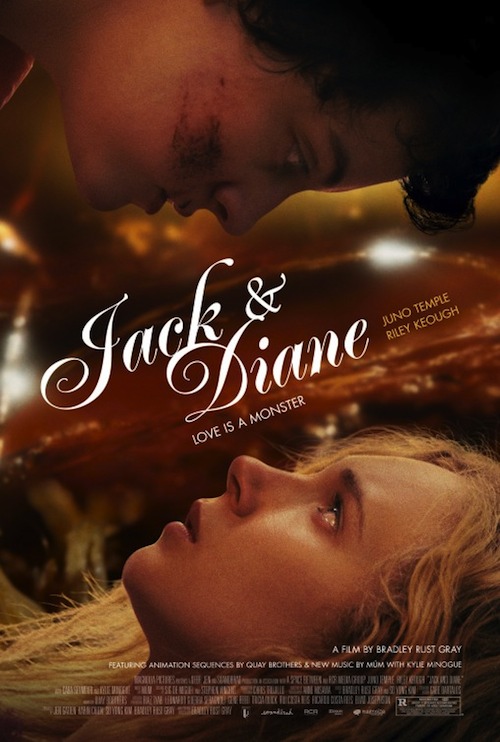
Coming between these kids might be dangerous, though. In moments of extreme emotional agitation Diane transforms into a werewolf—but, not really. For the most part, the lycanthropy is metaphorical, with only occasional hints that these trippy interludes have real consequences. At least they look distinctive, animated by the celebrated Quay Brothers in a style that is better described as macabre than frightening.

Frankly, it is a wonder Rust has not been picketed by the Hollywood thought police, considering J&D essentially equates its characters’ lesbianism with something explicitly monstrous. However, he handles their relationship with keen sensitivity and reasonably good taste. Indeed, J&D is being touted as the lesbian werewolf movie, but it is likely to disappoint fanboys hoping for either sort of exploitation.

Instead, J&D is your basic downtown indie. It is not mumblecore, but you can see it from here. Still, the earnest sincerity co-leads Juno Temple and an unrecognizable Riley Keough (Elvis’s granddaughter) bring to their characters shines through strikingly. Unfortunately, they are not well served by some overripe dialogue and the rather laborious pace.

If you were wondering, the Mellencamp song never appears on the J&D soundtrack and the ex-Johnny Cougar is reportedly not thrilled by the association. Be that as it may, the film itself is not terrible, but it is far from a cohesive whole. The Quays and particularly Keough did some fine work, but the concept remains only half-developed. Fans of the animators should find it worth checking out, but they can safely wait for Netflix and the like. For the curious, Jack & Diane is now playing at the Sundance Cinema in West Hollywood.

LFM GRADE: C+

Posted on November 3rd, 2012 at 12:17pm.

Barry Levinson Finds Eco-Terror Footage: LFM Reviews The Bay

By Joe Bendel. Evidently, chicken and seafood are not such a good mix after all. It seems the local poultry processing plant has been dumping the cluckers’ waste and entrails into the Chesapeake Bay. All the hormones and genetic boosters mixed with a little radiation have had a nasty effect on the isopods. The resulting bio-scare is documented by a rookie reporter and scads of random handheld devices in Barry Levinson’s massively disappointing The Bay, which opened this Friday at the IFC Center in New York.

In her online introduction, former journalism intern Donna Thompson ominously explains to the audience that they are about to see the truth the government tried to cover up. Fortunately, the g-men never ran a simple web search, which would have brought up a good chunk of the film we are about to sit through. It is the Fourth of July in Claridge, Maryland, but all is not well. Large schools of fish have washed up dead. Then humans start showing alarming symptoms.

With a good part of his town breaking out in boils and coughing up stomach lining, Mayor Stockman reacts by going into full stonewalling mode. We know he must be a bad guy, because he has nice things to say about business. After al, his name is Stock Man – that says it all, doesn’t? However, the overworked emergency room doctor duly notifies Homeland Security, who spring into action half a day later. Okay, that part we can buy into.

The town of Claridge, in happier times.

The found footage genre usually has weak characterization, because the conceit does not allow for much getting-to-know-you development, but The Bay hits a new low. As much as we are supposed to hiss at Mayor Stockman, he is the film’s most distinctive personality. Aside from some rueful self-deprecating remarks, the audience gets absolutely no sense of Thompson as an individual. Yet, though she seems to be the protagonist, she hardly figures in any of the action.

It is a problem when a film’s climax sneaks past you, but that is exactly what happens in The Bay when the credits start to role after a brief voiceover attempts to tie up the rat’s nest of loose ends. In contrast, anyone seeing North By Northwest for the first time will realize it is do or die time when Cary Grant is hanging off Mount Rushmore. Of course, Hitchcock’s film is a classic and Levinson’s genre outing is a didactic snooze.

Anything can be forgiven in an effective creature feature, but The Bay hardly has any narrative arc to it, whatsoever, and no real suspense to speak of. It is truly surprising a consistently commercial director like Levinson (Bugsy, Diner, Good Morning Vietnam) could helm such an inert, lifeless film, but here it is. A dud on every level, The Bay is not recommended at all now that it’s opened in New York at the IFC Center.

LFM GRADE: D-

Posted on November 3rd, 2012 at 12:16pm.

Tae Kwon Do & Synthesizer Rock: LFM Reviews The Newly Restored ’80s Cult Classic The Miami Connection

By Joe Bendel. Miami Vice lied to you. It wasn’t Cuban or Colombian cartels that controlled the South Florida drug trade in the 1980’s. It was the ninjas. However, they met their match in Tae Kwon Do grandmaster and inspirational speaker Y.K. Kim. He and his students lay down some hard rocking justice in his long lost, feather-haired, labor of love, The Miami Connection, which Alamo Drafthouse saved from obscurity to conquer the world through a series of midnight screenings, beginning this Friday (hopefully) in New York.

The Miami Ninjas pick a fight with the wrong band when they try to roust Dragon Sound from their new gig at “Central Florida’s hottest new night club” in Connection, co-directed by Kim and experienced exploitation auteur Woo-sang “Richard” Park. They are a tight band, who live, train, and rock together with Mark, their Tae Kwon Do master. The ninjas and drug dealers might have formed an alliance, but they are no match for the one-two punch of Tae Kwon Do and cheesy 80’s synthesizer rock.

Further complicating matters, Mark’s number one protégé John has been dating Jane, the kid sister of Jeff the gang leader, against his wishes. Granted, he overreacts, but it is hard to blame him for being underwhelmed by the gawky lover-boy. Indeed, things get personal quickly. The plot might be a touch hackneyed (you know when a Dragon Sound member puts on a fancy new suit for a special occasion, he is in for a world of hurt) and the dialogue is what it is (and that’s not much), but the fighting is pretty awesome, courtesy of Grandmaster Kim – who clearly has no aversion to a spot of blood here and there. Former champion kickboxer Maurice Smith certainly knew how to conduct himself in a fight scene as well, but he has some of the most laughable drama as Jim, the keyboard player with the unhealthy mailbox obsession.

Hats off to the in-damn-domitable Y.K. Kim, who is finally getting distribution and cult fandom for Miami Connection, after the snobby Florida critics brusquely dismissed its ill-fated Orlando release in 1987. Thanks to those stick-in-the-muds, Kim & Park’s heartfelt smackdown was almost lost to posterity. That said, the Miami Connection experience is best shared with a rowdy group of likeminded viewers. Hopefully, large and vocal crowds will duly turn out when it screens this Friday and Saturday nights (11/2 & 11/3) at the Landmark Sunshine in New York.

Posted on October 30th, 2012 at 1:16pm.

The Fugue’s Requiem: LFM Reviews A Late Quartet

By Joe Bendel. In classical string quartets, they say the second violinist is not necessarily subservient to the first. They also say there are no small parts, only small actors – but nobody believes that either. The complicated inter-relationships of an acclaimed string ensemble will be challenged to their breaking point in Yaron Zilberman’s A Late Quartet, which opens this Friday in New York.

The Fugue Quartet has performed together for nearly twenty-five years. Yet, as their quarter century anniversary approaches, their future becomes uncertain. Cellist Peter Mitchell, the senior member of the ensemble, has been diagnosed with early Parkinson’s. He can still function well enough to teach his students, including Alexandra Gelbart, the daughter of second violinist Robert and violist Juliette. However, it is not clear whether he is up to the rigorous demands of concert performance, especially Beethoven’s Opus 131 String Quartet in C-sharp minor, a punishing seven movement piece that offers no resting place for musicians who tackle it.

It quickly becomes apparent that Mitchell was the glue holding the quartet together, even though first violinist Daniel Lerner largely dominated the quartet’s artistic decisions through the force of his personality. He also has romantic history with Juliette Gelbart, one of the many reasons for Robert Gelbart’s burgeoning resentment. Yet, recognizing his talent, the Gelbarts send their daughter to him for personal tutoring, resulting in drama that could permanently rip the Fugue asunder.

Essentially, Quartet is soap opera at its most sophisticated and refined. There is plenty of angst and jealousy at play, but the screenplay (penned by Zilberman and Seth Grossman) really sings when addressing the musicians’ approach to their art. For those coming from the jazz tradition, it is fascinating to watch the debate between Robert Gelbart, who wants to play Beethoven’s Opus without charts to give it a freer, more emotionally spontaneous feeling, and Lerner, who insists on following every little notation, down to the squiggle. Gelbert is not advocating improvisation, just a bit more interpretive latitude in their attack, but for Lerner this would ignore the benefit gleaned from years of careful study.

Liraz Charhi in "A Late Quartet."

Although he refrains from eccentric Walkenisms, Christopher Walken still steals nearly every scene he appears in as Mitchell. Knocking some richly written lecture scenes out of the park, one wonders if perhaps he missed his calling as a music teacher. Yet, the most Oscar worthy performance comes from the one member of the quartet not previously nominated. Mark Ivanir really opens up the icily precise Lerner, markedly laying bare the messy insecurities so many great artists share. In contrast, as the Gelbarts, Philip Seymour Hoffman and Catherine Keener stay on familiar ground, depicting the petty tribulations of the privileged class. We have seen this from them both before, but at least Zilberman shows them bickering in interesting places, like Sotheby’s.

Perhaps Zilberman’s most important collaborator is the Brentano String Quartet, whose elegantly elegiac rendition of the Opus powerfully underscores the film. Their fans will also enjoy seeing cellist Nina Lee appearing as herself, whom Mitchell is determined to recruit as his replacement. Memorably capturing the heart and milieu of classical music, Quartet deserves attention during award season, particularly for Ivanir and Walken. Yet, as a true chamber piece, it may lack the bombast the academy responds to. Recommended for classical listeners and those who appreciate the drama inherent in creative differences, A Late Quartet opens this Friday (11/2) in New York at the Landmark Sunshine, or so we all hope.

LFM GRADE: B

Posted on October 30th, 2012 at 1:16pm.

Monty Python’s Graham Chapman is in There Somewhere: LFM Reviews A Liar’s Autobiography in 3D

Narrating "A Liar's Autobiography."

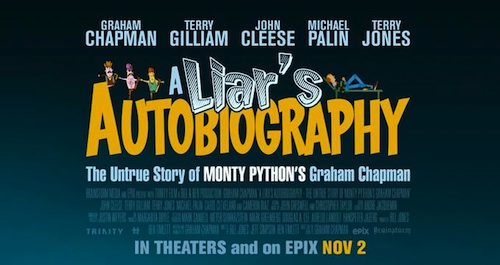
By Joe Bendel. He was the one with the pipe. Graham Chapman could be as silly as any of the Pythons, but only he had the noble bearing to portray King Arthur, the would-be messiah Brian Cohen, and a battalion of aristocratic British military officers. He also played the title role in Yellowbeard – but nobody’s perfect. Indeed, that could be the mantra of Bill Jones, Jeff Simpson & Ben Timlett’s A Liar’s Autobiography: the Untrue Story of Monty Python’s Graham Chapman (trailer here), a hyperkinetic kitchen sink of an animated biography, which opens in 3D this Friday, day-and-date with its 2D premiere on Epix.

Viewers of Jones (son of Terry) & Timlett’s Monty Python: Almost the Truth will know Chapman was the tragic Python, who struggled with substance and sex addictions, before succumbing to cancer at the terribly early age of forty-eight. Chapman was also perfectly open, if rather ambivalent, about his sexuality. Such a dramatic life offers plenty of grist for a biopic treatment, and it’s all in Liar’s Autobiography—somewhere.

Fourteen different animation houses using seventeen different animation styles illustrate the events of Chapman’s life, as narrated by the subject himself from the memoir that would inspire the film. Given the relative brevity and rapid succession of each constituent episode, it is hard to keep them all straight. At least they proceed in a somewhat orderly narrative fashion, depicting Chapman as a rather macabre baby (not unlike Seth Macfarlane’s Stewie), a precocious student, and as one of the gaggle of monkeys co-founding Monty Python.

The thread is easier to follow in his early years, though Autobiography is still prone to distraction – even dramatizing one of the Biggles war stories (strikingly rendered by Made Visual Studio) that captivated young Chapman. However, by the time Autobiography reaches Treat Studios’ Space Pods, the connection to reality has been gleefully severed.

A look at the life of a comic genius.

The greatest irony of Autobiography is that its biggest laughs and greatest emotional payoff comes from the real-life-honest-to-gosh video of John Cleese’s eulogy for Chapman, in which he promises to avoid “mindless good taste.” Most of the Pythons are represented in Autobiography, playing themselves as well as other co-conspirators and innocent bystanders. Fans will be delighted to hear honorary Python Carol Cleveland turns up for old time’s sake, too. Bizarrely, Cameron Diaz, who also used to be famous once, supplies the voice of Freud. However, Eric Idle is MIA, though his song “Sit on My Face” gets the full “Blame Canada” Busby Berkley treatment.

You don’t walk out of Autobiography, you stagger. While the 3D is characteristically hit or miss, the film[s] bombards the audience with wacky, tripped-out imagery. At times it is almost too much, but at least it scrupulously observes Chapman’s wishes regarding gratuitous good taste. You have to give its spirit proper due. Recommended more for the fanatical Python fan than the causal viewer (quick, what is the air-speed velocity of an unladen swallow?), A Liar’s Autobiography will be the first 3D release to play at the Angelika Film Center when it opens this Friday (11/2) in New York, simultaneous with its 2D broadcast on Epix.

LFM GRADE: B-

Posted on October 30th, 2012 at 1:15pm.

Vertigo in Southern India: LFM Reviews Akam (Palas in Bloom) @ The 2012 South Asian International Film Festival

By Joe Bendel. They are known as Yakshis in southern India, but we would think of them as succubi. Every culture has their equivalent, but one architect fears he married one. Yet, his perception of reality may or may not be so reliable in Shalini Usha Nair’s Akam (Palas in Bloom; trailer here), which screened at the 2012 South Asian International Film Festival in New York.

Srinivas seemed to have his life laid out perfectly, until an accident left the young architect visibly disfigured. Abandoned by his girlfriend, he descends into a deep existential depression. It is only the chance late night meeting with a mysterious woman that snaps him out of his lethargy. Just what Ragini was doing at his construction site at that hour is a question that will bother Srinivas in months to come, but it concerns him little during their brief courtship.

For a while everything is great, and then just as suddenly things are terrible again. Srinivas finds himself besieged by minor misfortunes and ailments that he is convinced Ragini has caused. He is convinced she is a Yakshi, who seduced him in order to torment and eventually murder him, because that is what Yakshis do.

If Ragini is a Yakshi, Nair isn’t telling. There is evidence in the film to support either conclusion, but none of it is trustworthy, because of the manner in which Srinivas’s obviously warped POV skews the film’s narrative. Indeed, Akam’s open-endedness clearly gave some SAIFF patrons fits, just as Nair intended.

Loosely based on Malayattoor Ramakrishnan’s novel Yakshi, Akam could have featured a spot of gore here and there, but Nair elected to keep it off-screen – which will further frustrate genre fans. That simply is not the tradition the film flows out of. However, there are enough hat-tips to Vertigo to inspire an angry missive from Kim Novak. Present day Kerala might seem worlds and centuries removed from Puritan New England, but Srinivas could almost be considered a Malayalam Hawthorne character, whose outward disfigurement corresponds to a spiritual disfigurement. The real horror of his story is the uncertainty over whether he is the victim or the tormentor, much like a Goodman Brown.

From "Akam."

As Srinivas, Fahadh Faasil vividly portrays a man plagued by inner demons and insecurities, while Anumol K’s Ragini certainly suggests a woman with closely guarded secrets. Freed from traditional genre demands, Nair’s pacing is decidedly patient. Unfortunately, the frequent flashbacks are not well delineated from the present day, often causing viewer confusion. Yet, her sparing use of sound, and the film’s overwhelming sense of darkness and stillness are unusually effective. Akam has a genuinely foreboding atmosphere that makes the ambiguous gamesmanship possible.

This is definitely not Bollywood. Technically it is Mollywood, but do not expect any Malayalam musical numbers. While the austerity of Nair’s style is demanding at times, the overall vibe really gets under your skin. Though not perfect, this is a film more festival programmers ought to consider. Recommended for cineastes who have a taste for the macabre but prefer mood over mayhem, Akam is set to have a limited Indian release this November.

LFM GRADE: B

Posted on October 29th, 2012 at 1:36pm.